Recognition: 2 theorem links
· Lean TheoremOpen-flavor threshold effects on quarkonium spectrum in the BOEFT
Pith reviewed 2026-05-10 15:29 UTC · model grok-4.3
The pith
Mixing quarkonium and tetraquark potentials in the Born-Oppenheimer effective field theory accounts for open-flavor threshold effects on the spectrum below threshold.
A machine-rendered reading of the paper's core claim, the machinery that carries it, and where it could break.
Core claim
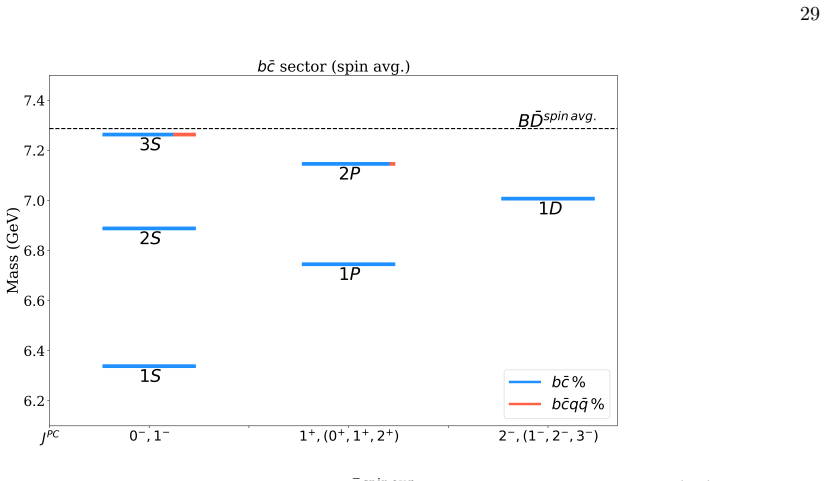
Open-flavor threshold effects emerge from the mixing between quarkonium and tetraquark static potentials sharing the same Born-Oppenheimer quantum numbers. The shapes of these potentials are fixed by lattice QCD, with tetraquark potentials repulsive at short distances and approaching meson thresholds at long distances. Solving the coupled Schrödinger equations with the adjoint meson mass fixed to the χ_c1(3872) mass determines the threshold-induced modifications to the quarkonium spectrum below threshold in both spin-averaged and spin-split cases.
What carries the argument
The coupled Schrödinger equations arising from mixing of quarkonium and tetraquark static potentials in BOEFT.
Load-bearing premise
The static potentials retain their lattice-determined shapes and that the single parameter fixed by the χ_c1(3872) mass is sufficient to describe threshold effects throughout the spectrum.
What would settle it
Precise measurement of mass shifts in specific quarkonium levels, such as the η_c or Υ states, that deviate from the predictions of the coupled equations without threshold mixing.
Figures


read the original abstract
The impact of open-flavor thresholds on the quarkonium spectrum has been a subject of study since the introduction of the Cornell potential and has been quantified through various phenomenological approaches, most notably the $^3P_0$ model. We revisit this problem using the Born--Oppenheimer effective field theory (BOEFT), an effective field theory systematically derived from QCD by exploiting hierarchies of energy scales and symmetries. Within the BOEFT, open-flavor threshold effects emerge from the mixing between quarkonium and tetraquark static potentials sharing the same Born--Oppenheimer quantum numbers. The shapes of the static potentials are constrained by lattice QCD calculations. Furthermore, we account for the distinctive behavior of the BOEFT tetraquark static potentials at short and large distances: at short distances they are repulsive, reflecting the color-octet configuration of the heavy quark-antiquark pair, while at large distances they asymptotically approach heavy-light meson-antimeson thresholds. To quantify threshold effects on the quarkonium spectrum below threshold, we solve a set of coupled Schr\"{o}dinger equations dictated by the BOEFT, whose only free parameter, the adjoint meson mass, is fixed to the mass of the $\chi_{c1}(3872)$ state. These coupled equations are solved both in the spin-isospin averaged threshold limit and, for the first time, including the spin splittings of the physical thresholds. We validate our results by computing the same threshold effects as self-energy corrections to the quarkonium propagator. We compare our predictions with existing experimental data and previous literature. Finally, we provide a field-theoretical interpretation of the pair-creation constant $\gamma$ appearing in the $^3P_0$ model.
Editorial analysis
A structured set of objections, weighed in public.
Referee Report
Summary. The manuscript develops a Born-Oppenheimer effective field theory (BOEFT) framework to study open-flavor threshold effects on the quarkonium spectrum. Threshold effects arise from mixing between quarkonium and tetraquark static potentials that share Born-Oppenheimer quantum numbers, with the potential shapes constrained by lattice QCD. The only free parameter (adjoint meson mass) is fixed to the experimental mass of the χ_c1(3872) state. Coupled Schrödinger equations are solved both in the spin-isospin averaged threshold limit and including physical spin splittings; results are validated by computing equivalent self-energy corrections to the quarkonium propagator, compared to data, and used to provide a field-theoretical interpretation of the pair-creation constant γ in the 3P0 model.
Significance. If the numerical results hold, the work supplies a systematic QCD-derived EFT treatment of threshold effects that have historically been addressed with phenomenological models. The explicit inclusion of spin splittings for the first time, the lattice-constrained potentials, the self-energy validation, and the interpretation of γ constitute clear strengths. The approach could improve quantitative understanding of spectrum shifts below threshold and the nature of states near open-flavor thresholds.
major comments (2)
- [§4] §4 (numerical solution of coupled Schrödinger equations): the central quantitative predictions for threshold-induced shifts rest on lattice QCD inputs for the static potentials, yet the manuscript does not display the propagation of lattice uncertainties or the sensitivity of the final spectrum to variations in the potential shapes; because the short-distance repulsion and long-distance asymptotic behavior directly control the mixing, this omission is load-bearing for the claimed spectrum modifications.
- [§5] §5 (validation and comparison): while self-energy corrections are stated to validate the coupled-equation results, no table or figure directly compares the numerical values of the threshold shifts obtained by the two methods for the same set of states; without this explicit cross-check, the internal consistency of the framework cannot be fully assessed.
minor comments (2)
- The notation for the Born-Oppenheimer quantum numbers and the labeling of the coupled channels could be summarized in a small table for clarity.
- [Introduction] A few sentences in the introduction that restate the hierarchy of scales would help readers unfamiliar with BOEFT connect the abstract to the concrete implementation.
Simulated Author's Rebuttal
We thank the referee for the careful reading of our manuscript and the constructive comments. The positive assessment of the BOEFT framework and its strengths is appreciated. We address each major comment below and will revise the manuscript to incorporate the requested improvements.
read point-by-point responses
-
Referee: [§4] §4 (numerical solution of coupled Schrödinger equations): the central quantitative predictions for threshold-induced shifts rest on lattice QCD inputs for the static potentials, yet the manuscript does not display the propagation of lattice uncertainties or the sensitivity of the final spectrum to variations in the potential shapes; because the short-distance repulsion and long-distance asymptotic behavior directly control the mixing, this omission is load-bearing for the claimed spectrum modifications.
Authors: We agree that a quantitative assessment of sensitivity to the lattice inputs is important given their role in controlling the mixing. In the revised manuscript we will add a dedicated discussion (with an accompanying table or figure) that varies the short-distance repulsive core and the long-distance asymptotic approach to threshold within the range permitted by existing lattice QCD results. This will show the resulting spread in the predicted threshold-induced shifts and thereby quantify the robustness of the spectrum modifications. revision: yes
-
Referee: [§5] §5 (validation and comparison): while self-energy corrections are stated to validate the coupled-equation results, no table or figure directly compares the numerical values of the threshold shifts obtained by the two methods for the same set of states; without this explicit cross-check, the internal consistency of the framework cannot be fully assessed.
Authors: We concur that an explicit side-by-side numerical comparison would make the internal validation more transparent. In the revised manuscript we will insert a table that reports, for each relevant state, the threshold shift obtained from the coupled Schrödinger equations alongside the shift obtained from the self-energy correction to the propagator. This will provide a direct, state-by-state cross-check of the two methods. revision: yes
Circularity Check
No significant circularity identified
full rationale
The paper constructs threshold effects within BOEFT, an EFT systematically derived from QCD via scale hierarchies and symmetries. Static potentials are taken from external lattice QCD calculations, with short-distance repulsion and long-distance threshold asymptotics following from color structure and heavy-light meson thresholds. The single free parameter (adjoint meson mass) is fixed to the experimental χ_c1(3872) mass, after which coupled Schrödinger equations are solved and results compared to independent experimental data for other states; an internal consistency check via self-energy corrections on the quarkonium propagator is performed. No step reduces a claimed prediction to an input by definition, no load-bearing premise rests solely on self-citation, and no ansatz or uniqueness theorem is smuggled in. The framework remains self-contained against external benchmarks.
Axiom & Free-Parameter Ledger
free parameters (1)
- adjoint meson mass =
mass of χ_c1(3872)
axioms (3)
- domain assumption BOEFT is systematically derived from QCD by exploiting hierarchies of energy scales and symmetries
- domain assumption Shapes of the static potentials are constrained by lattice QCD calculations
- domain assumption BOEFT tetraquark static potentials are repulsive at short distances and asymptotically approach heavy-light meson-antimeson thresholds at large distances
Lean theorems connected to this paper
-
IndisputableMonolith/Foundation/RealityFromDistinction.leanreality_from_one_distinction unclear?
unclearRelation between the paper passage and the cited Recognition theorem.
Within the BOEFT, open-flavor threshold effects emerge from the mixing between quarkonium and tetraquark static potentials sharing the same Born-Oppenheimer quantum numbers. … we solve a set of coupled Schrödinger equations … whose only free parameter, the adjoint meson mass, is fixed to the mass of the χ_c1(3872) state.
-
IndisputableMonolith/Cost/FunctionalEquation.leanwashburn_uniqueness_aczel unclear?
unclearRelation between the paper passage and the cited Recognition theorem.
The shapes of the static potentials are constrained by lattice QCD calculations … V_Σ+g(r) = V_0 + γ/r + σ r … V_Λσ_η(r) = …
What do these tags mean?
- matches
- The paper's claim is directly supported by a theorem in the formal canon.
- supports
- The theorem supports part of the paper's argument, but the paper may add assumptions or extra steps.
- extends
- The paper goes beyond the formal theorem; the theorem is a base layer rather than the whole result.
- uses
- The paper appears to rely on the theorem as machinery.
- contradicts
- The paper's claim conflicts with a theorem or certificate in the canon.
- unclear
- Pith found a possible connection, but the passage is too broad, indirect, or ambiguous to say the theorem truly supports the claim.
Reference graph
Works this paper leans on
-
[1]
The meson mass can be expressed in the heavy-quark expansion asm M(∗) =m Q + Λ¯q+O(1/m Q) with Λ ¯qbeing the binding energy and light quark mass contribution in the static limit
The rel- ative momentum between the meson-antimeson pair is given byk nJ M(∗) ¯M(∗) = q 2µM(∗) ¯M(∗)(EnlQ ¯QJ −m M(∗) −m ¯M(∗)) withµ M(∗) ¯M(∗) the meson-antimeson reduced mass, up to higher order relativistic corrections. The meson mass can be expressed in the heavy-quark expansion asm M(∗) =m Q + Λ¯q+O(1/m Q) with Λ ¯qbeing the binding energy and light...
-
[2]
J. J. Aubert et al. (E598), Experimental Observation of a Heavy ParticleJ, Phys. Rev. Lett.33, 1404 (1974). nl Mth.(Mexp.)(MeV) p ⟨r2⟩ %Σg %Σ ′ g + 2Πg %2Σ ′ g + Πg %Σu EM ¯Mspin avg. bind. ∆Ethr.spl. (MeV) (fm) (MeV) (MeV) c¯c 1P 3536.5 (3414.7) 0.6 99.4 0.4 0.2 −409.5 −0.4 b¯b 1P 9882.9 (9859.4) 0.4 99.9 0.1 −744.1 - 2P 10234.9 (10232.5) 0.6 99.4 0.3 0....
1974
-
[3]
J. E. Augustin et al. (SLAC-SP-017), Discovery of a Narrow Resonance ine +e− Annihilation, Phys. Rev. Lett.33, 1406 (1974)
1974
-
[4]
Bacci et al., Preliminary Result of Frascati (ADONE) on the Nature of a New 3.1-GeV Particle Produced in e+ e- Annihilation, Phys
C. Bacci et al., Preliminary Result of Frascati (ADONE) on the Nature of a New 3.1-GeV Particle Produced in e+ e- Annihilation, Phys. Rev. Lett.33, 1408 (1974), [Erratum: Phys.Rev.Lett. 33, 1649 (1974)]
1974
-
[5]
G. S. Abrams et al., The Discovery of a Second Narrow Resonance in e+ e- Annihilation, Phys. Rev. Lett.33, 1453 (1974)
1974
-
[6]
Appelquist and H
T. Appelquist and H. D. Politzer, Heavy quarks ande +e− annihilation, Phys. Rev. Lett.34, 43 (1975)
1975
-
[7]
Eichten, K
E. Eichten, K. Gottfried, T. Kinoshita, J. Kogut, K. D. Lane, and T. M. Yan, Spectrum of charmed quark-antiquark bound states, Phys. Rev. Lett.34, 369 (1975)
1975
-
[8]
W. R. Innes et al. (E288), Observation of Structure in the Υ Region, Phys. Rev. Lett.39, 1240 (1977), [Erratum: Phys.Rev.Lett. 39, 1640 (1977)]
1977
-
[9]
Andrews et al
D. Andrews et al. (CLEO), Observation of Three Upsilon States, Phys. Rev. Lett.44, 1108 (1980)
1980
-
[10]
B¨ ohringer, F
T. B¨ ohringer, F. Costantini, J. Dobbins, P. Franzini, K. Han, S. W. Herb, D. M. Kaplan, L. M. Lederman, G. Mageras, D. Peterson, E. Rice, J. K. Yoh, G. Finocchiaro, J. Lee-Franzini, G. Giannini, R. D. Schamberger, M. Sivertz, L. J. Spencer, and P. M. Tuts, Observation of Υ, Υ ′ , and Υ ′′ at the cornell electron storage ring, Phys. Rev. Lett.44, 1111 (1980)
1980
-
[11]
Bhanot and S
G. Bhanot and S. Rudaz, A New Potential for Quarkonium, Phys. Lett. B78, 119 (1978)
1978
-
[12]
J. L. Richardson, The Heavy Quark Potential and the Upsilon, J/psi Systems, Phys. Lett. B82, 272 (1979)
1979
-
[13]
Buchm¨ uller, G
W. Buchm¨ uller, G. Grunberg, and S. H. H. Tye, Regge slope and the Λ parameter in quantum chromodynamics: An empirical approach via quarkonia, Phys. Rev. Lett.45, 103 (1980). 46
1980
-
[14]
Martin, A FIT of Upsilon and Charmonium Spectra, Phys
A. Martin, A FIT of Upsilon and Charmonium Spectra, Phys. Lett. B93, 338 (1980)
1980
-
[15]
Buchm¨ uller and S
W. Buchm¨ uller and S. H. H. Tye, Quarkonia and Quantum Chromodynamics, Phys. Rev. D24, 132 (1981)
1981
-
[16]
Quigg, Bound states of heavy quarks and antiquarks, 9
C. Quigg, Bound states of heavy quarks and antiquarks, 9. international symposium on lepton and photon interactions at high energy. , Batavia, IL, USA., 23 - 29 Aug 1979
1979
-
[17]
P. A. Rapidis et al., Observation of a Resonance in e+ e- Annihilation Just Above Charm Threshold, Phys. Rev. Lett. 39, 526 (1977), [Erratum: Phys.Rev.Lett. 39, 974 (1977)]
1977
-
[18]
G. S. Abrams et al., Measurement of the Parameters of theψ ′′(3770) Resonance, Phys. Rev. D21, 2716 (1980)
1980
-
[19]
Andrews et al
D. Andrews et al. (CLEO), Observation of a Fourth Upsilon State in e+ e- Annihilations, Phys. Rev. Lett.45, 219 (1980)
1980
-
[20]
Micu, Decay rates of meson resonances in a quark model, Nucl
L. Micu, Decay rates of meson resonances in a quark model, Nucl. Phys. B10, 521 (1969)
1969
-
[21]
R. D. Carlitz and M. Kislinger, Regge amplitude arising from su(6)w vertices, Phys. Rev. D2, 336 (1970)
1970
-
[22]
Le Yaouanc, L
A. Le Yaouanc, L. Oliver, O. Pene, and J. C. Raynal, Naive quark pair creation model of strong interaction vertices, Phys. Rev. D8, 2223 (1973)
1973
-
[23]
Le Yaouanc, L
A. Le Yaouanc, L. Oliver, O. Pene, and J. C. Raynal, Strong Decays of psi-prime-prime (4.028) as a Radial Excitation of Charmonium, Phys. Lett. B71, 397 (1977)
1977
-
[24]
Ono, Strong Decay Widths of Bottomonium States Above Threshold, Phys
S. Ono, Strong Decay Widths of Bottomonium States Above Threshold, Phys. Rev. D23, 1118 (1981)
1981
-
[25]
Heikkila, S
K. Heikkila, S. Ono, and N. A. Tornqvist, Heavy c anti-c AND b anti-b quarkonium states and unitaruty effects, Phys. Rev. D29, 110 (1984), [Erratum: Phys.Rev.D 29, 2136 (1984)]
1984
-
[26]
Ono and N
S. Ono and N. A. Tornqvist, Continuum Mixing and Coupled Channel Effects inc¯candb ¯bQuarkonium, Z. Phys. C23, 59 (1984)
1984
-
[27]
N. A. Tornqvist, Quarkonium and Quark Loops, Acta Phys. Polon. B16, 503 (1985), [Erratum: Acta Phys.Polon.B 16, 683 (1985)]
1985
-
[28]
Roberts and B
W. Roberts and B. Silvestre-Brac, General method of calculation of any hadronic decay in the 3P0 model, Few Body Syst.11, 171 (1992)
1992
- [29]
- [30]
-
[31]
T. Barnes and E. S. Swanson, Hadron loops: General theorems and application to charmonium, Phys. Rev. C77, 055206 (2008), arXiv:0711.2080 [hep-ph]
- [32]
- [33]
-
[34]
Ferretti, G
J. Ferretti, G. Galata, E. Santopinto, and A. Vassallo, Bottomonium self-energies due to the coupling to the meson-meson continuum, Phys. Rev. C86, 015204 (2012)
2012
-
[35]
J. Ferretti, G. Galat` a, and E. Santopinto, Interpretation of the X(3872) as a charmonium state plus an extra component due to the coupling to the meson-meson continuum, Phys. Rev. C88, 015207 (2013), arXiv:1302.6857 [hep-ph]
-
[36]
J. Ferretti and E. Santopinto, Higher mass bottomonia, Phys. Rev. D90, 094022 (2014), arXiv:1306.2874 [hep-ph]
-
[37]
J. Ferretti, G. Galat` a, and E. Santopinto, Quark structure of theX(3872) andχ b(3P) resonances, Phys. Rev. D90, 054010 (2014), arXiv:1401.4431 [nucl-th]
-
[38]
J. Ferretti and E. Santopinto, Threshold corrections ofχ c (2 P ) andχ b (3 P ) states and J /ψρand J /ψωtransitions of theχ(3872) in a coupled-channel model, Phys. Lett. B789, 550 (2019), arXiv:1806.02489 [hep-ph]
- [39]
-
[40]
B. Blossier, J. Heitger, J. Neuendorf, and T. San Jos´ e, Hadronic decay of vector charmonium from the lattice, JHEP04, 139, arXiv:2411.10123 [hep-lat]
-
[41]
Bruschini, P
R. Bruschini, P. Gonz´ alez, and T. Tarutina,3P0 model revisited, Phys. Rev. D111, 074042 (2025)
2025
- [42]
- [43]
- [44]
- [45]
- [46]
- [47]
- [48]
- [49]
- [50]
-
[51]
Z. Zhao, A. Kaewsnod, K. Xu, N. Tagsinsit, X. Liu, A. Limphirat, and Y. Yan, Study of 1 −− P wave charmoniumlike and bottomoniumlike tetraquark spectroscopy, (2025), arXiv:2503.00552 [hep-ph]
work page internal anchor Pith review Pith/arXiv arXiv 2025
-
[52]
B. Chen and X. Liu, Investigating hybrid mesons with 0 +− and 2+− exotic quantum numbers, Eur. Phys. J. C85, 788 (2025), arXiv:2503.06116 [hep-ph]
- [53]
- [54]
- [55]
-
[56]
Kokoski and N
R. Kokoski and N. Isgur, Meson Decays by Flux Tube Breaking, Phys. Rev. D35, 907 (1987)
1987
-
[57]
Godfrey and R
S. Godfrey and R. Kokoski, The Properties of p Wave Mesons with One Heavy Quark, Phys. Rev. D43, 1679 (1991)
1991
- [58]
-
[59]
J. Segovia, D. R. Entem, and F. Fern´ andez, Scaling of the 3P0 Strength in Heavy Meson Strong Decays, Phys. Lett. B 715, 322 (2012), arXiv:1205.2215 [hep-ph]
-
[60]
Kumano and V
S. Kumano and V. R. Pandharipande, Decay of Mesons in Flux Tube Quark Model, Phys. Rev. D38, 146 (1988)
1988
-
[61]
Eichten, K
E. Eichten, K. Gottfried, T. Kinoshita, K. D. Lane, and T.-M. Yan, Charmonium: The Model, Phys. Rev. D17, 3090 (1978), [Erratum: Phys.Rev.D 21, 313 (1980)]
1978
-
[62]
Eichten, K
E. Eichten, K. Gottfried, T. Kinoshita, K. D. Lane, and T.-M. Yan, Charmonium: Comparison with Experiment, Phys. Rev. D21, 203 (1980)
1980
- [63]
- [64]
-
[65]
Gell-Mann, A Schematic Model of Baryons and Mesons, Phys
M. Gell-Mann, A Schematic Model of Baryons and Mesons, Phys. Lett.8, 214 (1964)
1964
-
[66]
R. L. Jaffe and K. Johnson, Unconventional States of Confined Quarks and Gluons, Phys. Lett. B60, 201 (1976)
1976
-
[67]
R. L. Jaffe, Multi-Quark Hadrons. 1. The Phenomenology of (2 Quark 2 anti-Quark) Mesons, Phys. Rev. D15, 267 (1977)
1977
-
[68]
R. L. Jaffe, Multi-Quark Hadrons. 2. Methods, Phys. Rev. D15, 281 (1977)
1977
- [69]
-
[70]
M. Ablikim et al. (BESIII), Observation of a Charged Charmoniumlike StructureZ c(4020) and Search for theZ c(3900) ine +e− →π +π−hc, Phys. Rev. Lett.111, 242001 (2013), arXiv:1309.1896 [hep-ex]
- [71]
-
[72]
A. Bondar et al. (Belle), Observation of two charged bottomonium-like resonances in Y(5S) decays, Phys. Rev. Lett.108, 122001 (2012), arXiv:1110.2251 [hep-ex]
-
[73]
P. Krokovny et al. (Belle), First observation of theZ 0 b (10610) in a Dalitz analysis of Υ(10860)→Υ(nS)π 0π0, Phys. Rev. D88, 052016 (2013), arXiv:1308.2646 [hep-ex]
-
[74]
M. Ablikim et al. (BESIII), Observation ofZ c(3900)0 ine +e− →π 0π0J/ψ, Phys. Rev. Lett.115, 112003 (2015), arXiv:1506.06018 [hep-ex]
-
[75]
R. Mizuk et al. (Belle), Observation of two resonance-like structures in the pi+ chi(c1) mass distribution in exclusive anti-B0 —>K- pi+ chi(c1) decays, Phys. Rev. D78, 072004 (2008), arXiv:0806.4098 [hep-ex]
-
[76]
K. Chilikin et al. (Belle), Observation of a new charged charmoniumlike state in ¯B0ßJ/ψK −π+ decays, Phys. Rev. D90, 112009 (2014), arXiv:1408.6457 [hep-ex]
-
[77]
M. Ablikim et al. (BESIII), Observation of a Near-Threshold Structure in theK + Recoil-Mass Spectra ine +e− → K+(D− s D∗0 +D ∗− s D0), Phys. Rev. Lett.126, 102001 (2021), arXiv:2011.07855 [hep-ex]
-
[78]
Aaijet al.(LHCb), Observation of New Resonances Decaying toJ/ψK ++ andJ/ψϕ, Phys
R. Aaij et al. (LHCb), Observation of New Resonances Decaying toJ/ψK ++ andJ/ψϕ, Phys. Rev. Lett.127, 082001 (2021), arXiv:2103.01803 [hep-ex]
-
[79]
Aaij et al., Evidence of aj/ψK 0 s structure inB 0 →j/ψϕK 0 s decays, Phys
R. Aaij et al., Evidence of aj/ψK 0 s structure inB 0 →j/ψϕK 0 s decays, Phys. Rev. Lett.131, 131901 (2023)
2023
-
[80]
Aaijet al.(LHCb), Nature Phys.18, 751 (2022), 2109.01038
R. Aaij et al. (LHCb), Observation of an exotic narrow doubly charmed tetraquark, Nature Phys.18, 751 (2022), arXiv:2109.01038 [hep-ex]
discussion (0)
Sign in with ORCID, Apple, or X to comment. Anyone can read and Pith papers without signing in.