Recognition: unknown
Cryogenic Loss Limits in Microwave Epitaxial AlN Acoustic Resonators
Pith reviewed 2026-05-10 13:17 UTC · model grok-4.3
The pith
A physics-based model accurately predicts how temperature limits the quality factor of epitaxial AlN acoustic resonators down to 6.5 K.
A machine-rendered reading of the paper's core claim, the machinery that carries it, and where it could break.
Core claim
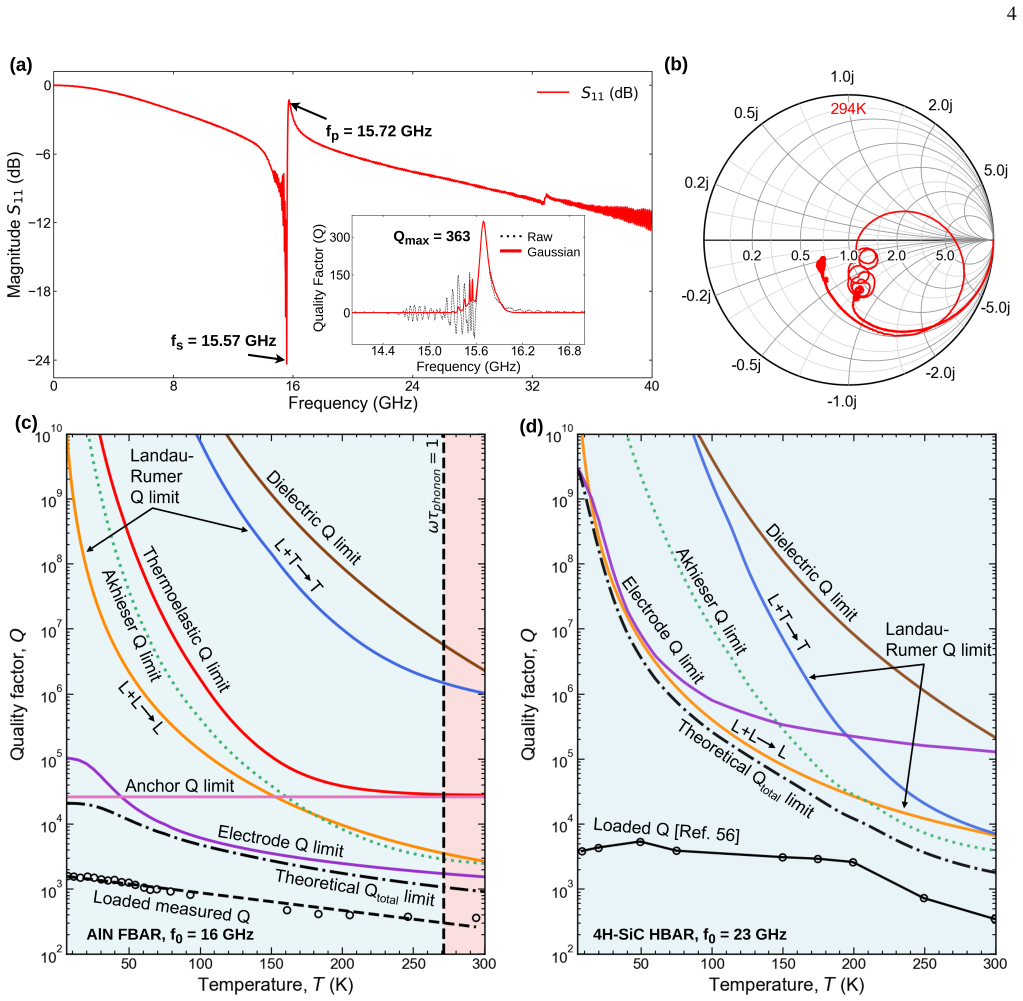
Measurements on a fabricated 16 GHz epitaxial AlN FBAR show the loaded quality factor decreasing monotonically from approximately 1589 at 6.5 K to 363 at 294 K. A physics-based model that includes both intrinsic temperature-dependent dissipation and an analytical anchor-radiation loss expression for bulk acoustic wave resonators reproduces this trend without post-hoc fitting and is further validated on a 23 GHz HBAR.
What carries the argument
The physics-based loss model that combines temperature-dependent intrinsic dissipation with an analytical anchor-radiation loss term for bulk acoustic wave resonators.
If this is right
- The Qf product reaches 24.79 THz at 6.5 K for the 16 GHz FBAR.
- Separate quantification of intrinsic and radiation losses guides geometry and material choices to raise cryogenic Q.
- The framework applies across FBAR and HBAR geometries, supporting its use for other low-loss resonators.
- Cryogenic microwave filter elements for superconducting quantum hardware can be designed by targeting the dominant loss mechanism at each temperature.
Where Pith is reading between the lines
- If the analytical radiation term remains accurate for altered anchor designs, device layouts can be optimized analytically before fabrication.
- Extension of the same loss accounting to millikelvin temperatures would directly inform integration with superconducting qubits.
- Comparison of the model against resonators on different substrates could reveal whether substrate losses are already included or still missing.
- The temperature scaling extracted here supplies a benchmark for testing new piezoelectric films beyond AlN.
Load-bearing premise
The model captures all relevant loss channels and the analytical anchor-radiation loss expression accurately predicts extrinsic losses from the given MIM stack and geometry without adjustments to the measured data.
What would settle it
A measured quality factor at 6.5 K that substantially exceeds the model's predicted upper bound for the same geometry and stack would falsify the claim that the listed mechanisms set the limit.
Figures



read the original abstract
Aluminum nitride (AlN)-based thin-film bulk acoustic wave resonators (FBARs) are promising compact platforms for 6G communications and quantum memory hardware, enabled by their integrable acoustic modes with high quality factors. However, temperature-dependent acoustic dissipation ultimately limits device performance. In this work, we fabricated a 16 GHz epitaxial AlN FBAR as a test platform, performed small-signal RF measurements from 6.5 K to 300 K, and developed a physics-based model to estimate the fundamental quality-factor limits of FBARs to cryogenic temperatures. The proposed model incorporates both intrinsic and extrinsic loss mechanisms, including an analytical anchor-radiation loss model for bulk acoustic wave resonators, rather than relying solely on finite-element simulations. Measured loaded quality factor (Q) decreases monotonically with temperature, from Qmax of approximately 1589 (Qf=24.79 THz) at 6.5 K to 363 at 294K (Qf=5.66 THz). This trend is consistent with the theoretical limit based on the resonator geometry and the chosen Metal-Insulator-Metal (MIM) stack. To demonstrate the generality of the physics-based framework, we further validate it by benchmarking against a 23 GHz high-overtone bulk acoustic resonator (HBAR) using previously reported data. The validated model provides a practical, transferable framework to interpret Q(T) limits in low-loss resonators by quantifying the temperature-dependent mechanisms that constrain Q, enabling the design of cryogenic microwave filter elements for superconducting quantum hardware.
Editorial analysis
A structured set of objections, weighed in public.
Referee Report
Summary. The manuscript reports fabrication and cryogenic (6.5–300 K) RF measurements of a 16 GHz epitaxial AlN thin-film bulk acoustic resonator (FBAR) in a MIM stack, with loaded Q decreasing from ~1589 at 6.5 K to 363 at 294 K. A physics-based model is presented that combines intrinsic loss channels with an analytical expression for anchor-radiation loss derived from the resonator geometry and stack; the measured Q(T) is stated to follow the resulting theoretical limit. The framework is further benchmarked against an independent 23 GHz HBAR dataset from prior literature.
Significance. If the central claim holds without post-hoc adjustment, the work supplies a practical, transferable model for quantifying temperature-dependent Q limits in low-loss acoustic resonators. This is relevant for cryogenic microwave components in superconducting quantum hardware. The analytical (rather than purely numerical) treatment of anchor-radiation loss and the external HBAR validation are concrete strengths that support generality beyond the primary device.
major comments (1)
- [Model/theory section] Model/theory section: The abstract asserts that the measured Q(T) trend is 'consistent with the theoretical limit based on the resonator geometry and the chosen MIM stack' and that the model is 'physics-based' with an 'analytical anchor-radiation loss model'. The manuscript must explicitly present the anchor-radiation formula (including any boundary conditions or effective parameters) and demonstrate that it contains zero adjustable constants fitted to the 16 GHz FBAR data (e.g., to the reported Qmax ≈ 1589 at 6.5 K). If any scaling or effective value is determined from the primary dataset, the consistency claim becomes circular and the transferability asserted in the abstract is unproven.
minor comments (3)
- [Abstract/Results] Abstract and results: Replace 'approximately 1589' with the precise measured value and state whether it is loaded or unloaded Q. Include error bars or uncertainty estimates on all Q(T) data points.
- [Model section] Model section: List the numerical values and sources of all material parameters (e.g., intrinsic loss coefficients, acoustic velocities) used in the calculations; clarify whether any were obtained by fitting to the FBAR measurements.
- [Validation section] Validation: The HBAR benchmark should report quantitative agreement metrics (e.g., RMS deviation or R^{2}) rather than qualitative consistency alone.
Simulated Author's Rebuttal
We thank the referee for their careful review and constructive feedback on our manuscript. We address the major comment below and have revised the manuscript to strengthen the presentation of the model.
read point-by-point responses
-
Referee: [Model/theory section] Model/theory section: The abstract asserts that the measured Q(T) trend is 'consistent with the theoretical limit based on the resonator geometry and the chosen MIM stack' and that the model is 'physics-based' with an 'analytical anchor-radiation loss model'. The manuscript must explicitly present the anchor-radiation formula (including any boundary conditions or effective parameters) and demonstrate that it contains zero adjustable constants fitted to the 16 GHz FBAR data (e.g., to the reported Qmax ≈ 1589 at 6.5 K). If any scaling or effective value is determined from the primary dataset, the consistency claim becomes circular and the transferability asserted in the abstract is unproven.
Authors: We agree that an explicit derivation of the anchor-radiation loss term is necessary to fully substantiate the physics-based claim and eliminate any perception of circularity. In the revised manuscript we have added a dedicated subsection to the theory section that presents the complete analytical formula for anchor-radiation loss. The expression is obtained from the acoustic power radiated into the supporting anchors, using the resonator lateral dimensions, electrode and AlN thicknesses, and the acoustic impedances and velocities of the MIM stack layers. Boundary conditions are set by continuity of stress and displacement at the anchor interfaces; no effective scaling factors or adjustable constants are introduced. All numerical inputs are taken from independent literature values for material properties and from the lithographic mask dimensions. The low-temperature Q limit is therefore a forward prediction of the model rather than a fitted parameter. The same geometry-only framework, with only the HBAR-specific layer thicknesses and lateral dimensions substituted, reproduces the independent 23 GHz HBAR dataset without further adjustment, confirming transferability. revision: yes
Circularity Check
No significant circularity; derivation remains independent of target data
full rationale
The paper constructs a physics-based model from intrinsic material loss mechanisms plus an analytical anchor-radiation expression derived directly from the stated MIM stack geometry and boundary conditions. Measured Q(T) is then compared to the resulting theoretical limit calculated from those geometry and material inputs; the abstract explicitly frames this as consistency rather than a fit. Validation is performed on an independent external HBAR dataset. No equations or statements in the provided text reduce the anchor-radiation term or overall limit to a parameter tuned against the 16 GHz FBAR measurements, nor do any load-bearing steps rely on self-citation chains. The framework therefore stands as a genuine forward prediction from geometry and physics, not a renaming or re-fitting of the observed values.
Axiom & Free-Parameter Ledger
free parameters (1)
- intrinsic and extrinsic loss coefficients
axioms (1)
- domain assumption Anchor radiation loss for bulk acoustic wave resonators can be expressed analytically from geometry and MIM stack without requiring finite-element simulation
Reference graph
Works this paper leans on
-
[1]
Cryogenic Loss Limits in Microwave Epitaxial AlN Acoustic Resonators
Experimentally,Q max of- ten denotes the maximum extractedQamong nearby oper- ating points and should be viewed as a device-level upper bound. Importantly,Q max can be raised by reducing extrinsic losses even if intrinsic material losses are unchanged13. Con- versely,Q max can remain low in excellent material if energy leaks through anchors or electrodes....
work page internal anchor Pith review Pith/arXiv arXiv 2026
-
[2]
Temperature dependence of the relaxation times as- sociated with phonon–phonon scattering and thermoelastic dissi- pation. The phonon relaxation time is modeled asτ phonon = 3κ(T)/ Cv(T)c 2 D , while the thermoelastic relaxation time is τTED = (b/π) 2 Cp(T)/κ(T). Here,bis the film thickness,κ(T)is the thermal conductivity71,C v(T)is the volumetric heat ca...
-
[3]
A loss mechanism study of a very highQsilicon mi- cromechanical oscillator,
pp. 74–77. 10X. Liu, J. F. Vignola, H. J. Simpson, B. R. Lemon, B. H. Houston, and D. M. Photiadis, “A loss mechanism study of a very highQsilicon mi- cromechanical oscillator,” Journal of Applied Physics97, 023524 (2005). 11M. Kazemi, S. Nabavi, M. Gratuze, and F. Nabki, “Anchor Loss Reduc- tion in Micro-Electro Mechanical Systems Flexural Beam Resonator...
2005
-
[4]
High-Q Capacitive- Piezoelectric AlN Lamb Wave Resonators,
21T.-T. Yen, A. P. Pisano, and C. T.-C. Nguyen, “High-Q Capacitive- Piezoelectric AlN Lamb Wave Resonators,” inProceedings of the 26th IEEE International Conference on Micro Electro Mechanical Systems (MEMS)(2013) pp. 114–117. 22R. Vetury, M. D. Hodge, and J. B. Shealy, “High Power, Wideband Single Crystal XBAW Technology for Sub-6 GHz Micro RF Filter App...
2013
-
[5]
Characteristics of an AlN-based Bulk Acoustic Wave Resonator in the Super High Fre- quency Range,
23K. Umeda, H. Kawamura, M. Takeuchi, and Y . Yoshino, “Characteristics of an AlN-based Bulk Acoustic Wave Resonator in the Super High Fre- quency Range,” Vacuum83, 672–674 (2008), selected papers revised from the Proceedings of the Ninth International Symposium on Sputtering and Plasma Processes (ISSP 2007), Kanazawa, Japan, 6–8 June
2008
-
[6]
Analysis and Removal of Spurious Re- sponse in SH0 Lithium Niobate MEMS Resonators,
24Y .-H. Song, R. Lu, and S. Gong, “Analysis and Removal of Spurious Re- sponse in SH0 Lithium Niobate MEMS Resonators,” IEEE Transactions on Electron Devices63, 2066–2073 (2016). 25J. Rodriguez, S. A. Chandorkar, C. A. Watson, and et al., “Direct Detection of Akhiezer Damping in a Silicon MEMS Resonator,” Scientific Reports9, 2244 (2019). 26M. Rinaldi, C...
2066
-
[7]
Quality factors in micron- and submicron-thick can- tilevers,
68K. Y . Yasumura, T. D. Stowe, E. M. Chow, T. Pfafman, T. W. Kenny, B. C. Stipe, and D. Rugar, “Quality factors in micron- and submicron-thick can- tilevers,” Journal of Microelectromechanical Systems9, 117–125 (2000). 69D. Sedmidubský, J. Leitner, P. Svoboda, Z. Sofer, and J. Machá ˇcek, “Heat capacity and phonon spectra of AIII nitrides,” Journal of Th...
discussion (0)
Sign in with ORCID, Apple, or X to comment. Anyone can read and Pith papers without signing in.