Recognition: unknown
Measurement of jet quenching in O+O collisions at sqrt{s_NN}=200 GeV by the STAR experiment at RHIC
Pith reviewed 2026-05-10 11:49 UTC · model grok-4.3
The pith
Jet quenching appears in oxygen-oxygen collisions through suppressed recoil yields at RHIC.
A machine-rendered reading of the paper's core claim, the machinery that carries it, and where it could break.
Core claim
In event-activity selected O+O collisions at sqrt(s_NN)=200 GeV, yields of associated charged hadrons and charged-particle jets recoiling from high-p_T triggers are suppressed by approximately 20 percent in high-activity relative to low-activity collisions, an absence of suppression being excluded at high significance; the suppression corresponds to a p_T shift of 0.70 plus or minus 0.15 (stat.) plus or minus 0.10 (syst.) GeV/c for R=0.5 jets and is interpreted as the redistribution of jet energy due to final-state interactions.
What carries the argument
Event-activity classified two-particle and jet-hadron correlations that compare normalized recoil yields between high- and low-activity classes to isolate final-state medium effects.
If this is right
- The energy removed from high-p_T jets is redistributed to lower-momentum particles through interactions in the collision medium.
- A quark-gluon plasma dense enough to quench jets can form in small O+O systems.
- The strength of the observed suppression provides a quantitative measure of medium-induced energy loss at this collision energy.
- The same correlation technique can be applied to other light-ion systems to map how quenching depends on system size.
Where Pith is reading between the lines
- If initial-state effects dominated, the suppression would not appear selectively in the high-activity class after normalization; the data therefore favor final-state medium interactions.
- The result encourages measurements of angular distributions or identified-particle yields around the same triggers to reveal the detailed pattern of energy redistribution.
- Higher-statistics data sets in the same or similar light-ion collisions could test whether the p_T shift scales with estimated path length through the medium.
Load-bearing premise
The selection of high event activity primarily captures collisions with a denser final-state medium rather than differences in initial nuclear structure or biases in trigger identification.
What would settle it
A model calculation that reproduces the measured 20 percent suppression and 0.70 GeV/c p_T shift using only initial-state nuclear modifications and no final-state medium would falsify the jet-quenching interpretation.
Figures


read the original abstract
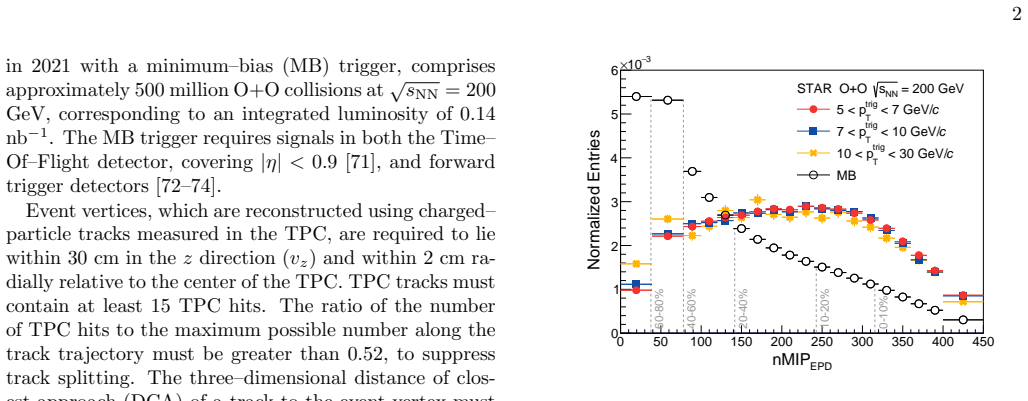
The STAR experiment at the Relativistic Heavy Ion Collider presents measurements of correlations between charged hadron triggers of high transverse momenta ($7 < p_{\rm T} < 30$ GeV/$c$) with recoiling charged hadrons ($3 < p_{\rm T} < 7$ GeV/$c$) or charged--particle jets ($p_{\rm T, jet} > 8$ GeV/$c$) in event--activity selected O+O collisions at $\sqrt{s_{\mathrm {NN}}}=200$ GeV. Yields of associated hadrons and jets, normalized by the number of trigger hadrons, are suppressed by approximately 20\% in high event activity relative to low event activity collisions, with an absence of suppression excluded with high significance. This suppression corresponds to a shift in p_{\rm T} of $0.70\pm0.15~(\rm stat.)~\pm0.10~(\rm syst.)$ GeV/$c$ for large--radius charged--particle jets ($R=0.5$), quantifying their energy redistribution due to final--state interactions. These measurements provide strong evidence for jet quenching in O+O collisions at $\sqrt{s_\mathrm{NN}}=200$ GeV, offering new insight into quark--gluon plasma formation in small collision systems.
Editorial analysis
A structured set of objections, weighed in public.
Referee Report
Summary. The paper reports STAR measurements of correlations between high-pT charged hadron triggers (7 < pT < 30 GeV/c) and associated charged hadrons (3 < pT < 7 GeV/c) or charged-particle jets (pT,jet > 8 GeV/c) in event-activity selected O+O collisions at √s_NN=200 GeV. It finds ~20% suppression of per-trigger yields in high- vs. low-event-activity collisions, corresponding to a pT shift of 0.70±0.15(stat.)±0.10(syst.) GeV/c for R=0.5 jets, and claims this as strong evidence for jet quenching and QGP formation in small systems.
Significance. If the final-state interpretation holds after addressing initial-state alternatives, the result would be significant for establishing the onset of jet quenching in the smallest systems at RHIC, extending knowledge of medium effects beyond larger A+A collisions.
major comments (2)
- [Abstract] Abstract: The central claim of 'strong evidence' for jet quenching interprets the ~20% suppression and 0.70 GeV/c pT shift as final-state energy loss. However, no quantitative comparison to initial-state-only models (e.g., HIJING or EPOS without quenching) using the same trigger and event-activity selections is presented, so nuclear shadowing, Cronin broadening, or impact-parameter-dependent initial parton distributions cannot be excluded as alternative explanations for the observed difference.
- [Results and methods] Results and methods sections: The statistical significance and systematic uncertainties on the suppression and pT shift depend on background subtraction for the correlations and the specific jet reconstruction algorithm. The manuscript provides insufficient detail on these procedures and the full breakdown of systematic studies to support the quantified energy redistribution claim.
minor comments (1)
- [Abstract] Abstract: The definition of 'event activity' (e.g., via mid-rapidity multiplicity or forward energy) is used for selection but not explicitly defined in the summary, which would aid reader clarity.
Simulated Author's Rebuttal
We thank the referee for the careful and constructive review of our manuscript. The comments raise important points about the strength of the final-state interpretation and the level of detail in the methods. We address each major comment below and will revise the manuscript to incorporate additional material where appropriate.
read point-by-point responses
-
Referee: [Abstract] Abstract: The central claim of 'strong evidence' for jet quenching interprets the ~20% suppression and 0.70 GeV/c pT shift as final-state energy loss. However, no quantitative comparison to initial-state-only models (e.g., HIJING or EPOS without quenching) using the same trigger and event-activity selections is presented, so nuclear shadowing, Cronin broadening, or impact-parameter-dependent initial parton distributions cannot be excluded as alternative explanations for the observed difference.
Authors: We agree that explicit comparisons to initial-state models would strengthen the interpretation. The observed suppression and pT shift are presented as evidence for final-state effects because the event-activity selection isolates differences at fixed trigger pT, and the magnitude of the shift is larger than typical initial-state modifications in small systems. Nevertheless, to directly address the referee's concern, we will add quantitative comparisons to HIJING and EPOS (without quenching) using identical trigger and event-activity selections in the revised manuscript. These will show that such models do not reproduce the measured suppression, thereby supporting the final-state interpretation. revision: yes
-
Referee: [Results and methods] Results and methods sections: The statistical significance and systematic uncertainties on the suppression and pT shift depend on background subtraction for the correlations and the specific jet reconstruction algorithm. The manuscript provides insufficient detail on these procedures and the full breakdown of systematic studies to support the quantified energy redistribution claim.
Authors: We acknowledge that additional methodological detail is warranted. In the revised manuscript we will expand the description of the background subtraction procedure for both the hadron-hadron and hadron-jet correlations, including the specific techniques, acceptance corrections, and any assumptions. We will also include a complete breakdown of systematic uncertainties, covering contributions from the jet reconstruction algorithm (R parameter, pT thresholds, and underlying-event subtraction), to better substantiate the reported suppression and pT shift values. revision: yes
Circularity Check
Direct experimental measurement; no derivation reduces to inputs by construction
full rationale
This is a pure experimental report of measured yields and suppressions in high- versus low-event-activity O+O collisions. The ~20% suppression and 0.70 GeV/c pT shift are extracted directly from data (trigger-normalized associated hadron/jet yields) without any fitted parameter, ansatz, or self-cited uniqueness theorem that forces the final-state interpretation. No equation or step equates the reported result to its own selection or normalization by construction; the central claim remains an empirical observation whose interpretation as quenching is independent of the measurement itself.
Axiom & Free-Parameter Ledger
axioms (1)
- domain assumption Standard assumptions regarding trigger hadron selection, background subtraction, and event activity classification in heavy-ion collisions.
Forward citations
Cited by 1 Pith paper
-
Geometric bias and centrality dependence of jet quenching in high-energy nuclear collisions
A refined HIJING initial-condition model with geometric bias from impact-parameter effects, combined with Boltzmann jet transport, describes the centrality dependence of charged-hadron suppression in 5.02 TeV Pb+Pb co...
Reference graph
Works this paper leans on
-
[1]
Heavy Ion Collisions: The Big Picture, and the Big Questions
W. Busza, K. Rajagopal, and W. van der Schee, Heavy Ion Collisions: The Big Picture, and the Big Questions, Ann. Rev. Nucl. Part. Sci.68, 339 (2018), arXiv:1802.04801 [hep-ph]
work page Pith review arXiv 2018
-
[2]
H. Elfner and B. M¨ uller, The exploration of hot and dense nuclear matter: introduction to relativistic heavy-ion physics, J. Phys. G50, 103001 (2023), arXiv:2210.12056 [nucl-th]
-
[3]
J. Adams et al. (STAR), Experimental and theoretical challenges in the search for the quark gluon plasma: The STAR Collaboration’s critical assessment of the evidence from RHIC collisions, Nucl. Phys. A757, 102 (2005), arXiv:nucl-ex/0501009
work page Pith review arXiv 2005
-
[4]
K. Adcox et al. (PHENIX), Formation of dense partonic matter in relativistic nucleus-nucleus collisions at RHIC: Experimental evaluation by the PHENIX collaboration, Nucl. Phys. A757, 184 (2005), arXiv:nucl-ex/0410003
- [5]
-
[6]
I. Arsene et al. (BRAHMS), Quark gluon plasma and color glass condensate at RHIC? The Perspective from the BRAHMS experiment, Nucl. Phys. A757, 1 (2005), arXiv:nucl-ex/0410020
-
[7]
The ALICE experiment: a journey through QCD
S. Acharya et al. (ALICE), The ALICE experiment: a journey through QCD, Eur. Phys. J. C84, 813 (2024), arXiv:2211.04384 [nucl-ex]
-
[8]
Overview of high-density QCD studies with the CMS experiment at the LHC
A. Hayrapetyan et al. (CMS), Overview of high-density QCD studies with the CMS experiment at the LHC, Phys. Rept.1115, 219 (2025), arXiv:2405.10785 [nucl- ex]
-
[9]
C. Gale, S. Jeon, and B. Schenke, Hydrodynamic Mod- eling of Heavy-Ion Collisions, Int. J. Mod. Phys. A28, 1340011 (2013), arXiv:1301.5893 [nucl-th]
work page Pith review arXiv 2013
-
[10]
Collective flow and viscosity in relativistic heavy-ion collisions
U. Heinz and R. Snellings, Collective flow and viscosity in relativistic heavy-ion collisions, Ann. Rev. Nucl. Part. Sci.63, 123 (2013), arXiv:1301.2826 [nucl-th]
work page Pith review arXiv 2013
-
[11]
Hydrodynamic Description of the Quark-Gluon Plasma
U. Heinz and B. Schenke, Hydrodynamic Description of the Quark-Gluon Plasma (2024) arXiv:2412.19393 [nucl- th]
-
[12]
J. W. Harris and B. M¨ uller, “QGP Signatures” Revisited, Eur. Phys. J. C84, 247 (2024), arXiv:2308.05743 [hep- ph]
-
[13]
G. F. Sterman and S. Weinberg, Jets from Quantum Chromodynamics, Phys. Rev. Lett.39, 1436 (1977)
1977
-
[14]
M. Dasgupta, F. Dreyer, G. P. Salam, and G. Soyez, Small-radius jets to all orders in QCD, JHEP04, 039, arXiv:1411.5182 [hep-ph]
-
[15]
Sapeta, QCD and Jets at Hadron Colliders, Prog
S. Sapeta, QCD and Jets at Hadron Colliders, Prog. Part. 6 Nucl. Phys.89, 1 (2016), arXiv:1511.09336 [hep-ph]
-
[16]
L. Cunqueiro and A. M. Sickles, Studying the QGP with Jets at the LHC and RHIC, Prog. Part. Nucl. Phys.124, 103940 (2022), arXiv:2110.14490 [nucl-ex]
-
[17]
L. Apolin´ ario, Y.-J. Lee, and M. Winn, Heavy quarks and jets as probes of the QGP, Prog. Part. Nucl. Phys. 127, 103990 (2022), arXiv:2203.16352 [hep-ph]
-
[18]
X.-N. Wang and U. A. Wiedemann, QGP@50: More than Four Decades of Jet Quenching (2025) arXiv:2508.18794 [hep-ph]
-
[19]
J. Chen, Z. Chen, M. Nie, H. Qiu, S. Shi, Z. Tang, Q. Xu, C. Yang, S. Yang, Z. Ye, L. Yi, W. Zha, C. Zhang, J. Zhang, Y. Zhang, and X. Zhu, Selected highlights from star experiment, Chin. Phys. Lett.43, 030102 (2026)
2026
- [20]
- [21]
- [22]
-
[23]
K. Aamodt et al. (ALICE), Elliptic flow of charged par- ticles in Pb-Pb collisions at 2.76 TeV, Phys. Rev. Lett. 105, 252302 (2010), arXiv:1011.3914 [nucl-ex]
-
[24]
Observation of Long-Range Near-Side Angular Correlations in Proton-Proton Collisions at the LHC
V. Khachatryan et al. (CMS), Observation of Long- Range Near-Side Angular Correlations in Proton-Proton Collisions at the LHC, JHEP09, 091, arXiv:1009.4122 [hep-ex]
-
[25]
S. Chatrchyan et al. (CMS), Observation of Long-Range Near-Side Angular Correlations in Proton-Lead Colli- sions at the LHC, Phys. Lett. B718, 795 (2013), arXiv:1210.5482 [nucl-ex]
-
[26]
M. Aaboud et al. (ATLAS), Measurement of long-range multiparticle azimuthal correlations with the subevent cumulant method inppandp+P bcollisions with the ATLAS detector at the CERN Large Hadron Collider, Phys. Rev. C97, 024904 (2018), arXiv:1708.03559 [hep- ex]
-
[27]
S. Acharya et al. (ALICE), Investigations of Anisotropic Flow Using Multiparticle Azimuthal Correlations in pp, p-Pb, Xe-Xe, and Pb-Pb Collisions at the LHC, Phys. Rev. Lett.123, 142301 (2019), arXiv:1903.01790 [nucl- ex]
-
[28]
S. Acharya et al. (ALICE), Emergence of Long- Range Angular Correlations in Low-Multiplicity Proton- Proton Collisions, Phys. Rev. Lett.132, 172302 (2024), arXiv:2311.14357 [nucl-ex]
-
[29]
Creation of quark-gluon plasma droplets with three distinct geometries
C. Aidala et al. (PHENIX), Creation of quark–gluon plasma droplets with three distinct geometries, Nature Phys.15, 214 (2019), arXiv:1805.02973 [nucl-ex]
- [30]
-
[31]
L. Adamczyk et al. (STAR), Long-range pseudorapidity dihadron correlations ind+Au collisions at √sNN = 200 GeV, Phys. Lett. B747, 265 (2015), arXiv:1502.07652 [nucl-ex]
- [32]
-
[33]
Y.-C. Chen et al., Long-range near-side correlation in e+e−collisions at 183-209 GeV with ALEPH archived data, Phys. Lett. B856, 138957 (2024), arXiv:2312.05084 [hep-ex]
-
[34]
B. Abelev et al. (ALICE), Transverse momentum distri- bution and nuclear modification factor of charged parti- cles inp-Pb collisions at √sN N = 5.02 TeV, Phys. Rev. Lett.110, 082302 (2013), arXiv:1210.4520 [nucl-ex]
-
[35]
Charged-particle nuclear modification factors in PbPb and pPb collisions at sqrt(s[NN]) = 5.02 TeV
V. Khachatryan et al. (CMS), Charged-particle nuclear modification factors in PbPb and pPb collisions at√sN N = 5.02 TeV, JHEP04, 039, arXiv:1611.01664 [nucl-ex]
- [36]
- [37]
- [38]
- [39]
-
[40]
S. Acharya et al. (ALICE), Constraints on jet quench- ing in p-Pb collisions at √sNN = 5.02 TeV mea- sured by the event-activity dependence of semi-inclusive hadron-jet distributions, Phys. Lett. B783, 95 (2018), arXiv:1712.05603 [nucl-ex]
-
[41]
G. Aad et al. (ATLAS), Strong Constraints on Jet Quenching in Centrality-Dependent p+Pb Collisions at 5.02 TeV from ATLAS, Phys. Rev. Lett.131, 072301 (2023), arXiv:2206.01138 [nucl-ex]
-
[42]
V. Chekhovsky et al. (CMS), Search for jet quenching with dijets from high-multiplicity pPb collisions at √sNN = 8.16 TeV, JHEP07, 118, arXiv:2504.08507 [nucl-ex]
-
[43]
L. Adamczyk et al. (STAR), Effect of event selection on jetlike correlation measurement ind+Au collisions at √sNN = 200 GeV, Phys. Lett. B743, 333 (2015), arXiv:1412.8437 [nucl-ex]
-
[44]
M. Abdulhamid et al. (STAR), Correlations of event ac- tivity with hard and soft processes in p+Au collisions at√sNN = 200 GeV at the RHIC STAR experiment, Phys. Rev. C110, 044908 (2024), arXiv:2404.08784 [nucl-ex]
- [45]
-
[46]
Progress in the Glauber Model at Collider Energies,
D. d’Enterria and C. Loizides, Progress in the Glauber Model at Collider Energies, Ann. Rev. Nucl. Part. Sci. 71, 315 (2021), arXiv:2011.14909 [hep-ph]
-
[47]
M. Alvioli, L. Frankfurt, D. Perepelitsa, and M. Strik- man, Global analysis of color fluctuation effects in pro- ton– and deuteron–nucleus collisions at RHIC and the LHC, Phys. Rev. D98, 071502 (2018), arXiv:1709.04993 [hep-ph]. 7
-
[48]
D. Behera, S. Deb, C. R. Singh, and R. Sahoo, Character- izing nuclear modification effects in high-energy O-O col- lisions at energies available at the CERN Large Hadron Collider: A transport model perspective, Phys. Rev. C 109, 014902 (2024), arXiv:2308.06078 [hep-ph]
- [49]
- [50]
-
[51]
C. Loizides, Glauber predictions for oxygen and neon collisions at energies available at the CERN Large Hadron Collider, Phys. Rev. C113, 014914 (2026), arXiv:2507.05853 [nucl-th]
-
[52]
J. Adams et al. (STAR), Direct observation of dijets in central Au+Au collisions at√sNN = 200 GeV, Phys. Rev. Lett.97, 162301 (2006), arXiv:nucl-ex/0604018
- [53]
-
[54]
K. Aamodt et al. (ALICE), Particle-yield modification in jet-like azimuthal di-hadron correlations in Pb-Pb colli- sions at √sN N = 2.76 TeV, Phys. Rev. Lett.108, 092301 (2012), arXiv:1110.0121 [nucl-ex]
-
[55]
J. Adam et al. (ALICE), Measurement of jet quench- ing with semi-inclusive hadron-jet distributions in cen- tral Pb-Pb collisions at √sNN = 2.76 TeV, JHEP09, 170, arXiv:1506.03984 [nucl-ex]
-
[56]
L. Adamczyk et al. (STAR), Measurements of jet quenching with semi-inclusive hadron+jet distributions in Au+Au collisions at √sN N = 200 GeV, Phys. Rev. C 96, 024905 (2017), arXiv:1702.01108 [nucl-ex]
- [57]
- [58]
- [59]
-
[60]
J. Gebhard, A. Mazeliauskas, and A. Takacs, No- quenching baseline for energy loss signals in oxygen- oxygen collisions, JHEP04, 034, arXiv:2410.22405 [hep- ph]
- [61]
- [62]
- [63]
- [64]
- [65]
- [66]
- [67]
-
[68]
K. H. Ackermann et al. (STAR), STAR detector overview, Nucl. Instrum. Meth. A499, 624 (2003)
2003
-
[69]
The STAR Time Projection Chamber: A Unique Tool for Studying High Multiplicity Events at RHIC
M. Anderson et al., The Star time projection cham- ber: A Unique tool for studying high multiplicity events at RHIC, Nucl. Instrum. Meth. A499, 659 (2003), arXiv:nucl-ex/0301015
work page Pith review arXiv 2003
-
[70]
C. Yang, J. Chen, Y. Ma, and Q. Xu, Inner TPC upgrade at RHIC-STAR, Sci. Sin. Phys. Mech. Astro.49, 102008 (2019)
2019
- [71]
- [72]
- [73]
-
[74]
Adamset al., The STAR Event Plane Detector, Nucl
J. Adams et al., The STAR Event Plane Detector, Nucl. Instrum. Meth. A968, 163970 (2020), arXiv:1912.05243 [physics.ins-det]
-
[75]
The anti-k_t jet clustering algorithm
M. Cacciari, G. P. Salam, and G. Soyez, The anti-k t jet clustering algorithm, JHEP04, 063, arXiv:0802.1189 [hep-ph]
work page internal anchor Pith review arXiv
-
[76]
M. Cacciari and G. P. Salam, Dispelling theN 3 myth for thek t jet-finder, Phys. Lett. B641, 57 (2006), arXiv:hep- ph/0512210
-
[77]
M. Cacciari, G. P. Salam, and G. Soyez, FastJet User Manual, Eur. Phys. J. C72, 1896 (2012), arXiv:1111.6097 [hep-ph]
work page internal anchor Pith review arXiv 2012
-
[78]
Catani, Y
S. Catani, Y. L. Dokshitzer, M. H. Seymour, and B. R. Webber, Longitudinally invariantK t clustering algo- rithms for hadron hadron collisions, Nucl. Phys. B406, 187 (1993)
1993
-
[79]
S. D. Ellis and D. E. Soper, Successive combination jet algorithm for hadron collisions, Phys. Rev. D48, 3160 (1993), arXiv:hep-ph/9305266
work page Pith review arXiv 1993
-
[80]
S. Chatrchyan et al. (CMS), Measurement of the Under- lying Event Activity inppCollisions at √s= 0.9 and 7 TeV with the Novel Jet-Area/Median Approach, JHEP 08, 130, arXiv:1207.2392 [hep-ex]
discussion (0)
Sign in with ORCID, Apple, or X to comment. Anyone can read and Pith papers without signing in.