Recognition: unknown
Spatially covariant gravity with two degrees of freedom: A perturbative analysis up to cubic order
Pith reviewed 2026-05-10 11:19 UTC · model grok-4.3
The pith
Five spatially covariant gravity Lagrangians can be constructed to propagate only two degrees of freedom up to cubic order around a cosmological background.
A machine-rendered reading of the paper's core claim, the machinery that carries it, and where it could break.
Core claim
We find five explicit Lagrangians that propagate only 2 DOFs up to cubic order in perturbations around a cosmological background. These theories therefore provide concrete candidate 2-DOF SCG models, at least at the perturbative level up to cubic order.
What carries the argument
Perturbative expansion of spatially covariant gravity Lagrangians around a cosmological background together with coefficient conditions that eliminate the scalar perturbation mode up to cubic order.
Load-bearing premise
Eliminating the scalar mode up to cubic order in perturbations around a cosmological background is sufficient to guarantee that the full theory propagates only two degrees of freedom.
What would settle it
Performing the full nonlinear Hamiltonian analysis on one of the five Lagrangians and finding an extra propagating scalar mode, or repeating the count on a non-cosmological background, would show that the 2-DOF property does not hold.
Figures
read the original abstract
There has been considerable interest in constructing modified gravity theories that propagate only two degrees of freedom (DOFs), corresponding to the tensorial gravitational waves of general relativity. Within the framework of spatially covariant gravity (SCG), the conditions for obtaining 2-DOF theories can be derived from Hamiltonian constraint analysis, but it is generally difficult to translate those conditions into explicit SCG Lagrangians, especially when the Lagrangian depends nonlinearly on the extrinsic curvature. In this work, we adopt an alternative perturbative approach. We consider polynomial-type SCG Lagrangians up to $d=3$, where $d$ denotes the total number of derivatives in each monomial, and expand them around a cosmological background. By requiring the scalar mode to be eliminated up to cubic order in perturbations, we derive the corresponding conditions on the coefficient functions in the Lagrangian. We find five explicit Lagrangians that propagate only 2 DOFs up to cubic order in perturbations around a cosmological background. These theories therefore provide concrete candidate 2-DOF SCG models, at least at the perturbative level up to cubic order.
Editorial analysis
A structured set of objections, weighed in public.
Referee Report
Summary. The paper develops a perturbative method within spatially covariant gravity (SCG) to construct theories with two degrees of freedom. It considers polynomial Lagrangians up to total derivative order d=3, expands them around a cosmological background, and derives conditions on coefficient functions by requiring elimination of the scalar perturbation mode up to cubic order. This yields five explicit Lagrangians that satisfy the 2-DOF condition at this perturbative level.
Significance. If the derived conditions are correct, the work supplies concrete, explicit candidate Lagrangians for 2-DOF SCG models, which is valuable given the difficulty of performing full nonlinear Hamiltonian constraint analysis on theories with nonlinear dependence on extrinsic curvature. The perturbative approach offers a practical route to generating testable models, and the explicit forms enable immediate follow-up studies on stability, cosmological dynamics, and observational signatures.
minor comments (3)
- [Abstract] The abstract and introduction would benefit from a concise statement of the precise monomials included in the d=3 polynomial ansatz (e.g., listing the independent terms involving the extrinsic curvature and spatial curvature).
- [Results] The five explicit Lagrangians identified in the results section should be collected in a single table or appendix, with their coefficient conditions written out explicitly, to improve readability and allow direct comparison.
- [Discussion] A short discussion of whether the derived conditions preserve the absence of ghosts or gradient instabilities at the cubic order (beyond scalar elimination) would strengthen the presentation, even if outside the main scope.
Simulated Author's Rebuttal
We thank the referee for their positive summary of our manuscript and for recognizing the value of the perturbative approach in identifying concrete candidate 2-DOF SCG Lagrangians. The recommendation for minor revision is noted, and we will incorporate any editorial improvements in the revised version.
Circularity Check
No significant circularity
full rationale
The paper imposes the condition that the scalar mode must vanish in the cubic-order perturbative equations around a cosmological background and solves for the coefficient functions in the assumed polynomial SCG Lagrangian (up to total derivative order d=3). This yields five explicit Lagrangians as direct outputs of the constraint-solving process. No step reduces by construction to a prior fit, self-definition, or load-bearing self-citation; the derivation remains self-contained within the stated perturbative framework and does not rely on external uniqueness theorems or renamed empirical patterns.
Axiom & Free-Parameter Ledger
axioms (2)
- domain assumption Lagrangians are restricted to polynomial form with total derivative order d ≤ 3
- domain assumption Eliminating the scalar mode in the perturbative expansion around a cosmological background implies only two degrees of freedom
Reference graph
Works this paper leans on
-
[1]
To this end, a higher-order perturbation analysis is necessary
by constraining the coefficients of thed= 3terms. To this end, a higher-order perturbation analysis is necessary. In the next section, we will expand the perturbed action to cubic order and require the complete disappearance of any dynamical scalar mode, thereby deriving further conditions that restrict the functional form of the Lagrangian. III. DEGENERA...
-
[2]
solution A1
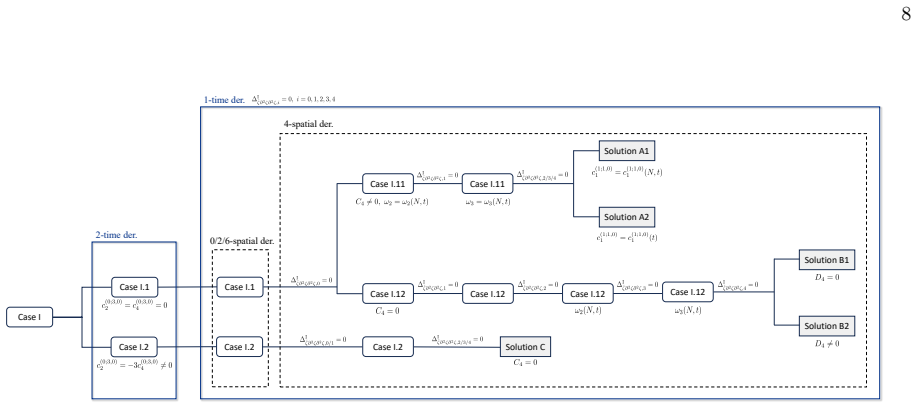
Case I.11 We first consider Case I.11, which corresponds to ω2 = C1N C5 −2C 2N andC 4 ̸= 0.(3.32) The equation∆ I11 ˙ζ∂ 2ζ∂ 2ζ,1 = 0, with ∆I11 ˙ζ∂ 2ζ∂ 2ζ,1 = 1 (C5 −2C 2 ¯N)2 4C1C4H ¯N(1 +C 2 ¯N)3 h C1C2 ¯N2 −C 5c(1;1,0)′ 1 + 2C2(2D3 +c (1;1,0) 1 +c (1;1,0)′ 1 ) ¯N + 3C4 2C2D1 ¯N3 −C 2(C5 −4)C 5 ¯N(ω3 −ω ′ 3) −4C 2 2(C5 −1) ¯N2ω′ 3 +C 2 5(ω′ 3 −2ω 3) + 4...
-
[3]
Solution B1
Case I.12 We next turn to Case I.12, which corresponds toC4 = 0. For this branch, the coefficient∆I.12 ˙ζ∂ 2ζ∂ 2ζ,1 vanishes identically. We therefore begin with∆I.12 ˙ζ∂ 2ζ∂ 2ζ,2, which implies ω2 = C1C2 2(2D3 +c (1;1,0) 1 )2N(1 +C 2N) −8D2 4 +C 1C2 2 C5(1 +C 2N) (3.55) andc (1;1,0) 1 ̸=−2D 3. Substituting this expression forω2 into∆ I12 ˙ζ∂ 2ζ∂ 2ζ,3, we...
-
[4]
Solution C
Case I.2 Finally, we return to Case I.2, withC4 = 0. In this branch, the equations (3.30) are drastically simplified, which leads toD4 = 0. We therefore obtain another set of solutions for the coefficients, which we call “Solution C”. The corresponding action is SC = Z dtd3xN √ h h ω2 ˆK ij ˆKij + 1 3 C1N 1 +C 2N K2 + C3 N 3R+ B1 N +B 2 +c (0;3,0) 1 ˆKij ...
-
[5]
+ 24C4˜c(1;1,0)′ 1 ω3 + 2˜c(1;1,0) 1 (˜c(1;1,0)′ 1 ω2 + 18C4ω3 −12C 4ω′ 3) +C 2 2 ¯N C1˜c(1;1,0) 1 (3˜c(1;1,0) 1 ω3 + 4˜c(1;1,0)′ 1 ω3 −2˜c(1;1,0) 1 ω′ 3) +D 1 ¯N ˜c(1;1,0)2 1 (ω2 −ω ′
-
[6]
+ 12C4˜c(1;1,0)′ 1 ω3 + 2˜c(1;1,0) 1 (˜c(1;1,0)′ 1 ω2 + 6C4ω3 −6C 4ω′ 3) ,(A2) ∆I ˙ζ∂ 2ζ∂ 2ζ,2 =−H 2 ¯N 72C5 2 C2 4 ¯N4ω2 3 + 36C2 4 D1 ¯N(2ω3 −ω ′ 3) +C 2 2 ¯N C1 ¯N ˜c(1;1,0)2 1 (ω2 −ω ′
-
[7]
+ 36C4˜c(1;1,0)′ 1 ω3 + 2˜c(1;1,0) 1 (˜c(1;1,0)′ 1 ω2 + 30C4ω3 −18C 4ω′ 3) + 12C4 24C4ω2 3 +D 1 ¯N2(2˜c(1;1,0) 1 ω2 + 2˜c(1;1,0)′ 1 ω2 −2˜c(1;1,0) 1 ω′ 2 + 12C4ω3 −9C 4ω′ 3) +C 4 2 ¯N3 288C2 4 ω2 3 +C 1 ¯N ˜c(1;1,0)2 1 (ω2 −ω ′ 2) + 12C4˜c(1;1,0)′ 1 ω3 + 2˜c(1;1,0) 1 (˜c(1;1,0)′ 1 ω2 + 6C4ω3 −6C 4ω′ 3) + 2C3 2 ¯N2 C1 ¯N ˜c(1;1,0)2 1 (ω2 −ω ′
-
[8]
+ 18C4˜c(1;1,0)′ 1 ω3 + 2˜c(1;1,0) 1 (˜c(1;1,0)′ 1 ω2 + 12C4ω3 −9C 4ω′ 3) + 6C4 36C4ω2 3 +D 1 ¯N2(˜c(1;1,0) 1 ω2 + ˜c(1;1,0)′ 1 ω2 −˜c(1;1,0) 1 ω′ 2 + 3C4ω3 −3C 4ω′ 3) + 4C2 −2D 2 4 ¯N2ω2 2 + 9C2 4 2ω2 3 +D 1 ¯N2(5ω3 −3ω ′ 3) + 3C4 ¯N D1 ¯N(˜c(1;1,0) 1 ω2 + ˜c(1;1,0)′ 1 ω2 −˜c(1;1,0) 1 ω′
-
[9]
+C 1(2˜c(1;1,0) 1 ω3 + ˜c(1;1,0)′ 1 ω3 −˜c(1;1,0) 1 ω′ 3) , (A3) ∆I ˙ζ∂ 2ζ∂ 2ζ,1 =−4C 4H ¯N(1 +C 2 ¯N)3 C1C2 ¯N ˜c(1;1,0)′ 1 ω2 + ˜c(1;1,0) 1 (ω2 −ω ′ 2) + 3C4 D1 ¯N(ω2 −ω ′
-
[10]
Appendix B: Degeneracy analysis in Case II In this appendix, we present the procedure used to analyze the degeneracy conditions in Case II
+C 1(2 +C 2 ¯N)ω3 + 4C2(1 +C 2 ¯N)ω2ω3 −C 1(1 +C 2 ¯N)ω ′ 3 ,(A4) and ∆I ˙ζ∂ 2ζ∂ 2ζ,0 =−4C 2 4 ¯N(1 +C 2 ¯N)4 2C2ω2 2 +C 1(ω2 −ω ′ 2) (A5) with˜c(1;1,0) 1 :=c (1;1,0) 1 + 2D3. Appendix B: Degeneracy analysis in Case II In this appendix, we present the procedure used to analyze the degeneracy conditions in Case II. From (3.67), if ˜f3 ̸= 0, then∆1 contains...
-
[11]
proportional
˜f3 ̸= 0 We first consider the subcase with˜f3 ̸= 0. Since the calculations in this part rely heavily on the operator∆1 in (3.67), it is useful to recast the relevant expressions into a form that makes the dependence on∆−1 1 explicit. In particular, the solutions forAandB can be rewritten equivalently as A= 1 ∆1 2(f3 −3 ˜f3) ¯N(1 +C 2 ¯N)(C1 +C 1C2 ¯N+ 3D...
-
[12]
˜f3 = 0 We next consider the subcase with˜f3 = 0. Under this assumption, the solutions forAandBobtained from (3.65) and (3.66) become local, namely, A= 1 +C 2 ¯N C2H ¯N ˙ζ− (d8 + 2J3)(1 +C 2 ¯N)3 3C2H ¯N2(C1 +C 1C2 ¯N+ 3D 1H ¯N)a2 ∂2ζ,(B22) and B= f3(1 +C 2 ¯N)3 2C2H ¯N2(C1 +C 1C2 ¯N+ 3D 1H ¯N)a ˙ζ − f3(d8 + 2J3)(1 +C 2 ¯N)5 3C2H ¯N3(C1 +C 1C2 ¯N+ 3D 1H ¯...
work page Pith review arXiv 2017
-
[13]
H. Takeda, S. Morisaki, and A. Nishizawa,Pure polarization test of GW170814 and GW170817 using waveforms consistent with modified theories of gravity,Phys. Rev. D103(2021), no. 6 064037, [arXiv:2010.14538]. [3]LIGO Scientific, VIRGO, KAGRACollaboration, A. G. Abac et al.,Direct multi-model dark-matter search with gravitational-wave interferometers using d...
-
[14]
Lovelock,The Einstein tensor and its generalizations,J
D. Lovelock,The Einstein tensor and its generalizations,J. Math. Phys.12(1971) 498–501
1971
-
[15]
Lovelock,The four-dimensionality of space and the einstein tensor,J
D. Lovelock,The four-dimensionality of space and the einstein tensor,J. Math. Phys.13(1972) 874–876
1972
-
[16]
Gao,Hamiltonian analysis of spatially covariant gravity, Phys
X. Gao,Hamiltonian analysis of spatially covariant gravity,Phys. Rev. D90(2014) 104033, [arXiv:1409.6708]
-
[17]
Gao,Unifying framework for scalar-tensor theories of gravity, Phys
X. Gao,Unifying framework for scalar-tensor theories of gravity,Phys. Rev. D90(2014) 081501, [arXiv:1406.0822]
-
[18]
X. Gao and Z.-B. Yao,Spatially covariant gravity with velocity of the lapse function: the Hamiltonian analysis, JCAP05(2019) 024, [arXiv:1806.02811]
- [19]
- [20]
-
[21]
Ghost Condensation and a Consistent Infrared Modification of Gravity
N. Arkani-Hamed, H.-C. Cheng, M. A. Luty, and S. Mukohyama,Ghost condensation and a consistent infrared modification of gravity,JHEP05(2004) 074, [hep-th/0312099]
work page Pith review arXiv 2004
-
[22]
The Effective Field Theory of Inflation
C. Cheung, P. Creminelli, A. L. Fitzpatrick, J. Kaplan, and L. Senatore,The Effective Field Theory of Inflation, JHEP03(2008) 014, [arXiv:0709.0293]
work page Pith review arXiv 2008
-
[23]
The Effective Field Theory of Dark Energy
G. Gubitosi, F. Piazza, and F. Vernizzi,The Effective Field Theory of Dark Energy,JCAP02(2013) 032, [arXiv:1210.0201]
work page Pith review arXiv 2013
-
[24]
Quantum Gravity at a Lifshitz Point
P. Horava,Quantum Gravity at a Lifshitz Point,Phys. Rev. D79(2009) 084008, [arXiv:0901.3775]
work page Pith review arXiv 2009
-
[25]
X. Gao,Higher derivative scalar-tensor theory from the spatially covariant gravity: a linear algebraic analysis, JCAP11(2020) 004, [arXiv:2006.15633]
-
[26]
Gao,Higher derivative scalar-tensor monomials and their classification,Sci
X. Gao,Higher derivative scalar-tensor monomials and their classification,Sci. China Phys. Mech. Astron.64 (2021), no. 1 210012, [arXiv:2003.11978]
-
[27]
X. Gao and Y.-M. Hu,Higher derivative scalar-tensor theory and spatially covariant gravity: the correspondence, Phys. Rev. D102(2020), no. 8 084006, [arXiv:2004.07752]
- [28]
- [29]
- [30]
- [31]
-
[32]
Saitou,Canonical invariance of spatially covariant scalar-tensor theory,Phys
R. Saitou,Canonical invariance of spatially covariant scalar-tensor theory,Phys. Rev. D94(2016), no. 10 104054, [arXiv:1604.03847]
-
[33]
Propagation of gravitational waves in a cosmological background,
X. Gao and X.-Y. Hong,Propagation of gravitational waves in a cosmological background,Phys. Rev. D101 (2020), no. 6 064057, [arXiv:1906.07131]
- [34]
- [35]
- [36]
- [37]
- [38]
-
[39]
J.-X. Feng, J.-Y. Fang, and X. Gao,Circularly polarized gravitational waves from parity-violating scalar-tensor theory,arXiv:2602.07430
-
[40]
N. Afshordi, D. J. H. Chung, and G. Geshnizjani,Cuscuton: A Causal Field Theory with an Infinite Speed of Sound,Phys. Rev. D75(2007) 083513, [hep-th/0609150]
-
[41]
N. Afshordi, D. J. H. Chung, M. Doran, and G. Geshnizjani,Cuscuton Cosmology: Dark Energy meets Modified Gravity,Phys. Rev. D75(2007) 123509, [astro-ph/0702002]
-
[42]
J. Bhattacharyya, A. Coates, M. Colombo, A. E. Gumrukcuoglu, and T. P. Sotiriou,Revisiting the cuscuton as a Lorentz-violating gravity theory,Phys. Rev. D97(2018), no. 6 064020, [arXiv:1612.01824]
- [43]
- [44]
-
[45]
J. Quintin and D. Yoshida,Cuscuton gravity as a classically stable limiting curvature theory,JCAP02(2020) 016, [arXiv:1911.06040]
-
[46]
N. Bartolo, A. Ganz, and S. Matarrese,Cuscuton inflation,JCAP05(2022), no. 05 008, [arXiv:2111.06794]
-
[47]
K.-i. Maeda and S. Panpanich,Cuscuta-Galileon cosmology: Dynamics, gravitational constants, and the Hubble constant,Phys. Rev. D105(2022), no. 10 104022, [arXiv:2202.04908]
-
[48]
K. Kohri and K.-i. Maeda,A possible solution to the helium anomaly of EMPRESS VIII by cuscuton gravity theory,PTEP2022(2022), no. 9 091E01, [arXiv:2206.11257]
- [49]
-
[50]
P. Channuie, K. Karwan, and J. Sangtawee,Observational constraints and preheating in cuscuton inflation,Eur. Phys. J. C83(2023), no. 5 421, [arXiv:2301.07019]
-
[51]
M. Mylova and N. Afshordi,Effective cuscuton theory,JHEP04(2024) 144, [arXiv:2312.06066]
-
[52]
I. Andrade and R. Menezes,Kinks in cuscuton-like models with two scalar fields,Eur. Phys. J. C83(2023), no. 8 706, [arXiv:2308.03738]
-
[53]
A. Iyonaga, K. Takahashi, and T. Kobayashi,Extended Cuscuton: Formulation,JCAP12(2018) 002, [arXiv:1809.10935]
-
[54]
A. Iyonaga, K. Takahashi, and T. Kobayashi,Extended Cuscuton as Dark Energy,JCAP07(2020) 004, [arXiv:2003.01934]
-
[55]
A. De Felice and S. Mukohyama,Minimal theory of massive gravity,Phys. Lett. B752(2016) 302–305, [arXiv:1506.01594]
-
[56]
A. De Felice and S. Mukohyama,Phenomenology in minimal theory of massive gravity,JCAP04(2016) 028, [arXiv:1512.04008]
-
[57]
D. Glavan and C. Lin,Einstein-Gauss-Bonnet Gravity in Four-Dimensional Spacetime,Phys. Rev. Lett.124 (2020), no. 8 081301, [arXiv:1905.03601]
- [58]
- [59]
- [60]
-
[61]
A. De Felice, A. Doll, and S. Mukohyama,A theory of type-II minimally modified gravity,JCAP09(2020) 034, [arXiv:2004.12549]
-
[62]
X. Gao and Z.-B. Yao,Spatially covariant gravity theories with two tensorial degrees of freedom: the formalism, Phys. Rev. D101(2020), no. 6 064018, [arXiv:1910.13995]
-
[63]
S. Mukohyama and K. Noui,Minimally Modified Gravity: a Hamiltonian Construction,JCAP07(2019) 049, [arXiv:1905.02000]
- [64]
- [65]
-
[66]
R. Carballo-Rubio, F. Di Filippo, and S. Liberati,Minimally modified theories of gravity: a playground for testing the uniqueness of general relativity,JCAP06(2018) 026, [arXiv:1802.02537]. [Erratum: JCAP 11, E02 (2018)]
- [67]
-
[68]
A. De Felice, S. Mukohyama, and M. C. Pookkillath,AddressingH0 tension by means of VCDM,Phys. Lett. B 816(2021) 136201, [arXiv:2009.08718]. [Erratum: Phys.Lett.B 818, 136364 (2021)]
-
[69]
A. De Felice, A. Doll, F. Larrouturou, and S. Mukohyama,Black holes in a type-II minimally modified gravity, JCAP03(2021) 004, [arXiv:2010.13067]
-
[70]
A. De Felice and S. Mukohyama,Weakening gravity for dark matter in a type-II minimally modified gravity,JCAP 04(2021) 018, [arXiv:2011.04188]
-
[71]
A. De Felice, F. Larrouturou, S. Mukohyama, and M. Oliosi,Minimal Theory of Bigravity: construction and cosmology,JCAP04(2021) 015, [arXiv:2012.01073]
-
[72]
J. Sangtawee and K. Karwan,Inflationary model in minimally modified gravity theories,Phys. Rev. D104(2021), no. 2 023511, [arXiv:2103.11463]. 26
- [73]
-
[74]
A. Iyonaga and T. Kobayashi,Distinguishing modified gravity with just two tensorial degrees of freedom from general relativity: Black holes, cosmology, and matter coupling,Phys. Rev. D104(2021), no. 12 124020, [arXiv:2109.10615]
-
[75]
A. De Felice, S. Mukohyama, and M. C. Pookkillath,Static, spherically symmetric objects in type-II minimally modified gravity,Phys. Rev. D105(2022), no. 10 104013, [arXiv:2110.14496]
-
[76]
M. C. Pookkillath,Minimally Modified Gravity Fitting Planck Data Better ThanΛCDM,Astron. Rep.65(2021), no. 10 1021–1025
2021
-
[77]
Ganz,Dynamical dark energy in minimally modified gravity,JCAP08(2022) 074, [arXiv:2203.12358]
A. Ganz,Dynamical dark energy in minimally modified gravity,JCAP08(2022) 074, [arXiv:2203.12358]
-
[78]
A. De Felice, K.-i. Maeda, S. Mukohyama, and M. C. Pookkillath,Comparison of two theories of Type-IIa minimally modified gravity,Phys. Rev. D106(2022), no. 2 024028, [arXiv:2204.08294]
- [79]
-
[80]
J. Saito and T. Kobayashi,Black hole perturbations in spatially covariant gravity with just two tensorial degrees of freedom,Phys. Rev. D108(2023), no. 10 104063, [arXiv:2308.00267]
discussion (0)
Sign in with ORCID, Apple, or X to comment. Anyone can read and Pith papers without signing in.