Recognition: unknown
Learning Ad Hoc Network Dynamics via Graph-Structured World Models
Pith reviewed 2026-05-10 11:58 UTC · model grok-4.3
The pith
A graph-structured recurrent state space model learns ad hoc network dynamics from offline trajectories to train size-generalizable clustering policies.
A machine-rendered reading of the paper's core claim, the machinery that carries it, and where it could break.
Core claim
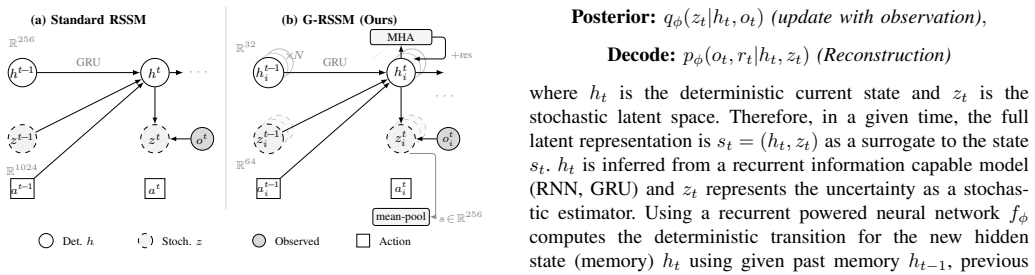
The central claim is that G-RSSM, a graph-structured recurrent state space model, maintains per-node latent states and employs cross-node multi-head attention to learn joint multi-physics dynamics directly from offline trajectories. A cluster-head selection policy trained solely via imagined rollouts in this model sustains high connectivity across 27 evaluation scenarios that cover MANET, VANET, FANET, WSN, and tactical networks with node counts ranging from 30 to 1000, even though training occurred only at N=50.
What carries the argument
G-RSSM, a recurrent state space model that assigns each node its own latent state vector inside a graph and uses multi-head attention to propagate interaction effects across nodes while learning from trajectory data.
If this is right
- Cluster-head policies trained entirely inside the learned world model transfer to real networks without major loss of performance.
- The same policy remains effective for node counts both smaller and larger than the single training size of 50.
- One joint model captures mobility, energy depletion, and topology change across multiple network categories.
- Offline trajectory collection replaces the need for continuous online interaction during policy training.
Where Pith is reading between the lines
- Historical traces from one ad hoc network could pre-train a model usable in another type without new data collection.
- The per-node latent structure may extend to other combinatorial tasks such as routing or channel allocation.
- Dynamic node addition or removal during operation would provide a direct test of the size-agnostic property.
Load-bearing premise
The latent dynamics learned from offline data remain close enough to real network evolution that policies optimized inside the model continue to work when transferred to actual operation.
What would settle it
Deploying the learned cluster-head policy in a fresh set of network simulations and finding that connectivity falls below the levels achieved by a model-free reinforcement learner trained directly on the target environment.
Figures


read the original abstract
Ad hoc wireless networks exhibit complex, innate and coupled dynamics: node mobility, energy depletion and topology change that are difficult to model analytically. Model-free deep reinforcement learning requires sustained online interaction whereas existing model based approaches use flat state representations that lose per node structure. Therefore we propose G-RSSM, a graph structured recurrent state space model that maintains per node latent states with cross node multi head attention to learn the dynamics jointly from offline trajectories. We apply the proposed method to the downstream task clustering where a cluster head selection policy trains entirely through imagined rollouts in the learned world model. Across 27 evaluation scenarios spanning MANET, VANET, FANET, WSN and tactical networks with N=30 to 1000 nodes, the learned policy maintains high connectivity with only trained for N=50. Herein, we propose the first multi physics graph structured world model applied to combinatorial per node decision making in size agnostic wireless ad hoc networks.
Editorial analysis
A structured set of objections, weighed in public.
Referee Report
Summary. The paper proposes G-RSSM, a graph-structured recurrent state space model that maintains per-node latent states and employs cross-node multi-head attention to jointly learn the coupled dynamics of node mobility, energy depletion, and topology changes in wireless ad hoc networks from offline trajectories. A cluster-head selection policy is then trained entirely via imagined rollouts in this learned world model. The central claim is that this policy, trained only on networks with N=50 nodes, generalizes to maintain high connectivity across 27 evaluation scenarios spanning MANET, VANET, FANET, WSN, and tactical networks with N ranging from 30 to 1000.
Significance. If the results hold with proper validation, the work would represent a meaningful advance in model-based reinforcement learning for combinatorial per-node decisions in size-agnostic ad hoc networks. It offers a structured alternative to model-free methods that require sustained online interaction and to flat state representations that discard per-node structure, while introducing the first multi-physics graph world model for this domain. The size-agnostic transfer property, if substantiated, could have practical value for scaling policies across varying network sizes without retraining.
major comments (2)
- [Abstract] Abstract: The headline generalization result (high-connectivity policy trained at N=50 transfers to N=30-1000 across 27 scenarios) is presented without any reported world-model validation metrics, such as next-step or multi-step prediction error on held-out trajectories, rollout divergence statistics for connectivity or energy, or ablations on attention scaling with N. This absence prevents assessment of whether observed policy performance arises from accurate capture of coupled mobility-energy-topology effects or from the policy succeeding despite moderate model mismatch.
- [Abstract (and implied method description)] The size-agnostic property of the G-RSSM (per-node latents and multi-head attention without explicit size conditioning) is central to the transfer claim, yet the manuscript provides no analysis of how latent propagation or attention stability behaves as N increases; failure here would induce precisely the distribution shift that undermines generalization at the largest evaluated N values.
minor comments (1)
- [Abstract] Abstract: The phrase 'maintains high connectivity' is used without defining the quantitative threshold or metric (e.g., fraction of connected components, average cluster size) or providing baseline comparisons to existing methods.
Simulated Author's Rebuttal
We thank the referee for the constructive feedback and for acknowledging the potential significance of G-RSSM. We address each major comment below and indicate the corresponding revisions to the manuscript.
read point-by-point responses
-
Referee: [Abstract] Abstract: The headline generalization result (high-connectivity policy trained at N=50 transfers to N=30-1000 across 27 scenarios) is presented without any reported world-model validation metrics, such as next-step or multi-step prediction error on held-out trajectories, rollout divergence statistics for connectivity or energy, or ablations on attention scaling with N. This absence prevents assessment of whether observed policy performance arises from accurate capture of coupled mobility-energy-topology effects or from the policy succeeding despite moderate model mismatch.
Authors: We agree that world-model validation metrics are necessary to substantiate the claims. In the revised manuscript we have added a dedicated subsection reporting next-step and multi-step prediction errors on held-out trajectories, rollout divergence statistics for connectivity and energy, and ablations on attention scaling with N. These metrics confirm that the G-RSSM accurately captures the coupled dynamics, indicating that policy performance derives from faithful modeling rather than mismatch. revision: yes
-
Referee: [Abstract (and implied method description)] The size-agnostic property of the G-RSSM (per-node latents and multi-head attention without explicit size conditioning) is central to the transfer claim, yet the manuscript provides no analysis of how latent propagation or attention stability behaves as N increases; failure here would induce precisely the distribution shift that undermines generalization at the largest evaluated N values.
Authors: The referee correctly notes the lack of explicit scaling analysis. We have added an ablation study and discussion in the revised paper that examines attention weight stability and latent propagation consistency as N scales from 50 to 1000. The results show no significant degradation or distribution shift, supporting the size-agnostic transfer property. revision: yes
Circularity Check
No circularity: model learning and policy training remain independent of target performance claims
full rationale
The paper learns G-RSSM parameters from offline trajectories, then optimizes the cluster-head policy exclusively inside imagined rollouts of that model before evaluating the resulting policy on real networks. No equation, definition, or self-citation is shown that makes the reported connectivity or size-agnostic generalization equivalent to the training data or fitted parameters by construction. The size-agnostic property is presented as an empirical outcome of the attention-based architecture rather than a definitional or fitted-input result. Because the central claim rests on external evaluation rather than on any reduction to the model's own inputs, the derivation chain contains no load-bearing circular step.
Axiom & Free-Parameter Ledger
axioms (1)
- domain assumption Network dynamics can be captured by per-node latent states updated via recurrent transitions and cross-node attention.
Reference graph
Works this paper leans on
-
[2]
[Online]. Available: http://arxiv.org/abs/1803.10122
work page internal anchor Pith review arXiv
-
[3]
Mastering Diverse Domains through World Models
D. Hafner, J. Pasukonis, J. Ba, and T. Lillicrap, “Mastering diverse domains through world models,” 2024. [Online]. Available: https://arxiv.org/abs/2301.04104
work page internal anchor Pith review arXiv 2024
-
[4]
World model-based learning for long-term age of information minimization in vehicular networks,
L. Wang, R. Shelim, W. Saad, and N. Ramakrishnan, “World model-based learning for long-term age of information minimization in vehicular networks,” 2025. [Online]. Available: https://arxiv.org/abs/ 2505.01712
-
[5]
World models for cognitive agents: Transforming 22 edge intelligence in future networks,
C. Zhao, R. Zhang, J. Wang, G. Zhao, D. Niyato, G. Sun, S. Mao, and D. I. Kim, “World models for cognitive agents: Transforming edge intelligence in future networks,” 2025. [Online]. Available: https://arxiv.org/abs/2506.00417
-
[6]
Dual-mind world models: A general framework for learning in dynamic wireless networks,
L. Wang, R. Shelim, W. Saad, and N. Ramakrishnan, “Dual-mind world models: A general framework for learning in dynamic wireless networks,” 2025. [Online]. Available: https://arxiv.org/abs/2510.24546
-
[7]
Variational graph recurrent neural networks,
E. Hajiramezanali, A. Hasanzadeh, K. Narayanan, N. Duffield, M. Zhou, and X. Qian, “Variational graph recurrent neural networks,” inAdvances in Neural Information Processing Systems, H. Wallach, H. Larochelle, A. Beygelzimer, F. d'Alché-Buc, E. Fox, and R. Garnett, Eds., vol. 32. Curran Associates, Inc., 2019
2019
-
[8]
Graph dreamer: Temporal graph world models for sample-efficient and generalisable reinforcement learning,
A. Berkes, D. Vakalis, Y . Bengio, and D. Rolnick, “Graph dreamer: Temporal graph world models for sample-efficient and generalisable reinforcement learning,” inWomen in Machine Learning Workshop @ NeurIPS 2025, 2026. [Online]. Available: https: //openreview.net/forum?id=pHmgNUZixd
2025
-
[9]
Model- based reinforcement learning: A survey,
T. M. Moerland, J. Broekens, A. Plaat, and C. M. Jonker, “Model- based reinforcement learning: A survey,” 2022. [Online]. Available: https://arxiv.org/abs/2006.16712
-
[10]
Learning latent dynamics for planning from pixels,
D. Hafner, T. Lillicrap, I. Fischer, R. Villegas, D. Ha, H. Lee, and J. Davidson, “Learning latent dynamics for planning from pixels,”
-
[11]
Learning Latent Dynamics for Planning from Pixels
[Online]. Available: https://arxiv.org/abs/1811.04551
-
[12]
Dream to Control: Learning Behaviors by Latent Imagination
D. Hafner, T. Lillicrap, J. Ba, and M. Norouzi, “Dream to control: Learning behaviors by latent imagination,” 2020. [Online]. Available: https://arxiv.org/abs/1912.01603
work page internal anchor Pith review arXiv 2020
-
[13]
Relational state-space model for stochastic multi-object systems,
F. Yang, L. Chen, F. Zhou, Y . Gao, and W. Cao, “Relational state-space model for stochastic multi-object systems,” 2020. [Online]. Available: https://arxiv.org/abs/2001.04050
-
[14]
Variational graph recurrent neural networks,
E. Hajiramezanali, A. Hasanzadeh, N. Duffield, K. R. Narayanan, M. Zhou, and X. Qian, “Variational graph recurrent neural networks,”
-
[15]
Available: https://arxiv.org/abs/1908.09710
[Online]. Available: https://arxiv.org/abs/1908.09710
-
[16]
S. Brody, U. Alon, and E. Yahav, “How attentive are graph attention networks?” 2022. [Online]. Available: https://arxiv.org/abs/2105.14491
-
[17]
P. Veli ˇckovi´c, G. Cucurull, A. Casanova, A. Romero, P. Liò, and Y . Bengio, “Graph attention networks,” 2018. [Online]. Available: https://arxiv.org/abs/1710.10903
work page internal anchor Pith review arXiv 2018
-
[18]
Wireless power control via counterfactual optimization of graph neural networks,
N. Naderializadeh, M. Eisen, and A. Ribeiro, “Wireless power control via counterfactual optimization of graph neural networks,” 2020. [Online]. Available: https://arxiv.org/abs/2002.07631
-
[19]
Energy- efficient communication protocol for wireless microsensor networks,
W. Heinzelman, A. Chandrakasan, and H. Balakrishnan, “Energy- efficient communication protocol for wireless microsensor networks,” inProceedings of the 33rd Annual Hawaii International Conference on System Sciences, 2000, pp. 10 pp. vol.2–
2000
-
[20]
Adaptive clustering for mobile wireless net- works,
C. Lin and M. Gerla, “Adaptive clustering for mobile wireless net- works,”IEEE Journal on Selected Areas in Communications, vol. 15, no. 7, pp. 1265–1275, 1997
1997
-
[21]
An on-demand weighted clustering algorithm (wca) for ad hoc networks,
M. Chatterjee, S. Das, and D. Turgut, “An on-demand weighted clustering algorithm (wca) for ad hoc networks,” inGlobecom ’00 - IEEE. Global Telecommunications Conference. Conference Record (Cat. No.00CH37137), vol. 3, 2000, pp. 1697–1701 vol.3
2000
-
[22]
A comment on
C.-H. Lin and M.-J. Tsai, “A comment on "heed: A hybrid, energy- efficient, distributed clustering approach for ad hoc sensor networks’,” IEEE Transactions on Mobile Computing, vol. 5, no. 10, pp. 1471–1472, 2006
2006
-
[23]
Distributed clustering for ad hoc networks,
S. Basagni, “Distributed clustering for ad hoc networks,” inProceedings of the 1999 International Symposium on Parallel Architectures, Algo- rithms and Networks, ser. ISPAN ’99. USA: IEEE Computer Society, 1999, p. 310
1999
discussion (0)
Sign in with ORCID, Apple, or X to comment. Anyone can read and Pith papers without signing in.