Recognition: unknown
The Phase Transitions in a p spin Glass Model: A Numerical Study
Pith reviewed 2026-05-10 09:30 UTC · model grok-4.3
The pith
Numerical study of long-range p-spin glass finds direct transition to full replica symmetry breaking phase instead of one-step breaking.
A machine-rendered reading of the paper's core claim, the machinery that carries it, and where it could break.
Core claim
Our results indicate a direct transition from the paramagnetic state to a full replica symmetry broken phase, with a renormalized value of λ≡ω2/ω1 < 1 suggesting a continuous FRSB transition. For σ = 0.85, the results suggest that the Kauzmann temperature TK in three dimensions might be zero and the complete absence of phase transitions in structural glasses.
What carries the argument
The lambda parameter λ ≡ ω2/ω1 extracted from the spin-overlap distribution, which controls whether the transition is discontinuous one-step RSB (requires λ > 1) or continuous full RSB (λ < 1), along with finite-size scaling of the spin-glass susceptibility.
Load-bearing premise
The power-law interaction with sigma equal to 0.85 serves as a faithful proxy for three-dimensional short-range p-spin glass behavior, and that finite-size effects alone account for the missing 1RSB transition in the simulated sizes.
What would settle it
Finding lambda greater than 1 or clear evidence of a discontinuous 1RSB jump in the overlap distribution for sigma around 0.55 in significantly larger systems would contradict the claim of a direct continuous FRSB transition.
Figures




read the original abstract
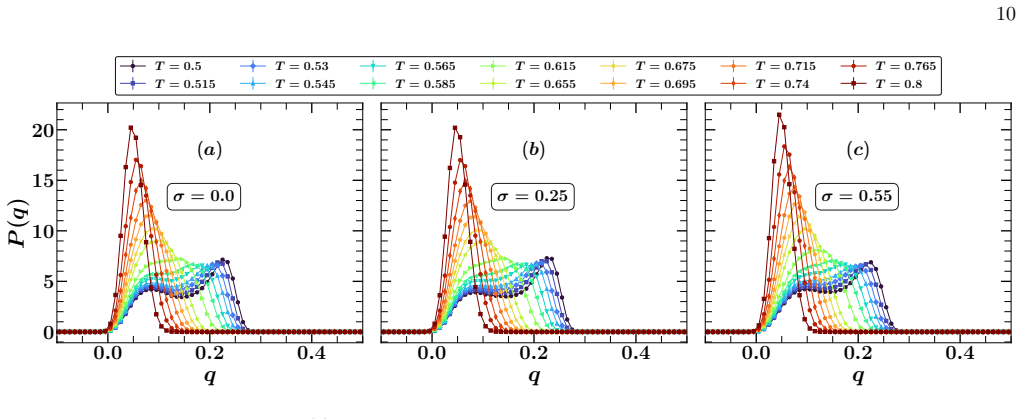
We investigate the balanced $M=4$, $p=4$ spin-glass model for a one-dimensional long-range proxy for the finite dimensional short-range $p$-spin glass model to examine the nature of the glass transition beyond mean-field theory. We perform large-scale Monte Carlo equilibrated simulations for both fully connected and power-law diluted versions of the model. The critical temperatures extracted from the finite-size scaling (FSS) analysis of spin-glass susceptibility are in good agreement with theoretical predictions for $\sigma = 0, 0.25$, and 0.55. For these values of the long-range exponent $\sigma$ (which is the power of the decrease of the interactions between the spins with their separation), one might have expected that mean-field theory would provide a good description of the system. However, the spin-overlap distribution and the value of the $\lambda$-parameter do not provide numerical evidence for a one-step replica symmetry breaking (1RSB) phase transition. Instead, our results indicate a direct transition from the paramagnetic state to a full replica symmetry broken phase, with a renormalized value of $\lambda\equiv \omega_2/\omega_1 < 1$ suggesting a continuous FRSB transition, despite this ratio being equal to 2 at mean-field level. A value of $\lambda > 1$ is required for the discontinuous 1RSB transition. We argue that strong finite-size effects and closely spaced transition temperatures remove the expected 1RSB transition for the system sizes which we can study. For values of the exponent $\sigma = 0.85$, which roughly corresponds to a three dimensional system, we find that the renormalized value of $\lambda$ is again less than 1, with no signs of either the 1RSB transition or the continuous FRSB transition, suggesting that the Kauzmann temperature $T_K$ in three dimensions might be zero and the complete absence of phase transitions in structural glasses.
Editorial analysis
A structured set of objections, weighed in public.
Referee Report
Summary. The manuscript reports large-scale Monte Carlo simulations of the balanced M=4, p=4 spin-glass model with long-range power-law interactions (parameterized by exponent sigma) as a proxy for finite-dimensional short-range p-spin glasses. Critical temperatures are extracted via finite-size scaling of the spin-glass susceptibility and found to agree with theoretical predictions for sigma=0, 0.25, and 0.55. The overlap distribution P(q) is featureless and the ratio lambda ≡ omega2/omega1 is reported <1, leading the authors to conclude a direct paramagnetic-to-full-RSB transition (with renormalized lambda suggesting continuous FRSB) rather than the expected 1RSB phase; this absence is attributed to strong finite-size effects and closely spaced transitions. For sigma=0.85 (proxy for 3D), no signatures of either transition are found, implying TK=0 and absence of phase transitions in structural glasses.
Significance. If the central claims hold, the work would numerically challenge the applicability of the mean-field 1RSB scenario even in regimes where mean-field theory is expected to be accurate, by showing that finite-size effects can suppress the 1RSB window and renormalize lambda below 1. The explicit agreement of extracted Tc values with independent theoretical predictions for multiple sigma values is a clear strength, as is the use of large-scale equilibrated simulations. The implications drawn for the Kauzmann temperature in three-dimensional glasses would be of broad interest if the proxy and finite-size arguments are placed on firmer quantitative footing.
major comments (3)
- [Discussion] Discussion section (argument on finite-size effects masking 1RSB): The reinterpretation that strong finite-size effects and closely spaced transition temperatures remove the expected 1RSB phase (requiring lambda>1 and discontinuous P(q)) for sigma=0, 0.25, 0.55 lacks quantitative support. No finite-size scaling plots, extrapolations in N, or derivation of the expected 1RSB temperature interval width from the mean-field free-energy functional are provided, even for the fully connected sigma=0 case where only 1/N corrections apply. This leaves the direct-FRSB claim unsupported by direct numerical evidence.
- [Results and Conclusions] Results for sigma=0.85 and conclusions: The claim of no phase transitions (and thus TK=0 in 3D) rests on the power-law model with sigma=0.85 as a faithful proxy for short-range 3D behavior together with featureless observables. Without quantified error bars on susceptibility or overlap data, explicit equilibration diagnostics (e.g., integrated autocorrelation times or multiple independent runs), or lower-temperature runs to rule out a transition below accessible scales, this strong implication for structural glasses is not yet load-bearing.
- [Results] Analysis of lambda parameter: The reported renormalized value lambda<1 (suggesting continuous FRSB) is central to the phase-diagram reinterpretation, yet the manuscript does not detail the precise extraction procedure for omega1 and omega2 from the simulated overlap distributions, nor does it provide statistical uncertainties or disorder-sample counts to establish that lambda is significantly below 1 rather than consistent with mean-field value 2 within errors.
minor comments (2)
- [Model and Methods] The notation for the lambda parameter (omega2/omega1) and its relation to the replicon eigenvalue should be defined explicitly in the main text or a dedicated methods subsection, as it is used to distinguish 1RSB from FRSB.
- [Figures] Figure captions for P(q) distributions should include the number of disorder realizations, system sizes shown, and temperature values to allow direct assessment of the claimed featurelessness.
Simulated Author's Rebuttal
We thank the referee for the careful reading and constructive comments on our manuscript. We address each major comment point by point below, with plans for revisions where appropriate to strengthen the presentation without altering the core findings.
read point-by-point responses
-
Referee: Discussion section (argument on finite-size effects masking 1RSB): The reinterpretation that strong finite-size effects and closely spaced transition temperatures remove the expected 1RSB phase for sigma=0, 0.25, 0.55 lacks quantitative support. No finite-size scaling plots, extrapolations in N, or derivation of the expected 1RSB temperature interval width from the mean-field free-energy functional are provided, even for the fully connected sigma=0 case. This leaves the direct-FRSB claim unsupported by direct numerical evidence.
Authors: We agree that the finite-size effects argument would benefit from more quantitative backing. In the revised manuscript we will add finite-size scaling plots of P(q) and lambda versus N for sigma=0 (where 1/N corrections are the only corrections), together with an explicit estimate of the mean-field 1RSB temperature window derived from the free-energy functional to demonstrate that the two transitions are closely spaced for the sizes we can equilibrate. For the power-law cases the evidence remains the observed featureless P(q) and lambda<1 across the accessible range; we will clarify that full extrapolation is computationally prohibitive but that the trend is consistent with masking of the 1RSB window. revision: yes
-
Referee: Results for sigma=0.85 and conclusions: The claim of no phase transitions (and thus TK=0 in 3D) rests on the power-law model with sigma=0.85 as a faithful proxy for short-range 3D behavior together with featureless observables. Without quantified error bars on susceptibility or overlap data, explicit equilibration diagnostics, or lower-temperature runs to rule out a transition below accessible scales, this strong implication for structural glasses is not yet load-bearing.
Authors: We accept that the presentation for sigma=0.85 requires additional rigor. The revised version will include error bars on all susceptibility and P(q) data, report integrated autocorrelation times and results from multiple independent runs to document equilibration, and explicitly state the lowest temperatures reached. We will moderate the language to present the absence of signatures as an indication (rather than a definitive proof) that TK=0 in the 3D-like regime, while retaining the proxy argument and the supporting Tc agreement found for smaller sigma. Additional lower-temperature runs are not feasible with current resources, but the existing data will be documented more transparently. revision: partial
-
Referee: Analysis of lambda parameter: The reported renormalized value lambda<1 is central to the phase-diagram reinterpretation, yet the manuscript does not detail the precise extraction procedure for omega1 and omega2 from the simulated overlap distributions, nor does it provide statistical uncertainties or disorder-sample counts to establish that lambda is significantly below 1 rather than consistent with mean-field value 2 within errors.
Authors: We will add a dedicated subsection describing the exact procedure used to extract omega1 and omega2 (via moments of the overlap distribution and the fitting protocol). We will also state the number of disorder realizations (several hundred per parameter set) and include statistical uncertainties on lambda, confirming that the reported values lie significantly below 1. These additions will be placed in both the methods and results sections. revision: yes
Circularity Check
Numerical results extracted from Monte Carlo simulations and compared to independent theoretical predictions
full rationale
The paper reports direct Monte Carlo measurements of the spin-glass susceptibility, finite-size scaling to obtain critical temperatures, the overlap distribution P(q), and the ratio λ ≡ ω2/ω1. These quantities are computed from equilibrated configurations and compared against pre-existing mean-field theoretical values for Tc at given σ; the interpretation of a direct paramagnetic-to-FRSB transition follows from the observed featureless P(q) and λ < 1 together with an auxiliary argument about finite-size effects. No step reduces a claimed result to a parameter fitted from the same data by construction, nor does any load-bearing premise collapse to a self-citation whose validity is assumed rather than independently verified. The derivation chain therefore remains self-contained against external benchmarks.
Axiom & Free-Parameter Ledger
axioms (1)
- domain assumption The balanced M=4 p=4 long-range model with tunable sigma is a valid proxy for the finite-dimensional short-range p-spin glass
Reference graph
Works this paper leans on
-
[1]
M. A. Moore and B. Drossel,p-Spin Model in Finite Di- mensions and Its Relation to Structural Glasses, Phys. Rev. Lett.89, 217202 (2002)
2002
-
[2]
Cannella and J
V. Cannella and J. A. Mydosh, Magnetic Ordering in Gold-Iron Alloys, Phys. Rev. B6, 4220 (1972)
1972
-
[3]
Parisi, Order Parameter for Spin-Glasses, Phys
G. Parisi, Order Parameter for Spin-Glasses, Phys. Rev. Lett.50, 1946 (1983)
1946
-
[4]
Parisi, Infinite Number of Order Parameters for Spin- Glasses, Phys
G. Parisi, Infinite Number of Order Parameters for Spin- Glasses, Phys. Rev. Lett.43, 1754 (1979)
1979
-
[5]
Sherrington and S
D. Sherrington and S. Kirkpatrick, Solvable Model of a Spin-Glass, Phys. Rev. Lett.35, 1792 (1975)
1975
-
[6]
S. F. Edwards and P. W. Anderson, Theory of spin glasses, Journal of Physics F: Metal Physics5, 965 (1975)
1975
-
[7]
Changjun Fan and Mutian Shen and Zohar Nussinov and Zhong Liu and Yizhou Sun and Yang-Yu Liu, Searching for spin glass ground states through deep reinforcement learning, Nature Communications14, 725 (2023)
2023
-
[8]
M. M. Rams, M. Mohseni, D. Eppens, K. Ja lowiecki, and B. Gardas, Approximate optimization, sampling, and spin-glass droplet discovery with tensor networks, Phys. Rev. E104, 025308 (2021)
2021
-
[9]
Takahashi and K
T. Takahashi and K. Hukushima, Evidence of a one-step replica symmetry breaking in a three-dimensional Potts glass model, Phys. Rev. E91, 020102 (2015)
2015
-
[10]
Sharma, J
A. Sharma, J. Yeo, and M. A. Moore, Metastable minima of the Heisenberg spin glass in a random magnetic field., Physical review. E94 5-1, 052143 (2016)
2016
-
[11]
G¨ otze, Some aspects of phase transitions described by the self consistent current relaxation theory, Zeitschrift f¨ ur Physik B Condensed Matter56, 139 (1984)
W. G¨ otze, Some aspects of phase transitions described by the self consistent current relaxation theory, Zeitschrift f¨ ur Physik B Condensed Matter56, 139 (1984)
1984
-
[12]
Gotze and L
W. Gotze and L. Sjogren, Relaxation processes in super- cooled liquids, Reports on Progress in Physics55, 241 (1992)
1992
-
[13]
Bouchaud, L
J.-P. Bouchaud, L. Cugliandolo, J. Kurchan, and M. M´ ezard, Mode-coupling approximations, glass theory and disordered systems, Physica A: Statistical Mechanics and its Applications226, 243 (1996)
1996
-
[14]
Kauzmann, The Nature of the Glassy State and the Behavior of Liquids at Low Temperatures., Chemical Re- views43, 219 (1948)
W. Kauzmann, The Nature of the Glassy State and the Behavior of Liquids at Low Temperatures., Chemical Re- views43, 219 (1948)
1948
-
[15]
Brangian, W
C. Brangian, W. Kob, and K. Binder, Statics and dy- namics of the ten-state mean-field Potts glass model: a Monte Carlo study, Journal of Physics A: Mathematical and General35, 191 (2002)
2002
-
[16]
T. R. Kirkpatrick, D. Thirumalai, and P. G. Wolynes, Scaling concepts for the dynamics of viscous liquids near an ideal glassy state, Phys. Rev. A40, 1045 (1989)
1989
-
[17]
Berthier, P
L. Berthier, P. Charbonneau, A. Ninarello, M. Ozawa, and S. Yaida, Zero-Temperature Glass Transition in Two Dimensions, Nature Communications10, 1508 (2019)
2019
- [18]
-
[19]
Gardner, Spin glasses with p-spin interactions, Nu- clear Physics B257, 747 (1985)
E. Gardner, Spin glasses with p-spin interactions, Nu- clear Physics B257, 747 (1985)
1985
-
[20]
D. J. Gross, I. Kanter, and H. Sompolinsky, Mean-Field Theory of the Potts Glass, Phys. Rev. Lett.55, 304 (1985)
1985
-
[21]
Berthier, G
L. Berthier, G. Biroli, P. Charbonneau, E. I. Corwin, S. Franz, and F. Zamponi, Gardner Physics in Amor- phous Solids and Beyond, The Journal of Chemical Physics151, 010901 (2019)
2019
-
[22]
Kotliar, P
G. Kotliar, P. W. Anderson, and D. L. Stein, One- dimensional spin-glass model with long-range random in- teractions, Phys. Rev. B27, 602 (1983)
1983
-
[23]
Larson, H
D. Larson, H. G. Katzgraber, M. A. Moore, and A. P. Young, Numerical studies of a one-dimensional three-spin spin-glass model with long-range interactions, Phys. Rev. B81, 064415 (2010)
2010
-
[24]
Leuzzi, G
L. Leuzzi, G. Parisi, F. Ricci-Tersenghi, and J. J. Ruiz- Lorenzo, Ising Spin-Glass Transition in a Magnetic Field Outside the Limit of Validity of Mean-Field Theory, Phys. Rev. Lett.103, 267201 (2009)
2009
-
[25]
R. A. Ba˜ nos, L. A. Fernandez, V. Martin-Mayor, and A. P. Young, Correspondence between long-range and short-range spin glasses, Phys. Rev. B86, 134416 (2012)
2012
-
[26]
Wittmann and A
M. Wittmann and A. P. Young, Spin glasses in the nonex- tensive regime, Phys. Rev. E85, 041104 (2012)
2012
-
[27]
Campellone, B
M. Campellone, B. Coluzzi, and G. Parisi, Numerical study of a short-rangep-spin glass model in three di- mensions, Phys. Rev. B58, 12081 (1998)
1998
-
[28]
Alvarez, S
D. Alvarez, S. Franz, and F. Ritort, Fragile-glass behavior 21 of a short-range p-spin model, Phys. Rev. B54, 9756 (1996)
1996
-
[29]
Marinari, C
E. Marinari, C. Naitza, F. Zuliani, G. Parisi, M. Picco, and F. Ritort, General method to determine replica sym- metry breaking transitions, Phys. Rev. Lett.81, 1698 (1998)
1998
-
[30]
Campellone, G
M. Campellone, G. Parisi, and P. Ranieri, Finite- dimensional corrections to the mean field in a short-range p-spin glassy model, Phys. Rev. B59, 1036 (1999)
1999
-
[31]
M. A. Moore and J. Yeo, Thermodynamic Glass Transi- tion in Finite Dimensions, Phys. Rev. Lett.96, 095701 (2006)
2006
-
[32]
Parisi, M
G. Parisi, M. Picco, and F. Ritort, Continuous phase transition in a spin-glass model without time-reversal symmetry, Phys. Rev. E60, 58 (1999)
1999
-
[33]
M. A. Moore, Interface Free Energies inp-Spin Glass Models, Phys. Rev. Lett.96, 137202 (2006)
2006
-
[34]
Brangian, W
C. Brangian, W. Kob, and K. Binder, Statics and dynam- ics of the ten-state nearest-neighbour Potts glass on the simple-cubic lattice, Journal of Physics A: Mathematical and General36, 10847 (2003)
2003
-
[35]
Brangian, W
C. Brangian, W. Kob, and K. Binder, Evidence against a glass transition in the 10-state short-range Potts glass, Europhysics Letters59, 546 (2002)
2002
-
[36]
L. W. Lee, H. G. Katzgraber, and A. P. Young, Critical behavior of the three- and ten-state short-range Potts glass: A Monte Carlo study, Phys. Rev. B74, 104416 (2006)
2006
-
[37]
Alvarez Ba˜ nos, A
R. Alvarez Ba˜ nos, A. Cruz, L. A. Fernandez, A. Gordillo- Guerrero, J. M. Gil-Narvion, M. Guidetti, A. Maio- rano, F. Mantovani, E. Marinari, V. Martin-Mayor, J. Monforte-Garcia, A. Mu˜ noz Sudupe, D. Navarro, G. Parisi, S. Perez-Gaviro, J. J. Ruiz-Lorenzo, B. Seoane, S. F. Schifano, A. Tarancon, R. Tripiccione, and D. Yl- lanes, Critical behavior of thr...
2010
-
[38]
Billoire, L
A. Billoire, L. Giomi, and E. Marinari, The mean-field infinite range p = 3 spin glass: Equilibrium landscape and correlation time scales, Europhysics Letters71, 824 (2005)
2005
-
[39]
H. Rieger, Search for a spin glass phase in finite- dimensional spin models with random multisite interac- tions, Physica A: Statistical Mechanics and its Applica- tions184, 279 (1992)
1992
-
[40]
Yeo and M
J. Yeo and M. A. Moore, Renormalization group analysis of theM-p-spin glass model withp= 3 andM= 3, Phys. Rev. B85, 100405 (2012)
2012
-
[41]
Caltagirone, U
F. Caltagirone, U. Ferrari, L. Leuzzi, G. Parisi, and T. Rizzo, IsingM-p-spin mean-field model for the struc- tural glass: Continuous versus discontinuous transition, Phys. Rev. B83, 104202 (2011)
2011
-
[42]
Yeo and M
J. Yeo and M. A. Moore, Origin of the growing length scale inM-p-spin glass models, Phys. Rev. E86, 052501 (2012)
2012
-
[43]
Yeo and M
J. Yeo and M. A. Moore, Replica symmetry broken states of some glass models, Phys. Rev. E108, 054134 (2023)
2023
-
[44]
Rizzo, Replica-symmetry-breaking transitions and off- equilibrium dynamics, Phys
T. Rizzo, Replica-symmetry-breaking transitions and off- equilibrium dynamics, Phys. Rev. E88, 032135 (2013)
2013
-
[45]
H. G. Katzgraber, D. Larson, and A. P. Young, Study of the de Almeida–Thouless Line Using Power-Law Di- luted One-Dimensional Ising Spin Glasses, Phys. Rev. Lett.102, 177205 (2009)
2009
-
[46]
Viana and A
L. Viana and A. J. Bray, Phase diagrams for dilute spin glasses, Journal of Physics C: Solid State Physics18, 3037 (1985)
1985
-
[47]
T. Mori, Instability of the mean-field states and general- ization of phase separation in long-range interacting sys- tems, Physical Review E84, 10.1103/physreve.84.031128 (2011)
-
[48]
Parisi and T
G. Parisi and T. Rizzo, Critical dynamics in glassy sys- tems, Phys. Rev. E87, 012101 (2013)
2013
-
[49]
Franz and G
S. Franz and G. Parisi, Critical properties of a three- dimensional p-spin model, The European Physical Jour- nal B - Condensed Matter and Complex Systems8, 417 (1999)
1999
-
[50]
Vedula, M
B. Vedula, M. A. Moore, and A. Sharma, Evidence that the de Almeida–Thouless transition disappears below six dimensions, Phys. Rev. E110, 054131 (2024)
2024
-
[51]
Vedula, M
B. Vedula, M. A. Moore, and A. Sharma, Erratum: Ev- idence that the de Almeida–Thouless transition disap- pears below six dimensions [Phys. Rev. E 110, 054131 (2024)], Phys. Rev. E111, 019902 (2025)
2024
-
[52]
J. H. Pixley and A. P. Young, Large-scale Monte Carlo simulations of the three-dimensionalXYspin glass, Phys. Rev. B78, 014419 (2008)
2008
-
[53]
H. G. Katzgraber, M. Palassini, and A. P. Young, Monte Carlo simulations of spin glasses at low temperatures, Phys. Rev. B63, 184422 (2001)
2001
-
[54]
K. Hukushima and K. Nemoto, Exchange Monte Carlo Method and Application to Spin Glass Simulations, Jour- nal of the Physical Society of Japan65, 1604 (1996), https://doi.org/10.1143/JPSJ.65.1604
-
[55]
K. Hukushima, H. Takayama, and H. Yoshino, Ex- change Monte Carlo Dynamics in the SK Model, Jour- nal of the Physical Society of Japan67, 12 (1998), https://doi.org/10.1143/JPSJ.67.12
-
[56]
A. J. Bray and M. A. Moore, Metastable states in spin glasses, Journal of Physics C: Solid State Physics13, L469 (1980)
1980
-
[57]
A. J. Bray and M. A. Moore, Replica symmetry and massless modes in the Ising spin glass, Journal of Physics C: Solid State Physics12, 79 (1979)
1979
-
[58]
H. G. Katzgraber and A. P. Young, Probing the Almeida- Thouless line away from the mean-field model, Phys. Rev. B72, 184416 (2005)
2005
-
[59]
Vedula, M
B. Vedula, M. A. Moore, and A. Sharma, Study of the de Almeida–Thouless line in the one-dimensional diluted power-lawXYspin glass, Phys. Rev. E108, 014116 (2023)
2023
-
[60]
Aspelmeier, H
T. Aspelmeier, H. G. Katzgraber, D. Larson, M. A. Moore, M. Wittmann, and J. Yeo, Finite-size critical scal- ing in Ising spin glasses in the mean-field regime, Phys. Rev. E93, 032123 (2016)
2016
-
[61]
Hasenbusch, A
M. Hasenbusch, A. Pelissetto, and E. Vicari, Critical be- havior of three-dimensional Ising spin glass models, Phys. Rev. B78, 214205 (2008)
2008
-
[62]
Binder, M
K. Binder, M. Nauenberg, V. Privman, and A. P. Young, Finite-size tests of hyperscaling, Phys. Rev. B31, 1498 (1985)
1985
-
[63]
W.J., Finite-size scaling above the upper critical dimension revisited: the case of the five-dimensional Ising model, Eur
Luijten, E., Binder, K., and Bl¨ ote, H. W.J., Finite-size scaling above the upper critical dimension revisited: the case of the five-dimensional Ising model, Eur. Phys. J. B 9, 289 (1999)
1999
-
[64]
J. L. Jones and A. P. Young, Finite-size scaling of the cor- relation length above the upper critical dimension in the five-dimensional Ising model, Phys. Rev. B71, 174438 (2005). 22
2005
-
[65]
Caltagirone, U
F. Caltagirone, U. Ferrari, L. Leuzzi, G. Parisi, F. Ricci- Tersenghi, and T. Rizzo, Critical Slowing Down Expo- nents of Mode Coupling Theory, Phys. Rev. Lett.108, 085702 (2012)
2012
-
[66]
Aguilar-Janita, V
M. Aguilar-Janita, V. Martin-Mayor, J. Moreno-Gordo, and J. J. Ruiz-Lorenzo, Evidence of a second-order phase transition in the six-dimensional Ising spin glass in a field, Phys. Rev. E109, 055302 (2024)
2024
-
[67]
L. A. Fernandez, I. Gonzalez-Adalid Pemartin, V. Martin-Mayor, G. Parisi, F. Ricci-Tersenghi, T. Rizzo, J. J. Ruiz-Lorenzo, and M. Veca, Numerical test of the replica-symmetric Hamiltonian for correla- tions of the critical state of spin glasses in a field, Phys. Rev. E105, 054106 (2022)
2022
-
[68]
H¨ oller and N
J. H¨ oller and N. Read, One-step replica-symmetry- breaking phase below the de Almeida–Thouless line in low-dimensional spin glasses, Phys. Rev. E101, 042114 (2020)
2020
discussion (0)
Sign in with ORCID, Apple, or X to comment. Anyone can read and Pith papers without signing in.