Host-guest co-amorphous structure revealed by the suppression of the first sharp diffraction peak in isotactic poly(4-methyl-1-pentene)
Pith reviewed 2026-05-10 07:58 UTC · model grok-4.3
The pith
Immersion in decane suppresses the first sharp diffraction peak in stretched P4MP1 by filling the polymer's internal voids, forming a host-guest co-amorphous structure at ambient conditions.
A machine-rendered reading of the paper's core claim, the machinery that carries it, and where it could break.
Core claim
Stretched samples of P4MP1 exhibit clear suppression of the amorphous FSDP when immersed in decane. This suppression occurs because decane molecules occupy the internal voids that produce the FSDP, creating a host-guest co-amorphous arrangement at room temperature and atmospheric pressure. The effect parallels the FSDP behavior seen under pressure with helium and the intensity changes in Bragg peaks of crystalline host-guest systems.
What carries the argument
The first sharp diffraction peak (FSDP), whose intensity drops when guest molecules fill the host polymer's pre-existing internal voids.
If this is right
- The co-amorphous structure permits selective sorption and guest exchange, similar to known co-crystals.
- Polymers that form such void-based hosts become candidates for liquid-phase molecular sieves.
- Changes in FSDP intensity ratios can serve as a diffraction signature comparable to Bragg peak ratio shifts in crystalline host-guest compounds.
- The approach works at ambient pressure and temperature, removing the need for high-pressure media to observe void occupation.
Where Pith is reading between the lines
- The same void-filling mechanism could be tested in other semicrystalline polymers that display a clear FSDP.
- Guest exchange experiments might reveal whether the structure supports reversible molecular sieving in solution.
- The parallel with helium-pressurized SiO2 glass suggests that FSDP suppression is a general indicator of void occupation across both polymeric and inorganic amorphous hosts.
Load-bearing premise
That the FSDP suppression is caused specifically by decane molecules occupying internal voids rather than by surface effects, conformational shifts, or unrelated interactions.
What would settle it
Direct measurement of decane density inside the polymer or an experiment in which decane cannot reach the voids but still produces no FSDP change.
Figures

read the original abstract
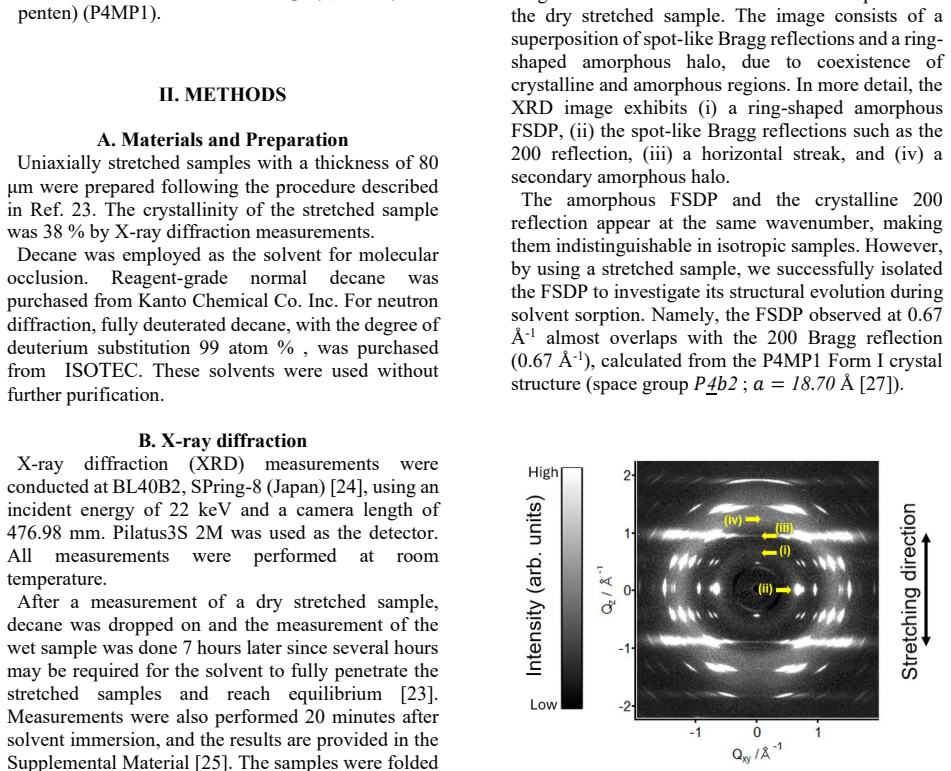
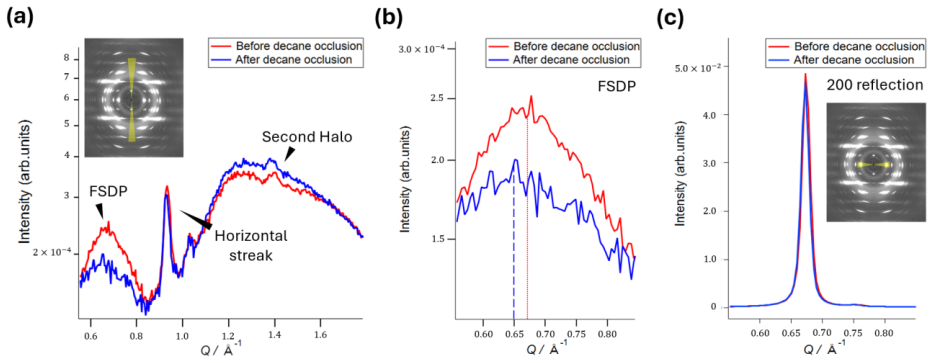
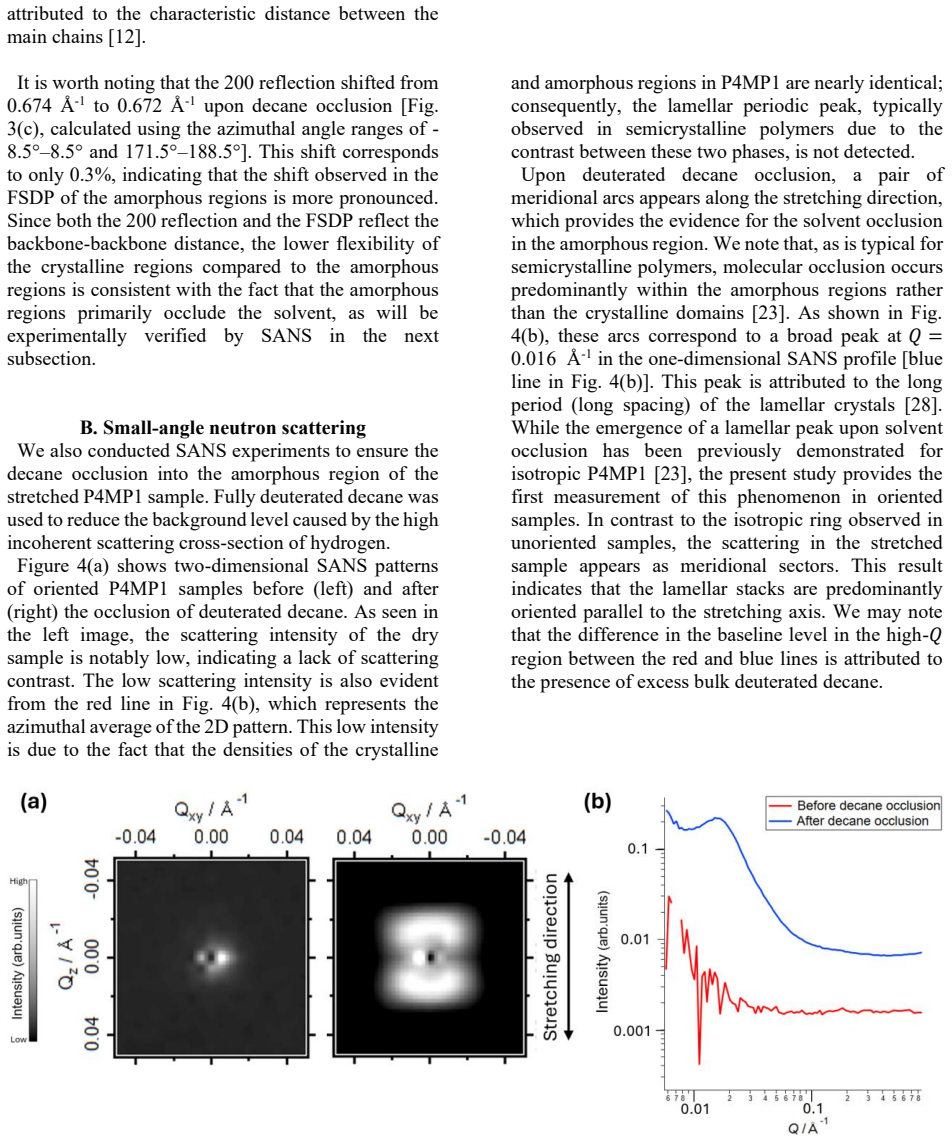
While host-guest co-crystals are well established, and co-amorphous solids are recognized in materials science, the concept of a host-guest co-amorphous structure remains largely unexplored. A potential analogue is seen in SiO2 glass under high pressure with helium as a pressure medium; the drop in compressibility in this system is ascribed to helium atoms occupying internal voids. In this study, we investigated a semicrystalline polymer, isotactic poly(4-methyl-pentene-1) (P4MP1), which shares key characteristics with SiO2 glass, particularly regarding the first sharp diffraction peak (FSDP). The FSDP in P4MP1 is attributed to internal voids, as evidenced by its suppression under pressure and recovery upon decompression for molten P4MP1. Notably, the response to helium as a pressure medium is also known to parallel the behavior observed in SiO2 glass. Here, we analyzed two-dimensional X-ray diffraction (2D-XRD) patterns of stretched P4MP1 and found a suppression of FSDP when P4MP1 is immersed in decane. The use of stretched samples enabled the clear isolation of the amorphous FSDP from overlapping crystalline diffractions. Our findings reveal the existence of a host-guest co-amorphous system at room temperature and atmospheric pressure, in which decane molecules occupy the amorphous host matrix of P4MP1. Unlike conventional co-amorphous mixtures, this structure is defined by the specific accommodation of guests within the host's inherent voids. Intriguingly, the signature of this structure in diffraction measurements, manifested as changes in the FSDP intensity ratio, may be regarded to parallel the variations in Bragg peak intensity ratios in host-guest co-crystals. Since selective sorption and guest exchange are well-known in co-crystals, hosts capable of forming co-amorphous structures will be promising materials for molecular sieves, or more generally, liquid-phase molecular sieves.
Editorial analysis
A structured set of objections, weighed in public.
Referee Report
Summary. The manuscript reports 2D-XRD measurements on stretched isotactic poly(4-methyl-1-pentene) (P4MP1) showing suppression of the amorphous first sharp diffraction peak (FSDP) upon immersion in decane at ambient conditions. By analogy to pressure-induced FSDP changes in molten P4MP1 and SiO2 glass (with helium), the authors interpret the intensity drop as direct evidence that decane molecules occupy the internal voids of the amorphous P4MP1 host matrix, thereby establishing a host-guest co-amorphous structure distinct from conventional co-amorphous mixtures. The stretching protocol is used to isolate the amorphous FSDP from crystalline peaks, and the FSDP intensity ratio change is proposed to parallel Bragg-peak ratio variations in host-guest co-crystals, with suggested applications to liquid-phase molecular sieves.
Significance. If the void-occupation interpretation is substantiated, the work would introduce a new conceptual category of host-guest co-amorphous solids at room temperature and atmospheric pressure, extending crystalline host-guest chemistry into the amorphous regime with potential for selective sorption. The experimental isolation of the amorphous FSDP via stretching is a useful technical step, and the explicit parallel to co-crystal diffraction signatures is a clear framing device. The result would be strengthened by quantitative metrics and controls that directly test the proposed mechanism against generic solvent-polymer interactions.
major comments (2)
- [Abstract and results section] Abstract and results section: The central claim that FSDP suppression demonstrates decane occupation of the host's native internal voids (rather than surface adsorption, swelling-induced conformational relaxation of isotactic helices, or non-specific packing changes) is not supported by any referenced control experiments such as reversibility after solvent removal, comparison with non-penetrating solvents of similar size, or sorption isotherms. The pressure/helium analogies cited for molten P4MP1 do not automatically transfer to ambient liquid immersion, leaving the mechanistic link load-bearing but untested.
- [Results section on 2D-XRD patterns] Results section on 2D-XRD patterns: The reported FSDP suppression is described qualitatively without accompanying quantitative intensity ratios (pre- vs. post-immersion), error bars, or statistical measures of reproducibility across samples. This makes it difficult to evaluate the magnitude of the effect or to compare it rigorously with the pressure-response data invoked for the SiO2-glass analogy.
minor comments (1)
- [Introduction or discussion] The manuscript would benefit from a brief explicit statement of the void-size scale reported for P4MP1 and the molecular dimensions of decane to allow readers to assess steric compatibility.
Simulated Author's Rebuttal
We thank the referee for the constructive and detailed comments, which help clarify the interpretive limits of our observations. We respond point by point below, indicating where revisions will be made to the manuscript.
read point-by-point responses
-
Referee: [Abstract and results section] Abstract and results section: The central claim that FSDP suppression demonstrates decane occupation of the host's native internal voids (rather than surface adsorption, swelling-induced conformational relaxation of isotactic helices, or non-specific packing changes) is not supported by any referenced control experiments such as reversibility after solvent removal, comparison with non-penetrating solvents of similar size, or sorption isotherms. The pressure/helium analogies cited for molten P4MP1 do not automatically transfer to ambient liquid immersion, leaving the mechanistic link load-bearing but untested.
Authors: We agree that the mechanistic interpretation would be strengthened by direct controls. Our claim rests on the documented analogy between FSDP suppression in molten P4MP1 under pressure (and in SiO2 glass with helium) and the observed intensity drop upon decane immersion, together with the use of stretched samples to isolate the amorphous signal. We acknowledge that this analogy does not automatically extend to room-temperature liquid immersion and that alternatives such as swelling or surface effects cannot be ruled out without additional data. In the revised manuscript we will expand the discussion to explicitly address these alternatives, state the interpretive nature of the analogy, and note that the suggested controls (reversibility, non-penetrating solvent comparisons, sorption isotherms) lie outside the present experimental scope. revision: partial
-
Referee: [Results section on 2D-XRD patterns] Results section on 2D-XRD patterns: The reported FSDP suppression is described qualitatively without accompanying quantitative intensity ratios (pre- vs. post-immersion), error bars, or statistical measures of reproducibility across samples. This makes it difficult to evaluate the magnitude of the effect or to compare it rigorously with the pressure-response data invoked for the SiO2-glass analogy.
Authors: We accept this criticism. The original text emphasized the qualitative observation to establish the phenomenon. In the revised version we will report the quantitative FSDP intensity ratios before and after immersion, together with error bars and reproducibility statistics obtained from multiple independent samples. These numbers will be placed in the results section and used to enable a direct numerical comparison with the pressure-response data cited for molten P4MP1 and SiO2 glass. revision: yes
- Direct experimental controls (reversibility after solvent removal, comparison with non-penetrating solvents of similar size, and sorption isotherms) were not performed and cannot be added without new measurements outside the scope of the current study.
Circularity Check
No circularity: claim rests on independent experimental observation plus external prior evidence
full rationale
The paper's derivation proceeds from direct 2D-XRD data on stretched P4MP1 showing FSDP suppression upon decane immersion, interpreted by analogy to previously reported pressure and helium effects on the same polymer and on SiO2 glass. No equations, fitted parameters, or predictions are introduced that reduce to the input data by construction. The void-FSDP attribution is presented as supported by cited external measurements rather than self-definition or a load-bearing self-citation chain. The host-guest conclusion is an interpretive inference, not a renaming or smuggling of an ansatz. The chain is therefore self-contained against external benchmarks.
Axiom & Free-Parameter Ledger
axioms (1)
- domain assumption The first sharp diffraction peak (FSDP) in P4MP1 arises from internal voids in the amorphous structure.
invented entities (1)
-
host-guest co-amorphous structure
no independent evidence
Reference graph
Works this paper leans on
-
[1]
T. Sato, N. Funamori, and T. Yagi, Nat. Commun. 2, 345 (2011)
work page 2011
-
[2]
G. Shen, Q. Mei, V. B. Prakapenta, P. Lazor, S. Sinogeikin, Y. Meng, and C. Park, Proc. Natl. Acad. Sci. U.S.A. 2, 345 (2011)
work page 2011
-
[3]
This phenomenon is seen in hosts with rigid frameworks, such as metal-organic frameworks (MOFs)
The ability of a host structure to maintain its crystalline form upon guest desorption is known as permanent porosity. This phenomenon is seen in hosts with rigid frameworks, such as metal-organic frameworks (MOFs). In the case of polymer hosts, the crystalline structure known as the δ e form in syndiotactic polystyrene (sPS) corresponds to this type of s...
work page 1997
-
[4]
D. L. Price, S. C. Moss, R. Reijers, M-L. Saboungi, and S. Susman, J. Phys. C: Solid State Phys. 21, L1069 (1988)
work page 1988
-
[5]
S. R. Elliott, Nature 354, 445 (1991)
work page 1991
-
[6]
S. R. Elliott, J. Phys.: Condens. Matter. 4, 7661 (1992)
work page 1992
-
[7]
S. R. Elliott, Phys. Rev. Lett. 67, 711 (1991)
work page 1991
-
[8]
Although the voids are not mentioned, the concept of density fluctuation may be seen in the figure in W. H. Zachariasen, J. Am. Chem. Soc. 54, 3841 (1932)
work page 1932
- [9]
- [10]
- [11]
- [12]
-
[13]
J. R. Katz, Trans. Faraday Soc. 32, 77 (1936)
work page 1936
-
[14]
R. L. Miller, R. F. Boyer, and J. Heijboer, J. Polym . Sci. Pol. Phys. 22, 2021 (1984)
work page 2021
-
[15]
A. Arbe, A. -C. Fenix, J. Colmenero, D. Richter, and P. Fouquet, Soft Matter 4, 1792 (2008)
work page 2008
-
[16]
L. C. Lopez, G. L. Wilkes, P. M. Stricklen, and S. A. White, J. Macromol. Sci. Part C Polym. Rev. 32, 301 (1992)
work page 1992
-
[17]
G. Tu, H. Zheng, J. Yang, H. Zhou, C. Feng, and H. Gao, Int. J. Mol. Sci. 26 , 600 (2025)
work page 2025
-
[18]
C. E. Wilkes, and M. H. Lehr, J. Macromol. Sci. -Phys. B7, 225 (1973). *Contact author: ayano@phys.keio.ac.jp
work page 1973
- [19]
-
[20]
J. H. Griffith and B. G. Rånby, J. Polym. Sci. 44, 369 (1960)
work page 1960
-
[21]
A. C. Puleo, D. R. Paul, and P. K. Wong, Polymer 30, 1357 (1989)
work page 1989
- [22]
-
[23]
H. Murashige, Y. Hiejima, Y. Sanada, and A. Chiba, Macromol. Symp. 408, 2200090 (2023)
work page 2023
- [24]
-
[25]
See Supplemental Material at [URL] for a comparison of the two-dimensional diffraction patterns of oriented P4MP1 in the FSDP region before and after solvent occlusion. The patterns for the dry sample, as well as those recorded 20 minutes and 7 hours afte r immersion in the solvent, are shown
- [26]
-
[27]
H. Kusanagi, M. Takase, Y. Chatani, and H. Tadokoro, J. Polym. Sci. Pol. Phys. 16, 131 (1978)
work page 1978
-
[28]
K. Mita, H. Okumura, K. Kimura, T. Isaki, M. Takenaka, and T. Kanaya, Polym. J. 45, 79 (2013)
work page 2013
-
[29]
A. Chiba, A. Oshima, and R. Akiyama, Langmuir 35, 17177 (2019). Supplemental Material for “Host-guest co-amorphous structure revealed by the suppression of the first sharp diffraction peak in isotactic poly(4-methyl-1-pentene)” Tomoki Ogihara,1 Yusuke Hiejima,2 and Ayano Chiba1* 1Department of Physics, Keio University, Yokohama, 223-8522, Japan 2Departmen...
work page 2019
discussion (0)
Sign in with ORCID, Apple, or X to comment. Anyone can read and Pith papers without signing in.