Recognition: unknown
Stylistic-STORM (ST-STORM) : Perceiving the Semantic Nature of Appearance
Pith reviewed 2026-05-10 08:56 UTC · model grok-4.3
The pith
ST-STORM disentangles image appearance from object content in self-supervised learning so that weather effects and textures become explicit semantic signals.
A machine-rendered reading of the paper's core claim, the machinery that carries it, and where it could break.
Core claim
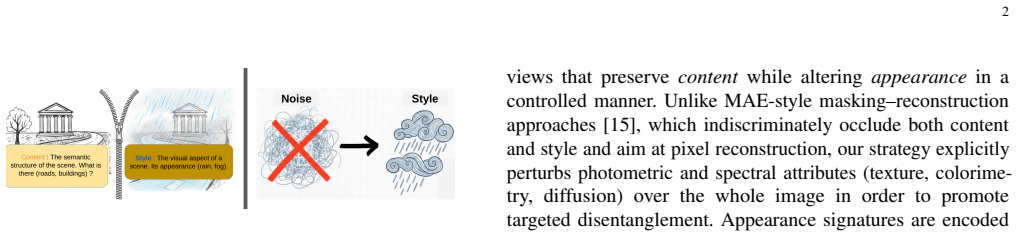
By maintaining two explicitly gated latent streams, one optimized for appearance-invariant semantics via JEPA and contrastive objectives and the other optimized for appearance signatures via prediction, reconstruction, and adversarial losses, the model isolates complex appearance phenomena such as atmospheric scattering and texture patterns while preserving object-level semantic representations.
What carries the argument
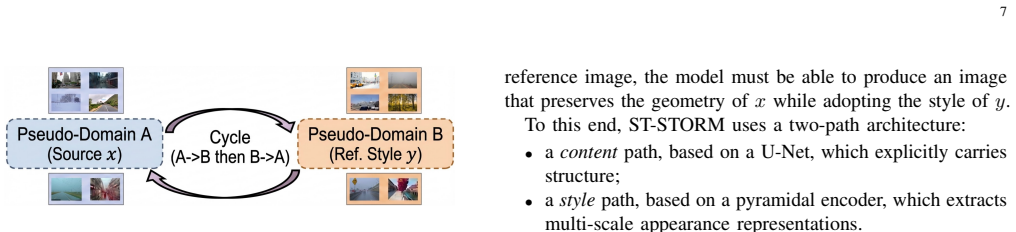
Dual gated latent streams: Content branch (JEPA predictor plus contrastive loss for semantic invariance) and Style branch (feature prediction, reconstruction, and adversarial constraint for appearance signatures).
If this is right
- The Style branch reaches F1 of 97 percent on multi-weather characterization while the Content branch holds F1 of 80 percent on ImageNet-1K.
- The Style branch reaches F1 of 94 percent on ISIC 2024 melanoma detection using only 10 percent labeled data.
- Critical appearance cues such as ground conditions and atmospheric effects remain available for downstream tasks like autonomous driving without trading off object recognition accuracy.
- The hybrid architecture improves preservation of appearance information compared with purely invariant SSL baselines.
Where Pith is reading between the lines
- The same gated separation could be applied to other appearance-heavy tasks such as material classification or art-style analysis without retraining the entire network.
- If the streams remain cleanly separated, the Style features might serve as a lightweight prior for few-shot adaptation on new weather or lighting conditions.
- A direct test would measure whether Style-branch representations transfer to material or reflectance estimation benchmarks that are not mentioned in the current evaluation.
Load-bearing premise
Explicit gating mechanisms and separate objectives can enforce clean disentanglement between content and style latent streams without information leakage or objective conflict.
What would settle it
A controlled ablation in which removing the gating layers or the adversarial term causes the Style branch features to become predictive of object category labels on ImageNet or causes the Content branch F1 to drop below the reported 80 percent.
Figures




read the original abstract
One of the dominant paradigms in self-supervised learning (SSL), illustrated by MoCo or DINO, aims to produce robust representations by capturing features that are insensitive to certain image transformations such as illumination, or geometric changes. This strategy is appropriate when the objective is to recognize objects independently of their appearance. However, it becomes counterproductive as soon as appearance itself constitutes the discriminative signal. In weather analysis, for example, rain streaks, snow granularity, atmospheric scattering, as well as reflections and halos, are not noise: they carry the essential information. In critical applications such as autonomous driving, ignoring these cues is risky, since grip and visibility depend directly on ground conditions and atmospheric conditions. We introduce ST-STORM, a hybrid SSL framework that treats appearance (style) as a semantic modality to be disentangled from content. Our architecture explicitly separates two latent streams, regulated by gating mechanisms. The Content branch aims at a stable semantic representation through a JEPA scheme coupled with a contrastive objective, promoting invariance to appearance variations. In parallel, the Style branch is constrained to capture appearance signatures (textures, contrasts, scattering) through feature prediction and reconstruction under an adversarial constraint. We evaluate ST-STORM on several tasks, including object classification (ImageNet-1K), fine-grained weather characterization, and melanoma detection (ISIC 2024 Challenge). The results show that the Style branch effectively isolates complex appearance phenomena (F1=97% on Multi-Weather and F1=94% on ISIC 2024 with 10% labeled data), without degrading the semantic performance (F1=80% on ImageNet-1K) of the Content branch, and improves the preservation of critical appearance
Editorial analysis
A structured set of objections, weighed in public.
Referee Report
Summary. The paper proposes ST-STORM, a hybrid self-supervised learning framework that explicitly disentangles content and style via two gated latent streams. The Content branch combines a JEPA scheme with contrastive learning to produce appearance-invariant semantic representations, while the Style branch employs feature prediction, reconstruction, and adversarial objectives to isolate appearance signatures such as textures, contrasts, and scattering effects. Evaluations claim that the Style branch achieves F1=97% on Multi-Weather and F1=94% on ISIC 2024 (with only 10% labeled data) without degrading the Content branch's F1=80% on ImageNet-1K.
Significance. If the reported disentanglement is verified, the work would be significant for computer vision applications in which appearance is itself the discriminative signal (e.g., weather-aware autonomous driving or dermatological imaging). It directly addresses a known limitation of invariance-focused SSL methods such as MoCo and DINO by treating style as a semantic modality rather than noise, and the dual-branch design with explicit gating offers a concrete architectural alternative.
major comments (2)
- [Evaluation] Evaluation section: The headline claim that the Style branch 'effectively isolates complex appearance phenomena' while the Content branch remains unaffected rests on the F1 scores (97% Multi-Weather, 94% ISIC, 80% ImageNet-1K), yet no cross-branch diagnostics (mutual information, linear probes from one branch into the other, or gating ablations) are reported. Without these, the numbers are compatible with both successful separation and with simple specialization under separate losses.
- [Methods] Methods section: The architecture is described as using 'gating mechanisms' and separate objectives (JEPA+contrastive on Content; prediction+reconstruction+adversarial on Style), but no equations for the combined loss, no diagram of the gating, and no training hyper-parameters are supplied. These details are load-bearing for reproducing the claimed separation and for assessing whether objective conflict or leakage occurs.
minor comments (1)
- [Abstract] The final sentence of the abstract is truncated ('and improves the preservation of critical appearance').
Simulated Author's Rebuttal
We thank the referee for the constructive feedback and for acknowledging the potential significance of explicitly treating style as a semantic modality in SSL. We address each major comment point by point below, with clarifications and commitments to revisions that strengthen the presentation of our results and methods without altering the core claims.
read point-by-point responses
-
Referee: [Evaluation] Evaluation section: The headline claim that the Style branch 'effectively isolates complex appearance phenomena' while the Content branch remains unaffected rests on the F1 scores (97% Multi-Weather, 94% ISIC, 80% ImageNet-1K), yet no cross-branch diagnostics (mutual information, linear probes from one branch into the other, or gating ablations) are reported. Without these, the numbers are compatible with both successful separation and with simple specialization under separate losses.
Authors: We agree that additional cross-branch diagnostics would provide more direct evidence of disentanglement beyond the task-specific F1 scores. The current results show the Style branch achieving high accuracy on appearance-driven tasks (F1=97% Multi-Weather, 94% ISIC with limited labels) while the Content branch retains semantic performance (F1=80% ImageNet-1K) under its invariance-focused objectives, which is enabled by the gated dual-stream design. To rule out the possibility of simple specialization without separation, we will add in revision: mutual information estimates between the two branches' representations, linear probes trained on one branch to predict the other, and gating ablations. These will appear in a new subsection of the Experiments section. revision: yes
-
Referee: [Methods] Methods section: The architecture is described as using 'gating mechanisms' and separate objectives (JEPA+contrastive on Content; prediction+reconstruction+adversarial on Style), but no equations for the combined loss, no diagram of the gating, and no training hyper-parameters are supplied. These details are load-bearing for reproducing the claimed separation and for assessing whether objective conflict or leakage occurs.
Authors: We acknowledge that the manuscript currently omits these implementation details, which are essential for reproducibility and for evaluating potential conflicts between the branch objectives. In the revised manuscript we will add: (1) a figure explicitly diagramming the dual-branch architecture and gating mechanisms, (2) the full mathematical formulation of the combined loss (including weighting coefficients for the JEPA, contrastive, prediction, reconstruction, and adversarial terms), and (3) a table listing all training hyperparameters such as learning rates, batch sizes, and regularization strengths. These additions will allow readers to assess objective interactions and leakage. revision: yes
Circularity Check
No circularity; empirical claims rest on training and evaluation, not self-referential derivations
full rationale
The paper introduces an architectural framework (gated content/style branches with JEPA+contrastive vs. prediction+reconstruction+adversarial objectives) and reports F1 scores on ImageNet-1K, Multi-Weather, and ISIC 2024. No equations, first-principles derivations, or predictions appear that reduce to fitted inputs by construction. No self-citation chains, uniqueness theorems, or ansatzes are invoked to force the central claims. Results are obtained via standard empirical SSL training and downstream evaluation, making the derivation chain self-contained against external benchmarks.
Axiom & Free-Parameter Ledger
free parameters (1)
- Gating mechanism weights
axioms (1)
- domain assumption Appearance signatures can be isolated from semantic content via separate optimization objectives and gating
invented entities (2)
-
Content branch
no independent evidence
-
Style branch
no independent evidence
Reference graph
Works this paper leans on
-
[1]
A combined corner and edge detector,
C. Harris, M. Stephenset al., “A combined corner and edge detector,” inAlvey vision conference, vol. 15, no. 50. Manchester, UK, 1988, pp. 10–5244
1988
-
[2]
Object recognition from local scale-invariant features,
D. G. Lowe, “Object recognition from local scale-invariant features,” in Proceedings of the seventh IEEE international conference on computer vision, vol. 2. Ieee, 1999, pp. 1150–1157
1999
-
[3]
Distinctive image features from scale-invariant keypoints,
——, “Distinctive image features from scale-invariant keypoints,”Inter- national journal of computer vision, vol. 60, no. 2, pp. 91–110, 2004
2004
-
[4]
Surf: Speeded up robust features,
H. Bay, T. Tuytelaars, and L. Van Gool, “Surf: Speeded up robust features,” inEuropean conference on computer vision. Springer, 2006, pp. 404–417
2006
-
[5]
Self-supervised learning from images with a joint-embedding predictive architecture,
M. Assran, Q. Duval, I. Misra, P. Bojanowski, P. Vincent, M. Rabbat, Y . LeCun, and N. Ballas, “Self-supervised learning from images with a joint-embedding predictive architecture,” inProceedings of the IEEE/CVF Conference on Computer Vision and Pattern Recognition, 2023, pp. 15 619–15 629
2023
-
[6]
O. Sim ´eoni, H. V . V o, M. Seitzer, F. Baldassarre, M. Oquab, C. Jose, V . Khalidov, M. Szafraniec, S. Yi, M. Ramamonjisoa, F. Massa, D. Haziza, L. Wehrstedt, J. Wang, T. Darcet, T. Moutakanni, L. Sentana, C. Roberts, A. Vedaldi, J. Tolan, J. Brandt, C. Couprie, J. Mairal, H. J ´egou, P. Labatut, and P. Bojanowski, “Dinov3,” 2025. [Online]. Available: h...
work page internal anchor Pith review Pith/arXiv arXiv 2025
-
[7]
An empirical study of training self- supervised vision transformers,
X. Chen, S. Xie, and K. He, “An empirical study of training self- supervised vision transformers,” inProceedings of the IEEE/CVF international conference on computer vision, 2021, pp. 9640–9649. 20
2021
-
[8]
What should not be contrastive in contrastive learning,
T. Xiao, X. Wang, A. A. Efros, and T. Darrell, “What should not be contrastive in contrastive learning,”arXiv preprint arXiv:2008.05659, 2020
-
[9]
Amortised invariance learning for contrastive self- supervision,
R. Chavhan, H. Gouk, J. Stuehmer, C. Heggan, M. Yaghoobi, and T. Hospedales, “Amortised invariance learning for contrastive self- supervision,”arXiv preprint arXiv:2302.12712, 2023
-
[10]
Understanding the role of equivariance in self-supervised learning,
Y . Wang, K. Hu, S. Gupta, Z. Ye, Y . Wang, and S. Jegelka, “Understanding the role of equivariance in self-supervised learning,”
-
[11]
Available: https://arxiv.org/abs/2411.06508
[Online]. Available: https://arxiv.org/abs/2411.06508
-
[12]
Unpaired Image- to-Image Translation using Cycle-Consistent Adversarial Networks,
J.-Y . Zhu, T. Park, P. Isola, and A. A. Efros, “Unpaired image- to-image translation using cycle-consistent adversarial networks,” 2020, arXiv preprint arXiv:1703.10593. [Online]. Available: https: //arxiv.org/abs/1703.10593
-
[13]
arXiv preprint arXiv:2007.15651
T. Park, A. A. Efros, R. Zhang, and J.-Y . Zhu, “Contrastive learning for unpaired image-to-image translation,” 2020, arXiv preprint arXiv:2007.15651. [Online]. Available: https://arxiv.org/abs/2007.15651
-
[14]
An algorithm for the machine calculation of complex fourier series,
J. W. Cooley and J. W. Tukey, “An algorithm for the machine calculation of complex fourier series,”Mathematics of computation, vol. 19, no. 90, pp. 297–301, 1965
1965
-
[15]
Sliced and radon wasserstein barycenters of measures,
N. Bonneel, J. Rabin, G. Peyr ´e, and H. Pfister, “Sliced and radon wasserstein barycenters of measures,”Journal of Mathematical Imaging and Vision, vol. 51, no. 1, pp. 22–45, 2015
2015
-
[16]
Masked autoencoders are scalable vision learners,
K. He, X. Chen, S. Xie, Y . Li, P. Doll ´ar, and R. Girshick, “Masked autoencoders are scalable vision learners,” inProceedings of the IEEE/CVF conference on computer vision and pattern recognition, 2022, pp. 16 000–16 009
2022
-
[17]
Momentum contrast for unsupervised visual representation learning,
K. He, H. Fan, Y . Wu, S. Xie, and R. Girshick, “Momentum contrast for unsupervised visual representation learning,” inProceedings of the IEEE/CVF conference on computer vision and pattern recognition, 2020, pp. 9729–9738
2020
-
[18]
Simclr: A simple framework for contrastive learning of visual representations,
T. Chen, S. Kornblith, M. Norouzi, and G. Hinton, “Simclr: A simple framework for contrastive learning of visual representations,” inInterna- tional Conference on Learning Representations, vol. 2, no. 4. PMLR New York, NY , USA, 2020
2020
-
[19]
BEiT: BERT Pre-Training of Image Transformers
H. Bao, L. Dong, S. Piao, and F. Wei, “Beit: Bert pre-training of image transformers,”arXiv preprint arXiv:2106.08254, 2021
work page internal anchor Pith review arXiv 2021
-
[20]
Deep residual learning for image recognition,
K. He, X. Zhang, S. Ren, and J. Sun, “Deep residual learning for image recognition,” inProceedings of the IEEE conference on computer vision and pattern recognition, 2016, pp. 770–778
2016
-
[21]
L. Yang, S.-W. Li, Y . Li, X. Lei, D. Wang, A. Mohamed, H. Zhao, and H. Xu, “In pursuit of pixel supervision for visual pre-training,”arXiv preprint arXiv:2512.15715, 2025
-
[22]
H. V . Assel, M. Ibrahim, T. Biancalani, A. Regev, and R. Balestriero, “Joint embedding vs reconstruction: Provable benefits of latent space prediction for self supervised learning,” 2025. [Online]. Available: https://arxiv.org/abs/2505.12477
-
[23]
Pixmim: Rethink- ing pixel reconstruction in masked image modeling,
Y . Liu, S. Zhang, J. Chen, K. Chen, and D. Lin, “Pixmim: Rethink- ing pixel reconstruction in masked image modeling,”arXiv preprint arXiv:2303.02416, 2023
-
[24]
Stare at what you see: Masked image modeling without reconstruction,
H. Xue, P. Gao, H. Li, Y . Qiao, H. Sun, H. Li, and J. Luo, “Stare at what you see: Masked image modeling without reconstruction,” inProceedings of the IEEE/CVF conference on computer vision and pattern recognition, 2023, pp. 22 732–22 741
2023
-
[25]
A-jepa: Joint-embedding predictive architecture can listen.arXiv preprint arXiv:2311.15830,
Z. Fei, M. Fan, and J. Huang, “A-jepa: Joint-embedding predictive architecture can listen,”arXiv preprint arXiv:2311.15830, 2023
-
[26]
V-JEPA 2: Self-Supervised Video Models Enable Understanding, Prediction and Planning
M. Assran, A. Bardes, D. Fan, Q. Garrido, R. Howes, M. Muckley, A. Rizvi, C. Roberts, K. Sinha, A. Zholuset al., “V-jepa 2: Self-supervised video models enable understanding, prediction and planning,”arXiv preprint arXiv:2506.09985, 2025
work page internal anchor Pith review arXiv 2025
-
[27]
Real- Time Weather Image Classification with SVM.arXiv preprint arXiv:2409.00821 (2024)
E. Ship, E. Spivak, S. Agarwal, R. Birman, and O. Hadar, “Real-time weather image classification with svm,”arXiv preprint arXiv:2409.00821, 2024
-
[28]
Feature extraction for classification of different weather conditions,
X. Zhao, P. Liu, J. Liu, and X. Tang, “Feature extraction for classification of different weather conditions,”Frontiers of Electrical and Electronic Engineering in China, vol. 6, no. 2, pp. 339–346, 2011
2011
-
[29]
Community transferrable representation learning for image style classification,
J. Cui, J. Shen, J. Wei, S. Liu, Z. Ye, S. Luo, and Z. Qin, “Community transferrable representation learning for image style classification,” ACM Transactions on Multimedia Computing, Communications and Applications, 2025
2025
-
[30]
D. Ruta, G. C. Tarres, A. Black, A. Gilbert, and J. Collomosse, “Aladin- nst: Self-supervised disentangled representation learning of artistic style through neural style transfer,”arXiv preprint arXiv:2304.05755, 2023
-
[31]
Unsupervised image style embeddings for retrieval and recognition tasks,
S. Gairola, R. Shah, and P. Narayanan, “Unsupervised image style embeddings for retrieval and recognition tasks,” inProceedings of the IEEE/CVF Winter Conference on Applications of Computer Vision, 2020, pp. 3281–3289
2020
-
[32]
Deep ten: Texture encoding network,
H. Zhang, J. Xue, and K. Dana, “Deep ten: Texture encoding network,” inProceedings of the IEEE conference on computer vision and pattern recognition, 2017, pp. 708–717
2017
-
[33]
Bilinear cnns for fine-grained visual recognition,
T.-Y . Lin, A. RoyChowdhury, and S. Maji, “Bilinear cnns for fine-grained visual recognition,” 2017. [Online]. Available: https: //arxiv.org/abs/1504.07889
-
[34]
Image style transfer using convolutional neural networks,
L. A. Gatys, A. S. Ecker, and M. Bethge, “Image style transfer using convolutional neural networks,” inProceedings of the IEEE conference on computer vision and pattern recognition, 2016, pp. 2414–2423
2016
-
[35]
Very Deep Convolutional Networks for Large-Scale Image Recognition
K. Simonyan and A. Zisserman, “Very deep convolutional networks for large-scale image recognition,” 2015. [Online]. Available: https: //arxiv.org/abs/1409.1556
work page internal anchor Pith review Pith/arXiv arXiv 2015
-
[36]
Image-to-Image Translation with Conditional Adversarial Networks , journal =
P. Isola, J.-Y . Zhu, T. Zhou, and A. A. Efros, “Image-to-image translation with conditional adversarial networks,” 2018, arXiv preprint arXiv:1611.07004. [Online]. Available: https://arxiv.org/abs/1611.07004
-
[37]
Generative adversarial networks,
I. Goodfellow, J. Pouget-Abadie, M. Mirza, B. Xu, D. Warde-Farley, S. Ozair, A. Courville, and Y . Bengio, “Generative adversarial networks,” Communications of the ACM, vol. 63, no. 11, pp. 139–144, 2020
2020
-
[38]
Semantic image synthesis with spatially-adaptive normalization,
T. Park, M.-Y . Liu, T.-C. Wang, and J.-Y . Zhu, “Semantic image synthesis with spatially-adaptive normalization,” 2019. [Online]. Available: https://arxiv.org/abs/1903.07291
-
[39]
The ‘ugly duckling’sign: identification of the common characteristics of nevi in an individual as a basis for melanoma screening,
J. Grob and J. Bonerandi, “The ‘ugly duckling’sign: identification of the common characteristics of nevi in an individual as a basis for melanoma screening,”Archives of dermatology, vol. 134, no. 1, pp. 103–104, 1998
1998
-
[40]
Early detection of malignant melanoma: the role of physician examination and self-examination of the skin
R. J. Friedman, D. S. Rigel, and A. W. Kopf, “Early detection of malignant melanoma: the role of physician examination and self-examination of the skin.”CA: a cancer journal for clinicians, vol. 35, no. 3, pp. 130–151, 1985
1985
-
[41]
Multi-class weather classification on single images,
Z. Zhang and H. Ma, “Multi-class weather classification on single images,” in2015 IEEE International Conference on Image Processing (ICIP). IEEE, 2015, pp. 4396–4400
2015
-
[42]
Weather phenomenon database (weapd),
H. Xiao, “Weather phenomenon database (weapd),”Harvard Dataverse dataset, p. 627, 2021
2021
-
[43]
Evaluation of cnn-based approaches to adverse weather image classification for autonomous driving systems,
V . Afxentiou and T. Vladimirova, “Evaluation of cnn-based approaches to adverse weather image classification for autonomous driving systems,” IEEE Open Journal of Intelligent Transportation Systems, 2025
2025
-
[44]
A study of weather-image classification combining vit and a dual enhanced-attention module,
J. Li and X. Luo, “A study of weather-image classification combining vit and a dual enhanced-attention module,”Electronics, vol. 12, no. 5, p. 1213, 2023
2023
-
[45]
Bootstrap your own latent-a new approach to self-supervised learning,
J.-B. Grill, F. Strub, F. Altch ´e, C. Tallec, P. Richemond, E. Buchatskaya, C. Doersch, B. Avila Pires, Z. Guo, M. Gheshlaghi Azaret al., “Bootstrap your own latent-a new approach to self-supervised learning,”Advances in neural information processing systems, vol. 33, pp. 21 271–21 284, 2020
2020
-
[46]
Emerging properties in self-supervised vision transformers,
M. Caron, H. Touvron, I. Misra, H. J ´egou, J. Mairal, P. Bojanowski, and A. Joulin, “Emerging properties in self-supervised vision transformers,” inProceedings of the IEEE/CVF international conference on computer vision, 2021, pp. 9650–9660
2021
-
[47]
Big self-supervised models are strong semi-supervised learners,
T. Chen, S. Kornblith, K. Swersky, M. Norouzi, and G. E. Hinton, “Big self-supervised models are strong semi-supervised learners,”Advances in neural information processing systems, vol. 33, pp. 22 243–22 255, 2020
2020
discussion (0)
Sign in with ORCID, Apple, or X to comment. Anyone can read and Pith papers without signing in.