Recognition: 2 theorem links
· Lean TheoremPreventing overfitting in deep learning using differential privacy
Pith reviewed 2026-05-15 12:19 UTC · model grok-4.3
The pith
Differential privacy can reduce overfitting in deep neural networks by adding noise during training to improve generalization on limited data.
A machine-rendered reading of the paper's core claim, the machinery that carries it, and where it could break.
Core claim
A differential-privacy based approach improves generalization in Deep Neural Networks by introducing noise that curbs overfitting when training data is limited.
What carries the argument
The differential privacy mechanism that injects noise into the training updates to bound the influence of any single training example.
If this is right
- Models using this approach should achieve higher accuracy on unseen data than standard training on the same limited set.
- The technique applies directly to practical settings where data collection is expensive or restricted.
- It provides a built-in privacy guarantee alongside the generalization benefit.
- Training can proceed with existing network architectures by modifying only the optimization step.
Where Pith is reading between the lines
- The same noise injection might help other model types such as random forests or linear models when data is scarce.
- Tuning the privacy budget could trade off between stronger generalization and acceptable accuracy loss.
- This links privacy mechanisms to regularization, suggesting future hybrids with dropout or weight decay.
Load-bearing premise
The noise from differential privacy will improve generalization without excessively harming the model's ability to learn useful patterns from the limited training data.
What would settle it
Train identical deep neural networks on the same small dataset with and without the differential privacy noise, then measure whether the noisy version achieves higher accuracy on a held-out test set.
Figures




read the original abstract
The use of Deep Neural Network based systems in the real world is growing. They have achieved state-of-the-art performance on many image, speech and text datasets. They have been shown to be powerful systems that are capable of learning detailed relationships and abstractions from the data. This is a double-edged sword which makes such systems vulnerable to learning the noise in the training set, thereby negatively impacting performance. This is also known as the problem of \emph{overfitting} or \emph{poor generalization}. In a practical setting, analysts typically have limited data to build models that must generalize to unseen data. In this work, we explore the use of a differential-privacy based approach to improve generalization in Deep Neural Networks.
Editorial analysis
A structured set of objections, weighed in public.
Referee Report
Summary. The manuscript claims that differential privacy can be used as an approach to improve generalization and prevent overfitting in deep neural networks, particularly in settings with limited training data, by leveraging privacy noise as a regularizer.
Significance. If the claim held with a concrete mechanism and supporting analysis, it would offer a principled regularization technique grounded in privacy theory, potentially useful for data-scarce regimes where standard methods like dropout may be insufficient.
major comments (1)
- [Abstract] Abstract: The manuscript announces an exploration of a DP-based approach but provides no concrete mechanism (such as DP-SGD with gradient clipping and noise addition), no derivation showing why calibrated privacy noise reduces the generalization gap, and no empirical results or comparisons to non-private baselines.
Simulated Author's Rebuttal
We thank the referee for the detailed review. We agree that the current manuscript is exploratory in nature and lacks the concrete mechanism, theoretical derivation, and empirical validation needed to substantiate the claims. We will revise the paper substantially to address these gaps while preserving the core idea of using privacy noise as a regularizer.
read point-by-point responses
-
Referee: [Abstract] Abstract: The manuscript announces an exploration of a DP-based approach but provides no concrete mechanism (such as DP-SGD with gradient clipping and noise addition), no derivation showing why calibrated privacy noise reduces the generalization gap, and no empirical results or comparisons to non-private baselines.
Authors: We acknowledge the validity of this observation. The submitted version only sketches the high-level motivation without specifying an implementation or providing supporting analysis or experiments. In the revised manuscript we will: (1) explicitly describe the DP-SGD procedure, including per-sample gradient clipping and the addition of calibrated Gaussian noise; (2) include a short derivation linking the privacy-induced noise to algorithmic stability and a bound on the generalization gap; and (3) report empirical results on image-classification tasks with deliberately restricted training-set sizes, comparing against non-private baselines such as dropout and L2 regularization. revision: yes
Circularity Check
No derivation chain; paper is purely exploratory with no equations or mechanisms
full rationale
The provided text contains only the statement that the authors 'explore the use of a differential-privacy based approach to improve generalization in Deep Neural Networks.' No equations, algorithms, derivations, specific DP mechanisms (such as DP-SGD), or load-bearing steps are present. Without any claimed derivation or prediction that could reduce to its inputs by construction, self-citation, or fitted renaming, there is no circularity to identify. The central claim is an unelaborated assumption, but this does not meet the criteria for circularity under the defined patterns.
Axiom & Free-Parameter Ledger
axioms (1)
- domain assumption Differential privacy mechanisms can be applied to neural network training to control information leakage while preserving utility.
Lean theorems connected to this paper
-
IndisputableMonolith/Cost/FunctionalEquation.leanwashburn_uniqueness_aczel unclear?
unclearRelation between the paper passage and the cited Recognition theorem.
We use the approach given in [2] ... Algorithm 1: Differentially private SGD ... Add noise ¯gt ← 1/L (∑i ¯gt(xi) + N(0,σ²C²I))
-
IndisputableMonolith/Foundation/RealityFromDistinction.leanreality_from_one_distinction unclear?
unclearRelation between the paper passage and the cited Recognition theorem.
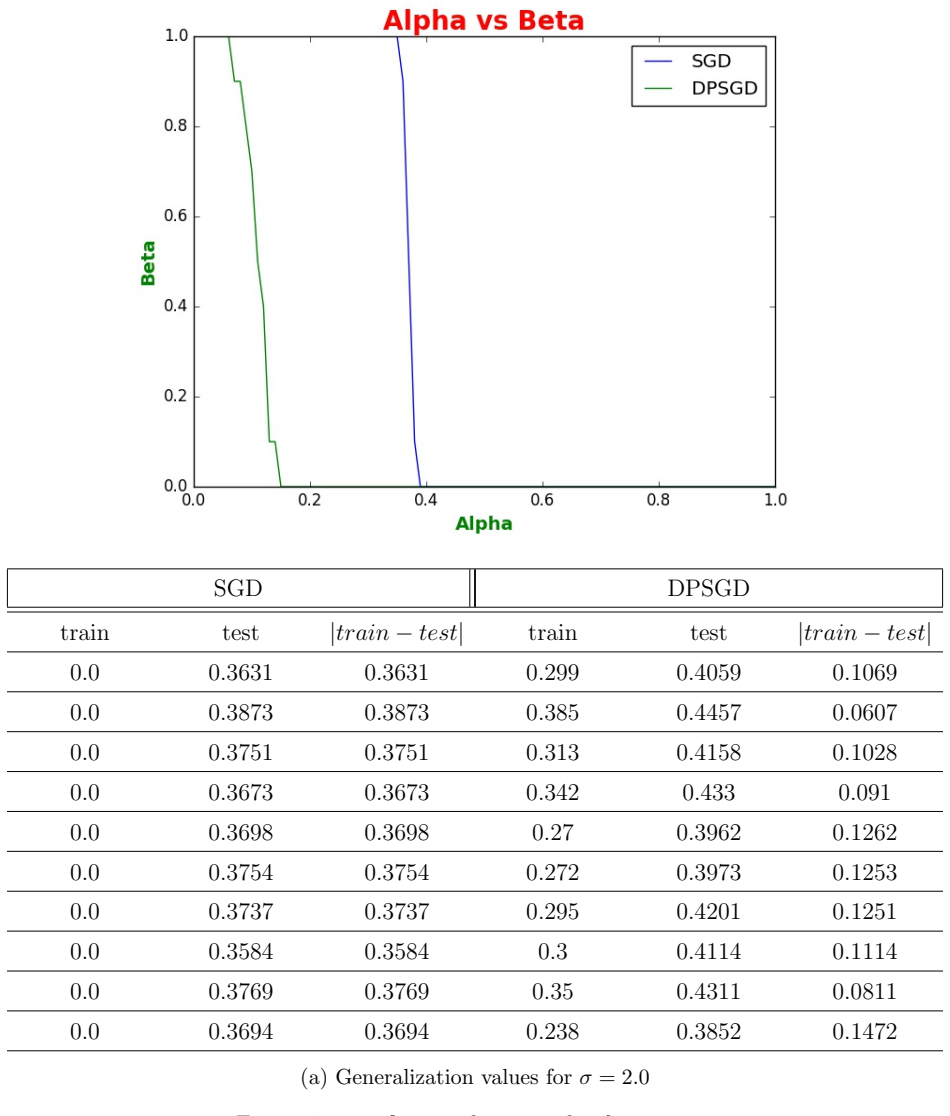
The hypothesis generated by Differentially Private Stochastic Gradient Descent (DP-SGD) ... difference in errors has been reduced by about 66%!
What do these tags mean?
- matches
- The paper's claim is directly supported by a theorem in the formal canon.
- supports
- The theorem supports part of the paper's argument, but the paper may add assumptions or extra steps.
- extends
- The paper goes beyond the formal theorem; the theorem is a base layer rather than the whole result.
- uses
- The paper appears to rely on the theorem as machinery.
- contradicts
- The paper's claim conflicts with a theorem or certificate in the canon.
- unclear
- Pith found a possible connection, but the passage is too broad, indirect, or ambiguous to say the theorem truly supports the claim.
Reference graph
Works this paper leans on
-
[1]
Mart ´ın Abadi, Ashish Agarwal, Paul Barham, Eugene Brevdo, Zhifeng Chen, Craig Citro, Greg S. Corrado, Andy Davis, Jeffrey Dean, Matthieu Devin, Sanjay Ghemawat, Ian Goodfellow, Andrew Harp, Geoffrey Irving, Michael Isard, Yangqing Jia, Rafal Joze- fowicz, Lukasz Kaiser, Manjunath Kudlur, Josh Levenberg, Dan Man´ e, Rajat Monga, Sherry Moore, Derek Murray,...
work page 2015
-
[2]
Deep learning with differential privacy
Mart ´ın Abadi, Andy Chu, Ian Goodfellow, H Brendan McMahan, Ilya Mironov, Kunal Talwar, and Li Zhang. Deep learning with differential privacy. InProceedings of the 2016 ACM SIGSAC Conference on Computer and Communications Security, pages 308–318. ACM, 2016
work page 2016
-
[3]
Differentially Private Empirical Risk Minimization: Efficient Algorithms and Tight Error Bounds
Raef Bassily, Adam D. Smith, and Abhradeep Thakurta. Private empirical risk mini- mization, revisited.CoRR, abs/1405.7085, 2014
work page internal anchor Pith review Pith/arXiv arXiv 2014
-
[4]
Amos Beimel, Hai Brenner, Shiva Prasad Kasiviswanathan, and Kobbi Nissim. Bounds on the sample complexity for private learning and private data release.Machine learning, 94(3):401–437, 2014
work page 2014
-
[5]
Large-scale machine learning with stochastic gradient descent
L´ eon Bottou. Large-scale machine learning with stochastic gradient descent. InPro- ceedings of COMPSTAT’2010, pages 177–186. Springer, 2010
work page 2010
-
[6]
Overfitting in neural nets: Backprop- agation, conjugate gradient, and early stopping
Rich Caruana, Steve Lawrence, and C Lee Giles. Overfitting in neural nets: Backprop- agation, conjugate gradient, and early stopping. InAdvances in neural information processing systems, pages 402–408, 2001
work page 2001
-
[7]
Adaptive learning with robust generalization guarantees
Rachel Cummings, Katrina Ligett, Kobbi Nissim, Aaron Roth, and Zhiwei Steven Wu. Adaptive learning with robust generalization guarantees. InConference on Learning Theory, pages 772–814, 2016
work page 2016
-
[8]
Aymeric Damien et al. Tflearn. https://github.com/tflearn/tflearn, 2016
work page 2016
-
[9]
Differential privacy: A survey of results
Cynthia Dwork. Differential privacy: A survey of results. InInternational Conference on Theory and Applications of Models of Computation, pages 1–19. Springer, 2008
work page 2008
-
[10]
Afirm foundation for private data analysis.Communications of the ACM, 54(1):86–95, 2011
Cynthia Dwork. Afirm foundation for private data analysis.Communications of the ACM, 54(1):86–95, 2011
work page 2011
-
[11]
Generalization in adaptive data analysis and holdout reuse
Cynthia Dwork, Vitaly Feldman, Moritz Hardt, Toni Pitassi, Omer Reingold, and Aaron Roth. Generalization in adaptive data analysis and holdout reuse. InAdvances in Neural Information Processing Systems, pages 2350–2358, 2015. 40
work page 2015
-
[12]
Cynthia Dwork, Vitaly Feldman, Moritz Hardt, Toniann Pitassi, Omer Reingold, and Aaron Roth. The reusable holdout: Preserving validity in adaptive data analysis.Sci- ence, 349(6248):636–638, 2015
work page 2015
-
[13]
Our data, ourselves: Privacy via distributed noise generation
Cynthia Dwork, Krishnaram Kenthapadi, Frank McSherry, Ilya Mironov, and Moni Naor. Our data, ourselves: Privacy via distributed noise generation. InEurocrypt, volume 4004, pages 486–503. Springer, 2006
work page 2006
-
[14]
Calibrating noise to sensitivity in private data analysis
Cynthia Dwork, Frank McSherry, Kobbi Nissim, and Adam Smith. Calibrating noise to sensitivity in private data analysis. InTCC, volume 3876, pages 265–284. Springer, 2006
work page 2006
-
[15]
The algorithmic foundations of differential privacy
Cynthia Dwork, Aaron Roth, et al. The algorithmic foundations of differential privacy. Foundations and Trends R�in Theoretical Computer Science, 9(3–4):211–407, 2014
work page 2014
-
[16]
Boosting and differential privacy
Cynthia Dwork, Guy N Rothblum, and Salil Vadhan. Boosting and differential privacy. InFoundations of Computer Science (FOCS), 2010 51st Annual IEEE Symposium on, pages 51–60. IEEE, 2010
work page 2010
-
[17]
Caglar Gulcehre, Marcin Moczulski, Misha Denil, and Yoshua Bengio. Noisy activation functions. In Maria Florina Balcan and Kilian Q. Weinberger, editors,Proceedings of The 33rd International Conference on Machine Learning, volume 48 ofProceedings of Machine Learning Research, pages 3059–3068, New York, New York, USA, 20–22 Jun
-
[18]
Richard H. R. Hahnloser, Rahul Sarpeshkar, Misha A. Mahowald, Rodney J. Douglas, and H. Sebastian Seung. Digital selection and analogue amplification coexist in a cortex- inspired silicon circuit.Nature, 405(6789):947–951, Jun 2000
work page 2000
-
[19]
Kevin Jarrett, Koray Kavukcuoglu, Yann LeCun, et al. What is the best multi-stage architecture for object recognition? InComputer Vision, 2009 IEEE 12th International Conference on, pages 2146–2153. IEEE, 2009
work page 2009
-
[20]
Lukasz Kaiser, Aidan N Gomez, Noam Shazeer, Ashish Vaswani, Niki Parmar, Llion Jones, and Jakob Uszkoreit. One model to learn them all.arXiv preprint arXiv:1706.05137, 2017
work page internal anchor Pith review Pith/arXiv arXiv 2017
-
[21]
What can we learn privately?SIAM Journal on Computing, 40(3):793– 826, 2011
Shiva Prasad Kasiviswanathan, Homin K Lee, Kobbi Nissim, Sofya Raskhodnikova, and Adam Smith. What can we learn privately?SIAM Journal on Computing, 40(3):793– 826, 2011
work page 2011
-
[22]
Overfitting and neural networks: conjugate gradient and backpropagation
Steve Lawrence and C Lee Giles. Overfitting and neural networks: conjugate gradient and backpropagation. InNeural Networks, 2000. IJCNN 2000, Proceedings of the IEEE- INNS-ENNS International Joint Conference on, volume 1, pages 114–119. IEEE, 2000
work page 2000
-
[23]
Yann LeCun. Une proc´ edure d’apprentissage pour r´ eseau a seuil asymmetrique (a learn- ing scheme for asymmetric threshold networks). InProceedings of Cognitiva 85, Paris, France. 1985. 41
work page 1985
-
[24]
Deep learning.Nature, 521(7553):436–444, 2015
Yann LeCun, Yoshua Bengio, and Geoffrey Hinton. Deep learning.Nature, 521(7553):436–444, 2015
work page 2015
-
[25]
Rectified linear units improve restricted boltzmann machines
Vinod Nair and Geoffrey E Hinton. Rectified linear units improve restricted boltzmann machines. InProceedings of the 27th international conference on machine learning (ICML-10), pages 807–814, 2010
work page 2010
-
[26]
Adding Gradient Noise Improves Learning for Very Deep Networks
Arvind Neelakantan, Luke Vilnis, Quoc V Le, Ilya Sutskever, Lukasz Kaiser, Karol Kurach, and James Martens. Adding gradient noise improves learning for very deep networks.arXiv preprint arXiv:1511.06807, 2015
work page internal anchor Pith review Pith/arXiv arXiv 2015
-
[27]
Andrew Y Ng. Feature selection, l 1 vs. l 2 regularization, and rotational invariance. In Proceedings of the twenty-first international conference on Machine learning, page 78. ACM, 2004
work page 2004
-
[28]
Simplifying neural networks by soft weight- sharing.Neural computation, 4(4):473–493, 1992
Steven J Nowlan and Geoffrey E Hinton. Simplifying neural networks by soft weight- sharing.Neural computation, 4(4):473–493, 1992
work page 1992
-
[30]
On the difficulty of training Recurrent Neural Networks
Razvan Pascanu, Tomas Mikolov, and Yoshua Bengio. Understanding the exploding gradient problem.CoRR, abs/1211.5063, 2012
work page internal anchor Pith review Pith/arXiv arXiv 2012
-
[31]
Automatic early stopping using cross validation: quantifying the criteria
Lutz Prechelt. Automatic early stopping using cross validation: quantifying the criteria. Neural Networks, 11(4):761–767, 1998
work page 1998
-
[32]
Learning represen- tations by back-propagating errors.Cognitive modeling, 5(3):1, 1988
David E Rumelhart, Geoffrey E Hinton, Ronald J Williams, et al. Learning represen- tations by back-propagating errors.Cognitive modeling, 5(3):1, 1988
work page 1988
-
[33]
Privacy-preserving deep learning
Reza Shokri and Vitaly Shmatikov. Privacy-preserving deep learning. InProceedings of the 22nd ACM SIGSAC conference on computer and communications security, pages 1310–1321. ACM, 2015
work page 2015
-
[34]
Stochastic gradient descent with differentially private updates
Shuang Song, Kamalika Chaudhuri, and Anand D Sarwate. Stochastic gradient descent with differentially private updates. InGlobal Conference on Signal and Information Processing (GlobalSIP), 2013 IEEE, pages 245–248. IEEE, 2013
work page 2013
-
[35]
Dropout: a simple way to prevent neural networks from overfitting
Nitish Srivastava, Geoffrey E Hinton, Alex Krizhevsky, Ilya Sutskever, and Ruslan Salakhutdinov. Dropout: a simple way to prevent neural networks from overfitting. Journal of Machine Learning Research, 15(1):1929–1958, 2014
work page 1929
-
[36]
Vladimir Naumovich Vapnik and Vlamimir Vapnik.Statistical learning theory, volume 1. Wiley New York, 1998
work page 1998
-
[37]
Paul John Werbos. Beyond regression: New tools for prediction and analysis in the behavioral sciences.Doctoral Dissertation, Applied Mathematics, Harvard University, MA, 1974. 42
work page 1974
discussion (0)
Sign in with ORCID, Apple, or X to comment. Anyone can read and Pith papers without signing in.