A Real-Time Bike-Pedestrian Safety System with Wide-Angle Perception and Evaluation Testbed for Urban Intersections
Pith reviewed 2026-05-10 06:53 UTC · model grok-4.3
The pith
A single edge device with a fisheye camera can provide real-time audible and visual warnings for bike-pedestrian collisions at intersections, achieving 93.3% sensitivity and 92.3% specificity.
A machine-rendered reading of the paper's core claim, the machinery that carries it, and where it could break.
Core claim
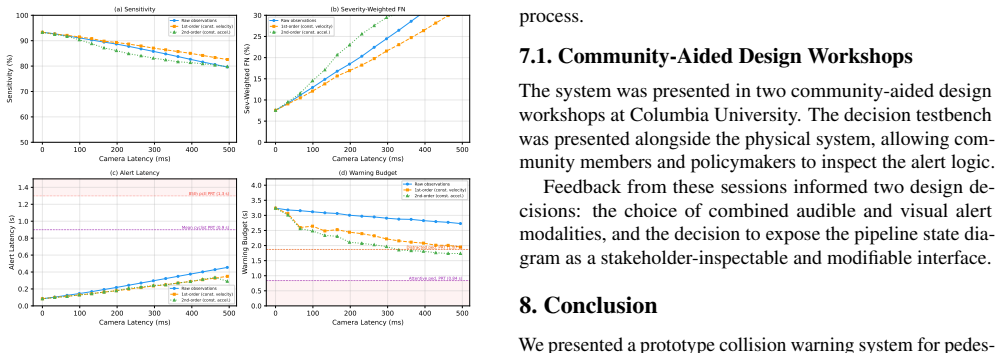
Under conformance testing that incorporates fisheye localization error, the pipeline achieves 93.3% sensitivity and 92.3% specificity with a mean warning budget of 3.3 seconds. This performance is obtained by combining a custom fisheye calibration method, fisheye-aware detection, lookup-table ground projection, and a first-order kinematic predictor within a design-time simulation that sweeps latencies and models stochastic failures across 24 scripted scenarios.
What carries the argument
The design-time conformance simulation incorporating 24 scripted hazard scenarios, stochastic size-aware detection failures, and a latency sweep to validate that the kinematic predictor maintains sufficient warning budgets.
If this is right
- The system runs at 30 fps on a single edge device producing alerts for unequipped users.
- The mean warning budget exceeds distracted-pedestrian reaction time across realistic camera latencies.
- The decision layer is formalized as a separable auditable testbench with explicit deployment gates and a residual risk register.
- The calibration pipeline overcomes corner-detection failure and optimizer divergence for ultra-wide lenses.
Where Pith is reading between the lines
- If the simulation predictions hold in practice, cities could deploy such systems at multiple intersections using existing camera mounts and minimal new infrastructure.
- The open-source code enables testing with different camera placements or integration with other sensors.
- Similar conformance testing approaches could be applied to other real-time safety systems involving latency-sensitive predictions.
Load-bearing premise
The design-time conformance simulation with 24 scripted hazard scenarios, stochastic size-aware detection failures, and latency sweep accurately predicts real-world performance, including actual camera latencies and pedestrian reaction times.
What would settle it
Deploying the system at a real urban intersection and measuring the actual warning times delivered before near-misses or collisions, compared against the simulated 3.3-second mean.
Figures



read the original abstract
Collisions between cyclists and pedestrians at urban intersections remain a persistent source of injuries, yet few systems attempt real-time warnings to unequipped road users using commodity hardware. We present a prototype collision warning system that runs on a single edge device with a wide-angle fisheye camera, producing audible and visual alerts at 30\,fps. The system makes four contributions. First, we develop a calibration pipeline for ultra-wide fisheye lenses that overcomes corner-detection failure and optimizer divergence through perspective remapping and direct bundle adjustment. Second, we combine fisheye-aware object detection with a closed-form ground-plane projection via a precomputed lookup table. Third, we introduce a design-time conformance simulation with 24 scripted hazard scenarios, stochastic size-aware detection failures, and a latency sweep showing that a first-order kinematic predictor maintains the mean warning budget above the distracted-pedestrian reaction time across realistic camera latencies. Fourth, we formalize the decision layer as a separable, auditable testbench with explicit deployment gates, contestability mechanisms, and a residual risk register. Under conformance testing with fisheye localization error, the selected pipeline configuration achieves 93.3\% sensitivity and 92.3\% specificity, with a mean warning budget of 3.3\,s. The system design was informed by community-aided design workshops. Code and replication scripts are available at https://github.com/mkturkcan/bikeped.
Editorial analysis
A structured set of objections, weighed in public.
Referee Report
Summary. The manuscript presents a prototype real-time collision-warning system for cyclists and pedestrians at urban intersections that runs at 30 fps on a single edge device equipped with a commodity fisheye camera. It contributes (1) a calibration pipeline for ultra-wide lenses that uses perspective remapping and direct bundle adjustment, (2) fisheye-aware detection combined with a precomputed lookup-table ground-plane projection, (3) a design-time conformance simulation built from 24 scripted hazard scenarios, stochastic size-aware detection failures, fisheye localization error, and a latency sweep, and (4) a separable, auditable decision layer with explicit deployment gates and a residual-risk register. Under the simulation the selected configuration reports 93.3 % sensitivity, 92.3 % specificity, and a mean warning budget of 3.3 s; code and replication scripts are released.
Significance. If the simulation parameters prove representative of real camera latencies, ground-plane projection errors, and pedestrian reaction distributions, the work supplies a practical, auditable, and reproducible testbed for commodity-hardware safety systems at intersections. The public release of code and replication scripts is a clear strength that supports independent verification and extension.
major comments (1)
- [Conformance simulation] Conformance simulation section: the central performance numbers (93.3 % sensitivity, 92.3 % specificity, 3.3 s mean warning budget) are obtained from a simulation that incorporates assumed values for edge-device latencies, fisheye localization error, and distracted-pedestrian reaction times. No field measurements, camera calibration data, or observed pedestrian crossing distributions are supplied to anchor these quantities, so the claim that the first-order kinematic predictor maintains the warning budget above reaction time rests on unvalidated modeling assumptions that directly affect the reported metrics.
minor comments (1)
- [Abstract / Introduction] The abstract and introduction list four contributions but do not explicitly map them to manuscript sections or figures; adding such a mapping would improve navigation.
Simulated Author's Rebuttal
We thank the referee for the constructive feedback and for recognizing the contributions of the prototype system and the public code release. We address the single major comment below.
read point-by-point responses
-
Referee: [Conformance simulation] Conformance simulation section: the central performance numbers (93.3 % sensitivity, 92.3 % specificity, 3.3 s mean warning budget) are obtained from a simulation that incorporates assumed values for edge-device latencies, fisheye localization error, and distracted-pedestrian reaction times. No field measurements, camera calibration data, or observed pedestrian crossing distributions are supplied to anchor these quantities, so the claim that the first-order kinematic predictor maintains the warning budget above reaction time rests on unvalidated modeling assumptions that directly affect the reported metrics.
Authors: We appreciate the referee highlighting this limitation. The conformance simulation is presented as a design-time, reproducible testbed (24 scripted hazard scenarios, stochastic size-aware failures, fisheye error model, and latency sweep) rather than a field-validated performance claim. The latency values reflect measured ranges on the target edge hardware at 30 fps; the fisheye localization error is taken from the calibration experiments reported in the manuscript; and the distracted-pedestrian reaction distribution is drawn from published studies on road-user behavior. We do not supply new field measurements or intersection-specific crossing data because the work focuses on a controlled, auditable simulation framework that can be extended by others. In the revised manuscript we will (1) add explicit citations and justification for each modeled parameter, (2) include a sensitivity table showing how the reported metrics vary with the assumptions, and (3) insert a dedicated limitations subsection stating that the 93.3 % sensitivity, 92.3 % specificity, and 3.3 s mean warning budget are conditional on the modeled parameters and that real-world validation remains necessary future work. These changes will make the conditional nature of the results transparent while preserving the value of the open testbed. revision: partial
Circularity Check
No circularity: performance metrics obtained from independent simulation benchmark on standard CV pipeline
full rationale
The paper assembles a fisheye calibration pipeline, object detection, ground-plane projection, and decision layer from standard computer-vision primitives, then evaluates the end-to-end system inside an explicitly described design-time conformance simulation (24 scripted scenarios, stochastic failures, latency sweep). The reported 93.3% sensitivity, 92.3% specificity and 3.3 s mean warning budget are direct outputs of that simulation run; no equation or parameter is fitted to these target figures and then re-labeled as a prediction. No self-citations are used to justify uniqueness theorems or load-bearing modeling choices, and the simulation is presented as an external test protocol rather than a closed loop. The derivation chain therefore remains self-contained against its stated evaluation method.
Axiom & Free-Parameter Ledger
free parameters (1)
- simulation parameters for detection failure and latency
axioms (1)
- domain assumption Standard fisheye distortion model remains valid after perspective remapping
Reference graph
Works this paper leans on
-
[1]
Vulnerable road user protec- tion
5GAA Automotive Association. Vulnerable road user protec- tion. Technical report, 5GAA, 2020. 1 /uni0000001b/uni00000017/uni0000001b/uni00000019/uni0000001b/uni0000001b/uni0000001c/uni00000013/uni0000001c/uni00000015/uni0000001c/uni00000017/uni0000001c/uni00000019/uni0000001c/uni0000001b /uni00000036/uni00000053/uni00000048/uni00000046/uni0000004c/uni0000...
work page 2020
-
[2]
AASHTO.A Policy on Geometric Design of Highways and Streets. American Association of State Highway and Trans- portation Officials, Washington, D.C., 7th edition, 2018. 2, 8, 11
work page 2018
-
[3]
Abdelrahman, Zubayer Islam, and Mohamed Abdel-Aty
Ahmed S. Abdelrahman, Zubayer Islam, and Mohamed Abdel-Aty. VRUCrossSafe for crossing intention prediction of vulnerable road users for improving safe crossing at inter- sections.npj Sustainable Mobility and Transport, 2:20, 2025. 2
work page 2025
-
[4]
Christian Creß, Zhenshan Bing, and Alois C. Knoll. Intel- ligent transportation systems using roadside infrastructure: A literature survey.IEEE Transactions on Intelligent Trans- portation Systems, 25(7):6309–6327, 2024. 2
work page 2024
-
[5]
Digital twin for pedestrian safety warning at a single urban traffic intersection
Yongjie Fu, Mehmet Kerem T¨urkcan, Vikram Anantha, Zoran Kostic, Gil Zussman, and Xuan Di. Digital twin for pedestrian safety warning at a single urban traffic intersection. In2024 IEEE Intelligent Vehicles Symposium (IV), pages 2640–2645. IEEE, 2024. 2
work page 2024
-
[6]
Thomas F. Fugger, Bryan C. Randles, Anthony C. Stein, William C. Whiting, and Brian Gallagher. Analysis of pedes- trian gait and perception-reaction at signal-controlled cross- walk intersections.Transp. Res. Rec., 1705(1):20–25, 2000. 2, 9, 10, 11
work page 2000
-
[7]
Hanna Jeppsson and Nils Lubbe. Simulating automated emer- gency braking with and without torricelli vacuum emergency braking for cyclists: Effect of brake deceleration and sensor field-of-view on accidents, injuries and fatalities.Accident Analysis & Prevention, 142:105538, 2020. 1
work page 2020
-
[8]
Glenn Jocher and Jing Qiu. Ultralytics YOLO11. https: //github.com/ultralytics/ultralytics, 2024. version 8.3.0. 3
work page 2024
-
[9]
Juho Kannala and Sami S. Brandt. A generic camera model and calibration method for conventional, wide-angle, and fish-eye lenses.IEEE TPAMI, 28(8):1335–1340, 2006. 4, 5
work page 2006
-
[10]
Songeun Kim and Soon-Yong Park. Expandable spherical projection and feature concatenation methods for real-time road object detection using fisheye image.Applied Sciences, 12(5):2403, 2022. 2
work page 2022
-
[11]
Robert Krajewski, Julian Bock, Laurent Kloeker, and Lutz Eckstein. The highd dataset: A drone dataset of naturalis- tic vehicle trajectories on german highways for validation of highly automated driving systems. In2018 21st interna- tional conference on intelligent transportation systems (ITSC), pages 2118–2125. IEEE, 2018. 1
work page 2018
-
[12]
Stephen Martin and Alexander Bigazzi. Cyclist perception– reaction time and stopping sight distance for unexpected haz- ards.Journal of Transportation Engineering, Part A: Systems, 151(6):04025030, 2025. 2, 7, 11
work page 2025
-
[13]
Yanghui Mo, Roshan Vijay, Raphael Rufus, Niels de Boer, Jungdae Kim, and Minsang Yu. Enhanced perception for autonomous vehicles at obstructed intersections: An imple- mentation of vehicle to infrastructure (V2I) collaboration. Sensors, 24(3):936, 2024. 2
work page 2024
-
[14]
Traffic safety facts 2020: A compilation of motor vehicle crash data
National Highway Traffic Safety Administration. Traffic safety facts 2020: A compilation of motor vehicle crash data. Technical Report DOT HS 813 375, U.S. Department of Trans- portation, 2020. 1
work page 2020
-
[15]
OASIS. MQTT version 5.0. https://docs.oasis- open.org/mqtt/mqtt/v5.0/mqtt- v5.0.html ,
-
[16]
Soo-Yong Park and Seok-Cheol Kee. Optimized right-turn pedestrian collision avoidance system using intersection Li- DAR.World Electric Vehicle Journal, 15(10):452, 2024. 2
work page 2024
-
[17]
Dayi Qu, Haiyang Li, Haomin Liu, Shaojie Wang, and Kekun Zhang. Crosswalk safety warning system for pedestrians to cross the street intelligently.Sustainability, 14(16):10223,
-
[18]
Traffic-Net: 3d traffic monitoring using a single camera
Mahdi Rezaei, Mohsen Azarmi, and Farzam Mohammad Pour Mir. Traffic-Net: 3d traffic monitoring using a single camera. CoRR, abs/2109.09165, 2021. 2
-
[19]
Hao Frank Yang, Yifan Ling, Cole Kopca, Sam Ricord, and Yinhai Wang. Cooperative traffic signal assistance system for non-motorized users and disabilities empowered by com- puter vision and edge artificial intelligence.Transportation Research Part C: Emerging Technologies, 145:103896, 2022. 2
work page 2022
-
[20]
A roadside cooperative perception system with multi-camera fusion at an intersection
Changlong Zhang, Jimin Wei, Shibo Qu, Xianning She, Jin- gang Dai, Sheng Ou, and Zetao Wang. A roadside cooperative perception system with multi-camera fusion at an intersection. In2023 IEEE 26th International Conference on Intelligent Transportation Systems (ITSC), pages 642–649. IEEE, 2023. 2
work page 2023
-
[21]
Tianya Zhang, Lei Cheng, Tam Bang, Lihao Guo, Mustafa Hajij, Siyang Cao, Austin Harris, and Mina Sartipi. Roadside sensor systems for vulnerable road user protection: A review of methods and applications.IEEE Access, 13:62717–62738,
-
[22]
Yun Zhang, Zhaoliang Zheng, Johnson Liu, Zhiyu Huang, Zewei Zhou, Zonglin Meng, Tianhui Cai, and Jiaqi Ma. MIC-BEV: Multi-infrastructure camera bird’s-eye-view trans- former with relation-aware fusion for 3d object detection. CoRR, abs/2510.24688, 2025. 2
-
[23]
Wei Zhou, Yuqing Liu, Lei Zhao, Sixuan Xu, and Chen Wang. Pedestrian crossing intention prediction from surveillance videos for over-the-horizon safety warning.IEEE Transac- tions on Intelligent Transportation Systems, 25(2):1394–1407,
-
[24]
Walter Zimmer, Joseph Birkner, Marcel Brucker, Huu Tung Nguyen, Stefan Petrovski, Bohan Wang, and Alois C. Knoll. InfraDet3D: Multi-modal 3d object detection based on road- side infrastructure camera and LiDAR sensors. In2023 IEEE Intelligent Vehicles Symposium (IV), pages 1–8. IEEE, 2023. 2
work page 2023
-
[25]
Walter Zimmer, Christian Creß, Huu Tung Nguyen, and Alois C. Knoll. TUMTraf intersection dataset: All you need for urban 3d camera-LiDAR roadside perception. In2023 IEEE 26th International Conference on Intelligent Trans- portation Systems (ITSC), pages 1030–1037. IEEE, 2023. 2
work page 2023
discussion (0)
Sign in with ORCID, Apple, or X to comment. Anyone can read and Pith papers without signing in.