REVIEW 2 major objections 2 minor 5 references
LLMs extract only a subset of the implicit inferences that humans identify in text, with differences in caution depending on context type.
Reviewed by Pith at T0; open to challenge. T0 means a machine referee read the full paper against a public rubric. the ladder, T0–T4 →
T0 review · grok-4.3
2026-05-10 06:54 UTC
load-bearing objection The paper's comparison of LLMs and humans on implicit inferences is interesting but undermined by weak details on the human annotation process. the 2 major comments →
Comparing Human and Large Language Model Interpretation of Implicit Information
The pith
A machine-rendered reading of the paper's core claim, the machinery that carries it, and where it could break.
Core claim
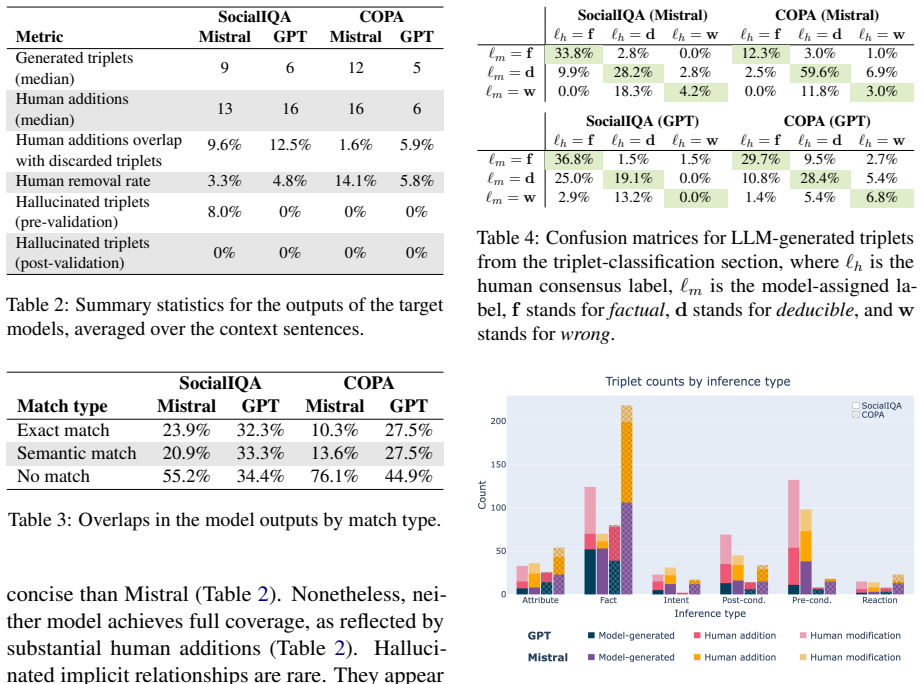
The paper establishes that LLM-based implicit information extraction pipelines produce relational triplets that humans largely agree with but find incomplete, as humans propose numerous additional inferences; furthermore, models exhibit greater conservatism in socially rich contexts compared to humans, who show more conservatism in shorter factual contexts.
What carries the argument
The LLM-based IIE pipeline, which extracts relational triplets from a context sentence, validates implicit inferences, and analyzes temporal relations to construct a knowledge graph.
Load-bearing premise
That the crowdsourced human annotations provide a reliable and unbiased standard for what counts as valid implicit information in the given sentences.
What would settle it
Running the same pipeline and human annotation process on a new dataset where models and humans produce statistically similar numbers of additional inferences would challenge the claim of limited LLM coverage.
If this is right
- LLM systems will require additional steps to achieve complete coverage of human-like implicit inferences.
- Context type influences the reliability of implicit extraction, with social contexts favoring human over model inferences.
- Knowledge graphs built from LLM outputs alone may miss key relational details present in human interpretations.
- Evaluation of LLMs on implicit tasks should account for both agreement and the volume of additional human suggestions.
Where Pith is reading between the lines
- Training LLMs on datasets that include human-proposed implicit additions could improve their coverage in future iterations.
- Applications involving dialogue or narrative understanding may need hybrid human-model systems to capture full implicit content.
- The observed patterns of conservatism suggest that model behavior could be tuned differently for social versus factual domains.
- Testing the pipeline on more diverse datasets might reveal whether the limited coverage is a general limitation or specific to the chosen contexts.
Editorial analysis
A structured set of objections, weighed in public.
Referee Report
Summary. The manuscript introduces the Implicit Information Extraction (IIE) task and an LLM-based pipeline that extracts relational triplets from context sentences, validates implicit inferences, and analyzes temporal relations. It evaluates two LLMs against crowdsourced human judgments on two datasets, claiming that humans agree with most model triplets but consistently propose many additions (indicating limited LLM coverage) and that models are more conservative about implicit inferences than humans in socially rich contexts while humans are more conservative in shorter, fact-oriented contexts.
Significance. If the central empirical comparisons hold after methodological clarification, the work would usefully document gaps in current LLM handling of implicit information relative to humans and identify context-type dependencies in inference conservatism. The public release of code at the cited GitHub repository is a clear strength supporting reproducibility. The overall significance remains moderate because the claims rest on unverified details of the human benchmark.
major comments (2)
- [Abstract and evaluation] Abstract and evaluation description: the reported findings on human-model agreement and context-dependent conservatism rest on crowdsourced judgments, yet the manuscript provides no information on dataset construction, number of annotators per item, inter-annotator agreement statistics, annotation guidelines, or statistical tests. Without these, it is impossible to determine whether the 'many additions' and conservatism differences reflect genuine model shortcomings or annotator variability and differing interpretations of 'implicit'.
- [IIE pipeline and experiments] Pipeline and comparison methodology: the triplet extraction, validation, and temporal analysis steps are described at a high level, but the manuscript does not report controls for prompt sensitivity, model choice effects, or explicit criteria used to decide when a human-proposed triplet counts as a true implicit inference missing from the model output. These omissions directly affect the load-bearing claim of limited LLM coverage.
minor comments (2)
- [Abstract] The abstract uses the term 'conservative' without a brief operational definition; adding one sentence would improve immediate clarity for readers.
- [Results] Figure or table captions describing the two datasets should explicitly state their sizes, domains, and how they were selected to support the social vs. fact-oriented contrast.
Simulated Author's Rebuttal
We thank the referee for the constructive feedback. We address each major comment below and will revise the manuscript accordingly to provide the requested methodological details.
read point-by-point responses
-
Referee: [Abstract and evaluation] Abstract and evaluation description: the reported findings on human-model agreement and context-dependent conservatism rest on crowdsourced judgments, yet the manuscript provides no information on dataset construction, number of annotators per item, inter-annotator agreement statistics, annotation guidelines, or statistical tests. Without these, it is impossible to determine whether the 'many additions' and conservatism differences reflect genuine model shortcomings or annotator variability and differing interpretations of 'implicit'.
Authors: We agree that these details are necessary to fully evaluate the human benchmark and the reported differences. The current manuscript omitted an expanded description of the crowdsourcing protocol for space reasons. In the revision we will add a dedicated subsection under Experiments that specifies dataset construction and sources, the number of annotators per item, inter-annotator agreement statistics, the annotation guidelines, and the statistical tests used to compare human and model outputs. This will allow readers to assess whether the observed patterns reflect genuine differences rather than annotator variability. revision: yes
-
Referee: [IIE pipeline and experiments] Pipeline and comparison methodology: the triplet extraction, validation, and temporal analysis steps are described at a high level, but the manuscript does not report controls for prompt sensitivity, model choice effects, or explicit criteria used to decide when a human-proposed triplet counts as a true implicit inference missing from the model output. These omissions directly affect the load-bearing claim of limited LLM coverage.
Authors: We acknowledge that the pipeline description is currently high-level. In the revised manuscript we will expand the IIE pipeline section to report (i) the specific prompts employed and results of prompt-sensitivity checks, (ii) the rationale for the two chosen LLMs together with any observed model-choice effects, and (iii) the explicit matching criteria (a combination of embedding-based semantic similarity and manual adjudication) used to determine when a human-proposed triplet constitutes a missing implicit inference. These additions will strengthen the evidence for limited LLM coverage. revision: yes
Circularity Check
No circularity: empirical comparison with independent human annotations
full rationale
The paper conducts an empirical evaluation of an LLM-based IIE pipeline against crowdsourced human judgments on two datasets, reporting agreement rates, proposed additions, and context-dependent differences in conservatism. No mathematical derivations, fitted parameters, or predictions appear; results follow directly from model outputs versus separate human annotations. No self-citations, uniqueness theorems, or ansatzes are invoked to support the central claims. The comparison is self-contained as standard experimental benchmarking without reduction to inputs by construction.
Axiom & Free-Parameter Ledger
invented entities (1)
-
Implicit Information Extraction (IIE) task
no independent evidence
read the original abstract
The interpretation of implicit meanings is an integral aspect of human communication. However, this framework may not transfer to interactions with Large Language Models (LLMs). To investigate this, we introduce the task of Implicit Information Extraction (IIE) and propose an LLM-based IIE pipeline that builds a structured knowledge graph from a context sentence by extracting relational triplets, validating implicit inferences, and analyzing temporal relations. We evaluate two LLMs against crowdsourced human judgments on two datasets. We find that humans agree with most model triplets yet consistently propose many additions, indicating limited coverage in current LLM-based IIE. Moreover, in our experiments, models appear to be more conservative about implicit inferences than humans in socially rich contexts, whereas humans become more conservative in shorter, fact-oriented contexts. Our code is available at https://github.com/Antonio-Dee/IIE_from_LLM.
Figures




Reference graph
Works this paper leans on
-
[1]
COfEE: A Comprehensive Ontology for Event Extraction from Text.Computer Speech & Language, 89:101702. Emily M. Bender, Timnit Gebru, Angelina McMillan- Major, and Shmargaret Shmitchell. 2021. On the Dangers of Stochastic Parrots: Can Language Models Be Too Big? InFAccT ’21: 2021 ACM Conference on Fairness, Accountability, and Transparency, pages 610–623. ...
work page 2021
-
[2]
Roi Cohen, Mor Geva, Jonathan Berant, and Amir Globerson
The Rise of AI-Generated Content in Wikipedia.Computing Research Repository (CoRR), abs/2410.08044. Roi Cohen, Mor Geva, Jonathan Berant, and Amir Globerson. 2023. Crawling The Internal Knowledge- Base of Language Models. InFindings of the Asso- ciation for Computational Linguistics: EACL 2023, pages 1811–1824. Association for Computational Linguistics. E...
-
[3]
The widespread adoption of large language model-assisted writing across society
A Survey of Text Classification With Trans- formers: How Wide? How Large? How Long? How Accurate? How Expensive? How Safe?IEEE Ac- cess, 12:6518–6531. Jiahui Geng, Fengyu Cai, Yuxia Wang, Heinz Koeppl, Preslav Nakov, and Iryna Gurevych. 2024. A Survey of Confidence Estimation and Calibration in Large Language Models. InProceedings of the 2024 Con- ference...
-
[4]
Improving Open Information Extraction with Large Language Models: A Study on Demonstra- tion Uncertainty.Computing Research Repository (CoRR). Mingyu Derek Ma, Jiao Sun, Mu Yang, Huang Kung- Hsiang, Nuan Wen, Shikhar Singh, Rujun Han, and Nanyun Peng. 2021. EventPlus: A Temporal Event Understanding Pipeline. InProceedings of the 2021 Conference of the Nor...
work page 2021
-
[5]
Annotating and Recognizing Event Modality in Text. InProceedings of the Nineteenth Interna- tional Florida Artificial Intelligence Research Soci- ety Conference, pages 333–339, Melbourne Beach, Florida, USA. AAAI Press. Pasi Shailendra, Rudra Chandra Ghosh, Rajdeep Ku- mar, and Nitin Sharma. 2024. Survey of Large Lan- guage Models for Answering Questions ...
work page 2024
discussion (0)
Sign in with ORCID, Apple, or X to comment. Anyone can read and Pith papers without signing in.