Electromagnetic Wightman functions and vacuum densities for a brane intersecting the AdS boundary
Pith reviewed 2026-05-10 05:22 UTC · model grok-4.3
The pith
A brane intersecting the AdS boundary induces nonzero vacuum expectation values for the electromagnetic energy-momentum tensor, with opposite signs for the two boundary conditions.
A machine-rendered reading of the paper's core claim, the machinery that carries it, and where it could break.
Core claim
The brane-induced contributions to the electromagnetic Wightman functions are derived explicitly in terms of elementary functions. These contributions produce vacuum expectation values whose signs for the electric-field square and magnetic-field square are opposite under the two boundary conditions. For the perfect-magnetic condition the electric contribution is negative while the magnetic contribution is positive. The vacuum expectation value of the energy-momentum tensor acquires a nonzero off-diagonal component, the energy density is positive for the perfect-magnetic condition, and both normal and parallel stresses change sign with distance from the brane. Unlike the Minkowski case, the V
What carries the argument
The brane-induced parts of the Wightman functions for the electromagnetic vector potential and field tensor, obtained by solving the wave equation in AdS geometry subject to the intersecting-brane boundary conditions.
If this is right
- The vacuum energy density remains positive for the perfect-magnetic boundary condition.
- Both normal and parallel stresses in the energy-momentum tensor change sign as a function of distance from the brane.
- The vacuum expectation values are reproduced by a scalar field with negative effective mass squared fixed by the AdS radius.
- The vacuum energy-momentum tensor stays nonzero throughout the (3+1)-dimensional AdS bulk.
Where Pith is reading between the lines
- The non-vanishing of the tensor in AdS but not in Minkowski space suggests that curvature alone can source vacuum stresses even with boundaries present.
- The sign reversal between the two boundary conditions may translate into different effective forces on the brane itself.
- The closed-form Wightman functions could be used to compute transition rates or entanglement measures for fields near the brane.
Load-bearing premise
The chosen boundary conditions on the brane are valid higher-dimensional generalizations of the perfect-electric and perfect-magnetic conditions, and the Wightman functions can be extracted by standard AdS techniques without extra regularization or mode mixing at the intersection point.
What would settle it
An independent calculation that finds a vanishing off-diagonal component in the vacuum energy-momentum tensor or a vanishing tensor everywhere would falsify the central result.
Figures
read the original abstract
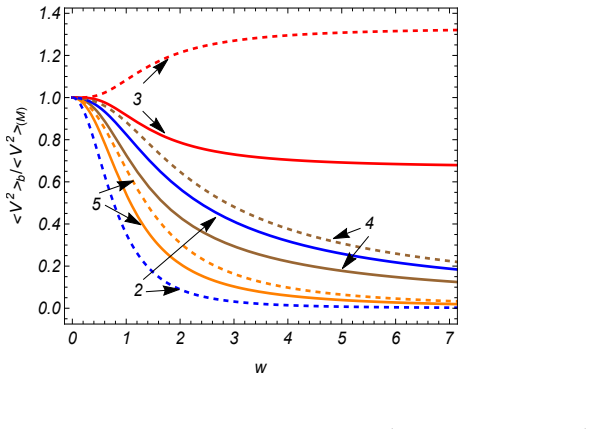
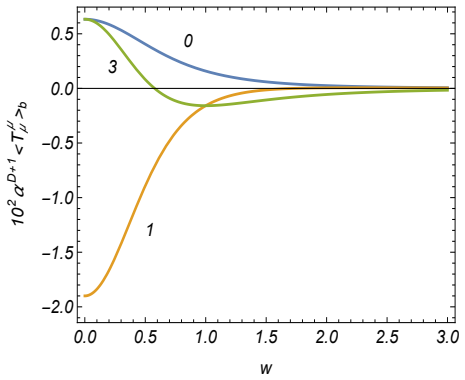
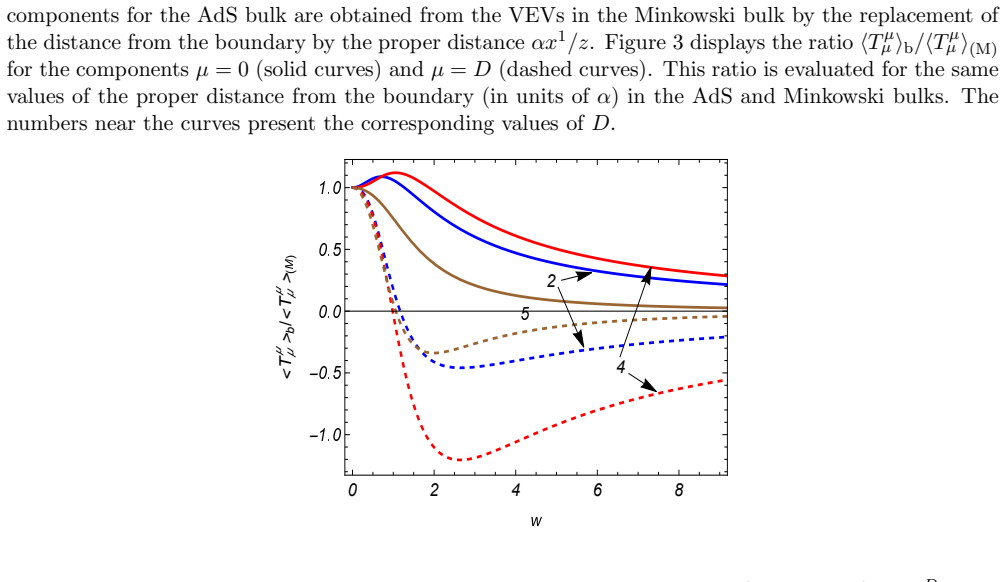
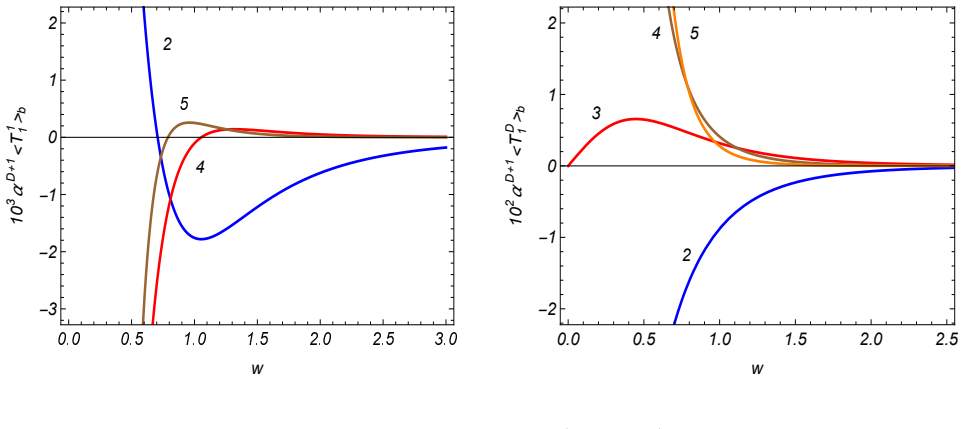
We investigate the combined effects of a brane intersecting the AdS boundary and background gravitational field on the local characteristics of the electromagnetic vacuum. Two types of boundary conditions on the brane are considered, which are higher-dimensional generalizations of the perfect electric (PEC) and perfect magnetic (PMC) boundary conditions in Maxwell's electrodynamics. The brane-induced contributions to the Wightman functions of the vector potential and field tensor are explicitly extracted. Simple expressions in terms of elementary functions are provided. The behavior of the vacuum expectation values (VEVs) is mimicked by a scalar field with a negative effective mass squared determined by the radius of the AdS spacetime. The expectation values of the electric and magnetic fields squares and of the energy-momentum tensor are investigated as local characteristics of the vacuum state. The brane-induced contributions to these VEVs have opposite signs for the PEC and PMC conditions. For the PMC condition, this contribution is negative for the electric field squared and positive for the magnetic field squared. The VEV of the energy-momentum tensor has a nonzero off-diagonal component. The brane-induced vacuum energy density is positive for PMC condition, whereas the normal and parallel stresses change sign as functions of the distance from the brane. Unlike the problem involving a planar boundary in the Minkowski bulk, the vacuum energy-momentum tensor does not vanish in (3+1)-dimensional AdS spacetime.
Editorial analysis
A structured set of objections, weighed in public.
Referee Report
Summary. The paper computes the brane-induced contributions to the electromagnetic Wightman functions for the vector potential and field strength in (3+1)-dimensional AdS spacetime with a brane intersecting the AdS boundary. It considers higher-dimensional generalizations of PEC and PMC boundary conditions, extracts explicit elementary-function expressions for these contributions, and uses them to evaluate the VEVs of E², B², and the energy-momentum tensor. The results are claimed to be mimicked by a negative-mass-squared scalar field, to exhibit opposite signs for PEC versus PMC, to include a nonzero off-diagonal EMT component, and to yield a non-vanishing EMT (unlike the Minkowski case).
Significance. If the explicit extractions and VEV computations are free of artifacts, the work provides concrete, usable expressions for vacuum polarization effects in a geometrically nontrivial AdS setup with intersecting boundaries. The mimicry by a negative-mass scalar and the curvature-induced non-vanishing of the EMT are potentially useful for holographic applications and for understanding how AdS curvature modifies Casimir-type physics. The elementary-function form is a strength that would facilitate further analytic or numerical studies.
major comments (3)
- [Section 3 (Wightman functions)] The central extraction of the brane-induced Wightman functions (the step that isolates the contributions from the intersecting brane while imposing both PEC/PMC conditions and AdS boundary fall-off) must be shown to be free of mode mixing or unsubtracted divergences at the codimension-2 intersection. The skeptic concern is load-bearing because the signs of the PEC/PMC contributions to <E²> and <B²>, the off-diagonal <T_zx>, and the positive brane-induced energy density for PMC all depend on the finite parts of these functions.
- [Section 4 (VEVs of field squares)] The statement that the VEVs are mimicked by a scalar field with negative effective mass squared determined by the AdS radius should be accompanied by an explicit identification of that mass value and a direct comparison of the functional forms (e.g., the distance dependence from the brane).
- [Section 5 (energy-momentum tensor)] The nonzero off-diagonal component of the energy-momentum tensor and the claimed sign changes of the normal and parallel stresses as functions of distance from the brane must be verified to satisfy the covariant conservation law ∇_μ <T^μ_ν> = 0 in AdS, including any boundary contributions at the intersection.
minor comments (2)
- [Section 2 (setup and boundary conditions)] Clarify the precise higher-dimensional definitions of the PEC and PMC conditions on the brane (tangential vs. normal components of F or A) and state whether they reduce exactly to the 3+1 Minkowski versions when the AdS radius is taken to infinity.
- [Section 3] The abstract claims 'simple expressions in terms of elementary functions'; ensure that all steps leading to these expressions (including any image-charge or mode-sum techniques adapted to AdS) are written out with sufficient intermediate steps for reproducibility.
Simulated Author's Rebuttal
We thank the referee for the careful reading of our manuscript and the constructive major comments. We address each point below and will revise the manuscript to strengthen the derivations and verifications as indicated.
read point-by-point responses
-
Referee: [Section 3 (Wightman functions)] The central extraction of the brane-induced Wightman functions (the step that isolates the contributions from the intersecting brane while imposing both PEC/PMC conditions and AdS boundary fall-off) must be shown to be free of mode mixing or unsubtracted divergences at the codimension-2 intersection. The skeptic concern is load-bearing because the signs of the PEC/PMC contributions to <E²> and <B²>, the off-diagonal <T_zx>, and the positive brane-induced energy density for PMC all depend on the finite parts of these functions.
Authors: We agree that an explicit demonstration of regularity at the codimension-2 intersection is necessary. Our derivation employs the method of images in AdS spacetime, subtracting the pure AdS contribution after imposing the PEC/PMC conditions on the brane and the appropriate fall-off at the AdS boundary. The resulting elementary-function expressions for the brane-induced Wightman functions are finite everywhere, including at the intersection, with no residual divergences or mode mixing in the subtracted terms. To address the concern directly, we will add a dedicated paragraph in Section 3 that examines the limiting behavior near the intersection and confirms the absence of artifacts in the finite parts used for the VEVs. revision: yes
-
Referee: [Section 4 (VEVs of field squares)] The statement that the VEVs are mimicked by a scalar field with negative effective mass squared determined by the AdS radius should be accompanied by an explicit identification of that mass value and a direct comparison of the functional forms (e.g., the distance dependence from the brane).
Authors: We will revise the relevant paragraph in Section 4 to provide the explicit value of the effective mass squared (fixed by the AdS curvature radius) and include a direct side-by-side comparison of the functional forms. This will explicitly show that the distance dependence of the electromagnetic VEVs from the brane matches the corresponding scalar-field expressions with that mass. revision: yes
-
Referee: [Section 5 (energy-momentum tensor)] The nonzero off-diagonal component of the energy-momentum tensor and the claimed sign changes of the normal and parallel stresses as functions of distance from the brane must be verified to satisfy the covariant conservation law ∇_μ <T^μ_ν> = 0 in AdS, including any boundary contributions at the intersection.
Authors: Because the VEVs are constructed from Wightman functions that satisfy the Maxwell equations in AdS, the conservation law is expected to hold by construction. Nevertheless, we will add an explicit verification in Section 5 by direct computation of the covariant divergence of the brane-induced <T^μ_ν>, confirming that it vanishes identically with no additional boundary contributions at the intersection arising from the imposed conditions. revision: yes
Circularity Check
No circularity: direct extraction of Wightman functions from AdS geometry and boundary conditions
full rationale
The derivation proceeds by imposing the higher-dimensional PEC/PMC conditions simultaneously with AdS boundary fall-offs, then explicitly constructing the brane-induced parts of the Wightman functions for A_μ and F_μν via standard mode-sum or image-charge techniques in AdS. These yield elementary-function expressions whose VEVs (including opposite signs for PEC/PMC, nonzero off-diagonal <T_zx>, and non-vanishing EMT unlike the Minkowski case) are computed directly as consequences. No parameter is fitted to a subset of data and relabeled a prediction, no self-citation supplies a uniqueness theorem or ansatz that the present work merely renames, and the negative-mass scalar mimicry is an observed outcome rather than an input. The chain is self-contained against external benchmarks and does not reduce to its own definitions.
Axiom & Free-Parameter Ledger
axioms (2)
- domain assumption Standard definition and properties of Wightman functions and vacuum expectation values in curved spacetime
- domain assumption Validity of PEC and PMC as higher-dimensional boundary conditions for Maxwell field
Reference graph
Works this paper leans on
-
[1]
S.W. Hawking, G.F.R. Ellis, The Large Scale Structure of Space-Time, Cambridge, Cambridge University Press, 1973
work page 1973
-
[2]
J.B. Griffiths, J. Podolsky, Exact Space-Times in Einstei n’s General Relativity, Cambridge, Cam- bridge University Press, 2009
work page 2009
-
[3]
O. Aharony, S.S. Gubser, J. Maldacena, H. Ooguri, Y. Oz, L arge N field theories, string theory and gravity, Phys. Rep. 323 (2000) 183
work page 2000
-
[4]
N˘ astase, Introduction to AdS/CFT Correspondence, C ambridge, Cambridge University Press, 2015
H. N˘ astase, Introduction to AdS/CFT Correspondence, C ambridge, Cambridge University Press, 2015
work page 2015
- [5]
-
[6]
J. Zaanen, Y.-W. Sun, Y. Liu, K. Schalm, Holographic Dual ity in Condensed Matter Physics, Cam- bridge, Cambridge University Press, 2015
work page 2015
-
[7]
P. Brax, C. van de Bruck, A.-C. Davis, Brane world cosmolo gy, Rep. Prog. Phys. 67 (2004) 2183
work page 2004
-
[8]
R. Maartens, K. Koyama, Brane-world gravity, Living Rev . Relativity 13 (2010) 5
work page 2010
-
[9]
V. M. Mostepanenko, N.N. Trunov, The Casimir Effect and Its Applications, Oxford, Clarendon, 1997
work page 1997
-
[10]
K.A. Milton, The Casimir Effect: Physical Manifestation of Zero-Point Energy, Singapore, World Scientific, 2002
work page 2002
-
[11]
M. Bordag, G.L. Klimchitskaya, U. Mohideen, V.M. Moste panenko, Advances in the Casimir Effect, New York, Oxford University Press, 2009
work page 2009
- [12]
-
[13]
M. Fabinger, P. Horava, Casimir effect between world-bra nes in heterotic M-theory, Nucl. Phys. B 580 (2000) 243
work page 2000
- [14]
-
[15]
Toms, Quantised bulk fields in the Randall–Sundrum compactification model, Phys
D.J. Toms, Quantised bulk fields in the Randall–Sundrum compactification model, Phys. Lett. B 484 (2000) 149
work page 2000
- [16]
-
[17]
W. D. Goldberger, I. Z. Rothstein, Quantum stabilizati on of compactified AdS 5, Phys. Lett. B 491 (2000) 339
work page 2000
- [18]
-
[19]
J. Garriga, O. Pujol´ as, T. Tanaka, Radion effective pote ntial in the brane-world, Nucl. Phys. B 605 (2001) 192. 18
work page 2001
-
[20]
I.H. Brevik, K.A. Milton, S. Nojiri, S.D. Odintsov, Qua ntum (in)stability of a brane-world AdS 5 universe at nonzero temperature, Nucl. Phys. B 599 (2001) 30 5
work page 2001
-
[21]
A. Flachi, D.J. Toms, Quantized bulk scalar fields in the Randall-Sundrum brane model, Nucl. Phys. B 610 (2001) 144
work page 2001
-
[22]
A. Flachi, I.G. Moss, D.J. Toms, Fermion vacuum energie s in brane world models, Phys. Lett. B 518 (2001) 153
work page 2001
-
[23]
A. Flachi, I.G. Moss, D.J. Toms, Quantized bulk fermion s in the Randall-Sundrum brane model, Phys. Rev. D 64 (2001) 105029
work page 2001
-
[24]
A.A. Saharian, M.R. Setare, The Casimir effect on backgro und of conformally flat brane-world geometries, Phys. Lett. B 552 (2003) 119
work page 2003
-
[25]
E. Elizalde, S. Nojiri, S.D. Odintsov, S. Ogushi, Casim ir effect in de Sitter and anti-de Sitter braneworlds, Phys. Rev. D 67 (2003) 063515
work page 2003
- [26]
- [27]
-
[28]
J. Garriga, A. Pomarol, A stable hierarchy from Casimir forces and the holographic interpretation Phys. Lett. B 560 (2003) 91
work page 2003
- [29]
- [30]
-
[31]
E. Elizalde, M. Minamitsuji, W. Naylor, Casimir effect in rugby-ball type flux compactifications, Phys. Rev. D 75 (2007) 064032
work page 2007
-
[32]
A.A. Saharian, A.L. Mkhitaryan, Wightman function and vacuum densities for a Z 2-symmetric thick brane in AdS spacetime, J. High Energy Phys. 08 (2007) 063
work page 2007
- [33]
-
[34]
R. Linares, H.A. Morales-T´ ecotl, O. Pedraza, Casimir force for a scalar field in warped brane worlds, Phys. Rev. D 77 (2008) 066012
work page 2008
- [35]
- [36]
-
[37]
L.P. Teo, Casimir effect in spacetime with extra dimensio ns - from Kaluza-Klein to Randall-Sundrum models, Phys. Lett. B 682 (2009) 259
work page 2009
-
[38]
M. Rypestol, I. Brevik, Finite-temperature Casimir effe ct in Randall-Sundrum models, New J. Phys. 12 (2010) 013022
work page 2010
- [39]
-
[40]
Teo, Finite temperature fermionic Casimir intera ction in anti-de Sitter space-time, Int
L.P. Teo, Finite temperature fermionic Casimir intera ction in anti-de Sitter space-time, Int. J. Mod. Phys. A 28 (2013) 1350158
work page 2013
-
[41]
R.A. Knapman, D.J. Toms, Stress-energy tensor for a qua ntized bulk scalar field in the Randall- Sundrum brane model, Phys. Rev. D 69 (2004) 044023
work page 2004
-
[42]
A.A. Saharian, Wightman function and Casimir densitie s on AdS bulk with application to the Randall-Sundrum braneworld, Nucl. Phys. B 712 (2005) 196
work page 2005
-
[43]
Saharian, Wightman function and vacuum fluctuatio ns in higher dimensional brane models, Phys
A.A. Saharian, Wightman function and vacuum fluctuatio ns in higher dimensional brane models, Phys. Rev. D 73 (2006) 044012
work page 2006
-
[44]
A.A. Saharian, Bulk Casimir densities and vacuum inter action forces in higher dimensional brane models, Phys. Rev. D 73 (2006) 064019
work page 2006
-
[45]
S.-H. Shao, P. Chen, J.-A. Gu, Stress-energy tensor ind uced by a bulk Dirac spinor in the Randall- Sundrum model, Phys. Rev. D 81 (2010) 084036
work page 2010
-
[46]
E. Elizalde, S.D. Odintsov, A.A. Saharian, Fermionic C asimir densities in anti-de Sitter spacetime, Phys. Rev. D 87 (2013) 084003
work page 2013
-
[47]
S. Bellucci, W. Oliveira dos Santos, E.R. Bezerra de Mel lo, A.A. Saharian, Cosmic string and brane induced effects on the fermionic vacuum in AdS spacetime, J. Hi gh Energy Phys. 05 (2022) 021
work page 2022
-
[48]
A.A. Saharian, Surface Casimir densities and induced c osmological constant on parallel branes in AdS spacetime, Phys. Rev. D 70 (2004) 064026
work page 2004
-
[49]
A.A. Saharian, Surface Casimir densities and induced c osmological constant in higher dimensional braneworlds, Phys. Rev. D 74 (2006) 124009
work page 2006
-
[50]
Teo, Casimir effect of electromagnetic field in Randa ll-Sundrum spacetime, J
L.P. Teo, Casimir effect of electromagnetic field in Randa ll-Sundrum spacetime, J. High Energy Phys. 10 (2010) 019
work page 2010
-
[51]
A.S. Kotanjyan, A.A. Saharian, Electromagnetic quant um effects in anti-de Sitter spacetime, Phys. At. Nucl. 80 (2017) 562
work page 2017
-
[52]
A.A. Saharian, A.S. Kotanjyan, A.A. Saharyan, H. G. Sar gsyan, Electromagnetic Casimir densities for planar boundaries in AdS spacetime, Int. J. Mod. Phys. A 3 5 (2020) 2040029
work page 2020
-
[53]
A.A. Saharian, A.S. Kotanjyan, H.G. Sargsyan, Electro magnetic field correlators and the Casimir effect for planar boundaries in AdS spacetime with applicatio n in braneworlds, Phys. Rev. D 102 (2020) 105014
work page 2020
-
[54]
Takayanagi, Holographic dual of BCFT, Phys
T. Takayanagi, Holographic dual of BCFT, Phys. Rev. Let t. 107 (2011) 101602
work page 2011
- [55]
- [56]
-
[57]
Suzuki, Gauge symmetries and conserved currents in A dS/BCFT, J
K. Suzuki, Gauge symmetries and conserved currents in A dS/BCFT, J. High Energy Phys. 06 (2024) 137
work page 2024
- [58]
- [59]
- [60]
-
[61]
S. Ryu, T. Takayanagi, Holographic derivation of entan glement entropy from the anti-de Sitter space/Conformal field theory correspondence, Phys. Rev. Le tt. 96 (2006) 181602
work page 2006
-
[62]
S. Ryu, T. Takayanagi, Aspects of holographic entangle ment entropy, J. High Energy Phys. 08 (2006) 045
work page 2006
-
[63]
T. Nishioka, S. Ryu, T. Takayanagi, Holographic entang lement entropy: an overview, J. Phys. A 42 (2009) 504008
work page 2009
-
[64]
B. Chen, B. Czech, Zi-Zhi Wang, Quantum information in h olographic duality, Rep. Prog. Phys. 85 (2022) 046001
work page 2022
-
[65]
E.R. Bezerra de Mello, A.A. Saharian, M.R. Setare, Vacu um densities for a brane intersecting the AdS boundary, Phys. Rev. D 92 (2015) 104005
work page 2015
-
[66]
S. Bellucci, A.A. Saharian, V.Kh. Kotanjyan, Vacuum de nsities and the Casimir forces for branes orthogonal to the AdS boundary, Phys. Rev. D 106 (2022) 06502 1
work page 2022
-
[67]
A.A. Saharian, Surface Casimir densities on branes ort hogonal to the boundary of anti-de Sitter spacetime, Physics 5(4) (2023) 1145
work page 2023
-
[68]
P.C.W. Davies, S.D. Unwin, Quantum vacuum energy and th e masslessness of the photon, Phys. Lett. B 98 (1981) 274
work page 1981
-
[69]
Barton, The Casimir effect with finite mass photons, Ann
G. Barton, The Casimir effect with finite mass photons, Ann . Phys. 162 (1985) 231
work page 1985
-
[70]
A.A. Saharian, H.H. Asatryan, Two-point functions and the vacuum densities in the Casimir effect for the Proca field, Eur. Phys. J. Plus 141 (2026) 106
work page 2026
-
[71]
B. Allen,T. Jacobson, Vector two point functions in max imally symmetric spaces, Commun. Math. Phys. 103 (1986) 669
work page 1986
- [72]
-
[73]
E. D’Hoker, D. Z. Freedman, Gauge boson exchange in AdS d+1, Nucl. Phys. B 544 (1999) 612
work page 1999
-
[74]
A.P. Prudnikov, Yu.A. Brychkov, O.I. Marichev, Integr als and Series, New York, Gordon and Breach, 1986, Vol. 2
work page 1986
-
[75]
N.D. Birrell, P.C.W. Davies, Quantum Fields in Curved S pace, Cambridge, Cambridge University Press, 1982
work page 1982
- [76]
discussion (0)
Sign in with ORCID, Apple, or X to comment. Anyone can read and Pith papers without signing in.