Recognition: unknown
Smokescreen: A Python package for data vector blinding and encryption in cosmological analyses
Pith reviewed 2026-05-10 04:05 UTC · model grok-4.3
The pith
A Python package blinds cosmological data vectors by adding cosmology-dependent shifts computed from the analysis model itself.
A machine-rendered reading of the paper's core claim, the machinery that carries it, and where it could break.
Core claim
The package implements data-vector blinding by computing cosmology-dependent shifts using likelihood evaluations on data vectors stored in a standard format, ensuring the theoretical model used for blinding is identical to the one used for inference while remaining agnostic to the specific observable. The original data file is encrypted to prevent accidental unblinding.
What carries the argument
cosmology-dependent shifts to data vectors computed via likelihood evaluations on standardized storage formats, paired with encryption of the true data file
Load-bearing premise
That applying cosmology-dependent shifts moves the observed data vector away from the true signal without changing its statistical properties, and that encryption reliably prevents accidental unblinding.
What would settle it
A test on simulated data with known input cosmology showing that blinded vectors produce parameter constraints matching the input only after the shifts are exactly reversed and the encryption is lifted.
Figures


read the original abstract
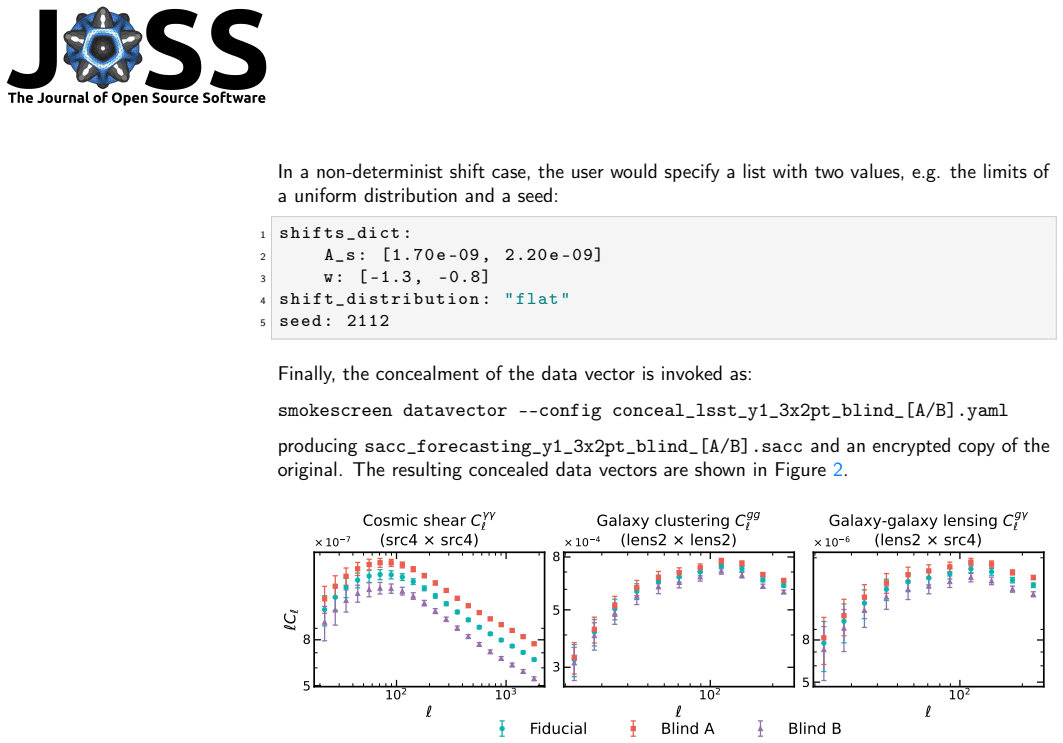
Smokescreen is an open-source Python library for data-vector concealment (blinding) in cosmological analyses. Data-vector blinding works by applying cosmology-dependent shifts to the observed data vector, moving it away from the true cosmological signal without affecting its statistical properties, so that analysts cannot infer the true result until the analysis is frozen and the blinding is lifted. The package computes these shifts using Firecrown likelihoods applied to data vectors stored in the SACC format, ensuring that the theoretical model used for blinding is identical to that used for inference whilst remaining agnostic to the specific observable being blinded. To prevent accidental unblinding, the original SACC file, containing the true cosmology, is encrypted. Although developed for the Vera C. Rubin Observatory Legacy Survey of Space and Time (LSST), Smokescreen is applicable to any experiment using Firecrown likelihoods and the SACC data format.
Editorial analysis
A structured set of objections, weighed in public.
Referee Report
Summary. Smokescreen is an open-source Python package for data-vector blinding in cosmological analyses. It computes additive, cosmology-dependent shifts to observed data vectors in SACC format by reusing Firecrown likelihoods (ensuring the blinding model matches the inference model), moves the vector away from the true cosmology without altering statistical properties, and encrypts the original file to prevent accidental unblinding. The package was developed for LSST but is presented as applicable to any Firecrown/SACC-based analysis.
Significance. If the implementation performs as described, the package addresses a practical need in large-scale cosmological surveys by providing a reproducible blinding workflow that maintains consistency between blinding and inference steps. The open-source release, use of standard SACC and Firecrown formats, and emphasis on encryption are strengths that support community adoption and analysis integrity.
major comments (2)
- [Validation or Implementation section] The central claim that additive shifts preserve statistical properties (covariance matrix and Gaussian likelihood shape) is stated as holding by construction, but the manuscript provides no explicit validation test or numerical demonstration (e.g., comparison of blinded vs. unblinded likelihoods on synthetic data) to confirm this in practice. This is load-bearing for the package's utility.
- [Encryption workflow description] The encryption step is described as preventing accidental unblinding, but the manuscript does not specify the encryption algorithm, key management, or how the blinded file is delivered to analysts while keeping the original secure. This detail is necessary to assess reliability against the weakest assumption noted in the design.
minor comments (3)
- [Abstract and Introduction] The abstract and introduction would benefit from a direct link to the GitHub repository, installation instructions, and example usage notebook to make the package immediately usable by readers.
- [Introduction] The manuscript should include a brief comparison to existing blinding tools or methods in cosmology (e.g., prior LSST or DES blinding approaches) to clarify the novelty of the Firecrown/SACC integration.
- [Figures] Figure captions and workflow diagrams (if present) should explicitly label the data flow from original SACC file through blinding shift to encrypted output.
Simulated Author's Rebuttal
We thank the referee for their positive assessment of the manuscript and for the recommendation of minor revision. Their comments highlight important areas for clarification that will strengthen the presentation of the package. We address each major comment below.
read point-by-point responses
-
Referee: [Validation or Implementation section] The central claim that additive shifts preserve statistical properties (covariance matrix and Gaussian likelihood shape) is stated as holding by construction, but the manuscript provides no explicit validation test or numerical demonstration (e.g., comparison of blinded vs. unblinded likelihoods on synthetic data) to confirm this in practice. This is load-bearing for the package's utility.
Authors: We agree that an explicit numerical demonstration would improve the manuscript. Although the preservation of the covariance matrix and Gaussian likelihood shape follows directly from the additive, data-independent nature of the shifts (as the blinding offset is computed from the theory prediction alone), we will add a new validation subsection. This will include a comparison of blinded versus unblinded likelihoods on synthetic data vectors, confirming that the statistical properties remain unchanged in practice. The revision will be made in the Implementation or Validation section. revision: yes
-
Referee: [Encryption workflow description] The encryption step is described as preventing accidental unblinding, but the manuscript does not specify the encryption algorithm, key management, or how the blinded file is delivered to analysts while keeping the original secure. This detail is necessary to assess reliability against the weakest assumption noted in the design.
Authors: We appreciate the request for additional operational details. The manuscript currently describes the encryption at a conceptual level to emphasize its role in the blinding workflow. In the revised version we will expand the relevant section to specify the encryption algorithm (AES-256 in CBC mode), the key-management approach (keys stored separately with access restricted to authorized personnel), and the delivery protocol (analysts receive only the blinded SACC file while the original remains encrypted and inaccessible until unblinding is authorized). These additions will directly address the security assumptions. revision: yes
Circularity Check
No significant circularity
full rationale
This is a software description paper for the Smokescreen package. It contains no derivations, equations, fitted parameters, predictions, or first-principles results. The central claims describe implemented functionality (additive cosmology-dependent shifts via Firecrown on SACC files, followed by encryption) that are realized in released code rather than reduced to prior results by construction. No self-citation load-bearing steps, ansatz smuggling, or renaming of known results appear. The package is self-contained against external benchmarks (Firecrown and SACC are independent libraries), yielding a normal non-finding of circularity.
Axiom & Free-Parameter Ledger
Reference graph
Works this paper leans on
-
[1]
Charles R. Harris and K. Jarrod Millman and St. Array programming with. 2020 , journal =. doi:10.1038/s41586-020-2649-2 , publisher =
-
[2]
and Haberland, Matt and Reddy, Tyler and Cournapeau, David and Burovski, Evgeni and Peterson, Pearu and Weckesser, Warren and Bright, Jonathan and
Virtanen, Pauli and Gommers, Ralf and Oliphant, Travis E. and Haberland, Matt and Reddy, Tyler and Cournapeau, David and Burovski, Evgeni and Peterson, Pearu and Weckesser, Warren and Bright, Jonathan and. Nature Methods , year =
-
[3]
Hunter, J. D. , Title =. Computing in Science & Engineering , Volume =
-
[4]
2016, in ELPUB, 87–90, doi: 10.3233/978-1-61499-649-1-87
Jupyter Notebooks a publishing format for reproducible computational workflows. IOS Press , year = 2016, pages =. doi:10.3233/978-1-61499-649-1-87 , adsurl =
-
[5]
McKerns and Leif Strand and Tim Sullivan and Alta Fang and Michael A
Michael M. McKerns and Leif Strand and Tim Sullivan and Alta Fang and Michael A. G. Aivazis , title =. arXiv preprint arXiv:1202.1056 , year =
-
[6]
Blinding multiprobe cosmological experiments. , keywords =. doi:10.1093/mnras/staa965 , archivePrefix =. 1911.05929 , primaryClass =
-
[7]
doi:10.1051/0004-6361/202554908 , archiveprefix =
KiDS-Legacy: Cosmological constraints from cosmic shear with the complete Kilo-Degree Survey. , keywords =. doi:10.1051/0004-6361/202554908 , archivePrefix =. 2503.19441 , primaryClass =
-
[8]
doi:10.48550/arXiv.2601.14559 , archiveprefix =
Dark Energy Survey Year 6 Results: Cosmological Constraints from Galaxy Clustering and Weak Lensing. arXiv e-prints , keywords =. doi:10.48550/arXiv.2601.14559 , archivePrefix =. 2601.14559 , primaryClass =
-
[9]
Hyper Suprime-Cam Year 3 results: Cosmology from galaxy clustering and weak lensing with HSC and SDSS using the emulator based halo model. , keywords =. doi:10.1103/PhysRevD.108.123517 , archivePrefix =. 2304.00704 , primaryClass =
-
[10]
Large Synoptic Survey Telescope: Dark Energy Science Collaboration
Large Synoptic Survey Telescope: Dark Energy Science Collaboration. arXiv e-prints , keywords =. doi:10.48550/arXiv.1211.0310 , archivePrefix =. 1211.0310 , primaryClass =
-
[11]
, archivePrefix = "arXiv", eprint =
The DES Science Verification weak lensing shear catalogues. , keywords =. doi:10.1093/mnras/stw990 , archivePrefix =. 1507.05603 , primaryClass =
-
[12]
Blind Observers of the Sky. , keywords =. doi:10.1088/1475-7516/2020/09/052 , archivePrefix =. 2006.10857 , primaryClass =
-
[13]
Measurement of _ m , _ from a Blind Analysis of Type Ia Supernovae with CMAGIC: Using Color Information to Verify the Acceleration of the Universe. , keywords =. doi:10.1086/503533 , archivePrefix =. astro-ph/0602411 , primaryClass =
-
[14]
A blinding solution for inference from astronomical data. , keywords =. doi:10.1093/mnras/staa043 , archivePrefix =. 1910.08533 , primaryClass =
-
[15]
The Astrophysical Journal Supplement Series , author =
Core Cosmology Library: Precision Cosmological Predictions for LSST. , keywords =. doi:10.3847/1538-4365/ab1658 , archivePrefix =. 1812.05995 , primaryClass =
-
[16]
CosmoSIS: Modular cosmological parameter estimation. Astronomy and Computing , keywords =. doi:10.1016/j.ascom.2015.05.005 , archivePrefix =. 1409.3409 , primaryClass =
-
[17]
2021, JCAP, 05, 057, doi: 10.1088/1475-7516/2021/05/057 van Eerten, H
Cobaya: code for Bayesian analysis of hierarchical physical models. , keywords =. doi:10.1088/1475-7516/2021/05/057 , archivePrefix =. 2005.05290 , primaryClass =
-
[18]
S. D. P. Vitenti and M. Penna-Lima , year =. ascl , primaryclass =:1408.013 , adsurl =
-
[19]
Lange, Johannes U , title = ". Monthly Notices of the Royal Astronomical Society , volume =. 2023 , month =. doi:10.1093/mnras/stad2441 , url =
-
[20]
The Journal of Open Source Software , year = 2016, month = aug, volume = 1, eid =
ChainConsumer. The Journal of Open Source Software , year = 2016, month = aug, volume = 1, eid =. doi:10.21105/joss.00045 , adsurl =
-
[21]
doi:10.1051/0004-6361/201322068 , Eid =. arXiv , Author =:1307.6212 , Journal =
-
[22]
The Astronomical Journal , author =
The Astropy Project: Building an Open-science Project and Status of the v2.0 Core Package. , keywords =. doi:10.3847/1538-3881/aabc4f , archivePrefix =. 1801.02634 , primaryClass =
-
[23]
The Astropy Project: Sustaining and Growing a Community-oriented Open-source Project and the Latest Major Release (v5.0) of the Core Package. , keywords =. doi:10.3847/1538-4357/ac7c74 , archivePrefix =. 2206.14220 , primaryClass =
work page internal anchor Pith review Pith/arXiv arXiv doi:10.3847/1538-4357/ac7c74
-
[24]
Armando Solé and jialin and Daniel Hay Guest and Yu Feng and Mark Kittisopikul , title =
Andrew Collette and Thomas Kluyver and Thomas A Caswell and James Tocknell and Jerome Kieffer and Aleksandar Jelenak and Anthony Scopatz and Darren Dale and Chen and Thomas VINCENT and Matt Einhorn and payno and juliagarriga and Pierlauro Sciarelli and Valentin Valls and Satrajit Ghosh and Ulrik Kofoed Pedersen and jakirkham and Martin Raspaud and Cyril D...
-
[25]
2000, ApJ, 538, 473, doi: 10.1086/309179
Efficient Computation of Cosmic Microwave Background Anisotropies in Closed Friedmann-Robertson-Walker Models. , keywords =. doi:10.1086/309179 , archivePrefix =. astro-ph/9911177 , primaryClass =
-
[26]
CMB power spectrum parameter degeneracies in the era of precision cosmology. , keywords =. doi:10.1088/1475-7516/2012/04/027 , archivePrefix =. 1201.3654 , primaryClass =
-
[27]
HMCODE-2020: improved modelling of non-linear cosmological power spectra with baryonic feedback. , keywords =. doi:10.1093/mnras/stab082 , archivePrefix =. 2009.01858 , primaryClass =
-
[28]
A unified pseudo-C _ framework. , keywords =. doi:10.1093/mnras/stz093 , archivePrefix =. 1809.09603 , primaryClass =
-
[29]
Brand, Amy and Allen, Liz and Altman, Micah and Hlava, Marjorie and Scott, Jo , title =. Learned Publishing , volume =. doi:10.1087/20150211 , year =
-
[30]
The Open Journal of Astrophysics , keywords =
The catalog-to-cosmology framework for weak lensing and galaxy clustering for LSST. The Open Journal of Astrophysics , keywords =. doi:10.21105/astro.2212.09345 , archivePrefix =. 2212.09345 , primaryClass =
discussion (0)
Sign in with ORCID, Apple, or X to comment. Anyone can read and Pith papers without signing in.