Recognition: unknown
Symmetry resolved entanglement in Lifshitz field theories
Pith reviewed 2026-05-10 02:50 UTC · model grok-4.3
The pith
Symmetry-resolved entanglement in Lifshitz scalar theories shows approximate equipartition at large dynamical exponent z with configurational entropy dominating, while fermionic models require the relativistic limit for genuine equipartitio
A machine-rendered reading of the paper's core claim, the machinery that carries it, and where it could break.
Core claim
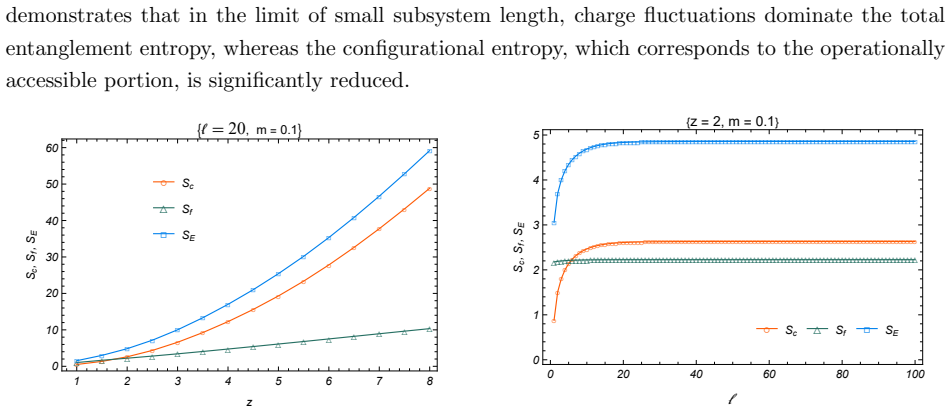
Using charged moments and the correlator method, the authors compute the symmetry-resolved Renyi and von Neumann entropies for Lifshitz theories. In Lifshitz scalar theories, approximate equipartition among charge sectors emerges in the large-z regime, with configurational entropy dominating, whereas Lifshitz fermionic models exhibit genuine equipartition only in the relativistic limit, with fluctuation entropy prevailing. The results also track the dependence on subsystem size, charge, mass, and the dynamical exponent z.
What carries the argument
Charged moments combined with the correlator method, which projects the entanglement entropy onto definite charge sectors in the Lifshitz models.
If this is right
- Approximate equipartition for large-z scalars implies configurational entropy dominates over fluctuation entropy in those models.
- Genuine equipartition for fermions at z=1 implies fluctuation entropy is the prevailing contribution in the relativistic limit.
- The resolved entropies vary with subsystem size, conserved charge, mass parameter, and dynamical exponent z in distinct scalar versus fermionic patterns.
- The approach supplies a calculational framework for operationally accessible, charge-resolved entanglement in non-relativistic quantum systems.
Where Pith is reading between the lines
- Particle-number resolved measurements in cold-atom realizations of Lifshitz scaling could distinguish scalar from fermionic cases by testing the predicted equipartition thresholds.
- The same charge-sector analysis may apply to other non-relativistic condensed-matter models with conserved particle number.
- Checking whether the approximate-equipartition feature survives in interacting Lifshitz theories would test the robustness of the free-field results.
Load-bearing premise
The charged moments and correlator method remain valid and sufficient to extract symmetry-resolved entropies in these Lifshitz models without additional non-relativistic corrections or ultraviolet divergences that would alter the reported equipartition behavior.
What would settle it
A direct numerical or experimental computation of charge-sector decomposed von Neumann entropy in a large-z Lifshitz scalar model that fails to exhibit approximate equipartition would falsify the central claim.
Figures




read the original abstract
We investigate symmetry-resolved entanglement in non-relativistic quantum field theories, including complex Lifshitz scalar chains and Lifshitz fermionic models. Using charged moments and the correlator method, we compute symmetry-resolved Renyi and von Neumann entropies and analyze their dependence on subsystem size, charge, mass, and the dynamical exponent z. Our results reveal distinct features of non-relativistic entanglement. In Lifshitz scalar theories, approximate equipartition among charge sectors emerges in the large-z regime, with configurational entropy dominating, whereas Lifshitz fermionic models exhibit genuine equipartition only in the relativistic limit, with fluctuation entropy prevailing. These findings highlight a rich interplay between conserved charges, subsystem size, mass, and dynamical scaling, and provide a framework to explore operationally accessible entanglement in non-relativistic systems. Our study offers insights relevant to experimental platforms such as cold atom setups and mesoscopic systems, where particle-number-resolved measurements can probe symmetry-resolved entanglement.
Editorial analysis
A structured set of objections, weighed in public.
Referee Report
Summary. The paper investigates symmetry-resolved Rényi and von Neumann entropies in Lifshitz scalar chains and fermionic models using charged moments and the correlator method. It reports approximate equipartition among charge sectors for scalars in the large-z regime (configurational entropy dominant) and genuine equipartition for fermions only in the relativistic limit z=1 (fluctuation entropy dominant), with dependence on subsystem size, charge, and mass.
Significance. If the central calculations are robust, the work identifies distinct non-relativistic signatures in symmetry-resolved entanglement and supplies a framework for probing operationally accessible entanglement in systems such as cold atoms, where particle-number resolution is feasible.
major comments (2)
- [§3] §3 (Charged moments for Lifshitz scalars): the derivation of Z_n(α) via the correlator method assumes the standard Gaussian form without explicit regularization of the anisotropic UV divergences arising from the (∂^z ϕ)^2 term; this is load-bearing because any z-dependent charge-sector corrections would modify the Fourier transform to p(Q) and the reported dominance of configurational entropy at large z.
- [§5] §5 (Fermionic Lifshitz results): the claim of genuine equipartition only at z=1 rests on the two-point function scaling |x-y|^{-1/z} yielding no extra charge-dependent terms in the charged moments for z≠1, yet no explicit check or counter-term analysis is provided to confirm the absence of such corrections when the Hamiltonian contains higher spatial derivatives.
minor comments (2)
- [Abstract] The abstract states the main results without referencing the lattice discretization or continuum extrapolation procedure employed for the Lifshitz chains.
- [Figures] Figure captions for the entropy plots should include the numerical precision or fitting range used in the correlator evaluations.
Simulated Author's Rebuttal
We thank the referee for their careful reading of our manuscript and for providing constructive feedback. We address each of the major comments in detail below. We agree that additional clarifications on regularization and counter-term analysis will strengthen the presentation, and we will incorporate these in the revised version.
read point-by-point responses
-
Referee: [§3] §3 (Charged moments for Lifshitz scalars): the derivation of Z_n(α) via the correlator method assumes the standard Gaussian form without explicit regularization of the anisotropic UV divergences arising from the (∂^z ϕ)^2 term; this is load-bearing because any z-dependent charge-sector corrections would modify the Fourier transform to p(Q) and the reported dominance of configurational entropy at large z.
Authors: We thank the referee for this important remark. Our derivation employs the correlator method for the Gaussian state of the Lifshitz scalar on a discrete chain, where the lattice spacing serves as the UV regulator. The anisotropic divergences associated with the higher-derivative term are present but, crucially, they appear as overall multiplicative factors in the expression for the charged moments Z_n(α) that are independent of the charge twist parameter α. This is because α modifies the boundary conditions or the phase in the correlation functions within the subsystem, but does not alter the UV behavior of the bulk propagator. As a result, these factors cancel in the normalized probabilities p(Q) obtained via Fourier transform, leaving the charge dependence unaffected. We will revise §3 to include an explicit demonstration of this α-independence through a brief regularization analysis, thereby confirming that the reported dominance of configurational entropy at large z remains valid. revision: yes
-
Referee: [§5] §5 (Fermionic Lifshitz results): the claim of genuine equipartition only at z=1 rests on the two-point function scaling |x-y|^{-1/z} yielding no extra charge-dependent terms in the charged moments for z≠1, yet no explicit check or counter-term analysis is provided to confirm the absence of such corrections when the Hamiltonian contains higher spatial derivatives.
Authors: We appreciate the referee pointing out the lack of explicit verification for the fermionic model. In the free fermionic Lifshitz theory, the charged moments are computed from the two-point correlation functions with the insertion of the U(1) phase factor e^{iα Q} for the subsystem. The scaling |x-y|^{-1/z} arises from the dispersion relation, and the higher spatial derivatives in the Hamiltonian modify the form of the correlator but maintain the Gaussian (bilinear) structure of the action. Consequently, no additional charge-dependent UV divergences or counterterms are introduced beyond those already accounted for in the standard treatment. To rigorously substantiate this, we will add an explicit counter-term analysis in the revised §5 (or a new appendix), computing the possible corrections for z ≠ 1 and showing that they do not generate extra α-dependent contributions that would spoil the equipartition at z=1. This will also clarify why fluctuation entropy dominates only in the relativistic limit. revision: yes
Circularity Check
No circularity: standard charged-moment computations applied to Lifshitz action
full rationale
The paper computes symmetry-resolved Rényi and von Neumann entropies via the charged moments Z_n(α) and the correlator method applied directly to the Lifshitz scalar and fermionic actions. These are standard QFT techniques whose validity for Gaussian states is independent of the target equipartition results; the reported large-z scalar behavior and z=1 fermionic behavior follow from the explicit two-point functions and Fourier transforms rather than from any redefinition, fitted parameter renamed as prediction, or self-citation chain. No equation reduces the final equipartition statements to the inputs by construction, and the derivation remains self-contained against external benchmarks such as the usual replica-trick formulas.
Axiom & Free-Parameter Ledger
Reference graph
Works this paper leans on
-
[1]
M. A. Nielsen, I. L. Chuang, Quantum Computation and Quantum Information, Cambridge Univ. Press., Cambridge (2000)
2000
-
[2]
Entanglement entropy and conformal field theory.J
P. Calabrese and J. Cardy, “Entanglement entropy and conformal field theory,” J. Phys. A42, 504005 (2009) doi:10.1088/1751-8113/42/50/504005 [arXiv:0905.4013 [cond-mat.stat-mech]]
-
[3]
Laflorencie, Quantum entanglement in condensed matter systems, Phys
N. Laflorencie, “Quantum entanglement in condensed matter systems,” Phys. Rept.646, 1-59 (2016) doi:10.1016/j.physrep.2016.06.008 [arXiv:1512.03388 [cond-mat.str-el]]
-
[4]
Entanglement entropy: holography and renormalization group,
T. Nishioka, “Entanglement entropy: holography and renormalization group,” Rev. Mod. Phys. 90, no.3, 035007 (2018) doi:10.1103/RevModPhys.90.035007 [arXiv:1801.10352 [hep-th]]
-
[5]
Lectures on entanglement in quantum field theory,
H. Casini and M. Huerta, “Lectures on entanglement in quantum field theory,” PoST ASI2021, 002 (2023) doi:10.22323/1.403.0002 [arXiv:2201.13310 [hep-th]]
-
[6]
Holographic Entanglement Entropy,
M. Rangamani and T. Takayanagi, “Holographic Entanglement Entropy,” Lect. Notes Phys. 931, pp.1-246 (2017) Springer, 2017, doi:10.1007/978-3-319-52573-0 [arXiv:1609.01287 [hep-th]]
-
[7]
N. Laflorencie and S. Rachel, “Spin-resolved entanglement spectroscopy of critical spin chains and Luttinger liquids,” J. Phys. A2014, no.11, P11013 (2014) doi:10.1088/1742- 5468/2014/11/P11013 [arXiv:1407.3779 [cond-mat.str-el]]
-
[8]
Olalla A. Castro-Alvaredo and Luc´ ıa Santamar´ ıa-Sanz,Symmetry Resolved Measures in Quan- tum Field Theory: a Short Review, arXiv:2403.06652 [hep-th], 2024
-
[9]
Probing entanglement in a many-body localized system,
A. Lukin, M. Rispoli, R. Schittko, M. E. Tai, A. M. Kaufman, S. Choi, V. Khemani, J. Leonard, and M. Greiner, “Probing entanglement in a many-body localized system,” Science364, 6437 (2019). 23
2019
-
[10]
A. Neven, J. Carrasco, V. Vitale, C. Kokail, A. Elben, M. Dalmonte, P. Calabrese, P. Zoller, B. Vermersch and R. Kueng,et al.“Symmetry-resolved entanglement detection using par- tial transpose moments,” npj Quantum Inf.7, 152 (2021) doi:10.1038/s41534-021-00487-y [arXiv:2103.07443 [quant-ph]]
-
[11]
Entanglement Barrier and its Symmetry Resolution: Theory and Experi- mental Observation,
A. Rath, V. Vitale, S. Murciano, M. Votto, J. Dubail, R. Kueng, C. Branciard, P. Calabrese and B. Vermersch, “Entanglement Barrier and its Symmetry Resolution: Theory and Experi- mental Observation,” PRX Quantum4, no.1, 010318 (2023) doi:10.1103/PRXQuantum.4.010318 [arXiv:2209.04393 [quant-ph]]
-
[12]
M. Goldstein and E. Sela, “Symmetry-resolved entanglement in many-body systems,” Phys. Rev. Lett.120, no.20, 200602 (2018) doi:10.1103/PhysRevLett.120.200602 [arXiv:1711.09418 [cond-mat.stat-mech]]
-
[13]
J. C. Xavier, F. C. Alcaraz and G. Sierra, “Equipartition of the entanglement entropy,” Phys. Rev. B98, no.4, 041106 (2018) doi:10.1103/PhysRevB.98.041106 [arXiv:1804.06357 [cond- mat.stat-mech]]
-
[14]
R. Bonsignori, P. Ruggiero and P. Calabrese, “Symmetry resolved entanglement in free fermionic systems,” J. Phys. A52, no.47, 475302 (2019) doi:10.1088/1751-8121/ab4b77 [arXiv:1907.02084 [cond-mat.stat-mech]]
-
[15]
Symmetry resolved entanglement in gapped integrable systems: a corner transfer matrix approach,
S. Murciano, G. Di Giulio and P. Calabrese, “Symmetry resolved entanglement in gapped integrable systems: a corner transfer matrix approach,” SciPost Phys.8, 046 (2020) doi:10.21468/SciPostPhys.8.3.046 [arXiv:1911.09588 [cond-mat.stat-mech]]
- [16]
-
[17]
Symmetry resolved entanglement in two- dimensional systems via dimensional reduction,
S. Murciano, P. Ruggiero and P. Calabrese, “Symmetry resolved entanglement in two- dimensional systems via dimensional reduction,” J. Stat. Mech.2008, 083102 (2020) doi:10.1088/1742-5468/aba1e5 [arXiv:2003.11453 [cond-mat.stat-mech]]
-
[18]
Entanglement and symmetry resolution in two dimensional free quantum field theories,
S. Murciano, G. Di Giulio and P. Calabrese, “Entanglement and symmetry resolution in two dimensional free quantum field theories,” JHEP08, 073 (2020) doi:10.1007/JHEP08(2020)073 [arXiv:2006.09069 [hep-th]]
-
[19]
Symmetry decomposition of negativity of massless free fermions,
S. Murciano, R. Bonsignori and P. Calabrese, “Symmetry decomposition of negativity of massless free fermions,” SciPost Phys.10, no.5, 111 (2021) doi:10.21468/SciPostPhys.10.5.111 [arXiv:2102.10054 [cond-mat.stat-mech]]
-
[20]
Symmetry resolved relative entropies and distances in conformal field theory,
L. Capizzi and P. Calabrese, “Symmetry resolved relative entropies and distances in conformal field theory,” JHEP10, 195 (2021) doi:10.1007/JHEP10(2021)195 [arXiv:2105.08596 [hep-th]]. 24
-
[21]
Symmetry-resolved entanglement in a long-range free-fermion chain,
F. Ares, S. Murciano and P. Calabrese, “Symmetry-resolved entanglement in a long-range free-fermion chain,” J. Stat. Mech.2206, no.6, 063104 (2022) doi:10.1088/1742-5468/ac7644 [arXiv:2202.05874 [cond-mat.stat-mech]]
-
[22]
Symmetry-Resolved Entanglement Entropy in Critical Free-Fermion Chains,
N. G. Jones, “Symmetry-Resolved Entanglement Entropy in Critical Free-Fermion Chains,” J. Statist. Phys.188, no.3, 28 (2022) doi:10.1007/s10955-022-02941-3 [arXiv:2202.11728 [quant-ph]]
-
[23]
M. Ghasemi, “Universal thermal corrections to symmetry-resolved entanglement entropy and full counting statistics,” JHEP05, 209 (2023) doi:10.1007/JHEP05(2023)209 [arXiv:2203.06708 [hep-th]]
- [24]
-
[25]
L. Capizzi, C. De Fazio, M. Mazzoni, L. Santamar´ ıa-Sanz and O. A. Castro-Alvaredo, “Sym- metry resolved entanglement of excited states in quantum field theory. Part II. Numerics, in- teracting theories and higher dimensions,” JHEP12, 128 (2022) doi:10.1007/JHEP12(2022)128 [arXiv:2206.12223 [hep-th]]
-
[26]
Entanglement resolution of free Dirac fermions on a torus,
A. Foligno, S. Murciano and P. Calabrese, “Entanglement resolution of free Dirac fermions on a torus,” JHEP03, 096 (2023) doi:10.1007/JHEP03(2023)096 [arXiv:2212.07261 [hep-th]]
-
[27]
Symmetry-resolved modular correlation functions in free fermionic theories,
G. Di Giulio and J. Erdmenger, “Symmetry-resolved modular correlation functions in free fermionic theories,” JHEP07, 058 (2023) doi:10.1007/JHEP07(2023)058 [arXiv:2305.02343 [hep- th]]
-
[28]
More on symmetry resolved operator entanglement,
S. Murciano, J. Dubail and P. Calabrese, “More on symmetry resolved operator entanglement,” J. Phys. A57, no.14, 145002 (2024) doi:10.1088/1751-8121/ad30d1 [arXiv:2309.04032 [cond- mat.stat-mech]]
-
[29]
Growth of block-diagonal operators and symmetry-resolved Krylov complexity,
P. Caputa, G. Di Giulio and T. Q. Loc, “Growth of block-diagonal operators and symmetry-resolved Krylov complexity,” Phys. Rev. Res.7, no.4, 4 (2025) doi:10.1103/9v9v-54zv [arXiv:2507.02033 [hep-th]]
-
[30]
F. Ares, J. Das and A. Kundu, “Symmetry Resolved Entanglement Entropy: Equipartition under Driven and Non-unitary Evolution in a Compact Boson CFT,” [arXiv:2603.28567 [hep- th]]
-
[31]
Symmetry-resolved entanglement in AdS 3/CFT2 cou- pled to U(1) Chern-Simons theory,
S. Zhao, C. Northe and R. Meyer, “Symmetry-resolved entanglement in AdS 3/CFT2 cou- pled to U(1) Chern-Simons theory,” JHEP07, 030 (2021) doi:10.1007/JHEP07(2021)030 [arXiv:2012.11274 [hep-th]]
-
[32]
Symmetry-resolved entanglement for excited states and two entangling intervals in AdS 3/CFT2,
K. Weisenberger, S. Zhao, C. Northe and R. Meyer, “Symmetry-resolved entanglement for excited states and two entangling intervals in AdS 3/CFT2,” JHEP12, 104 (2021) doi:10.1007/JHEP12(2021)104 [arXiv:2108.09210 [hep-th]]. 25
-
[33]
Lifshitz-type Quantum Field Theories in Particle Physics,
J. Alexandre, “Lifshitz-type Quantum Field Theories in Particle Physics,” Int. J. Mod. Phys. A26, 4523-4541 (2011) doi:10.1142/S0217751X11054656 [arXiv:1109.5629 [hep-ph]]
- [34]
-
[35]
Entanglement entropy of 2D conformal quantum critical points: Hearing the shape of a quantum drum,
E. Fradkin and J. E. Moore, “Entanglement entropy of 2D conformal quantum critical points: Hearing the shape of a quantum drum,” Phys. Rev. Lett.97, 050404 (2006)
2006
-
[36]
Entanglement entropy in non-relativistic field theories,
S. N. Solodukhin, “Entanglement entropy in non-relativistic field theories,” J. High Energy Phys.04, (2010) 101
2010
-
[37]
Gravitational effective action and entanglement entropy in UV modified theories with and without Lorentz symmetry,
D. Nesterov and S. N. Solodukhin, “Gravitational effective action and entanglement entropy in UV modified theories with and without Lorentz symmetry,” Nucl. Phys.B842, 141 (2011)
2011
-
[38]
Thermalization and entanglement following a non-relativistic holographic quench,
V. Keranen, E. Keski-Vakkuri, and L. Thorlacius, “Thermalization and entanglement following a non-relativistic holographic quench,” Phys. Rev. D85, 026005 (2012)
2012
-
[39]
Entanglement entropy and mutual information of circular entangling surfaces in the 2 + 1-dimensional quantum Lifshitz model,
T. Zhou, X. Chen, T. Faulkner, and E. Fradkin, “Entanglement entropy and mutual information of circular entangling surfaces in the 2 + 1-dimensional quantum Lifshitz model,” J. Stat. Mech. 1609, (2016) 093101
2016
-
[40]
Entanglement in Lifshitz-type quantum field theories,
M. R. Mohammadi Mozaffar and A. Mollabashi, “Entanglement in Lifshitz-type quantum field theories,” J. High Energy Phys.07, (2017) 120
2017
-
[41]
Entanglement entropy in Lifshitz theories,
T. He, J. M. Magan and S. Vandoren, “Entanglement entropy in Lifshitz theories,” SciPost Phys.3, 034 (2017)
2017
-
[42]
Logarithmic negativity in Lifshitz harmonic models,
M. R. Mohammadi Mozaffar and A. Mollabashi, “Logarithmic negativity in Lifshitz harmonic models,” J. Stat. Mech.1805, (2018) 053113
2018
-
[43]
Entanglement Evolution in Lifshitz-type Scalar Theories,
M. R. Mohammadi Mozaffar and A. Mollabashi, “Entanglement Evolution in Lifshitz-type Scalar Theories,” JHEP01, 137 (2019) doi:10.1007/JHEP01(2019)137 [arXiv:1811.11470 [hep- th]]
-
[44]
Universal Scaling in Fast Quenches Near Lifshitz-Like Fixed Points,
M. R. Mohammadi Mozaffar and A. Mollabashi, “Universal Scaling in Fast Quenches Near Lifshitz-Like Fixed Points,” Phys. Lett. B797, 134906 (2019) doi:10.1016/j.physletb.2019.134906 [arXiv:1906.07017 [hep-th]]
-
[45]
Logarithmic negativity in quantum Lifshitz theories,
J. Angel-Ramelli, C. Berthiere, V. G. M. Puletti and L. Thorlacius, “Logarithmic negativity in quantum Lifshitz theories,” J. High Energy Phys.09, (2020) 011
2020
-
[46]
A field theory study of entanglement wedge cross section: Odd entropy,
A. Mollabashi and K. Tamaoka, “A field theory study of entanglement wedge cross section: Odd entropy,” J. High Energy Phys.08, (2020) 078. 26
2020
-
[47]
Time scaling of entanglement in in- tegrable scale-invariant theories,
M. R. M. Mozaffar and A. Mollabashi, “Time scaling of entanglement in in- tegrable scale-invariant theories,” Phys. Rev. Res.4, no.2, L022010 (2022) doi:10.1103/PhysRevResearch.4.L022010 [arXiv:2106.14700 [hep-th]]
-
[48]
Entanglement and separability in con- tinuum Rokhsar-Kivelson states,
C. Boudreault, C. Berthiere and W. Witczak-Krempa, “Entanglement and separability in con- tinuum Rokhsar-Kivelson states,” Phys. Rev. Res.4, 033251 (2022)
2022
-
[49]
Entanglement entropies of an interval in the free Schr¨ odinger field theory at finite density,
M. Mintchev, D. Pontello, A. Sartori and E. Tonni, “Entanglement entropies of an interval in the free Schr¨ odinger field theory at finite density,” J. High Energy Phys.07, (2022) 120
2022
-
[50]
Entanglement entropies of an interval in the free Schr¨ odinger field theory on the half line,
M. Mintchev, D. Pontello, and E. Tonni, “Entanglement entropies of an interval in the free Schr¨ odinger field theory on the half line,” J. High Energy Phys.09, (2022) 090
2022
-
[51]
Reflected entropy and Markov gap in Lifshitz theories,
C. Berthiere, B. Chen and H. Chen, “Reflected entropy and Markov gap in Lifshitz theories,” J. High Energy Phys.09, (2023) 160
2023
-
[52]
Massless Lifshitz field theory for arbitrary z,
J. K. Basak, A. Chakraborty, C. S. Chu, D. Giataganas and H. Parihar, “Massless Lifshitz field theory for arbitrary z,” J. High Energy Phys.05, (2024) 284
2024
-
[53]
Entanglement in Lifshitz fermion theories,
M. J. Vasli, K. Babaei Velni, M. R. Mohammadi Mozaffar and A. Mollabashi, “Entanglement in Lifshitz fermion theories,” J. High Energy Phys.09, (2024) 122
2024
-
[54]
Capacity of entangle- ment in Lifshitz theories,
S. Khoshdooni, K. Babaei Velni and M. R. Mohammadi Mozaffar, “Capacity of entangle- ment in Lifshitz theories,” Phys. Rev. D112, no.2, 026027 (2025) doi:10.1103/7cg6-m7dn [arXiv:2505.08297 [hep-th]]
-
[55]
Entanglement of Indistinguishable Particles Shared be- tween Two Parties,
H. M. Wiseman and J. A. Vaccaro, “Entanglement of Indistinguishable Particles Shared be- tween Two Parties,” Phys. Rev. Lett.91, no.9, 097902 (2003) doi:10.1103/PhysRevLett.91.097902 [arXiv:quant-ph/0210002 [quant-ph]]
-
[56]
R´ enyi Generalization of the Accessible Entanglement Entropy,
H. Barghathi, C. M. Herdman and A. D. Maestro, “R´ enyi Generalization of the Accessible Entanglement Entropy,” Phys. Rev. Lett.121, no.15, 150501 (2018) doi:10.1103/PhysRevLett.121.150501 [arXiv:1804.01114 [cond-mat.quant-gas]]
-
[57]
Symmetry-resolved entanglement entropy for local and non-local QFTs,
R. Pirmoradian and M. R. Tanhayi, “Symmetry-resolved entanglement entropy for local and non-local QFTs,” Eur. Phys. J. C84, no.8, 849 (2024) doi:10.1140/epjc/s10052-024-13212-8 [arXiv:2311.00494 [hep-th]]
-
[58]
Symmetry resolution in non- Lorentzian field theories,
A. Banerjee, R. Basu, A. Bhattacharyya and N. Chakrabarti, “Symmetry resolution in non- Lorentzian field theories,” JHEP06, 121 (2024) doi:10.1007/JHEP06(2024)121 [arXiv:2404.02206 [hep-th]]
-
[59]
Calculation of reduced density matrices from correlation functions,
I. Peschel, “Calculation of reduced density matrices from correlation functions,” J. Phys. A36, no.14, L205 (2003) doi:10.1088/0305-4470/36/14/101 [arXiv:cond-mat/0212631 [cond-mat]]. 27
-
[60]
On the entanglement entropy for an XY spin chain,
I. Peschel, “On the entanglement entropy for an XY spin chain,” J. Stat. Mech.0412, P12005 (2004) doi:10.1088/1742-5468/2004/12/P12005 [arXiv:cond-mat/0410416 [cond-mat.stat-mech]]
-
[61]
Reduced density matrices and entanglement entropy in free lattice models.J
V. Eisler and I. Peschel, “Reduced density matrices and entanglement entropy in free lattice models,” J. Phys. A42, no.50, 504003 (2009) doi:10.1088/1751-8113/42/50/504003 [arXiv:0906.1663 [cond-mat.stat-mech]]
-
[62]
Entanglement asymmetry as a probe of symmetry breaking.Nat
F. Ares, S. Murciano and P. Calabrese, “Entanglement asymmetry as a probe of sym- metry breaking,” Nature Commun.14, no.1, 2036 (2023) doi:10.1038/s41467-023-37747-8 [arXiv:2207.14693 [cond-mat.stat-mech]]
-
[63]
Observing the Quantum Mpemba Effect in Quantum Simulations,
L. K. Joshi, J. Franke, A. Rath, F. Ares, S. Murciano, F. Kranzl, R. Blatt, P. Zoller, B. Vermersch and P. Calabrese,et al.“Observing the Quantum Mpemba Effect in Quantum Simulations,” Phys. Rev. Lett.133, no.1, 010402 (2024) doi:10.1103/PhysRevLett.133.010402 [arXiv:2401.04270 [quant-ph]]
-
[64]
Microscopic Origin of the Quantum Mpemba Effect in Integrable Systems,
C. Rylands, K. Klobas, F. Ares, P. Calabrese, S. Murciano and B. Bertini, “Microscopic Origin of the Quantum Mpemba Effect in Integrable Systems,” Phys. Rev. Lett.133, no.1, 010401 (2024) doi:10.1103/PhysRevLett.133.010401 [arXiv:2310.04419 [cond-mat.stat-mech]]
-
[65]
M. R. Mohammadi Mozaffar and A. Mollabashi, work in progress. 28
discussion (0)
Sign in with ORCID, Apple, or X to comment. Anyone can read and Pith papers without signing in.