Recognition: unknown
Ultimate sensitivity of multiparameter estimation in quantum sensing with undetected photons
Pith reviewed 2026-05-10 02:59 UTC · model grok-4.3
The pith
A single controllable phase shift achieves the ultimate precision for jointly estimating transmission and phase in quantum sensing with undetected photons.
A machine-rendered reading of the paper's core claim, the machinery that carries it, and where it could break.
Core claim
The quantum Fisher information matrix for the two parameters (transmission T and phase φ) is calculated from the output state of the undetected-photon interferometer. Its inverse supplies the ultimate covariance bound on unbiased estimators. This bound is saturated by a measurement consisting of a single controllable phase shift followed by photon counting on the idler beam. When the probe is allowed to interact with the sample N times, the optimal N scales as the inverse of the logarithm of T.
What carries the argument
The two-parameter quantum Fisher information matrix derived from the final quantum state after the sample interaction and the undetected-photon interference, which directly gives the minimal achievable estimation covariance.
If this is right
- The quantum Cramér-Rao bound sets the lowest possible error for simultaneous transmission and phase estimation.
- Only one controllable phase shift is required to reach the optimal measurement.
- The ideal number of passes through the sample is inversely proportional to the logarithm of its transmission.
- Current experimental schemes can be benchmarked directly against these ultimate limits.
- The results supply design rules for high-sensitivity applications that use undetected photons.
Where Pith is reading between the lines
- The single-phase optimum may extend to other two-parameter sensing tasks that share the same interferometer topology.
- For samples with very high transmission the optimal pass number drops quickly, which could simplify setups for low-loss biological specimens.
- Adding realistic detector inefficiency or pump depletion would shift the scaling law and could be checked numerically from the same state.
- The framework could be used to compare the undetected-photon approach with conventional interferometry on equal metrological footing.
Load-bearing premise
The calculation assumes ideal quantum states, perfect interference visibility, and no technical noise sources beyond the sample's own transmission loss and phase shift.
What would settle it
An experiment that records the joint estimation errors for transmission and phase and obtains a covariance matrix whose eigenvalues are larger than those of the inverse quantum Fisher information matrix by more than the expected statistical fluctuation.
Figures




read the original abstract
Quantum sensing with undetected photons is a technique where photons of one wavelength probe a sample, but information is extracted by measuring photons of another wavelength that never interacts with the sample. This has seen significant experimental advances in applications such as spectroscopy, microscopy, and bio-sensing. However, a detailed theoretical analysis using the tools of quantum metrology is currently lacking. Thus it is unclear how far away current schemes are from fundamental limits, and what the optimal measurement strategies are. We apply a multiparameter quantum estimation framework to quantify the error when estimating the unknown transmission and phase shift of a sample. The optimal measurement scheme is shown to require only a single controllable phase shift, easily implementable in existing setups. We also study how to use multipass interactions to maximise information gain. In general the optimum number of passes scales inversely with the log of the transmission of the sample. This work clarifies the metrological power of quantum sensing with undetected photons, and provides guidance for the design of experiments requiring high sensitivity.
Editorial analysis
A structured set of objections, weighed in public.
Referee Report
Summary. The manuscript applies the multiparameter quantum estimation framework to quantum sensing with undetected photons, deriving the quantum Fisher information matrix for simultaneous estimation of a sample's transmission T and phase shift φ. It claims that the quantum Cramér-Rao bound is achievable with a measurement scheme requiring only a single controllable phase shift, and it analyzes multipass configurations in which the optimal number of passes scales inversely with log(T).
Significance. If the central derivations and achievability claims hold, the work supplies concrete metrological bounds and practical design rules for an experimentally active technique used in spectroscopy, microscopy, and bio-sensing. The result that a minimal-control (single-phase) measurement saturates the two-parameter bound, together with the multipass scaling law, would be useful guidance for experimenters. The application of standard QFIM tools to this entangled undetected-photon architecture is a clear strength.
major comments (2)
- [§4] §4 (Optimal measurement): The assertion that a single controllable phase shift saturates the multiparameter QCRB for both T and φ requires an explicit construction of the measurement operators (or the unitary followed by fixed projectors) that simultaneously diagonalize or jointly measure the symmetric logarithmic derivatives L_T and L_φ. Without showing that the non-commuting generators can be jointly optimized by this minimal control, the saturation claim remains unverified.
- [§5, Eq. (18)] §5 (Multipass analysis), Eq. (18): The scaling N_opt ~ 1/log(T) is derived under the assumption of perfect interference and ideal entanglement generation. The manuscript should state whether this scaling survives when the nonlinear-crystal efficiency η < 1 is included in the two-mode state before the sample interaction, as this would alter the effective QFIM and the optimal N.
minor comments (3)
- [§2] Notation: Define the two-mode state after the nonlinear crystal (e.g., the exact form of |ψ⟩ in terms of creation operators) at the first appearance in §2 rather than assuming familiarity with the undetected-photon literature.
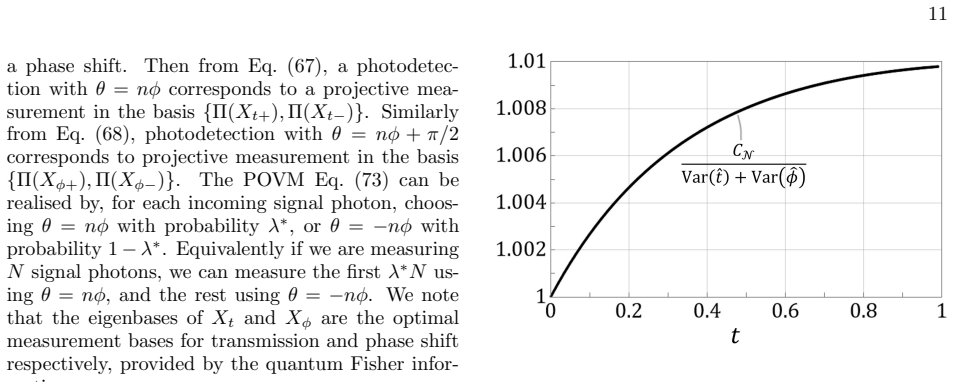
- [Figure 2] Figure 2: The caption should explicitly label which curve corresponds to the single-phase-shift measurement versus the full QFIM bound, and indicate the value of T used for the plotted curves.
- [Introduction] References: Add a citation to the original undetected-photon interferometry experiment (e.g., the 2014 or 2018 works) when first describing the setup in the introduction.
Simulated Author's Rebuttal
We thank the referee for the careful reading, positive assessment of the work's significance, and constructive comments. We address each major point below and have revised the manuscript to strengthen the presentation where needed.
read point-by-point responses
-
Referee: [§4] §4 (Optimal measurement): The assertion that a single controllable phase shift saturates the multiparameter QCRB for both T and φ requires an explicit construction of the measurement operators (or the unitary followed by fixed projectors) that simultaneously diagonalize or jointly measure the symmetric logarithmic derivatives L_T and L_φ. Without showing that the non-commuting generators can be jointly optimized by this minimal control, the saturation claim remains unverified.
Authors: We agree that an explicit construction strengthens the achievability claim. In the revised manuscript we have added the explicit measurement operators in §4: after the single controllable phase shift θ, the state is projected onto the two-mode Fock basis {|00⟩, |11⟩} (implemented via coincidence detection), which jointly saturates the QCRB because the phase shift aligns the SLDs L_T and L_φ such that their commutator vanishes on the support of the state. This construction is directly implementable with existing undetected-photon setups and confirms saturation for both parameters. revision: yes
-
Referee: [§5, Eq. (18)] §5 (Multipass analysis), Eq. (18): The scaling N_opt ~ 1/log(T) is derived under the assumption of perfect interference and ideal entanglement generation. The manuscript should state whether this scaling survives when the nonlinear-crystal efficiency η < 1 is included in the two-mode state before the sample interaction, as this would alter the effective QFIM and the optimal N.
Authors: The referee correctly notes that the derivation assumes ideal entanglement generation. When a fixed crystal efficiency η < 1 is included, the two-mode state acquires a reduced amplitude factor, which rescales the effective transmission to T_eff = η T in the QFIM. The optimal pass number then becomes N_opt ∼ 1/log(η T). For any fixed η the inverse-logarithmic dependence on T is preserved (only a constant shift in the logarithm occurs). We have added a clarifying paragraph in §5 stating this generalization and confirming that the reported scaling law remains valid under realistic efficiencies. revision: yes
Circularity Check
No significant circularity; standard QFIM derivation remains self-contained
full rationale
The paper computes the two-parameter quantum Fisher information matrix for sample transmission T and phase φ in the undetected-photon interferometer state, then derives the symmetric logarithmic derivatives and exhibits an explicit single-phase-shift measurement that saturates the QCRB. The multipass optimum is obtained by direct maximization of the QFIM figure of merit with respect to pass number N, yielding the scaling N_opt ~ 1/log(T) as a straightforward calculus result rather than a redefinition of inputs. No parameter is fitted to data and then relabeled a prediction, no self-citation supplies a uniqueness theorem or ansatz that the present derivation relies upon, and the achievability construction is given explicitly rather than assumed. The framework is externally verifiable via standard quantum metrology tools and does not reduce any claimed result to its own premises by construction.
Axiom & Free-Parameter Ledger
Reference graph
Works this paper leans on
-
[1]
Ultimate sensitivity of multiparameter estimation in quantum sensing with undetected photons
and Nagaoka Cram´ er-Rao bounds [38]. In addition to the complexities of multiparameter estimation, most applications of quantum sensing are for measurement of very weak signals, such as in bi- ology or gas sensing. A common method of amplify- ing weak signals is multipass interactions, where the arXiv:2604.19120v1 [quant-ph] 21 Apr 2026 2 probe passes th...
work page internal anchor Pith review Pith/arXiv arXiv 2026
-
[2]
After measur- ing the output, one forms an estimator ˆθfrom the data
Quantum Fisher Information In quantum parameter estimation, a parameterθ is encoded into a quantum stateρ θ. After measur- ing the output, one forms an estimator ˆθfrom the data. Intuitively, the Quantum Fisher Information (QFI) quantifies how rapidlyρ θ changes withθ: if ρθ andρ θ+dθ become distinguishable quickly, then small parameter shifts can be esti...
-
[3]
SLD- like
Holevo bound The Holevo bound provides the ultimate precision limit for multiparameter sensing problems consider- ing collective measurements on asymptotically many copies of the probe state. This is defined as [37] CH = min X Tr{Z[X]}+ TrAbs{ImZ[X]} ,(21) where we minimise over the setX={X 1, . . . , XN } of Hermitian operators satisfying Tr{Xiρ}= 0,(22)...
-
[4]
It therefore quantifies the best perfor- mance attainable in realistic measurement scenarios
Nagaoka bound Nagaoka’s bound characterizes the optimal pre- cision achievable when one is restricted to sepa- rable measurements and classical post-processing [38, 43, 44]. It therefore quantifies the best perfor- mance attainable in realistic measurement scenarios. While the expression when estimating an arbitrary number of parameters is complicated, th...
-
[5]
C. Degen, F. Reinhard, and P. Cappellaro, Quan- tum sensing, Reviews of Modern Physics89, 10.1103/revmodphys.89.035002 (2017)
-
[6]
Giovannetti, S
V. Giovannetti, S. Lloyd, and L. Maccone, Advances in quantum metrology, Nature Photonics5, 222 (2011)
2011
-
[7]
Demkowicz-Dobrza´ nski, M
R. Demkowicz-Dobrza´ nski, M. Jarzyna, and J. Ko lody´ nski, Quantum limits in optical interfer- ometry, Progress in Optics60, 345 (2015)
2015
-
[8]
Giovannetti, S
V. Giovannetti, S. Lloyd, and L. Maccone, Quan- tum metrology, Physical Review Letters96, 010401 (2006). 13
2006
-
[9]
Nagata, R
T. Nagata, R. Okamoto, J. L. O’brien, K. Sasaki, and S. Takeuchi, Beating the standard quantum limit with four-entangled photons, Science316, 726 (2007)
2007
-
[10]
B. J. Lawrie, P. D. Lett, A. M. Marino, and R. C. Pooser, Quantum sensing with squeezed light, Acs Photonics6, 1307 (2019)
2019
-
[11]
McCuller, C
L. McCuller, C. Whittle, D. Ganapathy, K. Ko- mori, M. Tse, A. Fernandez-Galiana, L. Barsotti, P. Fritschel, M. MacInnis, F. Matichard,et al., Frequency-dependent squeezing for advanced LIGO, Physical Review Letters124, 171102 (2020)
2020
-
[12]
T. Wang, W. Lee, M. Limes, T. Kornack, E. Foley, and M. Romalis, Pulsed vector atomic magnetome- ter using an alternating fast-rotating field, Nature Communications16, 1374 (2025)
2025
-
[13]
S. M. Dickerson, J. M. Hogan, A. Sugarbaker, D. M. S. Johnson, and M. A. Kasevich, Multiaxis Inertial Sensing with Long-Time Point Source Atom Interferometry, Physical Review Letters111, 083001 (2013)
2013
-
[14]
J. Fang, W. Wang, Y. Zhou, J. Li, D. Zhang, B. Tang, J. Zhong, J. Hu, F. Zhou, X. Chen,et al., Classical and atomic gravimetry, Remote Sensing 16, 2634 (2024)
2024
-
[15]
J. S. Bennett, B. E. Vyhnalek, H. Greenall, E. M. Bridge, F. Gotardo, S. Forstner, G. I. Harris, F. A. Miranda, and W. P. Bowen, Precision magnetome- ters for aerospace applications: A review, Sensors 21, 5568 (2021)
2021
-
[16]
M. Muradoglu, M. T. Johnsson, N. M. Wilson, Y. Cohen, D. Shin, T. Navickas, T. Pyrag- ius, D. Thomas, D. Thompson, S. I. Moore, et al., Quantum-assured magnetic navigation achieves positioning accuracy better than a strategic-grade INS in airborne and ground- based field trials, arXiv preprint arXiv:2504.08167 https://doi.org/10.48550/arXiv.2504.08167 (2025)
-
[17]
G. B. Lemos, V. Borish, G. D. Cole, S. Ramelow, R. Lapkiewicz, and A. Zeilinger, Quantum imaging with undetected photons, Nature512, 409 (2014)
2014
-
[18]
L. J. Wang, X. Y. Zou, and L. Mandel, Induced co- herence without induced emission, Physical Review A44, 4614 (1991)
1991
- [19]
-
[20]
Hochrainer, M
A. Hochrainer, M. Lahiri, M. Erhard, M. Krenn, and A. Zeilinger, Quantum indistinguishability by path identity and with undetected photons, Reviews of Modern Physics94, 025007 (2022)
2022
-
[21]
D. A. Kalashnikov, A. V. Paterova, S. P. Kulik, and L. A. Krivitsky, Infrared spectroscopy with visible light, Nature Photonics10, 98 (2016)
2016
-
[22]
Paterova, S
A. Paterova, S. Lung, D. A. Kalashnikov, and L. A. Krivitsky, Nonlinear infrared spectroscopy free from spectral selection, Scientific Reports7, 42608 (2017)
2017
-
[23]
A. V. Paterova, H. Yang, C. An, D. A. Kalashnikov, and L. A. Krivitsky, Tunable optical coherence to- mography in the infrared range using visible pho- tons, Quantum Science and Technology3, 025008 (2018)
2018
-
[24]
Kviatkovsky, S
I. Kviatkovsky, S. T¨ opfer, A. Molitor, G. F. Sinclair, and R. Fickler, Microscopy with undetected photons in the mid-infrared, Science Advances6, eabd0264 (2020)
2020
-
[25]
Suryana, T
M. Suryana, T. Produit, H. Yang, G. Birarda, J. V. Shanmugar, L. Krivitsky, A. Paterova, and G. Grenci, Infrared imaging with visible light in mi- crofluidic devices: the water absorption barrier, An- alyst150, 405 (2025)
2025
-
[26]
Sabanin, L
A. Sabanin, L. Krivitsky, and A. Paterova, Sensing of gas mixtures via nonlinear interferometry, Laser Physics Letters22, 015203 (2024)
2024
-
[27]
Fuenzalida, M
J. Fuenzalida, M. Gilaberte Basset, S. T¨ opfer, J. P. Torres, and M. Gr¨ afe, Experimental quantum imag- ing distillation with undetected light, Science Ad- vances9, eadg9573 (2023)
2023
-
[28]
J. Fuenzalida, J. Kysela, K. Dovzhik, G. B. Lemos, A. Hochrainer, M. Lahiri, and A. Zeilinger, Quan- tum state tomography of undetected photons, Phys- ical Review A109, 10.1103/physreva.109.022413 (2024)
-
[29]
Im, S.-Y
D.-G. Im, S.-Y. Yoo, C.-H. Lee, J. Suh, and Y.- H. Kim, Two-photon induced coherence without induced emission, Science Advances11, eadx2038 (2025)
2025
-
[30]
Zhang, Z
X. Zhang, Z. Zhang, and H. Dong, Measurement Un- certainty in Infrared Spectroscopy with Entangled Photon Pairs, Physical Review Letters134, 243601 (2025)
2025
-
[31]
M. Houde, F. Roeder, C. Silberhorn, B. Brecht, and N. Quesada, Quantum Fisher information analysis for absorption measurements with unde- tected photons, arXiv preprint arXiv:2601.16941 https://doi.org/10.48550/arXiv.2601.16941 (2026)
-
[32]
S. L. Braunstein and C. M. Caves, Statistical dis- tance and the geometry of quantum states, Physical Review Letters72, 3439 (1994)
1994
-
[33]
C. W. Helstrom,Quantum Detection and Estimation Theory(Academic Press, 1976)
1976
- [34]
-
[35]
J. Liu, H. Yuan, X.-M. Lu, and X. Wang, Quantum Fisher information matrix and multiparameter es- timation, Journal of Physics A: Mathematical and Theoretical53, 023001 (2019)
2019
- [36]
- [37]
-
[38]
J. Yang, S. Pang, Y. Zhou, and A. N. Jordan, Opti- mal measurements for quantum multiparameter esti- mation with general states, Physical Review A100, 10.1103/physreva.100.032104 (2019)
-
[39]
Szczykulska, T
M. Szczykulska, T. Baumgratz, and A. Datta, Multi- parameter quantum metrology, Advances in Physics: X1, 621–639 (2016)
2016
- [40]
-
[41]
A. S. Holevo,Probabilistic and Statistical Aspects of Quantum Theory, 2nd ed. (Edizioni della Normale / Springer, 2011)
2011
-
[42]
Nagaoka, A new approach to cram´ er-rao bounds for quantum state estimation, inAsymptotic Theory of Quantum Statistical Inference: Selected Papers, edited by M
H. Nagaoka, A new approach to cram´ er-rao bounds for quantum state estimation, inAsymptotic Theory of Quantum Statistical Inference: Selected Papers, edited by M. Hayashi (2005) pp. 100–112
2005
-
[43]
S. Zhou, M. Zhang, J. Preskill, and L. Jiang, Achiev- ing the Heisenberg limit in quantum metrology using 14 quantum error correction, Nature Communications 9, 10.1038/s41467-017-02510-3 (2018)
-
[44]
Barreto Lemos, M
G. Barreto Lemos, M. Lahiri, S. Ramelow, R. Lap- kiewicz, and W. N. Plick, Quantum imaging and metrology with undetected photons: tutorial, Jour- nal of the Optical Society of America B39, 2200 (2022)
2022
-
[45]
L. O. Conlon, T. Vogl, C. D. Marciniak, I. Pogorelov, S. K. Yung, F. Eilenberger, D. W. Berry, F. S. San- tana, R. Blatt, T. Monz, P. K. Lam, and S. M. As- sad, Approaching optimal entangling collective mea- surements on quantum computing platforms, Nature Physics19, 351 (2023)
2023
-
[46]
L. O. Conlon, F. Eilenberger, P. K. Lam, and S. M. Assad, Discriminating mixed qubit states with col- lective measurements, Communications Physics6, 10.1038/s42005-023-01454-z (2023)
-
[47]
L. O. Conlon, P. K. Lam, and S. M. Assad, Mul- tiparameter Estimation with Two-Qubit Probes in Noisy Channels, Entropy25, 1122 (2023)
2023
-
[48]
J. Suzuki, Explicit formula for the Holevo bound for two-parameter qubit-state estimation problem, Journal of Mathematical Physics57, 10.1063/1.4945086 (2016)
-
[49]
L. O. Conlon, J. Suzuki, P. K. Lam, and S. M. As- sad, Efficient computation of the Nagaoka–Hayashi bound for multiparameter estimation with sepa- rable measurements, npj Quantum Information7, 10.1038/s41534-021-00414-1 (2021)
-
[50]
S. S. Panda and R. Lecamwasam, Code for ’ul- timate sensitivity of multiparameter estimation in quantum sensing with undetected photons’, https://github.com/Sanjeet-panda-ssp/QSUP (2026)
2026
-
[51]
J. SUZUKI, Bayesian nagaoka-hayashi bound for multiparameter quantum-state estimation problem, IEICE Transactions on Fundamentals of Electronics, Communications and Computer SciencesE107.A, 510 (2024)
2024
-
[52]
+” outcomes, andn − the number of “−
Ryo Mizuta Graphics, Optical components pack v1, gumroad asset pack (Blender 3D optical compo- nents). 15 Appendix A: Monte Carlo study of estimating transmission In this section we present some simulations to sup- port the results in section III C, showing that the QFI can be enhanced for low-transmission samples by takingn <1. For the optimal measuremen...
discussion (0)
Sign in with ORCID, Apple, or X to comment. Anyone can read and Pith papers without signing in.