Recognition: unknown
Perspective: Quantum Computing on Magnetic Racetrack
Pith reviewed 2026-05-10 02:24 UTC · model grok-4.3
The pith
Magnetic domain walls can serve as both stationary and flying qubits for scalable quantum computation.
A machine-rendered reading of the paper's core claim, the machinery that carries it, and where it could break.
Core claim
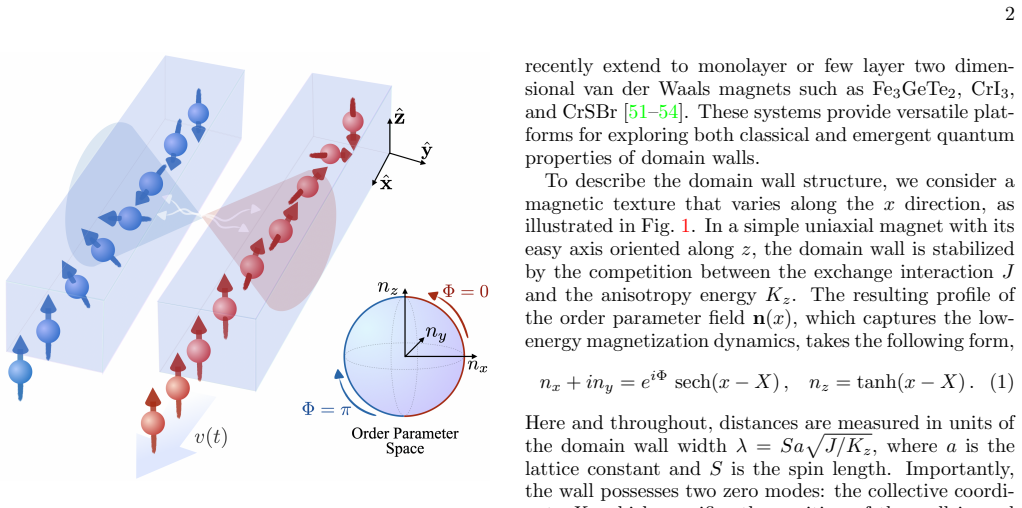
Magnetic domain walls have long been pursued as carriers of classical information for storage and processing. With the ability to create, control, and probe domain walls at the nanoscale, they are recently recognized as an ideal platform for studying macroscopic quantum effects and provide a natural blueprint for building scalable quantum computing architectures. In particular, the experimentally demonstrated high mobility of domain walls makes them not only suitable as stationary qubits but also as flying qubits, which may offer advantages over currently explored quantum computing platforms.
What carries the argument
Magnetic domain walls on racetracks, functioning as controllable carriers that can remain stationary for local operations or propagate to transfer quantum states.
If this is right
- High-mobility domain walls can act as flying qubits to move quantum information along the racetrack without separate transfer channels.
- Universal quantum computation becomes possible once the listed physical ingredients for coherence and gate control are met in suitable materials.
- Concrete material platforms such as specific ferromagnetic heterostructures can be targeted for initial demonstrations.
- Targeted experiments on coherence preservation and gate fidelity are required before scalable architectures can be built.
- Integration of magnetic and quantum information techniques opens routes to hybrid classical-quantum devices using the same racetrack structures.
Where Pith is reading between the lines
- The flying-qubit property might allow on-chip quantum networks where information travels with the domain wall rather than through fixed wiring.
- Challenges identified in the magnetic environment could be mitigated by engineering pinning sites or using topological protection within the wall structure.
- Success would encourage similar explorations of other magnetic textures such as skyrmions as quantum carriers.
- The perspective implicitly suggests that classical magnetic memory fabrication lines could be adapted with minimal changes for quantum prototypes.
Load-bearing premise
That the high mobility and nanoscale control already shown for domain walls in classical settings can be extended to preserve quantum coherence long enough for gate operations amid the surrounding magnetic fluctuations.
What would settle it
A measurement of domain-wall qubit coherence time that falls short of the duration required to complete a universal set of gates would falsify the feasibility claim.
Figures


read the original abstract
Magnetic domain walls have long been pursued as carriers of classical information for storage and processing. With the ability to create, control, and probe domain walls at the nanoscale, they are recently recognized as an ideal platform for studying macroscopic quantum effects and provide a natural blueprint for building scalable quantum computing architectures. In particular, the experimentally demonstrated high mobility of domain walls makes them not only suitable as stationary qubits but also as flying qubits, which may offer advantages over currently explored quantum computing platforms. In this Perspective, we outline our current understanding of the essential ingredients and key requirements for realizing universal quantum computation based on magnetic domain walls. We highlight promising concrete material platforms and identify the experiments that are still needed to advance this concept. We also discuss the potential challenges and point to new opportunities in this emerging research direction at the interface between magnetism and quantum information science.
Editorial analysis
A structured set of objections, weighed in public.
Referee Report
Summary. This perspective article argues that magnetic domain walls, long used for classical information storage, are now positioned as a promising platform for quantum computing due to their nanoscale controllability and experimentally demonstrated high mobility. The authors propose domain walls as both stationary and flying qubits, outline the key physical ingredients and requirements for universal quantum computation in this system, identify candidate material platforms, specify experiments still needed to demonstrate coherence and gate operations, and discuss associated challenges and opportunities at the interface of magnetism and quantum information science.
Significance. If the central proposal holds, the work could open a distinct hardware direction that exploits mature magnetic thin-film technologies for scalable quantum architectures, potentially offering advantages in mobility for flying-qubit schemes. By framing the extension from classical domain-wall control to the quantum regime as an explicit set of open requirements rather than an asserted fact, the manuscript provides a concrete roadmap that may usefully focus experimental efforts. Its value lies in synthesis and forward-looking identification of milestones rather than in new derivations or data.
minor comments (1)
- The abstract states that domain walls 'provide a natural blueprint' but does not quantify what 'natural' means in terms of existing fabrication compatibility or integration density; a single clarifying sentence would help readers gauge the claimed advantage over other platforms.
Simulated Author's Rebuttal
We thank the referee for the positive and insightful review. We are encouraged by the recognition that the Perspective provides a concrete roadmap identifying key physical requirements, material platforms, and necessary experiments at the interface of magnetism and quantum information science. The recommendation for acceptance is appreciated.
Circularity Check
No significant circularity in perspective article
full rationale
This is a perspective article whose content consists of an outlook, identification of material platforms, and specification of required future experiments rather than any derivation chain, theorem, or quantitative prediction. The abstract and full text frame domain-wall mobility results as externally demonstrated and the extension to quantum coherence as an open requirement, with no equations, fitted parameters, or self-citations that reduce any central claim to an internal definition or prior result by construction. All load-bearing statements remain independent of the paper's own inputs.
Axiom & Free-Parameter Ledger
axioms (2)
- domain assumption Domain walls can be created, controlled, and probed at the nanoscale with high mobility
- domain assumption Quantum coherence can be preserved in domain-wall systems long enough for gate operations
Reference graph
Works this paper leans on
-
[1]
Shor, Algorithms for quantum computation: discrete logarithms and factoring, inProceedings 35th Annual Symposium on Foundations of Computer Science(1994) pp
P. Shor, Algorithms for quantum computation: discrete logarithms and factoring, inProceedings 35th Annual Symposium on Foundations of Computer Science(1994) pp. 124–134
1994
-
[2]
Loss and D
D. Loss and D. P. DiVincenzo, Quantum computation with quantum dots, Phys. Rev. A57, 120 (1998)
1998
-
[3]
Basso Basset, M
F. Basso Basset, M. B. Rota, C. Schimpf, D. Tedeschi, K. D. Zeuner, S. F. Covre da Silva, M. Reindl, V. Zwiller, K. D. J¨ ons, A. Rastelli, and R. Trotta, En- tanglement swapping with photons generated on de- mand by a quantum dot, Phys. Rev. Lett.123, 160501 (2019)
2019
-
[4]
H. Qiao, Y. P. Kandel, S. K. Manikandan, A. N. Jordan, S. Fallahi, G. C. Gardner, M. J. Manfra, and J. M. Nichol, Conditional teleportation of quantum-dot spin states, Nature Communications11, 3022 (2020)
2020
-
[5]
N. W. Hendrickx, W. I. L. Lawrie, M. Russ, F. van Riggelen, S. L. de Snoo, R. N. Schouten, A. Sammak, G. Scappucci, and M. Veldhorst, A four-qubit germa- nium quantum processor, Nature591, 580 (2021)
2021
-
[6]
S. G. J. Philips, M. T. Mahale, Pratibhadzik, S. V. Amitonov, S. L. de Snoo, M. Russ, N. Kalhor, C. Volk, W. I. L. Lawrie, D. Brousse, L. Tryputen, B. P. Wuetz, A. Sammak, M. Veldhorst, G. Scappucci, and L. M. K. Vandersypen, Universal control of a six-qubit quantum processor in silicon, Nature609, 919 (2022)
2022
-
[7]
A. R. Mills, C. R. Guinn, M. J. Gullans, A. J. Sig- illito, M. M. Feldman, E. Nielsen, and J. R. Petta, Two- qubit silicon quantum processor with operation fidelity exceeding 99Science Advances8, eabn5130 (2022)
2022
-
[8]
J. Zou, S. Bosco, and D. Loss, Spatially correlated clas- sical and quantum noise in driven qubits, npj Quantum Information10, 46 (2024)
2024
-
[9]
Bosco, J
S. Bosco, J. Zou, and D. Loss, High-fidelity spin qubit shuttling via large spin-orbit interactions, PRX Quan- tum5, 020353 (2024)
2024
-
[10]
B. B. Blinov, D. L. Moehring, L. M. Duan, and C. Monroe, Observation of entanglement between a sin- gle trapped atom and a single photon, Nature428, 153 (2004)
2004
-
[11]
J. Volz, M. Weber, D. Schlenk, W. Rosenfeld, J. Vrana, K. Saucke, C. Kurtsiefer, and H. Weinfurter, Observa- tion of entanglement of a single photon with a trapped atom, Phys. Rev. Lett.96, 030404 (2006)
2006
-
[12]
Blatt and D
R. Blatt and D. Wineland, Entangled states of trapped atomic ions, Nature453, 1008 (2008)
2008
-
[13]
C. D. Bruzewicz, J. Chiaverini, R. McConnell, and J. M. Sage, Trapped-ion quantum computing: Progress and challenges,Applied Physics Reviews, Applied Physics Reviews6, 021314 (2019)
2019
-
[14]
J. Koch, T. M. Yu, J. Gambetta, A. A. Houck, D. I. Schuster, J. Majer, A. Blais, M. H. Devoret, S. M. Girvin, and R. J. Schoelkopf, Charge-insensitive qubit design derived from the cooper pair box, Phys. Rev. A 76, 042319 (2007)
2007
-
[15]
Barends, J
R. Barends, J. Kelly, A. Megrant, D. Sank, E. Jef- frey, Y. Chen, Y. Yin, B. Chiaro, J. Mutus, C. Neill, P. O’Malley, P. Roushan, J. Wenner, T. C. White, A. N. Cleland, and J. M. Martinis, Coherent josephson qubit suitable for scalable quantum integrated circuits, Phys. Rev. Lett.111, 080502 (2013)
2013
-
[16]
Wendin, Quantum information processing with su- perconducting circuits: a review, Reports on Progress in Physics80, 106001 (2017)
G. Wendin, Quantum information processing with su- perconducting circuits: a review, Reports on Progress in Physics80, 106001 (2017)
2017
-
[17]
S. S. P. Parkin, M. Hayashi, and L. Thomas, Magnetic domain-wall racetrack memory, Science320, 190 (2008). 13
2008
-
[18]
K.-S. Ryu, L. Thomas, S.-H. Yang, and S. Parkin, Chi- ral spin torque at magnetic domain walls, Nature Nan- otechnology8, 527 (2013)
2013
-
[19]
Yang, K.-S
S.-H. Yang, K.-S. Ryu, and S. Parkin, Domain-wall ve- locities of up to 750 m/s driven by exchange-coupling torque in synthetic antiferromagnets, Nature Nanotech- nology10, 221 (2015)
2015
-
[20]
K.-J. Kim, S. K. Kim, Y. Hirata, S.-H. Oh, T. Tono, D.-H. Kim, T. Okuno, W. S. Ham, S. Kim, G. Go, Y. Tserkovnyak, A. Tsukamoto, T. Moriyama, K.-J. Lee, and T. Ono, Fast domain wall motion in the vicinity of the angular momentum compensation temperature of ferrimagnets, Nature Materials16, 1187 (2017)
2017
-
[21]
S.-H. Yang, R. Naaman, Y. Paltiel, and S. S. P. Parkin, Chiral spintronics, Nature Reviews Physics3, 328 (2021)
2021
-
[22]
Y. Guan, X. Zhou, F. Li, T. Ma, S.-H. Yang, and S. S. P. Parkin, Ionitronic manipulation of current-induced do- main wall motion in synthetic antiferromagnets, Nature Communications12, 5002 (2021)
2021
-
[23]
Bl¨ asing, T
R. Bl¨ asing, T. Ma, S.-H. Yang, C. Garg, F. K. Dejene, A. T. N’Diaye, G. Chen, K. Liu, and S. S. P. Parkin, Exchange coupling torque in ferrimagnetic co/gd bilayer maximized near angular momentum compensation tem- perature, Nature Communications9, 4984 (2018)
2018
-
[24]
Yoshimura, K.-J
Y. Yoshimura, K.-J. Kim, T. Taniguchi, T. Tono, K. Ueda, R. Hiramatsu, T. Moriyama, K. Yamada, Y. Nakatani, and T. Ono, Soliton-like magnetic domain wall motion induced by the interfacial dzyaloshinskii– moriya interaction, Nature Physics12, 157 (2016)
2016
-
[25]
Y. Liu, W. Hou, X. Han, and J. Zang, Three- dimensional dynamics of a magnetic hopfion driven by spin transfer torque, Phys. Rev. Lett.124, 127204 (2020)
2020
-
[26]
J. Zou, S. Zhang, and Y. Tserkovnyak, Topological transport of deconfined hedgehogs in magnets, Phys. Rev. Lett.125, 267201 (2020)
2020
-
[27]
Hou, J.-X
W.-T. Hou, J.-X. Yu, M. Daly, and J. Zang, Thermally driven topology in chiral magnets, Phys. Rev. B96, 140403 (2017)
2017
-
[28]
J. Zou, S. K. Kim, and Y. Tserkovnyak, Topological transport of vorticity in heisenberg magnets, Phys. Rev. B99, 180402 (2019)
2019
-
[29]
Tserkovnyak and J
Y. Tserkovnyak and J. Zou, Quantum hydrodynamics of vorticity, Phys. Rev. Research1, 033071 (2019)
2019
-
[30]
Tserkovnyak, Perspective: (beyond) spin transport in insulators, Journal of Applied Physics124, 190901 (2018)
Y. Tserkovnyak, Perspective: (beyond) spin transport in insulators, Journal of Applied Physics124, 190901 (2018)
2018
-
[31]
Kumar, T
D. Kumar, T. Jin, R. Sbiaa, M. Kl¨ aui, S. Bedanta, S. Fukami, D. Ravelosona, S.-H. Yang, X. Liu, and S. N. Piramanayagam, Domain wall memory: Physics, mate- rials, and devices,Domain Wall Memory: Physics, Ma- terials, and Devices, Physics Reports958, 1 (2022)
2022
-
[32]
Luo and L
S. Luo and L. You, Skyrmion devices for memory and logic applications, APL Materials9, 050901 (2021)
2021
-
[33]
Grollier, D
J. Grollier, D. Querlioz, K. Y. Camsari, K. Everschor- Sitte, S. Fukami, and M. D. Stiles, Neuromorphic spin- tronics, Nature Electronics3, 360 (2020)
2020
-
[34]
Zhang and Y
S. Zhang and Y. Tserkovnyak, Antiferromagnet-based neuromorphics using dynamics of topological charges, Phys. Rev. Lett.125, 207202 (2020)
2020
-
[35]
Tserkovnyak and J
Y. Tserkovnyak and J. Xiao, Energy storage via topo- logical spin textures, Phys. Rev. Lett.121, 127701 (2018)
2018
-
[36]
Jones, J
D. Jones, J. Zou, S. Zhang, and Y. Tserkovnyak, Energy storage in magnetic textures driven by vorticity flow, Phys. Rev. B102, 140411 (2020)
2020
-
[37]
Parkin and S.-H
S. Parkin and S.-H. Yang, Memory on the racetrack, Nature nanotechnology10, 195 (2015)
2015
-
[38]
Braun and D
H.-B. Braun and D. Loss, Berry’s phase and quantum dynamics of ferromagnetic solitons, Phys. Rev. B53, 3237 (1996)
1996
-
[39]
Chiolero and D
A. Chiolero and D. Loss, Macroscopic quantum coher- ence in ferrimagnets, Phys. Rev. B56, 738 (1997)
1997
-
[40]
D. Loss, D. P. DiVincenzo, and G. Grinstein, Suppres- sion of tunneling by interference in half-integer-spin par- ticles, Physical review letters69, 3232 (1992)
1992
-
[41]
Huang, G
B. Huang, G. Clark, E. Navarro-Moratalla, D. R. Klein, R. Cheng, K. L. Seyler, D. Zhong, E. Schmidgall, M. A. McGuire, D. H. Cobden,et al., Layer-dependent fer- romagnetism in a van der waals crystal down to the monolayer limit, Nature546, 270 (2017)
2017
-
[42]
Song, Q.-C
T. Song, Q.-C. Sun, E. Anderson, C. Wang, J. Qian, T. Taniguchi, K. Watanabe, M. A. McGuire, R. St¨ ohr, D. Xiao, T. Cao, J. Wrachtrup, and X. Xu, Direct visu- alization of magnetic domains and moire magnetism in twisted 2d magnets, Science374, 1140 (2021)
2021
-
[43]
M. E. Ziebel, M. L. Feuer, J. Cox, X. Zhu, C. R. Dean, and X. Roy, Crsbr: an air-stable, two-dimensional mag- netic semiconductor, Nano letters24, 4319 (2024)
2024
-
[44]
Y. Zur, A. Noah, C. Boix-Constant, S. Ma˜ nas-Valero, N. Fridman, R. Rama-Eiroa, M. E. Huber, E. J. San- tos, E. Coronado, and Y. Anahory, Magnetic imaging and domain nucleation in crsbr down to the 2d limit, Advanced Materials35, 2307195 (2023)
2023
-
[45]
M. A. Tschudin, D. A. Broadway, P. Siegwolf, C. Schrader, E. J. Telford, B. Gross, J. Cox, A. E. Dubois, D. G. Chica, R. Rama-Eiroa,et al., Imag- ing nanomagnetism and magnetic phase transitions in atomically thin crsbr, Nature Communications15, 6005 (2024)
2024
-
[46]
Takei, Y
S. Takei, Y. Tserkovnyak, and M. Mohseni, Spin super- fluid josephson quantum devices, Physical Review B95, 144402 (2017)
2017
-
[47]
Tserkovnyak, J
Y. Tserkovnyak, J. Zou, S. K. Kim, and S. Takei, Quan- tum hydrodynamics of spin winding, Phys. Rev. B102, 224433 (2020)
2020
-
[48]
Takei and M
S. Takei and M. Mohseni, Quantum control of topo- logical defects in magnetic systems, Phys. Rev. B97, 064401 (2018)
2018
-
[49]
A. P. Petrovi´ c, C. Psaroudaki, P. Fischer, M. Garst, and C. Panagopoulos, Colloquium: Quantum properties and functionalities of magnetic skyrmions, Reviews of Modern Physics97, 031001 (2025)
2025
-
[50]
S. K. Kim and O. Tchernyshyov, Mechanics of a ferro- magnetic domain wall, Journal of Physics: Condensed Matter35, 134002 (2023)
2023
-
[51]
Y. Deng, Y. Yu, Y. Song, J. Zhang, N. Z. Wang, Z. Sun, Y. Yi, Y. Z. Wu, S. Wu, J. Zhu,et al., Gate-tunable room-temperature ferromagnetism in two-dimensional fe3gete2, Nature563, 94 (2018)
2018
-
[52]
H.-H. Yang, N. Bansal, P. R¨ ußmann, M. Hoffmann, L. Zhang, D. Go, Q. Li, A.-A. Haghighirad, K. Sen, S. Bl¨ ugel,et al., Magnetic domain walls of the van der waals material fe3gete2, 2D Materials9, 025022 (2022)
2022
-
[53]
Y. Guan, Y. Wu, Y. Zhang, J.-C. Jeon, W. Zhang, K. Xiao, and S. S. Parkin, Highly efficient current- induced domain wall motion in a room temperature van 14 der waals magnet, Nature Communications (2025)
2025
-
[54]
Thiel, Z
L. Thiel, Z. Wang, M. A. Tschudin, D. Rohner, I. Guti´ errez-Lezama, N. Ubrig, M. Gibertini, E. Gian- nini, A. F. Morpurgo, and P. Maletinsky, Probing mag- netism in 2d materials at the nanoscale with single-spin microscopy, Science364, 973 (2019)
2019
-
[55]
J. Zou, S. Bosco, B. Pal, S. S. P. Parkin, J. Klinovaja, and D. Loss, Quantum computing on magnetic race- tracks with flying domain wall qubits, Phys. Rev. Res. 5, 033166 (2023)
2023
-
[56]
Trif and Y
M. Trif and Y. Tserkovnyak, Cavity magnonics with domain walls in insulating ferromagnetic wires, Physical Review Research8, 013243 (2026)
2026
-
[57]
Vandersypen, H
L. Vandersypen, H. Bluhm, J. Clarke, A. Dzurak, R. Ishihara, A. Morello, D. Reilly, L. Schreiber, and M. Veldhorst, Interfacing spin qubits in quantum dots and donors—hot, dense, and coherent, npj Quantum Information3, 34 (2017)
2017
-
[58]
X. Mi, M. Benito, S. Putz, D. M. Zajac, J. M. Taylor, G. Burkard, and J. R. Petta, A coherent spin–photon interface in silicon, Nature555, 599 (2018)
2018
-
[59]
A. J. Landig, J. V. Koski, P. Scarlino, U. Mendes, A. Blais, C. Reichl, W. Wegscheider, A. Wallraff, K. En- sslin, and T. Ihn, Coherent spin–photon coupling using a resonant exchange qubit, Nature560, 179 (2018)
2018
-
[60]
S. E. Nigg, A. Fuhrer, and D. Loss, Superconducting grid-bus surface code architecture for hole-spin qubits, Physical review letters118, 147701 (2017)
2017
-
[61]
Trifunovic, O
L. Trifunovic, O. Dial, M. Trif, J. R. Wootton, R. Abebe, A. Yacoby, and D. Loss, Long-distance spin- spin coupling via floating gates, Phys. Rev. X2, 011006 (2012)
2012
-
[62]
Trifunovic, F
L. Trifunovic, F. L. Pedrocchi, and D. Loss, Long- distance entanglement of spin qubits via ferromagnet, Phys. Rev. X3, 041023 (2013)
2013
-
[63]
J. Zou, S. K. Kim, and Y. Tserkovnyak, Tuning entan- glement by squeezing magnons in anisotropic magnets, Phys. Rev. B101, 014416 (2020)
2020
-
[64]
J. Zou, S. Zhang, and Y. Tserkovnyak, Bell-state gen- eration for spin qubits via dissipative coupling, Phys. Rev. B106, L180406 (2022)
2022
-
[65]
Z. Xue, J. Zou, C. Cai, G. E. Bauer, and T. Yu, Di- rectional entanglement of spin-orbit locked nitrogen- vacancy centers by magnons, Physical Review B112, 094438 (2025)
2025
-
[66]
S. Driessen, J. Zou, E. Thingstad, J. Klinovaja, and D. Loss, Robust tripartite entanglement generation via correlated noise in spin qubits, arXiv preprint arXiv:2506.20466 (2025)
-
[67]
Panteleev and G
P. Panteleev and G. Kalachev, Quantum ldpc codes with almost linear minimum distance, IEEE Transac- tions on Information Theory68, 213 (2021)
2021
-
[68]
Panteleev and G
P. Panteleev and G. Kalachev, Degenerate quantum ldpc codes with good finite length performance, Quan- tum5, 585 (2021)
2021
-
[69]
N. P. Breuckmann and J. N. Eberhardt, Quantum low- density parity-check codes, PRX Quantum2, 040101 (2021)
2021
-
[70]
Froning, M
F. Froning, M. Ranˇ ci´ c, B. Het´ enyi, S. Bosco, M. Rehmann, A. Li, E. P. Bakkers, F. A. Zwanenburg, D. Loss, D. Zumb¨ uhl,et al., Strong spin-orbit interac- tion and g-factor renormalization of hole spins in ge/si nanowire quantum dots, Physical Review Research3, 013081 (2021)
2021
-
[71]
Dmytruk, D
O. Dmytruk, D. Chevallier, D. Loss, and J. Klinovaja, Renormalization of the quantum dot g-factor in super- conducting rashba nanowires, Physical Review B98, 165403 (2018)
2018
-
[72]
G. Qu, J. Zou, D. Loss, and T. Hirosawa, Density ma- trix renormalization group study of domain wall qubits, Physical Review B112, 054432 (2025)
2025
-
[73]
J. Zou, S. Bosco, J. Klinovaja, and D. Loss, Topological spin textures enabling quantum transmission, Physical Review Research7, 043036 (2025)
2025
-
[74]
Finco, A
A. Finco, A. Haykal, R. Tanos, F. Fabre, S. Chouaieb, W. Akhtar, I. Robert-Philip, W. Legrand, F. Ajejas, K. Bouzehouane, N. Reyren, T. Devolder, J.-P. Adam, J.-V. Kim, V. Cros, and V. Jacques, Imaging non- collinear antiferromagnetic textures via single spin re- laxometry, Nature Communications12, 767 (2021)
2021
-
[75]
Tsukamoto, Z
M. Tsukamoto, Z. Xu, T. Higo, K. Kondou, K. Sasaki, M. Asakura, S. Sakamoto, P. Gambardella, S. Miwa, Y. Otani,et al., Observation of chiral domain walls in an octupole-ordered antiferromagnet, Physical Review B112, L020404 (2025)
2025
-
[76]
J. Tang, A. Singh, N. J. Brennan, D. G. Chica, Y. Li, X. Roy, F. Rana, and Y. J. Bae, Coherent magnon– photon coupling in the magnetic semiconductor crsbr, Nano Letters25, 10912 (2025)
2025
-
[77]
Blais, A
A. Blais, A. L. Grimsmo, S. M. Girvin, and A. Wallraff, Circuit quantum electrodynamics, Reviews of Modern Physics93, 025005 (2021)
2021
-
[78]
J.-C. Jeon, A. Migliorini, J. Yoon, J. Jeong, and S. S. Parkin, Multicore memristor from electrically readable nanoscopic racetracks, Science386, 315 (2024)
2024
-
[79]
Okada, S
A. Okada, S. He, B. Gu, S. Kanai, A. Soumyanarayanan, S. T. Lim, M. Tran, M. Mori, S. Maekawa, F. Mat- sukura, H. Ohno, and C. Panagopoulos, Magnetization dynamics and its scattering mechanism in thin cofeb films with interfacial anisotropy, Proceedings of the Na- tional Academy of Sciences114, 3815 (2017)
2017
-
[80]
Maier-Flaig, S
H. Maier-Flaig, S. Klingler, C. Dubs, O. Surzhenko, R. Gross, M. Weiler, H. Huebl, and S. T. B. Goen- nenwein, Temperature-dependent magnetic damping of yttrium iron garnet spheres, Phys. Rev. B95, 214423 (2017)
2017
discussion (0)
Sign in with ORCID, Apple, or X to comment. Anyone can read and Pith papers without signing in.