Towards Application of Nanodiamonds for in-situ Monitoring of Radicals in Liquid Phase Chemical Reactions
Pith reviewed 2026-05-10 02:03 UTC · model grok-4.3
The pith
Nanodiamonds with NV centers detect TEMPO radicals in liquid by shortening spin relaxation time T1 in a concentration-dependent way.
A machine-rendered reading of the paper's core claim, the machinery that carries it, and where it could break.
Core claim
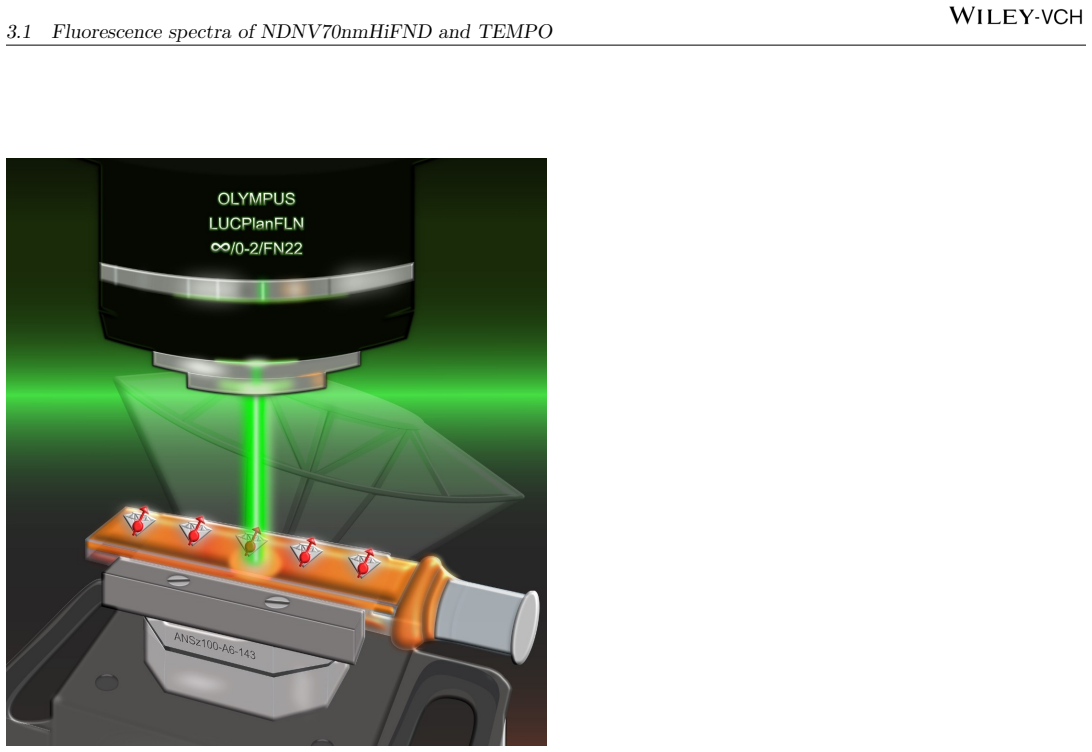
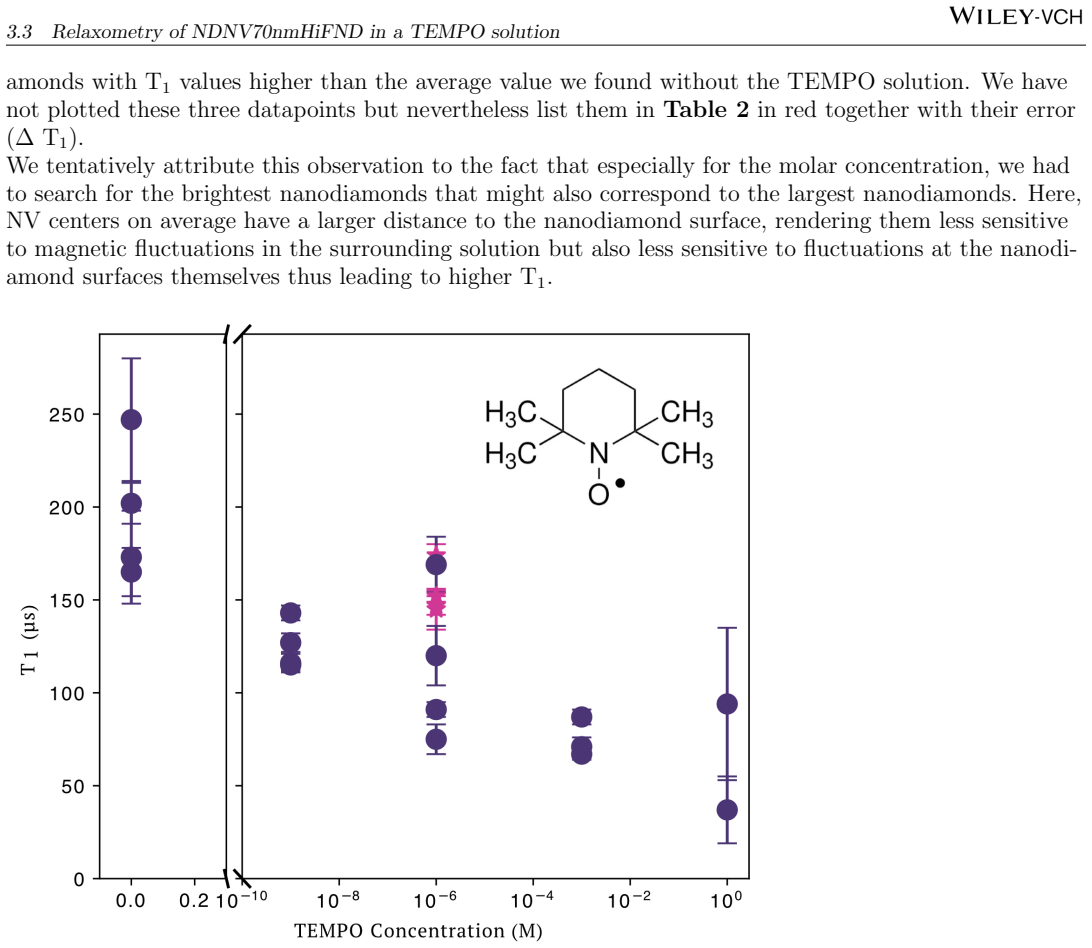
We demonstrate the successful in-situ detection of the nitroxide radical 2,2,6,6-Tetramethylpiperidinyloxyl (TEMPO) using NV center-based T1 relaxometry after depositing nanodiamonds onto the inner wall of a glass cuvette. A significant concentration-dependent shortening of the relaxation time was observed, from 197 μs ± 21 μs without radical to 66 μs ± 30 μs at a concentration of 1 M TEMPO. The detection is sensitive in the nanomolar range and the determined signal-to-noise ratio is between 1.6 and 3.
What carries the argument
NV center-based T1 relaxometry, in which the longitudinal spin relaxation time of the nitrogen-vacancy center shortens in response to magnetic fluctuations from nearby unpaired electrons.
If this is right
- Radical intermediates in liquid-phase reactions can be tracked continuously inside a standard glass cuvette without removing aliquots.
- The sensor responds across a wide concentration range from nanomolar to molar for nitroxide radicals.
- Optical readout through the diamond allows detection without electrical contacts or additional chemical labels.
- Signal-to-noise ratios of 1.6 to 3 support reliable monitoring even at low radical densities.
Where Pith is reading between the lines
- Continuous T1 monitoring during an ongoing reaction could capture the rise and decay of transient radicals in real time.
- The same nanodiamond deposition method might be adapted to flow cells or microreactors for online process control.
- Extending the approach to other radical types would require verifying that their magnetic noise spectra produce measurable T1 changes at similar distances.
Load-bearing premise
The shortening of the T1 relaxation time is caused specifically by magnetic fluctuations from the unpaired electrons of the TEMPO radicals rather than by other changes in the liquid, the cuvette, or the nanodiamond surface after deposition.
What would settle it
Repeating the experiment in the same cuvette with a non-magnetic molecule of similar size and concentration substituted for TEMPO and finding no comparable shortening of T1 would indicate the effect is not specific to radicals.
Figures
read the original abstract
In many chemical reactions, short-lived radical intermediates play a crucial role, while detecting such short-lived species in-situ remains challenging. The optically readable electronic spin of nitrogen-vacancy (NV) centers in diamond is a nanoscale sensor for such radical species: its longitudinal spin relaxation time (T$_{1}$) reacts to magnetic fluctuations from the unpaired electrons of radical species in its local environment. In this setting, we demonstrate the successful in-situ detection of the nitroxide radical 2,2,6,6-Tetramethylpiperidinyloxyl (TEMPO) using NV center-based T$_1$ relaxometry after depositing nanodiamonds onto the inner wall of a glass cuvette. A significant concentration-dependent shortening of the relaxation time was observed, from $197\:\mu s \pm 21\:\mu s$ without radical to $66\:\mu s \pm 30\:\mu s$ at a concentration of 1 M TEMPO. The detection is sensitive in the nanomolar (nM) range and the determined signal-to-noise ratio is between 1.6 and 3.
Editorial analysis
A structured set of objections, weighed in public.
Referee Report
Summary. The manuscript demonstrates in-situ detection of the nitroxide radical TEMPO in liquid phase using NV-center T1 relaxometry in nanodiamonds deposited on the inner wall of a glass cuvette. It reports a concentration-dependent shortening of the NV T1 time from 197 μs ± 21 μs (no radical) to 66 μs ± 30 μs at 1 M TEMPO, with claimed sensitivity in the nanomolar range and SNR of 1.6–3.
Significance. If the observed T1 shortening can be unambiguously attributed to magnetic noise from TEMPO unpaired electrons, the approach would represent a practical step toward nanoscale, optically readable sensing of radical intermediates in chemical reactions, a longstanding experimental challenge. The cuvette-based geometry is straightforward and potentially scalable, but the current data leave the specificity of the mechanism under-constrained.
major comments (3)
- [Experimental Methods] Experimental Methods (or equivalent section describing the cuvette setup): no control measurements are described using diamagnetic species at matched concentrations, pre/post-addition measurements in identical geometry, or surface-passivation checks. Without these, the attribution of the T1 drop specifically to TEMPO magnetic fluctuations (rather than viscosity, dielectric, or surface-charge changes) remains unisolated.
- [Results] Results section (concentration-dependence data): the reported T1 shortening is shown at 1 M (a very high concentration), yet the abstract claims nanomolar sensitivity; the manuscript must include the full concentration series, raw decay curves, fitting procedures, and statistical justification for the nM extrapolation and the stated SNR range of 1.6–3.
- [Discussion] Discussion of error sources: the large uncertainties (±21 μs and ±30 μs) and the deposition of nanodiamonds directly onto glass raise the possibility of strain or interface effects modulating T1 independently of radicals; these must be quantified or ruled out with additional characterization (e.g., AFM, Raman, or control depositions).
minor comments (2)
- [Abstract] The abstract states sensitivity “in the nanomolar (nM) range” but provides no explicit lowest concentration or calibration curve; this should be clarified with a figure or table.
- [Methods] Notation for T1 values and units is consistent, but the manuscript should explicitly state the number of independent measurements and the fitting model used to extract T1 from the relaxation curves.
Simulated Author's Rebuttal
We thank the referee for their constructive and detailed comments, which highlight important aspects for strengthening the attribution of our results and the presentation of the data. We address each major comment point by point below and indicate where revisions to the manuscript will be made.
read point-by-point responses
-
Referee: [Experimental Methods] Experimental Methods (or equivalent section describing the cuvette setup): no control measurements are described using diamagnetic species at matched concentrations, pre/post-addition measurements in identical geometry, or surface-passivation checks. Without these, the attribution of the T1 drop specifically to TEMPO magnetic fluctuations (rather than viscosity, dielectric, or surface-charge changes) remains unisolated.
Authors: We agree that additional controls would further isolate the mechanism. The observed T1 shortening scales specifically with TEMPO concentration and is absent in the no-radical baseline, which is inconsistent with bulk viscosity or dielectric changes (as these would not require unpaired electrons). In the revised manuscript we will expand the Experimental Methods section to explicitly describe the pre- and post-addition protocol in the same cuvette geometry and add a paragraph discussing why non-magnetic effects are unlikely. We will also note that diamagnetic controls (e.g., using TEMPOH) are planned for follow-up work but were outside the scope of this initial demonstration. revision: partial
-
Referee: [Results] Results section (concentration-dependence data): the reported T1 shortening is shown at 1 M (a very high concentration), yet the abstract claims nanomolar sensitivity; the manuscript must include the full concentration series, raw decay curves, fitting procedures, and statistical justification for the nM extrapolation and the stated SNR range of 1.6–3.
Authors: The manuscript already contains a concentration series (0 to 1 M) that underpins the claimed dependence and nM extrapolation, but we acknowledge the presentation was insufficiently detailed. In the revised Results section we will (i) display the full concentration series with all measured points, (ii) include representative raw T1 decay curves, (iii) specify the fitting model (single-exponential decay with offset), and (iv) add a statistical subsection deriving the nM sensitivity from the linear slope of 1/T1 versus concentration together with the SNR calculation (signal change divided by measurement standard deviation, yielding the reported 1.6–3 range). revision: yes
-
Referee: [Discussion] Discussion of error sources: the large uncertainties (±21 μs and ±30 μs) and the deposition of nanodiamonds directly onto glass raise the possibility of strain or interface effects modulating T1 independently of radicals; these must be quantified or ruled out with additional characterization (e.g., AFM, Raman, or control depositions).
Authors: We will revise the Discussion to include a dedicated paragraph on error sources. The reported uncertainties arise from nanodiamond-to-nanodiamond variability and are already stated; we will quantify their impact on the extracted sensitivity. Regarding glass deposition, we will cite prior work showing that NV T1 in similarly deposited nanodiamonds remains stable in the absence of radicals and will add pre-radical-addition T1 controls to demonstrate that interface/strain effects do not produce the observed concentration-dependent shortening. While AFM or Raman characterization of the specific deposits was not performed, the radical-specific response and consistency with literature T1 values argue against dominant interface modulation. revision: partial
Circularity Check
No circularity: direct experimental report with no derivations or self-referential models
full rationale
The manuscript is an experimental demonstration reporting measured T1 values (197 μs ± 21 μs without TEMPO to 66 μs ± 30 μs at 1 M) after nanodiamond deposition in a cuvette. No equations, first-principles derivations, fitted parameters, or predictions are presented that could reduce to the inputs by construction. The central claim rests on observed concentration-dependent shortening rather than any self-definitional loop, self-citation load-bearing step, or renamed ansatz. Self-citations, if present, are not required to justify the measurement itself.
Axiom & Free-Parameter Ledger
axioms (1)
- domain assumption The longitudinal spin relaxation time T1 of NV centers is sensitive to magnetic fluctuations from nearby unpaired electrons in radicals.
Reference graph
Works this paper leans on
-
[1]
Rondin, L. and Tetienne, J.-P. and Hingant, T. and Roch, J.-F. and Maletinsky, P. and Jacques, V. , title =. Rep. Prog. Phys. , year =
- [2]
-
[3]
Li, Min and Zhang, Qi and Kong, Xi and Li, Zhijie and Yang, Zhiping and Zhao, Sheng and Qin, Zhuoyang and Kong, Fei and Chen, Sanyou and Su, Jia and Ruan, Ke and Shi, Fazhan and Du, Jiangfeng , title =. Adv. Quantum Technol. , year =
- [4]
-
[5]
Pahchan, Pragya and Nandy, Abhijit and Ramireddy, Eswarayya and Banerjee, Shibdas , title =. Chem. Sci. , year =
-
[6]
Hall, L. T. and Kehayias, P. and Simpson, D. A. and Jarmola, A. and Stacey, A. and Budker, D. and Hollenberg, L. C. L. , title =. Nat. Commun. , year =
-
[7]
Steinert, S. and Ziem, F. and Hall, L. T. and Zappe, A. and Schweikert, M. and Götz, N. and Aird, A. and Balasubramanian, G. and Hollenberg, L. and Wrachtrup, J. , title =. Nat. Commun. , year =
-
[8]
Wood, James D. A. and Broadway, David A. and Hall, Liam T. and Stacey, Alastair and Simpson, David A. and Tetienne, Jean-Philippe and Hollenberg, Lloyd C. L. , title =. Phys. Rev. B , year =
-
[9]
and Seinstra, Renée and Zhang, Tao and Nollen, Ellen and Schirhagl, Romana , title =
Fan, Siyu and Zhang, Yue and Ainslie, Anna P. and Seinstra, Renée and Zhang, Tao and Nollen, Ellen and Schirhagl, Romana , title =. Advanced Science , year =
-
[10]
and Lay, Lianne and Ahmadi, Sepehr and Simpson, David A
Ralph, Trent and Grant, Erin S. and Lay, Lianne and Ahmadi, Sepehr and Simpson, David A. , title =. arXiv preprint , year =. doi:10.48550/arXiv.2602.17965 , eprint =
-
[11]
Ermakova, A. and Pramanik, G. and Cai, J.-M. and Algara-Siller, G. and Kaiser, U. and Weil, T. and Tzeng, Y.-K. and Chang, H. C. and McGuinness, L. P. and Plenio, M. B. and Naydenov, B. and Jelezko, F. , title =. Nano Lett. , year =
-
[12]
Sch. Tracking Temperature-Dependent Relaxation Times of Ferritin Nanomagnets with a Wideband Quantum Spectrometer , journal =. 2014 , volume =
work page 2014
-
[13]
Ziem, Florestan C. and G. Highly Sensitive Detection of Physiological Spins in a Microfluidic Device , journal =. 2013 , volume =
work page 2013
-
[14]
McGuinness, L. P. and Hall, L. T. and Stacey, A. and Simpson, D. A. and Hill, C. D. and Cole, J. H. and Ganesan, K. and Gibson, B. C. and Prawer, S. and Mulvaney, P. and Jelezko, F. and Wrachtrup, J. and Scholten, R. E. and Hollenberg, L. C. L. , title =. New J. Phys. , year =
-
[15]
Mamin, H. J. and Kim, M. and Sherwood, M. H. and Rettner, C. T. and Ohno, K. and Awschalom, D. D. and Rugar, D. , title =. Proc. Natl. Acad. Sci. U.S.A. , year =
-
[16]
Rendler, Torsten and Neburkova, Jitka and Zemek, Ondrej and Kotek, Jan and Zappe, Andrea and Chu, Zhiqin and Cigler, Petr and Wrachtrup, J. Optical imaging of localized chemical events using programmable diamond quantum nanosensors , journal =. 2017 , volume =
work page 2017
-
[17]
Tetienne, J.-P. and Hingant, T. and Rondin, L. and Cavaill. Spin relaxometry of single nitrogen-vacancy defects in diamond nanocrystals for magnetic noise sensing , journal =. 2013 , volume =
work page 2013
-
[18]
Sushkov, A. O. and Chisholm, N. and Lovchinsky, I. and Kubo, M. and Lo, P. K. and Bennett, S. D. and Hunger, D. and Akimov, A. and Walsworth, R. L. and Park, H. and Lukin, M. D. , title =. Nano Lett. , year =
-
[19]
Pandey, N. O. , title =
-
[20]
Cardoso Barbosa, Isabel and Gutsche, Jonas and Widera, Artur , title =. Phys. Rev. B , year =
-
[21]
TEMPO (2,2,6,6-Tetramethylpiperidin-1-oxyl), 98\ howpublished =. 2026 , note =
work page 2026
-
[22]
Iyer, Shiva and Yao, Changyu and Lazorik, Olivia and Bin Kashem, Md Shakil and Wang, Pengyun and Glenn, Gianna and Mohs, Michael and Shi, Yinyao and Mansour, Michael and Henriksen, Erik and Murch, Kater and Mukherji, Shankar and Zu, Chong , title =. Phys. Rev. Appl. , year =
discussion (0)
Sign in with ORCID, Apple, or X to comment. Anyone can read and Pith papers without signing in.