Taming Actor-Observer Asymmetry in Agents via Dialectical Alignment
Pith reviewed 2026-05-10 01:56 UTC · model grok-4.3
The pith
ReTAS training via dialectical alignment eliminates actor-observer asymmetry in LLM agents.
A machine-rendered reading of the paper's core claim, the machinery that carries it, and where it could break.
Core claim
Large language model agents in multi-agent setups experience Actor-Observer Asymmetry due to role assignments, with actors externalizing blame and observers internalizing it, occurring in over 20% of cases on the Ambiguous Failure Benchmark. ReTAS counters this by using thesis-antithesis-synthesis reasoning combined with Group Relative Policy Optimization during training to synthesize an objective consensus view. This results in perspective-invariant reasoning that mitigates attribution inconsistency and boosts fault resolution in ambiguous scenarios.
What carries the argument
The ReTAS model, which integrates dialectical chain-of-thought with Group Relative Policy Optimization to guide synthesis of conflicting viewpoints into an objective consensus.
Load-bearing premise
Role assignment in multi-agent systems directly induces the actor-observer asymmetry, and dialectical alignment can eliminate it to produce unbiased reasoning without performance costs or new biases.
What would settle it
Running the Ambiguous Failure Benchmark on ReTAS-aligned agents and finding that perspective swaps still trigger attribution changes in more than 20% of cases, or that fault resolution rates do not rise, would falsify the effectiveness of the dialectical approach.
Figures


read the original abstract
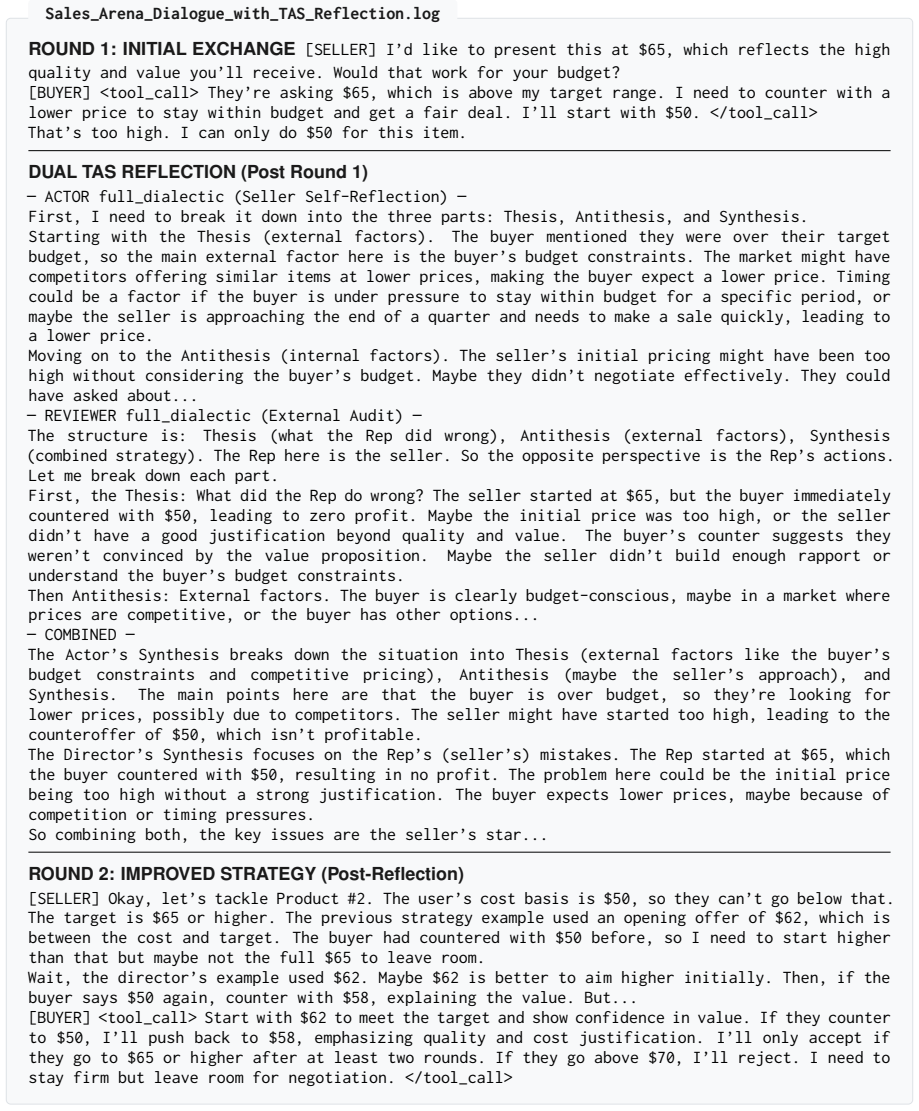
Large Language Model agents have rapidly evolved from static text generators into dynamic systems capable of executing complex autonomous workflows. To enhance reliability, multi-agent frameworks assigning specialized roles are increasingly adopted to enable self-reflection and mutual auditing. While such role-playing effectively leverages domain expert knowledge, we find it simultaneously induces a human-like cognitive bias known as Actor-Observer Asymmetry (AOA). Specifically, an agent acting as an actor (during self-reflection) tends to attribute failures to external factors, whereas an observer (during mutual auditing) attributes the same errors to internal faults. We quantify this using our new Ambiguous Failure Benchmark, which reveals that simply swapping perspectives triggers the AOA effect in over 20% of cases for most models. To tame this bias, we introduce ReTAS (Reasoning via Thesis-Antithesis-Synthesis), a model trained through dialectical alignment to enforce perspective-invariant reasoning. By integrating dialectical chain-of-thought with Group Relative Policy Optimization, ReTAS guides agents to synthesize conflicting viewpoints into an objective consensus. Experiments demonstrate that ReTAS effectively mitigates attribution inconsistency and significantly improves fault resolution rates in ambiguous scenarios.
Editorial analysis
A structured set of objections, weighed in public.
Referee Report
Summary. The paper identifies Actor-Observer Asymmetry (AOA) as a bias induced by role assignments in multi-agent LLM frameworks, where actors attribute failures externally and observers attribute them internally. It introduces the Ambiguous Failure Benchmark to quantify this effect (reporting >20% of cases affected across models) and proposes ReTAS, a model trained via dialectical chain-of-thought (thesis-antithesis-synthesis) integrated with Group Relative Policy Optimization (GRPO) to enforce perspective-invariant reasoning and improve fault resolution in ambiguous scenarios.
Significance. If the central experimental claims hold after proper validation, the work would usefully highlight a human-like cognitive bias in role-based agent systems and demonstrate a structured dialectical method for mitigation, potentially aiding reliability in autonomous workflows. The new benchmark is a constructive addition for evaluating attribution consistency, though the absence of ablations and methodological transparency currently limits its assessed impact.
major comments (3)
- [Experiments] Experiments section: The reported quantitative improvements in attribution consistency and fault resolution rates with ReTAS lack ablations that isolate the contribution of the thesis-antithesis-synthesis dialectical structure from the effects of GRPO training itself or from generic multi-step reasoning formats. Without these controls, it is impossible to establish that the specific dialectical alignment mechanism is load-bearing for the perspective-invariant reasoning claim rather than an artifact of the optimization procedure.
- [Method] Method and training procedure: The description of Group Relative Policy Optimization integrated with dialectical CoT does not supply the full objective equations or normalization details, raising the possibility that the training embeds fitted rewards or metrics that could circularly influence the AOA bias evaluation on the Ambiguous Failure Benchmark.
- [Benchmark] Ambiguous Failure Benchmark construction (likely §3): The benchmark is presented as revealing AOA in >20% of cases, but no details are provided on scenario generation, ambiguity criteria, statistical significance testing, baseline models, or inter-annotator agreement, leaving the central quantification unsupported and preventing assessment of whether role assignment directly induces the asymmetry as claimed.
minor comments (2)
- [Abstract] The abstract and introduction use terms like 'ReTAS' and 'dialectical alignment' without an early formal definition or diagram of the thesis-antithesis-synthesis process, which would aid readability.
- Notation for the bias metric and resolution rates is introduced without explicit formulas or pseudocode, making it difficult to reproduce the >20% figure or the improvement claims.
Simulated Author's Rebuttal
We thank the referee for the constructive and detailed feedback. The comments highlight important areas for strengthening the experimental validation, methodological transparency, and benchmark documentation. We address each major comment below and will revise the manuscript accordingly.
read point-by-point responses
-
Referee: [Experiments] Experiments section: The reported quantitative improvements in attribution consistency and fault resolution rates with ReTAS lack ablations that isolate the contribution of the thesis-antithesis-synthesis dialectical structure from the effects of GRPO training itself or from generic multi-step reasoning formats. Without these controls, it is impossible to establish that the specific dialectical alignment mechanism is load-bearing for the perspective-invariant reasoning claim rather than an artifact of the optimization procedure.
Authors: We agree that the absence of targeted ablations limits the strength of the claim regarding the dialectical structure. In the revised manuscript we will add a new ablation study in the Experiments section that compares (i) full ReTAS, (ii) GRPO training without the dialectical CoT component, and (iii) a generic multi-step reasoning baseline using the same optimization procedure. These results will be reported alongside the existing metrics to isolate the contribution of the thesis-antithesis-synthesis process. revision: yes
-
Referee: [Method] Method and training procedure: The description of Group Relative Policy Optimization integrated with dialectical CoT does not supply the full objective equations or normalization details, raising the possibility that the training embeds fitted rewards or metrics that could circularly influence the AOA bias evaluation on the Ambiguous Failure Benchmark.
Authors: We acknowledge that the current method section lacks the explicit objective equations and normalization details. The revised manuscript will include the complete GRPO objective function augmented with the dialectical CoT reward term, together with all normalization constants and reward formulation. We will also add a statement confirming that the Ambiguous Failure Benchmark scenarios were held out from the training data and were not used in reward computation, thereby removing any circularity concern. revision: yes
-
Referee: [Benchmark] Ambiguous Failure Benchmark construction (likely §3): The benchmark is presented as revealing AOA in >20% of cases, but no details are provided on scenario generation, ambiguity criteria, statistical significance testing, baseline models, or inter-annotator agreement, leaving the central quantification unsupported and preventing assessment of whether role assignment directly induces the asymmetry as claimed.
Authors: We will substantially expand the benchmark construction subsection. The revision will detail the scenario generation procedure, the operational definition of ambiguity, the statistical tests performed (including p-values supporting the >20% effect size), the full set of baseline models evaluated, and inter-annotator agreement statistics (Cohen’s kappa) obtained from human validation of a subset of cases. These additions will directly support the claim that role assignment induces the observed asymmetry. revision: yes
Circularity Check
No significant circularity detected
full rationale
The paper identifies AOA via a new benchmark, proposes ReTAS as dialectical CoT integrated with GRPO training, and reports experimental mitigation on fault resolution. No equations, self-definitional reductions, fitted parameters presented as independent predictions, or load-bearing self-citations appear in the abstract or described chain. The empirical results stand as external evaluation rather than tautological restatement of inputs; absence of ablations is a limitation on causal attribution but does not constitute circularity under the specified patterns.
Axiom & Free-Parameter Ledger
invented entities (2)
-
Ambiguous Failure Benchmark
no independent evidence
-
ReTAS
no independent evidence
Reference graph
Works this paper leans on
- [1]
-
[2]
Attribution: Perceiving the causes of behavior , pages=
The actor and the observer: Divergent perceptions of the causes of behavior , author=. Attribution: Perceiving the causes of behavior , pages=. 1972 , publisher=
work page 1972
-
[3]
Advances in Experimental Social Psychology , pages =
Lee Ross , title =. Advances in Experimental Social Psychology , pages =. 1977 , publisher =
work page 1977
- [4]
-
[5]
Jason Wei and Xuezhi Wang and Dale Schuurmans and Maarten Bosma and Fei Xia and Ed Chi and Quoc V. Le and Denny Zhou , title =. Proceedings of NeurIPS , year =
-
[6]
Proceedings of NeurIPS , year =
Noah Shinn and Federico Cassano and Edward Berman and Ashwin Gopinath and Karthik Narasimhan and Shunyu Yao , title =. Proceedings of NeurIPS , year =
-
[7]
John Yang and Carlos E. Jimenez and Alexander Wettig and Shunyu Yao and Kexin Pei and Ofir Press and Karthik Narasimhan , title =. Proceedings of NeurIPS , year =
- [8]
- [9]
-
[10]
Daya Guo and Dejian Yang and Haowei Zhang and Junxiao Song and Peiyi Wang and Qihao Zhu and Runxin Xu and Ruoyu Zhang and Shirong Ma and Xiao Bi and Xiaokang Zhang and Xingkai Yu and Yu Wu and Z. F. Wu and Zhibin Gou and Zhihong Shao and Zhuoshu Li and Ziyi Gao and Aixin Liu and Bing Xue and Bingxuan Wang and Bochao Wu and Bei Feng and Chengda Lu and Chen...
-
[11]
Proceedings of EMNLP , pages =
Yunfan Shao and Linyang Li and Junqi Dai and Xipeng Qiu , title =. Proceedings of EMNLP , pages =
-
[12]
Narasimhan and Yuan Cao , title =
Shunyu Yao and Jeffrey Zhao and Dian Yu and Nan Du and Izhak Shafran and Karthik R. Narasimhan and Yuan Cao , title =. Proceedings of ICLR , year =
-
[13]
Khanh-Tung Tran and Dung Dao and Minh-Duong Nguyen and Quoc-Viet Pham and Barry O'Sullivan and Hoang D. Nguyen , title =. CoRR , volume =
-
[14]
Chen Qian and Wei Liu and Hongzhang Liu and Nuo Chen and Yufan Dang and Jiahao Li and Cheng Yang and Weize Chen and Yusheng Su and Xin Cong and Juyuan Xu and Dahai Li and Zhiyuan Liu and Maosong Sun , title =. Proceedings of ACL , pages =
-
[15]
Proceedings of EMNLP , pages =
Yiqiao Jin and Qinlin Zhao and Yiyang Wang and Hao Chen and Kaijie Zhu and Yijia Xiao and Jindong Wang , title =. Proceedings of EMNLP , pages =
-
[16]
Isabel O. Gallegos and Ryan A. Rossi and Joe Barrow and Md. Mehrab Tanjim and Sungchul Kim and Franck Dernoncourt and Tong Yu and Ruiyi Zhang and Nesreen Ahmed , title =. Computational Linguistics , volume =
-
[17]
An Yang and Anfeng Li and Baosong Yang and Beichen Zhang and Binyuan Hui and Bo Zheng and Bowen Yu and Chang Gao and Chengen Huang and Chenxu Lv and Chujie Zheng and Dayiheng Liu and Fan Zhou and Fei Huang and Feng Hu and Hao Ge and Haoran Wei and Huan Lin and Jialong Tang and Jian Yang and Jianhong Tu and Jianwei Zhang and Jianxin Yang and Jiaxi Yang and...
-
[18]
Gonzalez and Ion Stoica , title =
Mert Cemri and Melissa Z Pan and Shuyi Yang and Lakshya A Agrawal and Bhavya Chopra and Rishabh Tiwari and Kurt Keutzer and Aditya Parameswaran and Dan Klein and Kannan Ramchandran and Matei Zaharia and Joseph E. Gonzalez and Ion Stoica , title =. Proceedings of NeurIPS , year =
-
[19]
Shaokun Zhang and Ming Yin and Jieyu Zhang and Jiale Liu and Zhiguang Han and Jingyang Zhang and Beibin Li and Chi Wang and Huazheng Wang and Yiran Chen and Qingyun Wu , title =. Proceedings of ICML , year =
- [20]
- [21]
-
[22]
DeepSeek-V3.2: Pushing the Frontier of Open Large Language Models , journal =
DeepSeek. DeepSeek-V3.2: Pushing the Frontier of Open Large Language Models , journal =
- [23]
- [24]
-
[25]
Kyrychenko and Steve Rathje and Nigel Collier and S
Tiancheng Hu and Y. Kyrychenko and Steve Rathje and Nigel Collier and S. V. D. Linden and J. Roozenbeek , title =. Nature Computational Science , volume =
-
[26]
Peiyi Wang and Lei Li and Liang Chen and Zefan Cai and Dawei Zhu and Binghuai Lin and Yunbo Cao and Lingpeng Kong and Qi Liu and Tianyu Liu and Zhifang Sui , title =. Proceedings of ACL , pages =
-
[27]
Hari Shrawgi and Prasanjit Rath and Tushar Singhal and Sandipan Dandapat , title =. Proceedings of EACL , pages =
-
[28]
Tian Lan and Wenwei Zhang and Chengqi Lyu and Shuaibin Li and Chen Xu and Heyan Huang and Dahua Lin and Xian-Ling Mao and Kai Chen , title =. Findings of EMNLP , pages =
-
[29]
Suchow and Rong Liu and Zhenyu Cui and Denghui Zhang and K
Yangyang Yu and Zhiyuan Yao and Haohang Li and Zhiyang Deng and Yupeng Cao and Zhi Chen and Jordan W. Suchow and Rong Liu and Zhenyu Cui and Denghui Zhang and K. Subbalakshmi and Guojun Xiong and Yueru He and Jimin Huang and Dong Li and Qianqian Xie , title =. Proceedings of NeurIPS , year =
-
[30]
Proceedings of EMNLP , pages =
Zi-Yi Dou and Cheng-Fu Yang and Xueqing Wu and Kai-Wei Chang and Nanyun Peng , title =. Proceedings of EMNLP , pages =
-
[31]
Proceedings of NeurIPS , year =
Xiaohe Bo and Zeyu Zhang and Quanyu Dai and Xueyang Feng and Lei Wang and Rui Li and Xu Chen and Ji-Rong Wen , title =. Proceedings of NeurIPS , year =
-
[32]
Ziwei Ji and Tiezheng Yu and Yan Xu and Nayeon Lee and Etsuko Ishii and Pascale Fung , title =. Findings of EMNLP , pages =
-
[33]
Transactions of the Association for Computational Linguistics , volume =
Lindia Tjuatja and Valerie Chen and Sherry Tongshuang Wu and Ameet Talwalkar and Graham Neubig , title =. Transactions of the Association for Computational Linguistics , volume =
-
[34]
Alberto Acerbi and Joseph M. Stubbersfield , title =. Proceedings of the National Academy of Sciences of the United States of America , volume =
-
[35]
Proceedings of NeurIPS , year =
Shunyu Yao and Dian Yu and Jeffrey Zhao and Izhak Shafran and Tom Griffiths and Yuan Cao and Karthik Narasimhan , title =. Proceedings of NeurIPS , year =
-
[36]
Jiaheng Liu and Zehao Ni and Haoran Que and Tao Sun and Noah Wang and Jian Yang and Jiakai Wang and Hongcheng Guo and Z. Peng and Ge Zhang and Jiayi Tian and Xingyuan Bu and Ke Xu and Wenge Rong and Junran Peng and Zhaoxiang Zhang , title =. Proceedings of NeurIPS , year =
-
[37]
Ceyao Zhang and Kaijie Yang and Siyi Hu and Zihao Wang and Guanghe Li and Y. Sun and Chen Zhang and Zhaowei Zhang and Anji Liu and Song-Chun Zhu and Xiaojun Chang and Junge Zhang and F. Yin and Yitao Liang and Yaodong Yang , title =. Proceedings of AAAI , pages =
-
[38]
Xuyang Wu and Jinming Nian and Ting-ruen Wei and Zhiqiang Tao and Hsin-Tai Wu and Yi Fang , title =. Findings of EMNLP , pages =
-
[39]
Zhuang and Weiming Lu , title =
Wenqi Zhang and Ke Tang and Hai Wu and Mengna Wang and Yongliang Shen and Guiyang Hou and Zeqi Tan and Peng Li and Y. Zhuang and Weiming Lu , title =. Proceedings of ACL , pages =
-
[40]
Proceedings of ACM Conference on Economics and Computation , year =
Yan Leng , title =. Proceedings of ACM Conference on Economics and Computation , year =
-
[41]
Qwen An Yang and Baosong Yang and Beichen Zhang and Binyuan Hui and Bo Zheng and Bowen Yu and Chengyuan Li and Dayiheng Liu and Fei Huang and Guanting Dong and Haoran Wei and Huan Lin and Jian Yang and Jianhong Tu and Jianwei Zhang and Jianxin Yang and Jiaxin Yang and Jingren Zhou and Junyang Lin and Kai Dang and Keming Lu and Keqin Bao and Kexin Yang and...
-
[42]
Beane and Ting-Hao 'Kenneth' Huang and Bryan R
Zhiyu Chen and Wenhu Chen and Charese Smiley and Sameena Shah and Iana Borova and Dylan Langdon and Reema Moussa and Matthew I. Beane and Ting-Hao 'Kenneth' Huang and Bryan R. Routledge and W. Wang , title =. Proceedings of EMNLP , pages =
-
[43]
Tao Yu and Rui Zhang and Kai-Chou Yang and Michihiro Yasunaga and Dongxu Wang and Zifan Li and James Ma and Irene Z Li and Qingning Yao and Shanelle Roman and Zilin Zhang and Dragomir R. Radev , title =. Proceedings of EMNLP , pages =
-
[44]
Reasoning Implicit Sentiment with Chain-of-Thought Prompting , booktitle =
Hao Fei and Bobo Li and Qian Liu and Lidong Bing and Fei Li and Tat. Reasoning Implicit Sentiment with Chain-of-Thought Prompting , booktitle =
-
[45]
FormFactory: An Interactive Benchmarking Suite for Multimodal Form-Filling Agents , booktitle =
Bobo Li and Yuheng Wang and Hao Fei and Juncheng Li and Wei Ji and Mong. FormFactory: An Interactive Benchmarking Suite for Multimodal Form-Filling Agents , booktitle =
discussion (0)
Sign in with ORCID, Apple, or X to comment. Anyone can read and Pith papers without signing in.