Secure Rate-Distortion-Perception: A Randomized Distributed Function Computation Approach for Realism
Pith reviewed 2026-05-09 23:37 UTC · model grok-4.3
The pith
For noiseless channels the exact secure rate-distortion-perception region is characterized and separate source-channel coding is optimal with unlimited common randomness.
A machine-rendered reading of the paper's core claim, the machinery that carries it, and where it could break.
Core claim
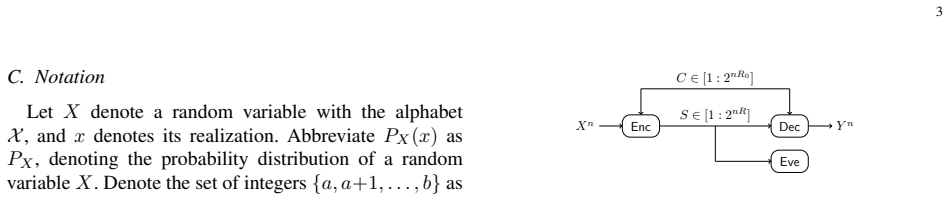
For noiseless channels, the exact secure RDP region is characterized. Separate source-channel coding is optimal for this exact secure RDP region with unlimited common randomness available. For broadcast channels with correlated noise components, an inner bound is derived and shown to be tight for a class of more-capable BCs. When both encoder and decoder have access to side information correlated with the source and the channel is noiseless, the exact RDP region is established. If only the decoder has correlated side information in the noiseless setting, an inner bound is derived along with a special case where the region is exact.
What carries the argument
Random binning-based coding scheme that simultaneously achieves strong secrecy, low distortion, and high perceptual quality.
If this is right
- Common randomness significantly reduces the communication rate in secure RDP settings for both binary and Gaussian sources.
- The inner bound derived for broadcast channels is tight for more-capable channels.
- Side information at both encoder and decoder yields an exact RDP region over noiseless channels.
- Side information only at the decoder yields an inner bound with at least one exact special case.
Where Pith is reading between the lines
- Shared randomness could be generated in practice to lower bandwidth demands in secure perceptual compression systems.
- The random-binning approach may extend to additional channel models where perception metrics replace or supplement distortion measures.
- Security constraints appear to interact with perception goals differently than they do with pure distortion.
Load-bearing premise
Unlimited common randomness is available between encoder and decoder and the perception metric permits random binning to achieve strong secrecy, low distortion, and high perceptual quality at once.
What would settle it
A concrete calculation for the binary or Gaussian source showing that common randomness fails to reduce the communication rate while still meeting strong secrecy and the perception target.
Figures


read the original abstract
Fundamental rate-distortion-perception (RDP) trade-offs arise in applications requiring maintained perceptual quality of reconstructed data, such as neural image compression. When compressed data is transmitted over public communication channels, security risks emerge. We therefore study secure RDP under negligible information leakage over both noiseless channels and broadcast channels, BCs, with correlated noise components. For noiseless channels, the exact secure RDP region is characterized. For BCs, an inner bound is derived and shown to be tight for a class of more-capable BCs. Separate source-channel coding is further shown to be optimal for this exact secure RDP region with unlimited common randomness available. Moreover, when both encoder and decoder have access to side information correlated with the source and the channel is noiseless, the exact RDP region is established. If only the decoder has correlated side information in the noiseless setting, an inner bound is derived along with a special case where the region is exact. Binary and Gaussian examples demonstrate that common randomness can significantly reduce the communication rate in secure RDP settings, unlike in standard rate-distortion settings. Thus, our results illustrate that random binning-based coding achieves strong secrecy, low distortion, and high perceptual quality simultaneously.
Editorial analysis
A structured set of objections, weighed in public.
Referee Report
Summary. The paper characterizes the exact secure rate-distortion-perception (RDP) region for noiseless channels and derives an inner bound for broadcast channels that is tight for more-capable BCs. It proves the optimality of separate source-channel coding under unlimited common randomness and analyzes side information scenarios. Binary and Gaussian examples are provided to show that common randomness can reduce the required communication rate while satisfying strong secrecy, distortion, and perception constraints simultaneously.
Significance. If the derivations hold, this work makes a significant contribution by integrating security into the RDP framework using a randomized distributed function computation approach. The exact characterizations and the demonstration that random binning achieves all three goals without rate penalty under unlimited common randomness are important for theoretical understanding and practical applications in secure perceptual data compression. The results on side information and channel models further broaden the applicability.
major comments (1)
- [Results for noiseless channels (Section 3)] The exact secure RDP region characterization in the noiseless case relies on unlimited common randomness for the random binning scheme to simultaneously achieve strong secrecy, the distortion constraint, and the perception constraint. This is load-bearing for the claim that the achievable region matches the converse without extra rate cost, as noted in the binary and Gaussian examples. The paper should clarify if any rate overhead is incurred when common randomness is limited.
minor comments (2)
- [Abstract] The abstract mentions 'randomized distributed function computation approach' but the introduction or Section 2 could better explain how this differs from standard random binning in secure rate-distortion theory.
- [Examples section] In the binary and Gaussian examples, the specific values of the perception metric and how it is computed should be detailed to allow readers to verify the rate reductions claimed.
Simulated Author's Rebuttal
We thank the referee for the constructive review and the recommendation for minor revision. We address the major comment point by point below.
read point-by-point responses
-
Referee: [Results for noiseless channels (Section 3)] The exact secure RDP region characterization in the noiseless case relies on unlimited common randomness for the random binning scheme to simultaneously achieve strong secrecy, the distortion constraint, and the perception constraint. This is load-bearing for the claim that the achievable region matches the converse without extra rate cost, as noted in the binary and Gaussian examples. The paper should clarify if any rate overhead is incurred when common randomness is limited.
Authors: We thank the referee for this observation. The exact secure RDP region characterization for noiseless channels in Section 3 is derived under the assumption of unlimited common randomness, which enables the random binning scheme to simultaneously satisfy strong secrecy, the distortion constraint, and the perception constraint without additional rate cost. This assumption is stated explicitly in the manuscript (e.g., in the abstract and the optimality result for separate source-channel coding), and the binary and Gaussian examples are presented to illustrate the rate-reduction benefit that common randomness provides under this model. The paper does not analyze the limited common randomness case; determining whether rate overhead would be incurred in that setting would require a separate analysis and is beyond the current scope. We will add a clarifying remark in the revised manuscript to emphasize the unlimited common randomness assumption and to note that the limited case remains an open direction for future research. revision: yes
Circularity Check
No circularity: bounds derived from standard information inequalities and explicit modeling assumptions
full rationale
The paper characterizes the exact secure RDP region for noiseless channels by deriving matching inner bounds (via random binning with unlimited common randomness) and outer bounds (via standard converse arguments using mutual information and secrecy constraints). Separate source-channel coding optimality is shown under the explicit assumption of unlimited common randomness, which is a modeling choice stated upfront rather than derived from the result. Binary and Gaussian examples illustrate rate reductions but serve as verifications, not as fitted inputs renamed as predictions. No self-definitional equations, fitted parameters called predictions, load-bearing self-citations, or smuggled ansatzes appear in the derivation chain. The results are self-contained against external benchmarks from rate-distortion and secrecy theory.
Axiom & Free-Parameter Ledger
axioms (1)
- standard math Standard definitions and properties of mutual information, rate-distortion functions, and strong secrecy in information theory.
Reference graph
Works this paper leans on
-
[1]
Timely and massive communication in 6G: Pragmatics, learning, and inference,
D. G ¨und¨uzet al., “Timely and massive communication in 6G: Pragmatics, learning, and inference,”IEEE BITS Inf. Theory Mag., Oct. 2023
work page 2023
-
[2]
Beyond transmitting bits: Context, semantics, and task- oriented communications,
——, “Beyond transmitting bits: Context, semantics, and task- oriented communications,”IEEE J. Sel. Areas Commun. (JSAC), vol. 41, no. 1, pp. 5–41, Nov. 2022
work page 2022
-
[3]
Information transmission with additional noise,
R. Dobrushin and B. Tsybakov, “Information transmission with additional noise,”IRE Trans. Inf. Theory (T-IT), vol. 8, no. 5, pp. 293–304, Sep. 1962
work page 1962
-
[4]
T. Berger, “Rate-distortion theory,”Wiley Encycl. Telecommun., 2003
work page 2003
-
[5]
I. Csisz ´ar and J. K ¨orner,Information Theory: Coding Theorems for Discrete Memoryless Systems. Cambridge University Press, 2011
work page 2011
-
[6]
Randomized distributed function computation with semantic communications: Applications to privacy,
O. G ¨unl¨u, “Randomized distributed function computation with semantic communications: Applications to privacy,” inIEEE Int. Workshop Inf. Forensics Security (WIFS), Dec. 2024, pp. 1–6
work page 2024
-
[7]
Distributed channel synthesis,
P. Cuff, “Distributed channel synthesis,”IEEE Trans. Inf. Theory, vol. 59, no. 11, pp. 7071–7096, Aug. 2013
work page 2013
-
[8]
O. G ¨unl¨u, M. Skorski, and H. V . Poor, “Low-latency rate- distortion-perception trade-off: A randomized distributed func- tion computation application,” inEuCNC & 6G Summit, June 2025
work page 2025
-
[9]
Deep randomized distributed function computation (DeepRDFC): Neural distributed channel simulation,
D. Bergstr ¨om and O. G ¨unl¨u, “Deep randomized distributed function computation (DeepRDFC): Neural distributed channel simulation,” inIEEE Int. Symp. Inf. Theory (ISIT), June 2025
work page 2025
-
[10]
G. ˚Ahlgren and O. G ¨unl¨u, “Secure rate-distortion-perception trade-off over channels: A randomized distributed function com- putation (RDFC) application,” inIEEE Int. Symp. Inf. Theory (ISIT), Michigan, June 2025
work page 2025
-
[11]
Compress- ing images by encoding their latent representations with rela- tive entropy coding,
G. Flamich, M. Havasi, and J. M. Hern ´andez-Lobato, “Compress- ing images by encoding their latent representations with rela- tive entropy coding,”Adv. Neural Inf. Process. Sys. (NeurIPS), vol. 33, pp. 16 131–16 141, Dec. 2020
work page 2020
-
[12]
Minimal random code learning: Getting bits back from compressed model parameters,
M. Havasi, R. Peharz, and J. M. Hern ´andez-Lobato, “Minimal random code learning: Getting bits back from compressed model parameters,” inInt. Conf. Learn. Representations (ICLR), May 2019
work page 2019
-
[13]
Adaptive compression in federated learning via side information,
B. Isiket al., “Adaptive compression in federated learning via side information,” inInt. Conf. Artificial Intel. Statistics (AIS- TATS), vol. 238, May 2024, pp. 487–495
work page 2024
-
[14]
Compression with exact error distribution for federated learning,
M. Hegazyet al., “Compression with exact error distribution for federated learning,” inInt. Conf. Artificial Intel. Statistics (AISTATS), May 2024, pp. 613–621
work page 2024
-
[15]
O. G ¨unl¨u, “Randomized distributed function computation (RDFC): ultra-efficient semantic communication applications to privacy,”Springer EURASIP J. Inf. Secur. (JIS), 2026
work page 2026
-
[16]
Optimal compression of locally differentially private mechanisms,
A. Shahet al., “Optimal compression of locally differentially private mechanisms,” inInt. Conf. Artificial Intel. Statistics (AISTATS), Mar. 2022, pp. 7680–7723
work page 2022
-
[17]
Sayood,Introduction to Data Compression, 4th ed
K. Sayood,Introduction to Data Compression, 4th ed. Morgan Kaufmann, 2017
work page 2017
-
[18]
Rethinking lossy compression: The rate-distortion-perception tradeoff,
Y . Blau and T. Michaeli, “Rethinking lossy compression: The rate-distortion-perception tradeoff,” inInt. Conf. Mach. Learn. (ICML), June 2019, pp. 675–685
work page 2019
-
[19]
R. Matsumoto, “Introducing the perception-distortion tradeoff into the rate-distortion theory of general information sources,” IEICE Commun. Express (ComEX), vol. 7, no. 11, pp. 427–431, 2018
work page 2018
-
[20]
On the rate-distortion-perception function,
J. Chenet al., “On the rate-distortion-perception function,”IEEE J. Sel. Areas Inf. Theory (JSAIT), vol. 3, no. 4, pp. 664–673, Dec. 2022
work page 2022
-
[21]
Universal rate-distortion-perception represen- tations for lossy compression,
G. Zhanget al., “Universal rate-distortion-perception represen- tations for lossy compression,”Adv. Neural Inf. Process. Sys. (NeurIPS), vol. 34, pp. 11 517–11 529, Dec. 2021
work page 2021
-
[22]
A coding theorem for the rate- distortion-perception function,
L. Theis and A. B. Wagner, “A coding theorem for the rate- distortion-perception function,” inProc. Neural Compress.: From Inf. Theory Appl., Workshop Int. Conf. Learn. Represent. ICLR, May 2021
work page 2021
-
[23]
Output constrained lossy source coding with limited common randomness,
N. Saldi, T. Linder, and S. Y ¨uksel, “Output constrained lossy source coding with limited common randomness,”IEEE Trans. Inf. Theory (T-IT), vol. 61, no. 9, pp. 4984–4998, Sep. 2015
work page 2015
-
[24]
End-to-end optimized image compression,
J. Ball ´e, V . Laparra, and E. P. Simoncelli, “End-to-end optimized image compression,” inInternational Conference on Learning Representations (ICLR), 2017
work page 2017
-
[25]
The rate-distortion-perception tradeoff: The role of common randomness,
A. B. Wagner, “The rate-distortion-perception tradeoff: The role of common randomness,”arXiv preprint arXiv:2202.04147, Feb. 2022
-
[26]
The rate-distortion- perception trade-off: The role of private randomness,
Y . Hamdi, A. B. Wagner, and D. G ¨und¨uz, “The rate-distortion- perception trade-off: The role of private randomness,”arXiv preprint arXiv:2404.01111, Apr. 2024
-
[27]
I. Goodfellowet al., “Generative adversarial nets,”Adv. Neural Inf. Process. Sys. (NeurIPS), pp. 2672–2680, Dec. 2014
work page 2014
-
[28]
Wasserstein generative adversarial networks,
M. Arjovsky, S. Chintala, and L. Bottou, “Wasserstein generative adversarial networks,” inInt. Conf. Mach. Learning (ICML), Aug. 2017, pp. 214–223
work page 2017
-
[29]
Improved training of Wasserstein GANs,
I. Gulrajaniet al., “Improved training of Wasserstein GANs,” Adv. Neural Inf. Process. Sys. (NeurIPS), vol. 30, pp. 5769–5779, Dec. 2017
work page 2017
-
[30]
Secure Deep-JSCC against mul- tiple eavesdroppers,
S. A. Ameli Kalkhoran, M. Letafati, E. Erdemir, B. H. Khalaj, H. Behroozi, and D. G ¨und¨uz, “Secure Deep-JSCC against mul- tiple eavesdroppers,” inIEEE Global Commun. Conf. (GLOBE- COM), 2023, pp. 3433–3438
work page 2023
-
[31]
SecDiff: Diffusion-aided secure deep joint source-channel coding against adversarial attacks,
C. Zhao, J. Wang, R. Zhang, D. Niyato, H. Du, Z. Xiong, D. I. Kim, and P. Zhang, “SecDiff: Diffusion-aided secure deep joint source-channel coding against adversarial attacks,”IEEE J. Sel. Areas Commun. (JSAC), vol. 44, pp. 3705–3720, 2026
work page 2026
-
[32]
Secure multi-function computation with private remote sources,
O. G ¨unl¨u, M. Bloch, and R. F. Schaefer, “Secure multi-function computation with private remote sources,” inIEEE Int. Symp. Inf. Theory (ISIT), July 2021, pp. 1403–1408
work page 2021
-
[33]
Rate-distortion theory for secrecy systems,
C. Schieler and P. Cuff, “Rate-distortion theory for secrecy systems,” inIEEE Int. Symp. Inf. Theory (ISIT), July 2013, pp. 2219–2223
work page 2013
-
[34]
O. G ¨unl¨u, M. Skorski, and H. V . Poor, “Low-latency realism through randomized distributed function computations: A Shan- non theoretic approach,”Entropy, vol. 28, no. 1, p. 86, 2026
work page 2026
-
[35]
A mathematical theory of communication,
C. E. Shannon, “A mathematical theory of communication,”Bell Syst. Tech. J., vol. 27, no. 3, pp. 379–423, 1948
work page 1948
-
[36]
Channel-aware optimal transport: A theoretical framework for generative communication,
X. Qu, R. Li, J. Chen, L. Yu, and X. Wang, “Channel-aware optimal transport: A theoretical framework for generative com- munication,”arXiv preprint arXiv:2412.19025, 2024
-
[37]
Source-channel separation theorems for distortion perception coding,
C. Tian, J. Chen, and K. Narayanan, “Source-channel separation theorems for distortion perception coding,” inIEEE Int. Sym. on Inf. Theory (ISIT), 2025, pp. 1–6
work page 2025
-
[38]
The rate-distortion function for source coding with side information at the decoder,
A. Wyner and J. Ziv, “The rate-distortion function for source coding with side information at the decoder,”IEEE Trans. Inf. Theory (T-IT), vol. 22, no. 1, pp. 1–10, 1976
work page 1976
-
[39]
Y . Hamdi, A. B. Wagner, and D. G ¨und¨uz, “Rate-distortion- perception trade-off with strong realism constraints: Role of side information and common randomness,” 2025. [Online]. Available: https://arxiv.org/abs/2507.14825 20
-
[40]
The rate-distortion-perception trade- off with side information,
Y . Hamdi and D. G ¨und¨uz, “The rate-distortion-perception trade- off with side information,” inIEEE Int. Symp. on Inf. Theory (ISIT), 2023, pp. 1056–1061
work page 2023
-
[41]
Conditional rate-distortion-perception trade-off,
X. Niuet al., “Conditional rate-distortion-perception trade-off,” inIEEE Int. Symp. on Inf. Theory (ISIT), 2023, pp. 1068–1073
work page 2023
-
[42]
Secure rate-distortion-perception trade-off with side information,
G. ˚Ahlgren and O. G ¨unl¨u, “Secure rate-distortion-perception trade-off with side information,” inIEEE Wireless Commun. and Netw. Conf. (WCNC), Malaysia, April 2026, accepted
work page 2026
-
[43]
Achievability proof via output statistics of random binning,
M. H. Yassaee, M. R. Aref, and A. Gohari, “Achievability proof via output statistics of random binning,”IEEE Trans. Inf. Theory (T-IT), vol. 60, no. 11, pp. 6760–6786, Nov. 2014
work page 2014
-
[44]
Communication in networks for coordinating behavior,
P. Cuff, “Communication in networks for coordinating behavior,” PhD dissertation, Stanford University, 2009
work page 2009
-
[45]
A. E. Gamal and Y .-H. Kim,Network Information Theory. Cambridge, U.K.: Cambridge University Press, 2011
work page 2011
-
[46]
G. Cervia, G. Bassi, and M. Skoglund, “Secure strong coordina- tion,” inProc. IEEE Conf. Commun. Netw. Secur. (CNS). IEEE, 2020, pp. 1–6
work page 2020
-
[47]
Strong coordination of signals and actions over noisy channels with two- sided state information,
G. Cervia, L. Luzzi, M. Le Treust, and M. R. Bloch, “Strong coordination of signals and actions over noisy channels with two- sided state information,”IEEE Trans. Inf. Theory (T-IT), vol. 66, no. 8, pp. 4681–4708, 2020
work page 2020
-
[48]
Remote joint strong coordination and reliable communication,
G. Cervia, T. J. Oechtering, and M. Skoglund, “Remote joint strong coordination and reliable communication,” inIEEE Int. Symp. Inf. Theory (ISIT), June 2020, pp. 932–937
work page 2020
discussion (0)
Sign in with ORCID, Apple, or X to comment. Anyone can read and Pith papers without signing in.