Recognition: unknown
Mol-Debate: Multi-Agent Debate Improves Structural Reasoning in Molecular Design
Pith reviewed 2026-05-10 00:40 UTC · model grok-4.3
The pith
A multi-agent generate-debate-refine loop improves structural reasoning for text-guided molecular design.
A machine-rendered reading of the paper's core claim, the machinery that carries it, and where it could break.
Core claim
Mol-Debate introduces a generation paradigm consisting of an iterative generate-debate-refine loop that uses perspective-oriented orchestration to address developer-debater conflicts, global versus local structural reasoning, and the integration of static and dynamic information, resulting in state-of-the-art performance on molecular design tasks.
What carries the argument
The generate-debate-refine loop orchestrated by multiple perspectives to handle conflicts and integrate different reasoning scales.
If this is right
- Outperforms strong baselines on exact match for ChEBI-20 dataset.
- Achieves higher weighted success rate on S²-Bench for molecular generation.
- Provides a more dynamic reasoning process suitable for real-world iterative drug design workflows.
Where Pith is reading between the lines
- If the approach generalizes, it could be adapted for other constrained generation tasks like protein design or material synthesis.
- Future work might test whether the performance gains depend on specific agent roles or the number of debate rounds.
Load-bearing premise
That the perspective-oriented orchestration sufficiently resolves the conflicts and integration challenges in the debate loop to deliver the performance improvements.
What would settle it
A controlled test where disabling the debate component results in performance equal to or better than the full Mol-Debate system on the ChEBI-20 or S²-Bench benchmarks.
Figures


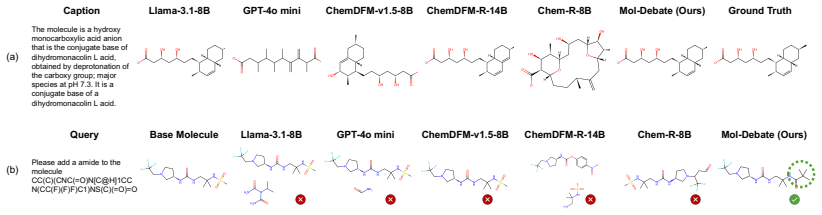


read the original abstract
Text-guided molecular design is a key capability for AI-driven drug discovery, yet it remains challenging to map sequential natural-language instructions with non-linear molecular structures under strict chemical constraints. Most existing approaches, including RAG, CoT prompting, and fine-tuning or RL, emphasize a small set of ad-hoc reasoning perspectives implemented in a largely one-shot generation pipeline. In contrast, real-world drug discovery relies on dynamic, multi-perspective critique and iterative refinement to reconcile semantic intent with structural feasibility. Motivated by this, we propose Mol-Debate, a generation paradigm that enables such dynamic reasoning through an iterative generate-debate-refine loop. We further characterize key challenges in this paradigm and address them through perspective-oriented orchestration, including developer-debater conflict, global-local structural reasoning, and static-dynamic integration. Experiments demonstrate that Mol-Debate achieves state-of-the-art performance against strong general and chemical baselines, reaching 59.82% exact match on ChEBI-20 and 50.52% weighted success rate on S$^2$-Bench. Our code is available at https://github.com/wyuzh/Mol-Debate.
Editorial analysis
A structured set of objections, weighed in public.
Referee Report
Summary. The paper introduces Mol-Debate, a multi-agent framework for text-guided molecular design that uses an iterative generate-debate-refine loop with perspective-oriented orchestration. It targets challenges including developer-debater conflict, global-local structural reasoning, and static-dynamic integration. Experiments claim state-of-the-art results, with 59.82% exact match on ChEBI-20 and 50.52% weighted success rate on S²-Bench, outperforming general and chemical baselines. Code is released at https://github.com/wyuzh/Mol-Debate.
Significance. If the gains hold under compute-matched controls, the work would provide evidence that multi-perspective iterative debate improves structural reasoning over one-shot methods in molecular generation, with potential implications for AI-driven drug discovery. The public code release is a positive factor for reproducibility and further validation.
major comments (2)
- [Experiments] Experiments section (results on ChEBI-20 and S²-Bench): the central performance claims (59.82% exact match, 50.52% weighted success) are not supported by evidence that baselines were evaluated under matched computational budgets (same total LLM calls or tokens per sample). The generate-debate-refine loop multiplies invocations relative to one-shot or single-agent baselines, so the reported deltas cannot be securely attributed to the orchestration rather than extended inference.
- [Section 3] Section 3 (perspective-oriented orchestration): the description of how the loop resolves developer-debater conflict, global-local structural reasoning, and static-dynamic integration is not accompanied by ablations that isolate the contribution of each mechanism to the final metrics, leaving the causal link to the claimed improvements unquantified.
minor comments (1)
- [Abstract] The abstract and introduction could more explicitly list the specific general and chemical baselines used for comparison.
Simulated Author's Rebuttal
We thank the referee for the constructive feedback on our manuscript. We address each major comment below and will revise the paper to incorporate additional experiments and analyses that directly respond to the concerns raised.
read point-by-point responses
-
Referee: [Experiments] Experiments section (results on ChEBI-20 and S²-Bench): the central performance claims (59.82% exact match, 50.52% weighted success) are not supported by evidence that baselines were evaluated under matched computational budgets (same total LLM calls or tokens per sample). The generate-debate-refine loop multiplies invocations relative to one-shot or single-agent baselines, so the reported deltas cannot be securely attributed to the orchestration rather than extended inference.
Authors: We acknowledge that the iterative generate-debate-refine loop incurs additional LLM invocations compared to one-shot baselines. Our original experiments followed the standard evaluation protocols and published configurations of each baseline. To address the concern, we will add new experiments in the revised manuscript that enforce matched computational budgets (equal total LLM calls or token limits per sample) across all methods. These results will be reported alongside the existing metrics to isolate the contribution of the perspective-oriented orchestration. revision: yes
-
Referee: [Section 3] Section 3 (perspective-oriented orchestration): the description of how the loop resolves developer-debater conflict, global-local structural reasoning, and static-dynamic integration is not accompanied by ablations that isolate the contribution of each mechanism to the final metrics, leaving the causal link to the claimed improvements unquantified.
Authors: We agree that quantitative ablations are needed to establish the individual impact of each mechanism. In the revised manuscript, we will add a new ablation study (either in Section 3 or as a dedicated subsection) that evaluates performance when each component is removed or disabled in turn: developer-debater conflict resolution, global-local structural reasoning, and static-dynamic integration. Results will be presented on both ChEBI-20 and S²-Bench to quantify their contributions to the overall gains. revision: yes
Circularity Check
No circularity; empirical results rest on reported experiments
full rationale
The paper presents an empirical method (Mol-Debate) with an iterative generate-debate-refine loop and reports performance numbers (59.82% exact match on ChEBI-20, 50.52% weighted success on S²-Bench) against baselines. No derivation chain, equations, fitted parameters renamed as predictions, or self-citation load-bearing steps appear in the abstract or described structure. Claims are grounded in experimental outcomes rather than reducing to definitions or prior self-referential results by construction. The skeptic concern about compute-matching is a validity issue, not circularity.
Axiom & Free-Parameter Ledger
Reference graph
Works this paper leans on
-
[1]
Journal of the American Chemical Society , volume=
Signal processing at the molecular level , author=. Journal of the American Chemical Society , volume=. 2001 , publisher=
2001
-
[2]
Ecotoxicology and environmental safety , volume=
Molecular biomarkers of oxidative stress in aquatic organisms in relation to toxic environmental pollutants , author=. Ecotoxicology and environmental safety , volume=. 2006 , publisher=
2006
-
[3]
SMILES, a chemical language and information system. 1. Introduction to methodology and encoding rules , author=. Journal of chemical information and computer sciences , volume=. 1988 , publisher=
1988
-
[4]
IEEE transactions on knowledge and data engineering , volume=
Empowering molecule discovery for molecule-caption translation with large language models: A chatgpt perspective , author=. IEEE transactions on knowledge and data engineering , volume=. 2024 , publisher=
2024
-
[5]
Proceedings of the 63rd Annual Meeting of the Association for Computational Linguistics (Volume 1: Long Papers) , pages=
Removal of hallucination on hallucination: Debate-augmented RAG , author=. Proceedings of the 63rd Annual Meeting of the Association for Computational Linguistics (Volume 1: Long Papers) , pages=
-
[6]
Proceedings of the 2021 Conference on Empirical Methods in Natural Language Processing , pages=
Text2mol: Cross-modal molecule retrieval with natural language queries , author=. Proceedings of the 2021 Conference on Empirical Methods in Natural Language Processing , pages=
2021
-
[7]
Cell Reports Physical Science , volume=
Developing ChemDFM as a large language foundation model for chemistry , author=. Cell Reports Physical Science , volume=. 2025 , publisher=
2025
-
[8]
ChemDFM-R: A Chemical Reasoning LLM Enhanced with Atomized Chemical Knowledge
ChemDFM-R: A Chemical Reasoning LLM Enhanced with Atomized Chemical Knowledge , author=. arXiv preprint arXiv:2507.21990 , year=
work page internal anchor Pith review Pith/arXiv arXiv
-
[9]
arXiv e-prints , pages=
The llama 3 herd of models , author=. arXiv e-prints , pages=
-
[10]
Forty-first International Conference on Machine Learning , year=
Improving factuality and reasoning in language models through multiagent debate , author=. Forty-first International Conference on Machine Learning , year=
-
[11]
Proceedings of the 32nd ACM International Conference on Multimedia , pages=
A picture is worth a graph: A blueprint debate paradigm for multimodal reasoning , author=. Proceedings of the 32nd ACM International Conference on Multimedia , pages=
-
[12]
arXiv preprint arXiv:2204.11817 , year=
Translation between molecules and natural language , author=. arXiv preprint arXiv:2204.11817 , year=
-
[13]
MolReFlect: Towards In-Context Fine-grained Alignments between Molecules and Texts
MolReFlect: Towards In-Context Fine-grained Alignments between Molecules and Texts , author=. arXiv preprint arXiv:2411.14721 , year=
work page internal anchor Pith review Pith/arXiv arXiv
-
[14]
Chem-r: Learning to reason as a chemist
Chem-R: Learning to Reason as a Chemist , author=. arXiv preprint arXiv:2510.16880 , year=
-
[15]
Briefings in Bioinformatics , volume =
Zhang, Wengyu and Tian, Qi and Cao, Yi and Fan, Wenqi and Jiang, Dongmei and Wang, Yaowei and Li, Qing and Wei, Xiao-Yong , title =. Briefings in Bioinformatics , volume =. 2025 , month =
2025
-
[16]
https://ai
The llama 4 herd: The beginning of a new era of natively multimodal ai innovation , author=. https://ai. meta. com/blog/llama-4-multimodal-intelligence/, checked on , volume=
-
[17]
ACS central science , volume=
Molecular transformer: a model for uncertainty-calibrated chemical reaction prediction , author=. ACS central science , volume=. 2019 , publisher=
2019
-
[18]
Advances in neural information processing systems , volume=
Attention is all you need , author=. Advances in neural information processing systems , volume=
-
[19]
Advances in neural information processing systems , volume=
Retrieval-augmented generation for knowledge-intensive nlp tasks , author=. Advances in neural information processing systems , volume=
-
[20]
Mol-r1: Towards explicit long-cot reasoning in molecule discovery , author=. arXiv preprint arXiv:2508.08401 , year=
-
[21]
Advances in neural information processing systems , volume=
Chain-of-thought prompting elicits reasoning in large language models , author=. Advances in neural information processing systems , volume=
-
[22]
Vicinagearth , volume=
A survey on LLM-based multi-agent systems: workflow, infrastructure, and challenges , author=. Vicinagearth , volume=. 2024 , publisher=
2024
-
[23]
Large Language Model based Multi-Agents: A Survey of Progress and Challenges
Large language model based multi-agents: A survey of progress and challenges , author=. arXiv preprint arXiv:2402.01680 , year=
work page internal anchor Pith review arXiv
-
[24]
Release , volume=
Rdkit documentation , author=. Release , volume=
-
[25]
2025 , archivePrefix=
Speak-to-Structure: Evaluating LLMs in Open-domain Natural Language-Driven Molecule Generation , author=. 2025 , archivePrefix=
2025
-
[26]
2009 , publisher=
Levenshtein distance: Information theory, computer science, string (computer science), string metric, damerau? Levenshtein distance, spell checker, hamming distance , author=. 2009 , publisher=
2009
-
[27]
Gpt-4o system card , author=. arXiv preprint arXiv:2410.21276 , year=
work page internal anchor Pith review Pith/arXiv arXiv
-
[28]
GeLLM O : Generalizing Large Language Models for Multi-property Molecule Optimization
Dey, Vishal and Hu, Xiao and Ning, Xia. GeLLM O : Generalizing Large Language Models for Multi-property Molecule Optimization. Proceedings of the 63rd Annual Meeting of the Association for Computational Linguistics (Volume 1: Long Papers). 2025
2025
-
[29]
Structural Reasoning Improves Molecular Understanding of LLM
Jang, Yunhui and Kim, Jaehyung and Ahn, Sungsoo. Structural Reasoning Improves Molecular Understanding of LLM. Proceedings of the 63rd Annual Meeting of the Association for Computational Linguistics (Volume 1: Long Papers). 2025
2025
-
[30]
M ol XPT : Wrapping Molecules with Text for Generative Pre-training
Liu, Zequn and Zhang, Wei and Xia, Yingce and Wu, Lijun and Xie, Shufang and Qin, Tao and Zhang, Ming and Liu, Tie-Yan. M ol XPT : Wrapping Molecules with Text for Generative Pre-training. Proceedings of the 61st Annual Meeting of the Association for Computational Linguistics (Volume 2: Short Papers). 2023
2023
-
[31]
Proceedings of the 2023 Conference on Empirical Methods in Natural Language Processing , pages=
BioT5: Enriching Cross-modal Integration in Biology with Chemical Knowledge and Natural Language Associations , author=. Proceedings of the 2023 Conference on Empirical Methods in Natural Language Processing , pages=
2023
-
[32]
Nature , volume=
The Virtual Lab of AI agents designs new SARS-CoV-2 nanobodies , author=. Nature , volume=. 2025 , publisher=
2025
-
[33]
The Twelfth International Conference on Learning Representations , year=
Mol-Instructions: A Large-Scale Biomolecular Instruction Dataset for Large Language Models , author=. The Twelfth International Conference on Learning Representations , year=
-
[34]
DeepSeek-R1: Incentivizing Reasoning Capability in LLMs via Reinforcement Learning
Deepseek-r1: Incentivizing reasoning capability in llms via reinforcement learning , author=. arXiv preprint arXiv:2501.12948 , year=
work page internal anchor Pith review Pith/arXiv arXiv
-
[35]
Proceedings of the 2024 Conference on Empirical Methods in Natural Language Processing , pages=
More than catastrophic forgetting: Integrating general capabilities for domain-specific llms , author=. Proceedings of the 2024 Conference on Empirical Methods in Natural Language Processing , pages=
2024
-
[36]
Briefings in Bioinformatics , volume=
Identifying the kind behind SMILES—anatomical therapeutic chemical classification using structure-only representations , author=. Briefings in Bioinformatics , volume=. 2022 , publisher=
2022
-
[37]
Openai gpt-5 system card , author=. arXiv preprint arXiv:2601.03267 , year=
work page internal anchor Pith review Pith/arXiv arXiv
-
[38]
https://blog.google/innovation-and-ai/technology/developers-tools/gemma-4/ , year=
Gemma 4: Byte for byte, the most capable open models , author=. https://blog.google/innovation-and-ai/technology/developers-tools/gemma-4/ , year=
-
[39]
Artificial Intelligence Repository , year=
Mt-mol: Multi agent system with tool-based reasoning for molecular optimization , author=. Artificial Intelligence Repository , year=
-
[40]
Collaborative expert llms guided multi-objective molecular optimization , author=. arXiv preprint arXiv:2503.03503 , year=
-
[41]
PharmAgents: Building a virtual pharma with large language model agents
Pharmagents: Building a virtual pharma with large language model agents , author=. arXiv preprint arXiv:2503.22164 , year=
-
[42]
The twelfth international conference on learning representations , year=
Conversational drug editing using retrieval and domain feedback , author=. The twelfth international conference on learning representations , year=
-
[43]
Findings of the Association for Computational Linguistics: ACL 2025 , pages=
RL-guider: Leveraging historical decisions and feedback for drug editing with large language models , author=. Findings of the Association for Computational Linguistics: ACL 2025 , pages=
2025
-
[44]
International Conference on Machine Learning , pages=
LDMol: A Text-to-Molecule Diffusion Model with Structurally Informative Latent Space Surpasses AR Models , author=. International Conference on Machine Learning , pages=. 2025 , organization=
2025
-
[45]
Nature machine intelligence , volume=
Augmenting large language models with chemistry tools , author=. Nature machine intelligence , volume=. 2024 , publisher=
2024
-
[46]
Findings of the Association for Computational Linguistics: NAACL 2025 , pages=
Tooling or not tooling? the impact of tools on language agents for chemistry problem solving , author=. Findings of the Association for Computational Linguistics: NAACL 2025 , pages=
2025
-
[47]
2026 , eprint=
ChemAmp: Amplified Chemistry Tools via Composable Agents , author=. 2026 , eprint=
2026
-
[48]
Think in Latent Thoughts: A New Paradigm for Gloss-Free Sign Language Translation
Think in Latent Thoughts: A New Paradigm for Gloss-Free Sign Language Translation , author=. arXiv preprint arXiv:2604.15301 , year=
work page internal anchor Pith review Pith/arXiv arXiv
-
[49]
Self-Paced Learning for Images of Antinuclear Antibodies , year=
Jiang, Yiyang and Qian, Guangwu and Wu, Jiaxin and Huang, Qi and Li, Qing and Wu, Yongkang and Wei, Xiao-Yong , journal=. Self-Paced Learning for Images of Antinuclear Antibodies , year=
-
[50]
Jiang, Yiyang and Zhang, Wengyu and Zhang, Xulu and Wei, Xiao-Yong and Chen, Chang Wen and Li, Qing , title =. 2024 , isbn =. doi:10.1145/3664647.3681115 , booktitle =
-
[51]
Exploring the reasoning abilities of multimodal large language models (mllms): A comprehensive survey on emerging trends in multimodal reasoning , author=. arXiv preprint arXiv:2401.06805 , year=
-
[52]
Proceedings of the IEEE/CVF conference on computer vision and pattern recognition , pages=
Llms are good sign language translators , author=. Proceedings of the IEEE/CVF conference on computer vision and pattern recognition , pages=
-
[53]
2026 , eprint=
From Competition to Coopetition: Coopetitive Training-Free Image Editing Based on Text Guidance , author=. 2026 , eprint=
2026
discussion (0)
Sign in with ORCID, Apple, or X to comment. Anyone can read and Pith papers without signing in.