Recognition: unknown
ProMMSearchAgent: A Generalizable Multimodal Search Agent Trained with Process-Oriented Rewards
Pith reviewed 2026-05-10 01:07 UTC · model grok-4.3
The pith
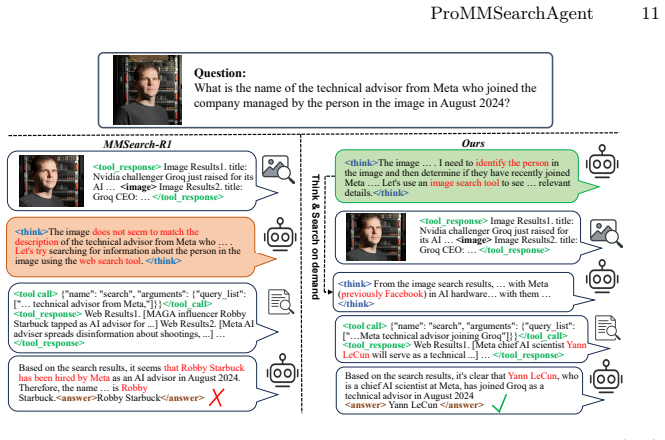
A multimodal search agent trained entirely in a static local sandbox with introspective rewards transfers zero-shot to live Google Search and sets new records on visual reasoning benchmarks.
A machine-rendered reading of the paper's core claim, the machinery that carries it, and where it could break.
Core claim
By decoupling policy learning into a deterministic local static sandbox and using an introspective process-oriented reward that generates dense behavioral metadata, the agent learns to initiate multimodal or text searches only when it detects visual or factual uncertainty; the locally trained policy then transfers zero-shot to the live Google Search API and reaches new state-of-the-art accuracy.
What carries the argument
The introspective process-oriented reward, which probes the agent's parametric knowledge boundaries inside the sandbox to supply dense signals that reward correct decisions about when to search.
If this is right
- The agent outperforms MMSearch-R1 by 5.1 percent on FVQA-test, 6.3 percent on InfoSeek, and 11.3 percent on MMSearch.
- Policy learning can be completed entirely offline in a controlled sandbox before any live API calls are made.
- Search initiation decisions become more precise because rewards target cognitive uncertainty rather than final answer correctness alone.
- Zero-shot transfer removes the need to expose training to unpredictable or costly real-web interactions.
Where Pith is reading between the lines
- The same sandbox-plus-introspective-reward pattern may reduce training costs for other web-facing agents that currently require live interaction during learning.
- Process-level signals about knowledge gaps could be combined with other modalities or tasks where outcome rewards are equally sparse.
- Extending the sandbox with more varied simulated web responses might further close the remaining gap to fully online training.
Load-bearing premise
The static sandbox and the agent's self-probed knowledge boundaries are similar enough to live web dynamics that the learned search decisions will work without further training.
What would settle it
Running the trained agent on the live Google Search API and observing no performance gain or outright failure compared with training directly in the real environment.
Figures


read the original abstract
Training multimodal agents via reinforcement learning for knowledge-intensive visual reasoning is fundamentally hindered by the extreme sparsity of outcome-based supervision and the unpredictability of live web environments. To resolve these algorithmic and environmental bottlenecks, we introduce ProMMSearchAgent, establishing a novel Sim-to-Real training paradigm for multimodal search. We decouple policy learning into a deterministic, local static sandbox. Crucially, to learn effectively within this constrained environment, we propose an introspective process-oriented reward. By probing the agent's own parametric knowledge boundaries, we generate dense behavioral metadata that explicitly rewards the correct cognitive decision, initiating a multimodal or text search only when visually or factually uncertain. Extensive experiments demonstrate that our locally-trained policy transfers zero-shot to the live Google Search API. ProMMSearchAgent achieves new SOTA performance, outperforming MMSearch-R1 by +5.1% on FVQA-test, +6.3% on InfoSeek, and +11.3% on MMSearch.
Editorial analysis
A structured set of objections, weighed in public.
Referee Report
Summary. The manuscript introduces ProMMSearchAgent, a multimodal search agent for knowledge-intensive visual reasoning. It proposes a Sim-to-Real paradigm that decouples policy learning into a deterministic local static sandbox and uses an introspective process-oriented reward. This reward probes the agent's parametric knowledge boundaries to generate dense supervision, rewarding correct cognitive decisions such as initiating a multimodal or text search only when uncertain. The central claim is that the locally trained policy transfers zero-shot to the live Google Search API, achieving new SOTA results with gains of +5.1% on FVQA-test, +6.3% on InfoSeek, and +11.3% on MMSearch over MMSearch-R1.
Significance. If the zero-shot transfer and reported gains hold under detailed scrutiny, the work would be significant for multimodal agent training. The introspective process-oriented reward offers a promising mechanism to address extreme outcome sparsity by leveraging the agent's own knowledge boundaries for dense behavioral feedback, and the Sim-to-Real setup could enable more efficient training without constant live API access. This could influence future designs for generalizable agents in unpredictable environments, provided the sim-to-real gap is rigorously characterized.
major comments (3)
- [Abstract] Abstract: The specific quantitative gains (+5.1% on FVQA-test, +6.3% on InfoSeek, +11.3% on MMSearch) and zero-shot transfer claim are presented without any reference to experimental setup, baselines, number of runs, variance, or statistical tests. This absence is load-bearing for the central SOTA and generalization claims, as the data cannot be assessed for robustness.
- [Method] Method section: The deterministic local static sandbox is introduced without any description of its construction, such as how search results are mocked, whether result variability or latency is simulated, or how uncertainty is injected. This detail is essential to evaluate whether the introspective reward truly enables transfer to live Google Search API stochasticity.
- [Experiments] Experiments section: No ablations are mentioned that isolate the introspective process-oriented reward's contribution to zero-shot transfer versus standard outcome rewards or other factors. Without these, it remains possible that the reported improvements stem from benchmark alignment rather than the proposed paradigm.
Simulated Author's Rebuttal
We thank the referee for the constructive feedback, which helps strengthen the clarity and rigor of our claims regarding the Sim-to-Real paradigm and the introspective reward. We address each major comment point-by-point below, with proposed revisions to the manuscript.
read point-by-point responses
-
Referee: [Abstract] Abstract: The specific quantitative gains (+5.1% on FVQA-test, +6.3% on InfoSeek, +11.3% on MMSearch) and zero-shot transfer claim are presented without any reference to experimental setup, baselines, number of runs, variance, or statistical tests. This absence is load-bearing for the central SOTA and generalization claims, as the data cannot be assessed for robustness.
Authors: We agree that the abstract should better contextualize the quantitative claims to support immediate assessment of robustness. While the full experimental protocol (including baselines such as MMSearch-R1, evaluation on FVQA-test/InfoSeek/MMSearch, averaging over 3 random seeds with reported standard deviations, and statistical comparisons) is detailed in Section 4, we will revise the abstract to add a brief reference to the evaluation setup and note that variance and significance details are provided in the main text. revision: yes
-
Referee: [Method] Method section: The deterministic local static sandbox is introduced without any description of its construction, such as how search results are mocked, whether result variability or latency is simulated, or how uncertainty is injected. This detail is essential to evaluate whether the introspective reward truly enables transfer to live Google Search API stochasticity.
Authors: The sandbox is introduced in Section 3 as a deterministic local static environment using cached real-world search results to enable efficient policy training without live API calls. However, we acknowledge the current description is high-level and lacks explicit details on result mocking mechanics, the deliberate choice not to simulate variability or latency (to isolate policy learning), and uncertainty injection via the agent's internal parametric knowledge probes. We will expand Section 3.1 with these specifics to better characterize the Sim-to-Real gap and support the zero-shot transfer claim. revision: yes
-
Referee: [Experiments] Experiments section: No ablations are mentioned that isolate the introspective process-oriented reward's contribution to zero-shot transfer versus standard outcome rewards or other factors. Without these, it remains possible that the reported improvements stem from benchmark alignment rather than the proposed paradigm.
Authors: We recognize the value of isolating the process-oriented reward's role in enabling zero-shot transfer. The main experiments include comparisons to outcome-reward baselines (Table 2), but we did not provide a dedicated ablation focused on the transfer setting. We will add a new ablation subsection (and associated table) in the revised Experiments section that directly compares the full model against an outcome-reward-only variant under zero-shot live API evaluation, to demonstrate the contribution of the introspective component. revision: yes
Circularity Check
No circularity detected; no equations, derivations, or self-referential reductions in the described training paradigm
full rationale
The abstract and provided text describe a Sim-to-Real paradigm decoupling policy learning into a deterministic local sandbox with an introspective process-oriented reward that probes parametric knowledge boundaries to generate dense behavioral metadata. No mathematical equations, fitted parameters renamed as predictions, self-citations as load-bearing premises, or uniqueness theorems appear. The zero-shot transfer to live Google Search API is presented as an empirical outcome from extensive experiments rather than a constructed prediction equivalent to inputs. The central claim rests on the assumption that the sandbox and reward capture necessary dynamics, but this is not reduced by definition or self-reference to the reported SOTA gains. No load-bearing steps reduce to the paper's own inputs by construction.
Axiom & Free-Parameter Ledger
axioms (2)
- domain assumption The deterministic local static sandbox sufficiently approximates live web search dynamics for zero-shot policy transfer.
- domain assumption Probing the agent's own parametric knowledge boundaries produces dense, correct behavioral metadata that guides search decisions.
invented entities (1)
-
introspective process-oriented reward
no independent evidence
Reference graph
Works this paper leans on
-
[1]
Bai, S., Chen, K., Liu, X., Wang, J., Ge, W., Song, S., Dang, K., Wang, P., Wang, S., Tang, J., et al.: Qwen2. 5-vl technical report. arXiv preprint arXiv:2502.13923 (2025)
work page internal anchor Pith review Pith/arXiv arXiv 2025
-
[2]
Learning to reason with search for llms via reinforcement learning,
Chen, M., Sun, L., Li, T., Sun, H., Zhou, Y., Zhu, C., Wang, H., Pan, J.Z., Zhang, W., Chen, H., et al.: Learning to reason with search for llms via reinforcement learning. arXiv preprint arXiv:2503.19470 (2025)
- [3]
-
[4]
In: Proceedings of the IEEE/CVF conference on computer vision and pattern recognition
Chen, Z., Wu, J., Wang, W., Su, W., Chen, G., Xing, S., Zhong, M., Zhang, Q., Zhu, X., Lu, L., et al.: Internvl: Scaling up vision foundation models and aligning for generic visual-linguistic tasks. In: Proceedings of the IEEE/CVF conference on computer vision and pattern recognition. pp. 24185–24198 (2024)
2024
-
[5]
In: Proceedings of the IEEE/CVF International Conference on Computer Vision
Cheng, X., Zhang, W., Zhang, S., Yang, J., Guan, X., Wu, X., Li, X., Zhang, G., Liu, J., Mai, Y., et al.: Simplevqa: Multimodal factuality evaluation for multimodal large language models. In: Proceedings of the IEEE/CVF International Conference on Computer Vision. pp. 4637–4646 (2025)
2025
-
[6]
Deng, Y., Bansal, H., Yin, F., Peng, N., Wang, W., Chang, K.W.: Openvl- thinker: An early exploration to complex vision-language reasoning via iterative self-improvement. arXiv preprint arXiv:2503.17352 (2025)
-
[7]
Fu, M., Peng, Y., Liu, B., Wan, Y., Chen, D.: Livevqa: Live visual knowledge seeking. arXiv preprint arXiv:2504.05288 (2025)
- [8]
-
[9]
DeepSeek-R1: Incentivizing Reasoning Capability in LLMs via Reinforcement Learning
Guo, D., Yang, D., Zhang, H., Song, J., Zhang, R., Xu, R., Zhu, Q., Ma, S., Wang, P., Bi, X., et al.: Deepseek-r1: Incentivizing reasoning capability in llms via reinforcement learning. arXiv preprint arXiv:2501.12948 (2025)
work page internal anchor Pith review Pith/arXiv arXiv 2025
-
[10]
In: Proceedings of the 37th International Conference on Machine Learning
Guu, K., Lee, K., Tung, Z., Pasupat, P., Chang, M.W.: Realm: retrieval-augmented language model pre-training. In: Proceedings of the 37th International Conference on Machine Learning. ICML’20, JMLR.org (2020)
2020
-
[11]
Advances in Neural Information Processing Systems36, 867–878 (2023)
Hu, Z., Iscen, A., Sun, C., Chang, K.W., Sun, Y., Ross, D., Schmid, C., Fathi, A.: Avis: Autonomous visual information seeking with large language model agent. Advances in Neural Information Processing Systems36, 867–878 (2023)
2023
-
[12]
Jaech, A., Kalai, A., Lerer, A., Richardson, A., El-Kishky, A., Low, A., Helyar, A., Madry, A., Beutel, A., Carney, A., et al.: Openai o1 system card. arXiv preprint arXiv:2412.16720 (2024)
work page internal anchor Pith review Pith/arXiv arXiv 2024
- [13]
-
[14]
Jiang, D., Zhang, R., Guo, Z., Wu, Y., Lei, J., Qiu, P., Lu, P., Chen, Z., Fu, C., Song, G., et al.: Mmsearch: Benchmarking the potential of large models as multi- modal search engines. arXiv preprint arXiv:2409.12959 (2024)
-
[15]
Search-R1: Training LLMs to Reason and Leverage Search Engines with Reinforcement Learning
Jin, B., Zeng, H., Yue, Z., Yoon, J., Arik, S., Wang, D., Zamani, H., Han, J.: Search-r1: Training llms to reason and leverage search engines with reinforcement learning. arXiv preprint arXiv:2503.09516 (2025)
work page internal anchor Pith review arXiv 2025
-
[16]
In: Webber, B., Cohn, T., He, Y., Liu, Y
Karpukhin, V., Oguz, B., Min, S., Lewis, P., Wu, L., Edunov, S., Chen, D., Yih, W.t.: Dense passage retrieval for open-domain question answering. In: Webber, B., Cohn, T., He, Y., Liu, Y. (eds.) Proceedings of the 2020 Conference on Empirical Methods in Natural Language Processing (EMNLP). pp. 6769–6781. Association for Computational Linguistics, Online (...
2020
-
[17]
LLaVA-OneVision: Easy Visual Task Transfer
Li, B., Zhang, Y., Guo, D., Zhang, R., Li, F., Zhang, H., Zhang, K., Zhang, P., Li, Y., Liu, Z., et al.: Llava-onevision: Easy visual task transfer. arXiv preprint arXiv:2408.03326 (2024)
work page internal anchor Pith review arXiv 2024
-
[18]
Aria: An open multimodal native mixture-of-experts model
Li, D., Liu, Y., Wu, H., Wang, Y., Shen, Z., Qu, B., Niu, X., Zhou, F., Huang, C., Li, Y., et al.: Aria: An open multimodal native mixture-of-experts model. arXiv preprint arXiv:2410.05993 (2024)
- [19]
-
[20]
In: Proceedings of the IEEE/CVF conference on computer vision and pattern recognition
Liu, H., Li, C., Li, Y., Lee, Y.J.: Improved baselines with visual instruction tun- ing. In: Proceedings of the IEEE/CVF conference on computer vision and pattern recognition. pp. 26296–26306 (2024)
2024
-
[21]
Advances in neural information processing systems36, 34892–34916 (2023)
Liu, H., Li, C., Wu, Q., Lee, Y.J.: Visual instruction tuning. Advances in neural information processing systems36, 34892–34916 (2023)
2023
-
[22]
Liu, S., Zeng, Z., Ren, T., Li, F., Zhang, H., Yang, J., Jiang, Q., Li, C., Yang, J., Su, H., Zhu, J., Zhang, L.: Grounding dino: Marrying dino with grounded pre-training for open-set object detection (2024),https://arxiv.org/abs/2303.05499
work page internal anchor Pith review arXiv 2024
-
[23]
M., Shiee, N., Grasch, P., Jia, C., Yang, Y ., and Gan, Z
Narayan, K., Xu, Y., Cao, T., Nerella, K., Patel, V.M., Shiee, N., Grasch, P., Jia, C., Yang, Y., Gan, Z.: Deepmmsearch-r1: Empowering multimodal llms in multimodal web search. arXiv preprint arXiv:2510.12801 (2025)
-
[24]
OpenAI, :, Hurst, A., Lerer, A., Goucher, A.P., Perelman, A., Ramesh, A., Clark, A., Ostrow, A., Akila Welihinda, e.a.: Gpt-4o system card (2024),https://arxiv. org/abs/2410.21276
work page internal anchor Pith review Pith/arXiv arXiv 2024
-
[25]
In: The Twelfth International Conference on Learning Representations (2024)
Peng, Z., Wang, W., Dong, L., Hao, Y., Huang, S., Ma, S., Ye, Q., Wei, F.: Ground- ing multimodal large language models to the world. In: The Twelfth International Conference on Learning Representations (2024)
2024
-
[26]
DeepSeekMath: Pushing the Limits of Mathematical Reasoning in Open Language Models
Shao, Z., Wang, P., Zhu, Q., Xu, R., Song, J., Bi, X., Zhang, H., Zhang, M., Li, Y., Wu, Y., et al.: Deepseekmath: Pushing the limits of mathematical reasoning in open language models, 2024. URL https://arxiv. org/abs/2402.033002(3), 5 (2024)
work page internal anchor Pith review Pith/arXiv arXiv 2024
-
[27]
In: Proceedings of the Twentieth European Conference on Computer Systems
Sheng, G., Zhang, C., Ye, Z., Wu, X., Zhang, W., Zhang, R., Peng, Y., Lin, H., Wu, C.: Hybridflow: A flexible and efficient rlhf framework. In: Proceedings of the Twentieth European Conference on Computer Systems. pp. 1279–1297 (2025)
2025
-
[28]
Wang, L., Yang, N., Huang, X., Jiao, B., Yang, L., Jiang, D., Majumder, R., Wei, F.: Text embeddings by weakly-supervised contrastive pre-training (2024), https://arxiv.org/abs/2212.03533
work page internal anchor Pith review arXiv 2024
- [29]
-
[30]
Mmsearch-r1: Incentivizing lmms to search.arXiv preprint arXiv:2506.20670, 2025
Wu, J., Deng, Z., Li, W., Liu, Y., You, B., Li, B., Ma, Z., Liu, Z.: Mmsearch-r1: Incentivizing lmms to search. arXiv preprint arXiv:2506.20670 (2025)
-
[31]
Yao, S., Zhao, J., Yu, D., Du, N., Shafran, I., Narasimhan, K., Cao, Y.: React: Synergizing reasoning and acting in language models (2023),https://arxiv.org/ abs/2210.03629
work page internal anchor Pith review Pith/arXiv arXiv 2023
- [32]
-
[33]
Deepresearcher: Scaling deep research via reinforcement learning in real-world environments
Zheng, Y., Fu, D., Hu, X., Cai, X., Ye, L., Lu, P., Liu, P.: Deepresearcher: Scaling deep research via reinforcement learning in real-world environments. arXiv preprint arXiv:2504.03160 (2025) A System Prompt Here is the system prompt utilized during both training and inference. It incor- porates detailed tool specifications and outlines the ReAct agent’s...
discussion (0)
Sign in with ORCID, Apple, or X to comment. Anyone can read and Pith papers without signing in.