Recognition: unknown
SubTropica
Pith reviewed 2026-05-09 23:37 UTC · model grok-4.3
The pith
SubTropica is a Mathematica package for symbolic integration of multi-polylogarithmic integrals via tropical geometry.
A machine-rendered reading of the paper's core claim, the machinery that carries it, and where it could break.
Core claim
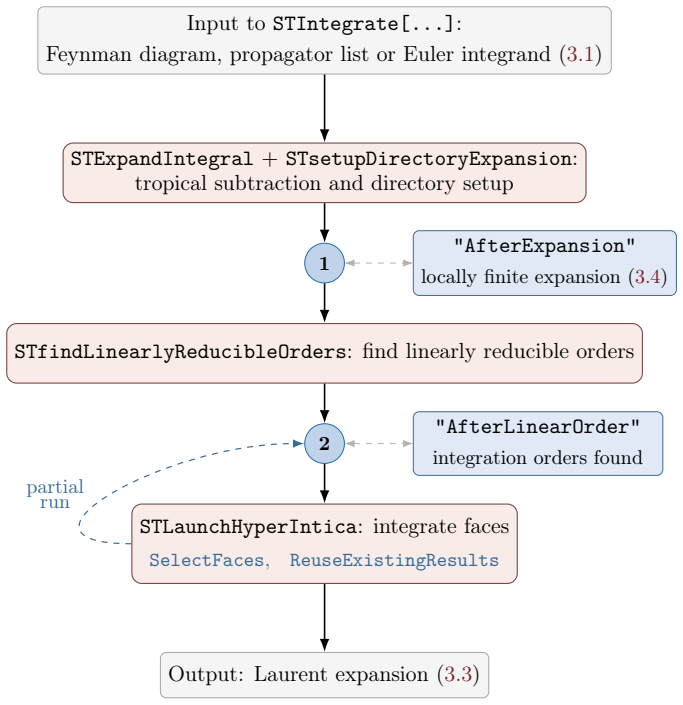
We present SubTropica, a Mathematica package that performs symbolic integration of multi-polylogarithmic integrals using recent advances in tropical geometry. It focuses on the class of linearly-reducible Euler integrals, such as Feynman integrals, and expands them using a tropical subtraction scheme. The engine behind it is HyperIntica, a native Mathematica package for hyperlogarithm integration that can be used independently. This paper documents both packages and illustrates their usage on examples from across different physics applications. Additionally, we introduce an AI-driven library of Feynman integrals, which catalogs diagrams discussed in the literature and serves as a database.
What carries the argument
The tropical subtraction scheme that expands linearly-reducible Euler integrals for subsequent evaluation by the HyperIntica hyperlogarithm integration engine.
Load-bearing premise
The tropical subtraction scheme and HyperIntica engine together handle every linearly-reducible Euler integral without hidden restrictions or failures on realistic cases.
What would settle it
A concrete linearly-reducible Euler integral taken from the literature for which the package either fails to produce a symbolic result or yields an answer that disagrees with an independently known closed form.
Figures


read the original abstract
We present SubTropica, a Mathematica package that performs symbolic integration of multi-polylogarithmic integrals using recent advances in tropical geometry. It focuses on the class of linearly-reducible Euler integrals, such as Feynman integrals, and expands them using a tropical subtraction scheme. The engine behind it is HyperIntica, a native Mathematica package for hyperlogarithm integration that can be used independently. This paper documents both packages and illustrates their usage on examples from across different physics applications. Additionally, we introduce an AI-driven library of Feynman integrals, which catalogs diagrams discussed in the literature and serves as a database for computed results. Its online version is available at: https://subtropi.ca and features a graphical user interface for diagram input and retrieval of records.
Editorial analysis
A structured set of objections, weighed in public.
Referee Report
Summary. The paper presents SubTropica, a Mathematica package for symbolic integration of multi-polylogarithmic integrals via tropical geometry, targeting linearly-reducible Euler integrals (e.g., Feynman integrals) through a tropical subtraction scheme. It documents the standalone HyperIntica engine for hyperlogarithm integration and introduces an AI-driven online database of Feynman integrals with a GUI at https://subtropi.ca, illustrated by usage examples from physics applications.
Significance. If the described tropical subtraction scheme and HyperIntica engine correctly and efficiently handle the stated class of integrals, the work would deliver a practical computational resource for perturbative calculations in high-energy physics. The accompanying database could aid literature synthesis and result reuse. The manuscript's descriptive focus on a software tool and database, rather than new derivations, means its impact hinges on demonstrated reliability rather than theoretical novelty.
major comments (1)
- Abstract: The central claim that SubTropica performs correct symbolic integration of the full class of linearly-reducible Euler integrals is presented without any test cases, benchmarks against known results, error analysis, or implementation details, preventing assessment of whether the tropical subtraction scheme works as asserted on realistic examples.
Simulated Author's Rebuttal
We thank the referee for their careful reading of the manuscript and for the constructive feedback. We address the major comment below and will revise the abstract to better highlight the illustrative examples already present in the paper.
read point-by-point responses
-
Referee: Abstract: The central claim that SubTropica performs correct symbolic integration of the full class of linearly-reducible Euler integrals is presented without any test cases, benchmarks against known results, error analysis, or implementation details, preventing assessment of whether the tropical subtraction scheme works as asserted on realistic examples.
Authors: The abstract provides a concise summary of the package's purpose and scope. The full manuscript documents the tropical subtraction scheme, the HyperIntica engine, and illustrates usage on concrete examples drawn from physics applications, which serve as demonstrations on realistic linearly-reducible Euler integrals. Implementation details appear in the subsequent sections. We agree that a brief reference to these examples would strengthen the abstract and aid assessment; we will revise the abstract accordingly. Comprehensive benchmarks and formal error analysis for the entire class lie beyond the current scope but can be expanded in follow-up work. revision: yes
Circularity Check
Software documentation paper with no derivation chain
full rationale
This is a tool and database paper documenting the SubTropica Mathematica package and its HyperIntica engine for symbolic integration of linearly-reducible Euler integrals via a tropical subtraction scheme. It contains no mathematical derivations, theorems, predictions, or load-bearing equations that could reduce to self-referential inputs, fitted parameters, or self-citations. The text is purely descriptive, consisting of package documentation, usage examples across physics applications, and an AI-driven integral library catalog. No steps in the presentation rely on circular reductions, self-definitional claims, or imported uniqueness results; the work is self-contained as software documentation.
Axiom & Free-Parameter Ledger
Reference graph
Works this paper leans on
-
[1]
Salvatori,The tropical geometry of subtraction schemes,2406.14606
G. Salvatori,The tropical geometry of subtraction schemes,2406.14606
-
[2]
Hillman,A subtraction scheme for feynman integrals,2311.03439
A. Hillman,A subtraction scheme for feynman integrals,2311.03439
-
[3]
F. Brown and C. Dupont,Single-valued integration and superstring amplitudes in genus zero,Commun. Math. Phys.382(2021) 815 [1910.01107]
-
[4]
Brown,The Massless higher-loop two-point function,Commun
F. Brown,The massless higher-loop two-point function,Commun. Math. Phys.287(2009) 925 [0804.1660]
-
[5]
Panzer,Algorithms for the symbolic integration of hyperlogarithms with applications to feynman integrals,Computer Physics Communications188 (2015) 148–166
E. Panzer,Algorithms for the symbolic integration of hyperlogarithms with applications to feynman integrals,Computer Physics Communications188 (2015) 148–166
2015
-
[6]
Schnetz,Numbers and Functions in Quantum Field Theory,Phys
O. Schnetz,Numbers and Functions in Quantum Field Theory,Phys. Rev. D 97(2018) 085018 [1606.08598]
-
[7]
E. Panzer,Algorithms for the symbolic integration of hyperlogarithms with applications to Feynman integrals,Comput. Phys. Commun.188(2015) 148 [1403.3385]. 77
- [8]
- [9]
-
[10]
Generating Feynman Diagrams and Amplitudes with FeynArts 3
T. Hahn,Generating Feynman diagrams and amplitudes with FeynArts 3, Comput. Phys. Commun.140(2001) 418 [hep-ph/0012260]
work page Pith review arXiv 2001
-
[11]
T. Hahn and M. Perez-Victoria,Automatized one loop calculations in four-dimensions and D-dimensions,Comput. Phys. Commun.118(1999) 153 [hep-ph/9807565]
-
[12]
FeynCalc 10: Do multiloop integrals dream of computer codes?,
V. Shtabovenko, R. Mertig and F. Orellana,FeynCalc 10: Do multiloop integrals dream of computer codes?,Comput. Phys. Commun.306(2025) 109357 [2312.14089]
-
[13]
Package-X: A Mathematica package for the analytic calculation of one-loop integrals
H.H. Patel,Package-X: A Mathematica package for the analytic calculation of one-loop integrals,Comput. Phys. Commun.197(2015) 276 [1503.01469]
work page Pith review arXiv 2015
-
[14]
Patel,Package-X 2.0: A Mathematica package for the analytic calculation of one-loop integrals,Comput
H.H. Patel,Package-X 2.0: A Mathematica package for the analytic calculation of one-loop integrals,Comput. Phys. Commun.218(2017) 66 [1612.00009]
-
[15]
FeynHelpers: Connecting FeynCalc to FIRE and Package-X
V. Shtabovenko,FeynHelpers: Connecting FeynCalc to FIRE and Package-X,Comput. Phys. Commun.218(2017) 48 [1611.06793]
work page Pith review arXiv 2017
-
[16]
A.V. Smirnov and M. Zeng,FIRE 6.5: Feynman integral reduction with new simplification library,Comput. Phys. Commun.302(2024) 109261 [2311.02370]
-
[17]
Reduze 2 - Distributed Feynman Integral Reduction
A. von Manteuffel and C. Studerus,Reduze 2 - Distributed Feynman Integral Reduction,1201.4330
-
[18]
LiteRed 1.4: a powerful tool for the reduction of the multiloop integrals
R.N. Lee,LiteRed 1.4: a powerful tool for reduction of multiloop integrals,J. Phys. Conf. Ser.523(2014) 012059 [1310.1145]
work page Pith review arXiv 2014
-
[19]
Kira - A Feynman Integral Reduction Program
P. Maierhöfer, J. Usovitsch and P. Uwer,Kira—A Feynman integral reduction program,Comput. Phys. Commun.230(2018) 99 [1705.05610]
work page Pith review arXiv 2018
-
[20]
J. Klappert, F. Lange, P. Maierhöfer and J. Usovitsch,Integral reduction with Kira 2.0 and finite field methods,Comput. Phys. Commun.266(2021) 108024 [2008.06494]. 78
-
[21]
A. Georgoudis, K.J. Larsen and Y. Zhang,Azurite: An algebraic geometry based package for finding bases of loop integrals,Comput. Phys. Commun. 221(2017) 203 [1612.04252]
- [22]
- [23]
-
[24]
T. Peraro,FiniteFlow: multivariate functional reconstruction using finite fields and dataflow graphs,JHEP07(2019) 031 [1905.08019]
-
[25]
C. Meyer,Algorithmic transformation of multi-loop master integrals to a canonical basis with CANONICA,Comput. Phys. Commun.222(2018) 295 [1705.06252]
-
[26]
Lee,Libra: A package for transformation of differential systems for multiloop integrals,Comput
R.N. Lee,Libra: A package for transformation of differential systems for multiloop integrals,Comput. Phys. Commun.267(2021) 108058 [2012.00279]
-
[27]
M. Hidding,DiffExp, a Mathematica package for computing Feynman integrals in terms of one-dimensional series expansions,Comput. Phys. Commun.269(2021) 108125 [2006.05510]
-
[28]
O. Gituliar and V. Magerya,Fuchsia: a tool for reducing differential equations for Feynman master integrals to epsilon form,Comput. Phys. Commun.219(2017) 329 [1701.04269]
-
[29]
Prausa,epsilon: A tool to find a canonical basis of master integrals, Comput
M. Prausa,epsilon: A tool to find a canonical basis of master integrals, Comput. Phys. Commun.219(2017) 361 [1701.00725]
- [30]
-
[31]
G. Heinrich, S.P. Jones, M. Kerner, V. Magerya, A. Olsson and J. Schlenk, Numerical scattering amplitudes with pySecDec,Comput. Phys. Commun. 295(2024) 108956 [2305.19768]. 79
-
[32]
A.V. Smirnov, N.D. Shapurov and L.I. Vysotsky,Fiesta5: Numerical high-performance feynman integral evaluation,Comput. Phys. Commun.277 (2022) 108386 [2110.11660]
-
[33]
X. Liu and Y.-Q. Ma,AMFlow: A Mathematica package for Feynman integrals computation via auxiliary mass flow,Comput. Phys. Commun.283 (2023) 108565 [2201.11669]
-
[34]
M. Borinsky, H.J. Munch and F. Tellander,Tropical Feynman integration in the Minkowski regime,Comput. Phys. Commun.292(2023) 108874 [2302.08955]
-
[35]
Maitre,HPL, a mathematica implementation of the harmonic polylogarithms,Comput
D. Maitre,HPL, a mathematica implementation of the harmonic polylogarithms,Comput. Phys. Commun.174(2006) 222 [hep-ph/0507152]
-
[36]
T. Huber and D. Maître,HypExp, a Mathematica package for expanding hypergeometric functions around integer-valued parameters,Comput. Phys. Commun.175(2006) 122 [hep-ph/0507094]
-
[37]
T. Huber and D. Maître,HypExp 2, Expanding hypergeometric functions about half-integer parameters,Comput. Phys. Commun.178(2008) 755 [0708.2443]
- [38]
- [39]
-
[40]
M. Correia, M. Giroux and S. Mizera,SOFIA: Singularities of Feynman integrals automatized,Comput. Phys. Commun.320(2026) 109970 [2503.16601]
-
[41]
C. Duhr and F. Dulat,PolyLogTools — polylogs for the masses,JHEP08 (2019) 135 [1904.07279]
- [42]
-
[43]
B. Ananthanarayan, S. Banik, S. Bera and S. Datta,FeynGKZ: A Mathematica package for solving Feynman integrals using GKZ hypergeometric systems,Comput. Phys. Commun.287(2023) 108699 [2211.01285]. 80
-
[44]
Bourjaily,Efficient Tree-Amplitudes in N=4: Automatic BCFW Recursion in Mathematica,1011.2447
J.L. Bourjaily,Efficient Tree-Amplitudes in N=4: Automatic BCFW Recursion in Mathematica,1011.2447
-
[45]
D. Maitre and P. Mastrolia,S@M, a Mathematica Implementation of the Spinor-Helicity Formalism,Comput. Phys. Commun.179(2008) 501 [0710.5559]
-
[46]
M. Accettulli Huber,SpinorHelicity4D: a Mathematica toolbox for the four-dimensional spinor-helicity formalism,2304.01589
-
[47]
Bourjaily,Computational Tools for Trees in Gauge Theory and Gravity, 2312.17745
J.L. Bourjaily,Computational Tools for Trees in Gauge Theory and Gravity, 2312.17745
- [48]
-
[50]
SubTropica GitHub repository, 2026
2026
-
[51]
Gawrilow and M
E. Gawrilow and M. Joswig,polymake: a framework for analyzing convex polytopes, inPolytopes—combinatorics and computation (Oberwolfach, 1997), vol. 29 ofDMV Sem., pp. 43–73, Birkhäuser, Basel (2000)
1997
-
[52]
Assarf, E
B. Assarf, E. Gawrilow, K. Herr, M. Joswig, B. Lorenz, A. Paffenholz et al., Computing convex hulls and counting integer points withpolymake,Math. Program. Comput.9(2017) 1
2017
-
[53]
Introduction to the GiNaC Framework for Symbolic Computation within the C++ Programming Language
C.W. Bauer, A. Frink and R. Kreckel,Introduction to the GiNaC framework for symbolic computation within the C++ programming language,J. Symb. Comput.33(2002) 1 [cs/0004015]
work page internal anchor Pith review arXiv 2002
-
[54]
V. Chestnov and G. Crisanti,Sampling Polynomial Rational Remainders with SPQR: A new Package for Polynomial Division and Elimination, 2511.14875
-
[55]
Howell et al.,Homebrew: The missing package manager for macOS (or Linux), 2009
M. Howell et al.,Homebrew: The missing package manager for macOS (or Linux), 2009
2009
-
[56]
Borinsky, H.J
M. Borinsky, H.J. Munch and F. Tellander,Tropical feynman integration in the minkowski regime,Computer Physics Communications292(2023) 108874. 81
2023
-
[57]
Panzer,On hyperlogarithms and feynman integrals with divergences and many scales,Journal of High Energy Physics2014(2014)
E. Panzer,On hyperlogarithms and feynman integrals with divergences and many scales,Journal of High Energy Physics2014(2014)
2014
-
[58]
Nilsson and M
L. Nilsson and M. Passare,Mellin transforms of multivariate rational functions,Journal of Geometric Analysis23(2013) 24
2013
-
[59]
Borinsky,Tropical Monte Carlo quadrature for Feynman integrals,Ann
M. Borinsky,Tropical monte carlo quadrature for feynman integrals,Ann. Inst. H. Poincare D Comb. Phys. Interact.10(2023) 635 [2008.12310]
-
[60]
B. Jantzen, A.V. Smirnov and V.A. Smirnov,Expansion by regions: revealing potential and glauber regions automatically,Eur. Phys. J. C72 (2012) 2139 [1206.0546]
-
[61]
Macaulay2, a software system for research in algebraic geometry
D.R. Grayson and M.E. Stillman, “Macaulay2, a software system for research in algebraic geometry.” Available athttp://www2.macaulay2.com
-
[62]
Bertini: Software for numerical algebraic geometry
D.J. Bates, J.D. Hauenstein, A.J. Sommese and C.W. Wampler, “Bertini: Software for numerical algebraic geometry.” Available at http://bertini.nd.eduwith permanent doi: dx.doi.org/10.7274/R0H41PB5
-
[63]
H.S. Hannesdottir and S. Mizera,What is the iεfor the S-matrix?, SpringerBriefs in Physics, Springer (1, 2023), 10.1007/978-3-031-18258-7, [2204.02988]
- [64]
-
[65]
N. Arkani-Hamed, A. Hillman and S. Mizera,Feynman polytopes and the tropical geometry of uv and ir divergences,Phys. Rev. D105(2022) 125013 [2202.12296]
-
[66]
Ziegler,Lectures on Polytopes, vol
G.M. Ziegler,Lectures on Polytopes, vol. 152 ofGraduate Texts in Mathematics, Springer-Verlag, New York (1995)
1995
-
[67]
Berkesch, J
C. Berkesch, J. Forsgård and M. Passare,Euler-mellin integrals and a-hypergeometric functions,Michigan Mathematical Journal63(2014) 101
2014
-
[68]
Schultka,Toric geometry and regularization of feynman integrals, 1806.01086
K. Schultka,Toric geometry and regularization of feynman integrals, 1806.01086
-
[69]
What is a toric variety?
D. Cox, “What is a toric variety?.” 82
-
[70]
R.P. Stanley,Enumerative Combinatorics: Volume 1, Cambridge University Press (2011), 10.1017/CBO9781139058520
-
[71]
Brown,On the periods of some feynman integrals, 2010
F.C.S. Brown,On the periods of some feynman integrals, 2010
2010
-
[72]
F. Chavez and C. Duhr,Three-mass triangle integrals and single-valued polylogarithms,JHEP11(2012) 114 [1209.2722]
-
[73]
J. Ablinger, J. Blumlein, A. Hasselhuhn, S. Klein, C. Schneider and F. Wissbrock,Massive 3-loop Ladder Diagrams for Quarkonic Local Operator Matrix Elements,Nucl. Phys. B864(2012) 52 [1206.2252]
-
[74]
C. Anastasiou, C. Duhr, F. Dulat and B. Mistlberger,Soft triple-real radiation for Higgs production at N3LO,JHEP07(2013) 003 [1302.4379]
-
[75]
C. Anastasiou, C. Duhr, F. Dulat, F. Herzog and B. Mistlberger, Real-virtual contributions to the inclusive Higgs cross-section atN3LO, JHEP12(2013) 088 [1311.1425]
-
[76]
Panzer,Feynman integrals and hyperlogarithms, Ph.D
E. Panzer,Feynman integrals and hyperlogarithms, Ph.D. thesis, Humboldt U., 2015.1506.07243. 10.18452/17157
-
[77]
S. Weinzierl,Feynman Integrals. A Comprehensive Treatment for Students and Researchers, UNITEXT for Physics, Springer (2022), 10.1007/978-3-030-99558-4, [2201.03593]
-
[78]
O. Barrera, A. Dersy, R. Husain, M.D. Schwartz and X. Zhang,Analytic regression of Feynman integrals from high-precision numerical sampling, JHEP01(2026) 014 [2507.17815]
-
[79]
E. Gardi and Z. Zhu,Computing the soft anomalous dimension with massless particles using the method of regions,JHEP03(2026) 173 [2509.18017]
-
[80]
D. Chicherin, G.P. Korchemsky, E. Sokatchev and A. Zhiboedov,Energy correlators in four-dimensional gravity,2512.23791
-
[81]
G. Brunello, S. Caron-Huot, G. Crisanti, M. Giroux and S. Smith, High-energy evolution in planar QCD to three loops: the non-conformal contribution,JHEP11(2025) 055 [2508.03794]
discussion (0)
Sign in with ORCID, Apple, or X to comment. Anyone can read and Pith papers without signing in.