Recognition: unknown
Spontaneous spherical symmetry breaking of black holes with resonant hair
Pith reviewed 2026-05-08 10:33 UTC · model grok-4.3
The pith
Black holes with resonant scalar hair spontaneously break spherical symmetry and decay to bald black holes or separate bosonic lumps.
A machine-rendered reading of the paper's core claim, the machinery that carries it, and where it could break.
Core claim
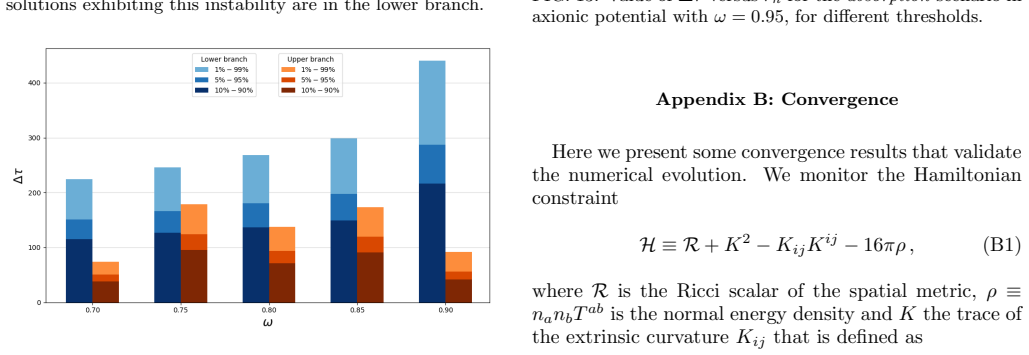
Black holes with resonant hair are dynamically unstable. When the Einstein-Maxwell-gauged-scalar equations are solved without imposing spherical symmetry, the configurations either fission, producing a bald black hole and a separate bosonic lump, or undergo absorption that leaves only a bald black hole. In both channels the non-spherical degrees of freedom are essential, and the same qualitative behavior appears for two distinct classes of scalar self-interaction potentials.
What carries the argument
Non-spherical dynamical evolution of the Einstein-Maxwell-gauged-scalar system that exposes the instability of otherwise static resonant-hair solutions.
If this is right
- Resonant-hair solutions cannot remain static and spherical once non-spherical perturbations are present.
- The end products are either a bald black hole plus a bosonic lump or a bald black hole alone.
- The instabilities appear in at least two different scalar potentials, pointing toward broader applicability.
- Spherical symmetry must be broken dynamically for the hair to be removed.
Where Pith is reading between the lines
- Resonant hair is unlikely to form or persist from generic, non-symmetric initial conditions.
- Similar symmetry-breaking instabilities may affect other families of hairy black holes that rely on spherical assumptions.
- Astrophysical searches for black-hole hair may need to account for rapid decay channels once non-spherical motion is included.
Load-bearing premise
The two specific scalar self-interaction potentials examined are representative enough to conclude that the instabilities are likely generic.
What would settle it
A long-term numerical evolution starting from a resonant-hair black hole and using fully generic, non-spherical initial data that shows no decay or symmetry breaking would falsify the instability claim.
Figures




read the original abstract
Black holes with resonant hair are static, spherical, electrically charged solutions of the Einstein-Maxwell-(gauged-)scalar system. Scalar self-interactions are mandatory for their existence. Initial dynamical studies restricted to spherical symmetry suggested stability; more recently, fully non-spherical dynamical studies revealed instabilities, at least for a particular class of self-interactions. Here, we provide a more detailed study of this instability together with a different decay channel, depending on the chosen solutions. Moreover, considering a second model, we provide evidence that the instabilities may be generic for different classes of self-interactions. We conclude these solutions are dynamically unstable and split into a bosonic lump and a bald black hole (via fission) or implode to the latter (via absorption). In both cases, the non-spherical dynamics seems to be key.
Editorial analysis
A structured set of objections, weighed in public.
Referee Report
Summary. The manuscript studies the dynamical stability of static, spherically symmetric black holes with resonant hair in the Einstein-Maxwell-(gauged-)scalar theory. These solutions require scalar self-interactions for their existence. Prior spherical evolutions suggested stability, but the authors perform fully non-spherical numerical simulations for one class of potentials and a second model, finding that the configurations are unstable: they either fission into a bosonic lump plus a bald black hole or undergo absorption, with non-spherical dynamics playing an essential role. The authors conclude that the instability may be generic across different self-interaction classes.
Significance. If the numerical results prove robust, the work is significant because it demonstrates that resonant hair cannot persist under generic perturbations and underscores the necessity of non-spherical analysis for hairy black-hole stability. It advances understanding of spontaneous symmetry breaking in gravitational systems and constrains possible extensions of the no-hair paradigm.
major comments (3)
- Abstract and discussion of genericity: the claim that instabilities 'may be generic' rests on explicit simulations for only one class of self-interactions plus a single additional model. No analytic argument is supplied showing that the fission or absorption mechanism is independent of the precise form of the scalar potential, even though the existence condition for resonant hair itself depends on that potential.
- Numerical results section: the manuscript reports no convergence tests, grid-resolution studies, or error estimates for the fully non-spherical evolutions. Without these, it is impossible to determine whether the observed decay channels are physical or sensitive to numerical artifacts, initial-data choices, or discretization parameters.
- Section on model comparison: while two potentials are examined, the paper does not explore the space of other self-interactions that still permit resonant hair, leaving open the possibility that some viable potentials produce stable solutions and thereby weakening the genericity conclusion.
minor comments (2)
- Figure captions and evolution plots should explicitly state the grid resolutions and any convergence checks performed.
- The abstract's reference to 'more recently' non-spherical studies should be supplemented with precise citations to those works in the introduction.
Simulated Author's Rebuttal
We thank the referee for their thorough review and valuable comments on our manuscript. We address each of the major comments point by point below, providing clarifications and indicating where revisions will be made to improve the paper.
read point-by-point responses
-
Referee: Abstract and discussion of genericity: the claim that instabilities 'may be generic' rests on explicit simulations for only one class of self-interactions plus a single additional model. No analytic argument is supplied showing that the fission or absorption mechanism is independent of the precise form of the scalar potential, even though the existence condition for resonant hair itself depends on that potential.
Authors: We acknowledge that our evidence for genericity is numerical and limited to two models, without a general analytic demonstration. The resonant hair solutions exist only for specific potentials, but the instability we observe in non-spherical dynamics appears to stem from the breaking of spherical symmetry under perturbations. We will revise the abstract and discussion sections to more cautiously phrase our conclusion as providing 'evidence that the instabilities may be generic across different self-interaction classes,' and include a note on the limitations of our study. Unfortunately, developing an analytic argument for the independence from the potential form is not feasible within the current framework and would require substantial additional theoretical work. revision: partial
-
Referee: Numerical results section: the manuscript reports no convergence tests, grid-resolution studies, or error estimates for the fully non-spherical evolutions. Without these, it is impossible to determine whether the observed decay channels are physical or sensitive to numerical artifacts, initial-data choices, or discretization parameters.
Authors: The referee is correct that explicit convergence tests and error estimates were not reported in the manuscript. This omission will be rectified in the revised version by adding a dedicated subsection in the numerical results that presents grid resolution studies, convergence tests at multiple resolutions, and quantitative error estimates to validate the physical nature of the fission and absorption channels. revision: yes
-
Referee: Section on model comparison: while two potentials are examined, the paper does not explore the space of other self-interactions that still permit resonant hair, leaving open the possibility that some viable potentials produce stable solutions and thereby weakening the genericity conclusion.
Authors: We selected two distinct classes of self-interactions that support resonant hair to illustrate the instability in varied contexts. A comprehensive scan of all possible potentials permitting such hair is impractical for this work. In the revision, we will elaborate on the rationale for choosing these models and stress that our findings offer suggestive evidence of genericity rather than exhaustive proof. This addresses the concern by clarifying the scope of our claims. revision: partial
- The lack of an analytic argument proving that the instability mechanism is independent of the scalar potential's precise form.
Circularity Check
No circularity: results from direct numerical evolution of field equations
full rationale
The paper's central claims rest on numerical time evolutions of the Einstein-Maxwell-(gauged-)scalar system for two specific scalar potentials, showing fission or absorption instabilities that break spherical symmetry. No derivation step equates a claimed prediction to its own inputs by construction, renames a fitted quantity, or reduces the instability conclusion to a self-citation chain. The existence of resonant hair solutions is taken from prior work, but the dynamical instability analysis is independent and performed afresh via simulation; the limited scope to two potentials is a scope limitation rather than a circular reduction.
Axiom & Free-Parameter Ledger
free parameters (1)
- scalar self-interaction parameters
axioms (1)
- standard math Einstein field equations coupled to Maxwell and scalar fields
invented entities (1)
-
resonant hair
no independent evidence
Reference graph
Works this paper leans on
-
[1]
Abbott, Gw190521: A binary black hole merger with a total mass of 150 msun, Physical Review Letters125, 101102 (2020)
R. Abbott, Gw190521: A binary black hole merger with a total mass of 150 msun, Physical Review Letters125, 101102 (2020)
2020
-
[2]
Abbott, Gwtc-1: A gravitational-wave transient cata- 9 FIG
R. Abbott, Gwtc-1: A gravitational-wave transient cata- 9 FIG. 14. Convergence to zero of the norm-2 of the Hamil- tonian constraintHfor Q-ball potential withr h = 0.3 and ω= 0.95, in the lower branch, corresponding to the absorp- tion process. log of compact binary mergers observed by ligo and virgo during the first and second observing runs, Physical Re...
2019
-
[3]
Abbott, Gwtc-2: Compact binary coalescences ob- served by ligo and virgo during the first half of the third observing run, Physical Review X11, 021053 (2021)
R. Abbott, Gwtc-2: Compact binary coalescences ob- served by ligo and virgo during the first half of the third observing run, Physical Review X11, 021053 (2021)
2021
-
[4]
Abbott, Gwtc-3: Compact binary coalescences ob- served by ligo and virgo during the second part of the third observing run, Physical Review X13, 041039 (2023)
R. Abbott, Gwtc-3: Compact binary coalescences ob- served by ligo and virgo during the second part of the third observing run, Physical Review X13, 041039 (2023)
2023
- [5]
-
[6]
Laser Interferometer Space Antenna
P. Amaro-Seoane, H. Audley, S. Babak, J. Baker, E. Ba- rausse, P. Bender, E. Berti, P. Binetruy, M. Born, D. Bortoluzzi, J. Camp, C. Caprini, V. Cardoso, M. Colpi, J. Conklin, N. Cornish, C. Cutler, K. Danz- mann, R. Dolesi, L. Ferraioli, V. Ferroni, E. Fitzsi- mons, J. Gair, L. G. Bote, D. Giardini, F. Gib- ert, C. Grimani, H. Halloin, G. Heinzel, T. Her...
work page internal anchor Pith review doi:10.48550/arxiv.1702.00786 2017
- [7]
-
[8]
M. Boyle, D. Hemberger, D. A. B. Iozzo, G. Lovelace, S. Ossokine, H. P. Pfeiffer, M. A. Scheel, L. C. Stein, C. J. Woodford, A. B. Zimmerman, N. Afshari, K. Bar- kett, J. Blackman, K. Chatziioannou, T. Chu, N. De- mos, N. Deppe, S. E. Field, N. L. Fischer, E. Foley, H. Fong, A. Garcia, M. Giesler, F. Hebert, I. Hinder, R. Katebi, H. Khan, L. E. Kidder, P....
- [9]
-
[10]
I. Hinder, A. Buonanno, M. Boyle, Z. B. Etienne, J. Healy, N. K. Johnson-McDaniel, A. Nagar, H. Nakano, Y. Pan, H. P. Pfeiffer, M. P¨ urrer, C. Reisswig, M. A. Scheel, E. Schnetter, U. Sperhake, B. Szil´ agyi, W. Tichy, B. Wardell, A. Zenginoglu, D. Alic, S. Bernuzzi, T. Bode, B. Br¨ ugmann, L. T. Buchman, M. Campanelli, T. Chu, T. Damour, J. D. Grigsby, ...
-
[11]
J. C. Bustillo, N. Sanchis-Gual, A. Torres-Forn´ e, J. A. Font, A. Vajpeyi, R. Smith, C. Herdeiro, E. Radu, and S. H. W. Leong, GW190521 as a merger of Proca stars: A potential new vector boson of 8.7×10 −13 ev, Physical Review Letters126, 081101 (2021)
2021
-
[12]
N. Sanchis-Gual, J. Calder´ on Bustillo, C. Herdeiro, E. Radu, J. A. Font, S. H. W. Leong, and A. Torres- Forn´ e, Impact of the wavelike nature of Proca stars on their gravitational-wave emission, Phys. Rev. D106, 124011 (2022), arXiv:2208.11717 [gr-qc]
-
[13]
C. A. R. Herdeiro and E. Radu, Asymptotically flat black holes with scalar hair: A review, International Journal of Modern Physics D24, 1542014 (2015)
2015
-
[14]
C. A. R. Herdeiro and E. Radu, Spherical electro-vacuum black holes with resonant, scalarq-hair, The European Physical Journal C80, 10.1140/epjc/s10052-020-7976-9 (2020), arXiv:2004.00336 [gr-qc]
-
[15]
Nonlinear self- interaction induced black hole bomb.Phys
C.-Y. Zhang, Q. Chen, Y. Liu, Y. Tian, B. Wang, and H. Zhang, Nonlinear self-interaction induced black hole bomb 10.48550/ARXIV.2309.05045 (2023), arXiv:2309.05045 [gr-qc]
-
[16]
L. Zhao, L. Chen, and C.-Y. Zhang, Radial os- cillations of scalar hair in black hole bombs 10.48550/ARXIV.2508.15477 (2025), arXiv:2508.15477 [gr-qc]
-
[17]
Splitting the Gravitational Atom: Instabilities of Black Holes with Synchronized or Resonant Hair
J. Nicoules, J. Ferreira, C. A. R. Herdeiro, E. Radu, and 10 (a) Hamiltonian constraintHbefore fission takes place. (b) Hamiltonian constraintHduring the fission process. FIG. 15. Convergence to zero of the norm-2 of the Hamiltonian constraintHfor Q-ball potential withr h = 0.3 andω= 0.7, in the upper branch. The plot on the right is time shifted to match...
work page internal anchor Pith review Pith/arXiv arXiv 2026
-
[18]
T. W. Baumgarte,Numerical Relativity: Solving Ein- stein’s Equations on the Computer(Cambridge Univer- sity Press, 2010) p. 698
2010
-
[19]
M. Alcubierre, J. C. Degollado, and M. Salgado, The einstein-maxwell system in 3+1 form and initial data for multiple charged black holes, Physical Review D80, 104022 (2009), arXiv:0907.1151 [gr-qc]
-
[20]
M. Zilh˜ ao, H. Witek, and V. Cardoso, Nonlinear interac- tions between black holes and proca fields, Classical and Quantum Gravity32, 234003 (2015), arXiv:1505.00797 [gr-qc]
-
[21]
D. Hilditch, An introduction to well-posedness and free-evolution, International Journal of Modern Physics A Vol. 28 (2013) 134001528, 1340015 (2013), arXiv:1309.2012 [gr-qc]
-
[22]
Newman and R
E. Newman and R. Penrose, An approach to gravita- tional radiation by a method of spin coefficients, Journal of Mathematical Physics3, 566 (1962)
1962
-
[23]
M. Zilh˜ ao, V. Cardoso, C. Herdeiro, L. Lehner, and U. Sperhake, Collisions of charged black holes, Phys. Rev. D 85, 124062 (2012)85, 124062 (2012), arXiv:1205.1063 [gr-qc]
-
[24]
J.-P. Hong, M. Suzuki, and M. Yamada, Charged black holes in non-linear q-clouds with o(3) symmetry, Physics Letters B803, 135324 (2020)
2020
-
[25]
J.-P. Hong, M. Suzuki, and M. Yamada, Spherically sym- metric scalar hair for charged black holes, Physical Re- view Letters125, 111104 (2020)
2020
-
[26]
Werneck, S
L. Werneck, S. Cupp, T. Assump¸ c˜ ao, S. R. Brandt, C.- H. Cheng, P. Diener, J. Doherty, Z. Etienne, R. Haas, T. P. Jacques, B. Karaka¸ s, K. Topolski, B.-J. Tsao, M. Alcubierre, D. Alic, G. Allen, M. Ansorg, M. Babiuc- Hamilton, L. Baiotti, W. Benger, E. Bentivegna, S. Bernuzzi, T. Bode, G. Bozzola, B. Brendal, B. Brueg- mann, M. Campanelli, F. Cipollet...
2023
-
[27]
M. Zilh˜ ao and F. L¨ offler, An Introduction to the Ein- stein Toolkit, Int. J. Mod. Phys. A28, 1340014 (2013), arXiv:1305.5299 [gr-qc]
-
[28]
V. Jaramillo, D. N´ u˜ nez, M. Ruiz, and M. Zilh˜ ao, Full 3D nonlinear dynamics of charged and magne- tized boson stars, Phys. Rev. D111, 024070 (2025), arXiv:2411.07284 [gr-qc]
-
[29]
E. Schnetter, S. H. Hawley, and I. Hawke, Evolutions in 3- D numerical relativity using fixed mesh refinement, Class. Quantum Grav.21, 1465 (2004), arXiv:gr-qc/0310042. 11
-
[30]
J. Thornburg, A Fast Apparent-Horizon Finder for 3-Dimensional Cartesian Grids in Numerical Relativ- ity, Class. Quantum Grav.21, 743 (2004), arXiv:gr- qc/0306056
-
[31]
T. W. Baumgarte and S. L. Shapiro, Numerical integra- tion of einstein’s field equations, Physical Review D59, 024007 (1998)
1998
-
[32]
Shibata and T
M. Shibata and T. Nakamura, Evolution of three- dimensional gravitational waves: Harmonic slicing case, Physical Review D52, 5428 (1995)
1995
-
[33]
Witek, M
H. Witek, M. Zilhao, G. Ficarra, and M. Elley, Canuda: a public numerical relativity library to probe fundamental physics (2020)
2020
-
[34]
Sperhake, Binary black-hole evolutions of excision and puncture data, Phys
U. Sperhake, Binary black-hole evolutions of excision and puncture data, Phys. Rev. D76, 104015 (2007), arXiv:gr- qc/0606079
-
[35]
G. Bozzola and V. Paschalidis, Numerical-relativity sim- ulations of the quasi-circular inspiral and merger of non- spinning, charged black holes: methods and comparison with approximate approaches, Phys. Rev. D 104, 044004 (2021)104, 044004 (2021), arXiv:2104.06978 [gr-qc]
-
[36]
G. Bozzola, kuibit: Analyzing Einstein Toolkit simula- tions with Python, J. Open Source Softw.6, 3099 (2021), arXiv:2104.06376 [gr-qc]
-
[37]
Childs, E
H. Childs, E. Brugger, B. Whitlock, J. Meredith, S. Ah- ern, D. Pugmire, K. Biagas, M. C. Miller, C. Harri- son, G. H. Weber, H. Krishnan, T. Fogal, A. Sanderson, C. Garth, E. W. Bethel, D. Camp, O. Rubel, M. Du- rant, J. M. Favre, and P. Navratil, High Performance Visualization–Enabling Extreme-Scale Scientific Insight (2012)
2012
-
[38]
https://github.com/jpmvferreira/instability- QhairyBH/
discussion (0)
Sign in with ORCID, Apple, or X to comment. Anyone can read and Pith papers without signing in.