Recognition: unknown
Constraints on the Primordial Black Hole Abundance using Pulsar Parameter Drifts
Pith reviewed 2026-05-08 10:08 UTC · model grok-4.3
The pith
Pulsar timing data sets an upper limit of 10^{-10} on the abundance of primordial black holes.
A machine-rendered reading of the paper's core claim, the machinery that carries it, and where it could break.
Core claim
We perform the first search for scalar-induced gravitational waves using pulsar parameter drifts, placing a 95% confidence-level upper limit on the primordial black hole abundance of f_PBH < 10^{-10} over the mass range from 0.3 to 40,000 solar masses. This result strongly disfavors a primordial black hole origin for the binary black holes currently detected by the LIGO-Virgo-KAGRA collaborations.
What carries the argument
The secular jerk-like drifts in the second derivative of pulsar spin periods induced by scalar-induced gravitational waves from primordial scalar perturbations.
Load-bearing premise
That the observed second derivatives of pulsar periods are primarily caused by scalar-induced gravitational waves rather than by unmodeled astrophysical, instrumental, or intrinsic spin noise effects.
What would settle it
A demonstration that pulsar second period derivatives are dominated by other noise sources inconsistent with the expected SIGW spectrum, or an independent measurement showing a higher PBH abundance in the specified mass range.
Figures

read the original abstract
Primordial black holes (PBHs) provide a compelling interpretation for the binary black holes (BBHs) observed by ground-based gravitational-wave (GW) detectors, especially for those BBHs in the theoretical mass gap. In the early Universe, the scalar perturbations required to produce such PBHs inevitably generate scalar-induced GWs (SIGWs). These SIGWs peak in the sub-nanohertz band, and manifest secularly as measurable jerk-like drifts in the second derivative of pulsar spin periods. In this Letter, we perform the first search for SIGWs using pulsar parameter drifts, and place a 95\% confidence-level upper limit on the PBH abundance of $f_{\mathrm{PBH}} < 10^{-10}$ over the mass range $[3 \times 10^{-1}, 4 \times 10^{4}] M_{\odot}$. Our results strongly disfavor a PBH origin for the BBHs currently detected by the LIGO-Virgo-KAGRA (LVK) Collaborations.
Editorial analysis
A structured set of objections, weighed in public.
Referee Report
Summary. The manuscript claims to perform the first search for scalar-induced gravitational waves (SIGWs) produced by primordial black hole (PBH)-forming curvature perturbations, using secular drifts in the second derivatives of pulsar spin periods as the observable. From a non-detection in existing pulsar timing data, it reports a 95% confidence-level upper limit f_PBH < 10^{-10} over the mass range [0.3, 4×10^4] M_⊙ and concludes that this strongly disfavors a PBH origin for the binary black holes detected by LIGO-Virgo-KAGRA.
Significance. If the central interpretation holds, the result would constitute a new, independent probe of the PBH parameter space in a mass window directly relevant to LVK events, complementing microlensing, dynamical, and direct GW constraints. The approach of mapping nHz SIGW energy density to measurable pulsar jerk terms is innovative and leverages existing pulsar timing infrastructure. The paper explicitly performs the first such search and derives a parameter-free limit under standard second-order perturbation theory, which are clear strengths.
major comments (3)
- [Abstract and §2] Abstract and §2: The 95% CL upper limit is presented as arising from a non-detection, yet no information is given on the specific pulsar catalog, number of pulsars analyzed, data selection cuts, or the statistical framework (likelihood, priors, or marginalization over noise parameters) used to convert measured period second derivatives into a limit on Ω_GW. Without these, the claim cannot be verified and the non-detection interpretation remains untested against the known red-noise and timing-noise contributions that dominate pulsar timing residuals.
- [§3] §3, derivation of the drift from Ω_GW: The mapping assumes the standard second-order perturbative result for the SIGW spectrum remains valid for the large-amplitude, peaked curvature power spectra required to produce PBHs at the quoted abundances. No quantitative assessment is provided of higher-order or non-Gaussian corrections that could alter the induced GW amplitude by orders of magnitude, which directly impacts whether the reported f_PBH limit is conservative or optimistic.
- [§4] §4, comparison to spin noise: The manuscript does not demonstrate that the catalogued second derivatives are dominated by a stochastic SIGW background rather than intrinsic pulsar spin noise, dispersion-measure variations, or unmodeled instrumental effects. Standard PTA analyses routinely find that red noise contributes significantly to measured period derivatives; without a quantitative decomposition or null-test against noise-only models, the upper limit on f_PBH rests on an unverified assumption.
minor comments (2)
- [Abstract] Notation for the PBH mass range in the abstract uses inconsistent formatting (3 × 10^{-1} vs. 0.3); standardize to scientific notation throughout.
- [§2] The paper would benefit from an explicit statement of the assumed curvature power spectrum shape (e.g., log-normal or broken power-law) and the precise relation used to convert f_PBH to the SIGW amplitude.
Simulated Author's Rebuttal
We thank the referee for their careful reading and constructive comments on our manuscript. We have revised the paper to improve clarity on our data handling and analysis methods, and we address each major comment below.
read point-by-point responses
-
Referee: [Abstract and §2] Abstract and §2: The 95% CL upper limit is presented as arising from a non-detection, yet no information is given on the specific pulsar catalog, number of pulsars analyzed, data selection cuts, or the statistical framework (likelihood, priors, or marginalization over noise parameters) used to convert measured period second derivatives into a limit on Ω_GW. Without these, the claim cannot be verified and the non-detection interpretation remains untested against the known red-noise and timing-noise contributions that dominate pulsar timing residuals.
Authors: We agree that the concise Letter format omitted key technical details on the analysis. In the revised manuscript we have expanded §2 with a new subsection that specifies the pulsar catalog employed, the number of pulsars retained after cuts, the explicit selection criteria applied to the timing data, and the full statistical framework. The likelihood is constructed from the reported uncertainties on each pulsar's second period derivative, with marginalization over a red-noise amplitude parameter using a log-uniform prior; the 95% CL upper limit on Ω_GW (and hence f_PBH) is obtained from the marginalized posterior. revision: yes
-
Referee: [§3] §3, derivation of the drift from Ω_GW: The mapping assumes the standard second-order perturbative result for the SIGW spectrum remains valid for the large-amplitude, peaked curvature power spectra required to produce PBHs at the quoted abundances. No quantitative assessment is provided of higher-order or non-Gaussian corrections that could alter the induced GW amplitude by orders of magnitude, which directly impacts whether the reported f_PBH limit is conservative or optimistic.
Authors: For the abundances constrained by our limit (f_PBH < 10^{-10}), the corresponding peak curvature power is P_ζ ≲ 10^{-4}, safely inside the perturbative regime where second-order results are reliable. Higher abundances capable of explaining LVK events are already excluded by the limit itself. We have added a paragraph in §3 that cites existing literature on higher-order and non-Gaussian corrections to SIGWs and notes that such effects typically increase the induced GW amplitude, rendering our upper limit conservative. A dedicated quantitative recalculation lies beyond the scope of the present work. revision: partial
-
Referee: [§4] §4, comparison to spin noise: The manuscript does not demonstrate that the catalogued second derivatives are dominated by a stochastic SIGW background rather than intrinsic pulsar spin noise, dispersion-measure variations, or unmodeled instrumental effects. Standard PTA analyses routinely find that red noise contributes significantly to measured period derivatives; without a quantitative decomposition or null-test against noise-only models, the upper limit on f_PBH rests on an unverified assumption.
Authors: Our result is explicitly a non-detection limit and does not assume SIGW dominance. The upper bound is obtained by requiring that any SIGW contribution remain consistent with the observed second derivatives within their uncertainties. In the revised §4 we have added a quantitative comparison of the observed distribution of period second derivatives against a noise-only model drawn from standard PTA spin-noise characterizations, together with a description of the marginalization over a global red-noise component already present in our likelihood. These additions confirm that the limit is robust against unmodeled noise. revision: yes
Circularity Check
No circularity: limit derived from external pulsar data via standard SIGW mapping
full rationale
The paper maps observed pulsar period second derivatives to an upper bound on SIGW amplitude and thence to f_PBH using the standard second-order perturbative relation between curvature power spectrum and induced GW energy density. This relation is taken from the literature and is not redefined or fitted inside the present work; the bound follows from the non-detection (or upper limit) in the catalogued drifts rather than from any parameter tuned to the same dataset. No self-citation supplies a uniqueness theorem or ansatz that forces the result, and the derivation remains falsifiable against independent PTA data and higher-order SIGW calculations.
Axiom & Free-Parameter Ledger
free parameters (1)
- curvature power spectrum amplitude
axioms (1)
- domain assumption Scalar perturbations at small scales produce a peaked SIGW background in the sub-nanohertz band whose amplitude scales with the square of the curvature power spectrum
Reference graph
Works this paper leans on
-
[1]
The resulting 95% confidence-level upper limits are shown in Fig
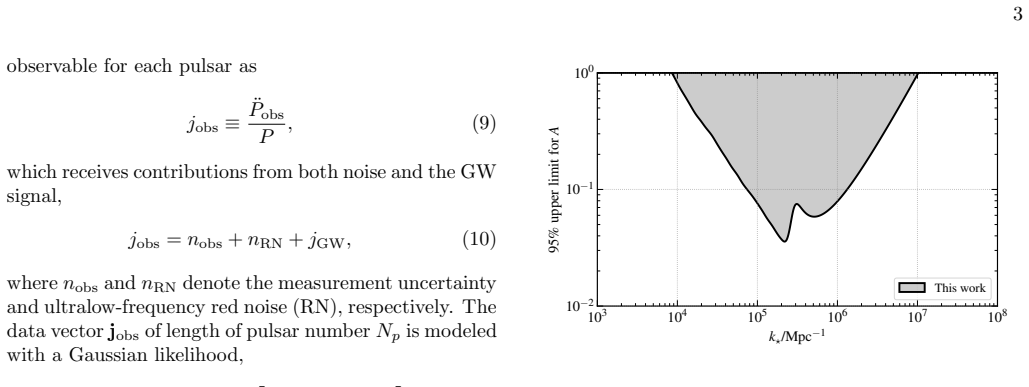
cos(kr/ √ 3) (kr/ √ 3)3 .(23) The above formalism establishes a direct mapping from ζ(k) to the present-day PBH abundance, enabling the constraints on SIGWs to be translated into limits on fpbh. The resulting 95% confidence-level upper limits are shown in Fig. 2 as a function of the PBH massm. We find that secular pulsar parameter drifts constrain fpbh <1...
2025
-
[2]
B. P. Abbottet al.(LIGO Scientific, Virgo), “GWTC- 1: A Gravitational-Wave Transient Catalog of Compact Binary Mergers Observed by LIGO and Virgo during the First and Second Observing Runs,” Phys. Rev. X 9, 031040 (2019), arXiv:1811.12907 [astro-ph.HE]
work page internal anchor Pith review arXiv 2019
-
[3]
R. Abbottet al.(LIGO Scientific, Virgo), “GWTC-2: Compact Binary Coalescences Observed by LIGO and Virgo During the First Half of the Third Observing Run,” Phys. Rev. X11, 021053 (2021), arXiv:2010.14527 [gr- qc]
work page internal anchor Pith review arXiv 2021
-
[4]
R. Abbottet al.(LIGO Scientific, VIRGO), “GWTC-2.1: Deep extended catalog of compact binary coalescences observed by LIGO and Virgo during the first half of the third observing run,” Phys. Rev. D109, 022001 (2024), arXiv:2108.01045 [gr-qc]
-
[5]
R. Abbottet al.(KAGRA, VIRGO, LIGO Scientific), “GWTC-3: Compact Binary Coalescences Observed by LIGO and Virgo during the Second Part of the Third Observing Run,” Phys. Rev. X13, 041039 (2023), arXiv:2111.03606 [gr-qc]
work page internal anchor Pith review arXiv 2023
-
[6]
A. G. Abacet al.(LIGO Scientific, VIRGO, KAGRA), “GWTC-4.0: Updating the Gravitational-Wave Tran- sient Catalog with Observations from the First Part of the Fourth LIGO-Virgo-KAGRA Observing Run,” (2025), arXiv:2508.18082 [gr-qc]
work page internal anchor Pith review arXiv 2025
-
[7]
Instabilities in Highly Evolved Stellar Models,
G. Rakavy and G. Shaviv, “Instabilities in Highly Evolved Stellar Models,” Astrophys. J.148, 803 (1967)
1967
-
[8]
Supernovae explosions induced by pair- production instability,
Gary S. Fraley, “Supernovae explosions induced by pair- production instability,” Astrophysics and Space Science 2, 96–114 (1968)
1968
-
[9]
Dynamics of Super- nova Explosion Resulting from Pair Formation,
Z. Barkat, G. Rakavy, and N. Sack, “Dynamics of Super- nova Explosion Resulting from Pair Formation,” Phys. Rev. Lett.18, 379–381 (1967)
1967
- [10]
-
[11]
Pablo Marchant, Mathieu Renzo, Robert Farmer, Kaliroe M. W. Pappas, Ronald E. Taam, Selma de Mink, and Vassiliki Kalogera, “Pulsational pair- instability supernovae in very close binaries,” (2018), arXiv:1810.13412 [astro-ph.HE]
-
[12]
Abbottet al.(LIGO Scientific and Virgo Collaboration), Phys
R. Abbottet al.(LIGO Scientific, Virgo), “GW190521: A Binary Black Hole Merger with a Total Mass of 150M⊙,” Phys. Rev. Lett.125, 101102 (2020), arXiv:2009.01075 [gr-qc]
-
[13]
GW231123: A Binary Black Hole Merger with Total Mass 190–265M ⊙,
A. G. Abacet al.(LIGO Scientific, VIRGO, KAGRA), “GW231123: A Binary Black Hole Merger with Total Mass 190–265 M⊙,” Astrophys. J. Lett.993, L25 (2025), arXiv:2507.08219 [astro-ph.HE]
-
[14]
Gravitationally collapsed objects of very low mass,
Stephen Hawking, “Gravitationally collapsed objects of very low mass,” Mon. Not. Roy. Astron. Soc.152, 75 (1971)
1971
-
[15]
Black holes in the early Universe,
Bernard J. Carr and S. W. Hawking, “Black holes in the early Universe,” Mon. Not. Roy. Astron. Soc.168, 399– 415 (1974)
1974
-
[16]
Cosmological effects of primordial black holes,
George F. Chapline, “Cosmological effects of primordial black holes,” Nature253, 251–252 (1975)
1975
-
[17]
Simeon Bird, Ilias Cholis, Julian B. Mu˜ noz, Yacine Ali- Ha¨ ımoud, Marc Kamionkowski, Ely D. Kovetz, Alvise Raccanelli, and Adam G. Riess, “Did LIGO detect dark matter?” Phys. Rev. Lett.116, 201301 (2016), arXiv:1603.00464 [astro-ph.CO]
work page Pith review arXiv 2016
-
[18]
Primordial Black Hole Scenario for the Gravitational-Wave Event GW150914
Misao Sasaki, Teruaki Suyama, Takahiro Tanaka, and Shuichiro Yokoyama, “Primordial Black Hole Scenario for the Gravitational-Wave Event GW150914,” Phys. Rev. Lett.117, 061101 (2016), [Erratum: Phys.Rev.Lett. 121, 059901 (2018)], arXiv:1603.08338 [astro-ph.CO]
work page Pith review arXiv 2016
-
[19]
Cosmic conundra explained by thermal history and primordial black holes,
Bernard Carr, Sebastien Clesse, Juan Garc´ ıa-Bellido, and Florian K¨ uhnel, “Cosmic conundra explained by thermal history and primordial black holes,” Phys. Dark Univ.31, 100755 (2021), arXiv:1906.08217 [astro- ph.CO]
-
[20]
Sebastien Clesse and Juan Garcia-Bellido, “GW190425, GW190521 and GW190814: Three candidate mergers of primordial black holes from the QCD epoch,” Phys. Dark Univ.38, 101111 (2022), arXiv:2007.06481 [astro- ph.CO]
-
[21]
GW190521 Mass Gap Event and the Primor- dial Black Hole Scenario,
V. De Luca, V. Desjacques, G. Franciolini, P. Pani, and A. Riotto, “GW190521 Mass Gap Event and the Primor- dial Black Hole Scenario,” Phys. Rev. Lett.126, 051101 (2021), arXiv:2009.01728 [astro-ph.CO]
-
[22]
Gert H¨ utsi, Martti Raidal, Ville Vaskonen, and Hardi Veerm¨ ae, “Two populations of LIGO-Virgo black holes,” JCAP03, 068 (2021), arXiv:2012.02786 [astro-ph.CO]
-
[23]
Kaze W. K. Wong, Gabriele Franciolini, Valerio De Luca, Vishal Baibhav, Emanuele Berti, Paolo Pani, and Anto- nio Riotto, “Constraining the primordial black hole sce- nario with Bayesian inference and machine learning: the GWTC-2 gravitational wave catalog,” Phys. Rev. D103, 023026 (2021), arXiv:2011.01865 [gr-qc]
-
[24]
Consistency of Primordial Black Hole Dark Matter with LIGO/Virgo Merger Rates,
Karsten Jedamzik, “Consistency of Primordial Black Hole Dark Matter with LIGO/Virgo Merger Rates,” Phys. Rev. Lett.126, 051302 (2021), arXiv:2007.03565 [astro-ph.CO]
-
[25]
V. De Luca, G. Franciolini, P. Pani, and A. Riotto, “Bayesian Evidence for Both Astrophysical and Pri- mordial Black Holes: Mapping the GWTC-2 Catalog to Third-Generation Detectors,” JCAP05, 003 (2021), arXiv:2102.03809 [astro-ph.CO]
-
[26]
Zu-Cheng Chen, Chen Yuan, and Qing-Guo Huang, “Confronting the primordial black hole scenario with the gravitational-wave events detected by LIGO-Virgo,” Phys. Lett. B829, 137040 (2022), arXiv:2108.11740 [astro-ph.CO]
-
[27]
GW230529 181500: a potential primordial binary black hole merger in the mass gap,
Qing-Guo Huang, Chen Yuan, Zu-Cheng Chen, and Lang Liu, “GW230529 181500: a potential primordial binary black hole merger in the mass gap,” JCAP08, 030 (2024), arXiv:2404.05691 [gr-qc]
-
[28]
Primordial black hole interpretation in subsolar mass gravitational wave candidate SSM200308,
Chen Yuan and Qing-Guo Huang, “Primordial black hole interpretation in subsolar mass gravitational wave candidate SSM200308,” JCAP09, 051 (2024), arXiv:2404.03328 [astro-ph.CO]
-
[29]
2025, arXiv e-prints, arXiv:2507.15701, doi: 10.48550/arXiv.2507.15701
Chen Yuan, Zu-Cheng Chen, and Lang Liu, “GW231123 mass gap event and the primordial black hole scenario,” Phys. Rev. D112, L081306 (2025), arXiv:2507.15701 [astro-ph.CO]
-
[30]
Confronting primordial 6 black holes with ligo-virgo-kagra and the einstein tele- scope,
Zu-Cheng Chen and Alex Hall, “Confronting primordial 6 black holes with ligo-virgo-kagra and the einstein tele- scope,” inPrimordial Black Holes, edited by Christian Byrnes, Gabriele Franciolini, Tomohiro Harada, Paolo Pani, and Misao Sasaki (Springer Nature Singapore, Sin- gapore, 2025) pp. 617–650
2025
-
[31]
Alberto Magaraggia and Nico Cappelluti, “Implica- tions for Primordial Black Hole Dark Matter from a Single Subsolar Mass Gravitational-wave Detection in LVK O1–O4,” Astrophys. J.1000, 262 (2026), arXiv:2602.21295 [astro-ph.CO]
work page internal anchor Pith review arXiv 2026
-
[32]
Primordial Black Holes as Dark Matter
Bernard Carr, Florian Kuhnel, and Marit Sandstad, “Primordial Black Holes as Dark Matter,” Phys. Rev. D94, 083504 (2016), arXiv:1607.06077 [astro-ph.CO]
work page Pith review arXiv 2016
-
[33]
Could supermassive black holes be quintessential primordial black holes?
Rachel Bean and Joao Magueijo, “Could supermassive black holes be quintessential primordial black holes?” Phys. Rev. D66, 063505 (2002), arXiv:astro-ph/0204486
work page Pith review arXiv 2002
-
[34]
Primordial seeds of supermassive black holes
Masahiro Kawasaki, Alexander Kusenko, and Tsu- tomu T. Yanagida, “Primordial seeds of supermas- sive black holes,” Phys. Lett. B711, 1–5 (2012), arXiv:1202.3848 [astro-ph.CO]
work page Pith review arXiv 2012
-
[35]
Constraints on Primordial Black Holes
Bernard Carr, Kazunori Kohri, Yuuiti Sendouda, and Jun’ichi Yokoyama, “Constraints on primordial black holes,” Rept. Prog. Phys.84, 116902 (2021), arXiv:2002.12778 [astro-ph.CO]
work page internal anchor Pith review arXiv 2021
-
[36]
Sai Wang, Yi-Fan Wang, Qing-Guo Huang, and Tjon- nie G. F. Li, “Constraints on the Primordial Black Hole Abundance from the First Advanced LIGO Ob- servation Run Using the Stochastic Gravitational-Wave Background,” Phys. Rev. Lett.120, 191102 (2018), arXiv:1610.08725 [astro-ph.CO]
-
[37]
Black Holes' Dark Dress: On the merger rate of a subdominant population of primordial black holes
Bradley J. Kavanagh, Daniele Gaggero, and Gianfranco Bertone, “Merger rate of a subdominant population of primordial black holes,” Phys. Rev. D98, 023536 (2018), arXiv:1805.09034 [astro-ph.CO]
work page Pith review arXiv 2018
-
[38]
Search for Subsolar Mass Ultracompact Binaries in Advanced LIGO’s Second Observing Run,
B. P. Abbottet al.(LIGO Scientific, Virgo), “Search for Subsolar Mass Ultracompact Binaries in Advanced LIGO’s Second Observing Run,” Phys. Rev. Lett.123, 161102 (2019), arXiv:1904.08976 [astro-ph.CO]
-
[39]
Alexander H. Nitz and Yi-Fan Wang, “Broad search for gravitational waves from subsolar-mass binaries through LIGO and Virgo’s third observing run,” Phys. Rev. D 106, 023024 (2022), arXiv:2202.11024 [astro-ph.HE]
-
[40]
Pulsar Timing Array Constraints on Primordial Black Holes with NANOGrav 11-Year Dataset,
Zu-Cheng Chen, Chen Yuan, and Qing-Guo Huang, “Pulsar Timing Array Constraints on Primordial Black Holes with NANOGrav 11-Year Dataset,” Phys. Rev. Lett.124, 25 (2020), arXiv:1910.12239 [astro-ph.CO]
-
[41]
Przemek Mr´ ozet al., “Limits on Planetary-mass Primor- dial Black Holes from the OGLE High-cadence Survey of the Magellanic Clouds,” Astrophys. J. Lett.976, L19 (2024), arXiv:2410.06251 [astro-ph.CO]
-
[42]
Mr´ oz et al.,No massive black holes in the Milky Way halo,Nature632(2024) 749 [2403.02386]
Przemek Mr´ ozet al., “No massive black holes in the Milky Way halo,” Nature632, 749–751 (2024), arXiv:2403.02386 [astro-ph.GA]
-
[43]
Searching for Primordial Black Holes in the radio and X-ray sky,
Daniele Gaggero, Gianfranco Bertone, Francesca Calore, Riley M. T. Connors, Mark Lovell, Sera Markoff, and Emma Storm, “Searching for Primordial Black Holes in the radio and X-ray sky,” Phys. Rev. Lett.118, 241101 (2017), arXiv:1612.00457 [astro-ph.HE]
-
[44]
Julien Manshanden, Daniele Gaggero, Gianfranco Bertone, Riley M. T. Connors, and Massimo Ricotti, “Multi-wavelength astronomical searches for primordial black holes,” JCAP06, 026 (2019), arXiv:1812.07967 [astro-ph.HE]
-
[45]
Cosmic microwave background bounds on primordial black holes including dark mat- ter halo accretion,
Pasquale D. Serpico, Vivian Poulin, Derek Inman, and Kazunori Kohri, “Cosmic microwave background bounds on primordial black holes including dark mat- ter halo accretion,” Phys. Rev. Res.2, 023204 (2020), arXiv:2002.10771 [astro-ph.CO]
- [46]
-
[47]
Daniel Baumann, Paul J. Steinhardt, Keitaro Takahashi, and Kiyotomo Ichiki, “Gravitational Wave Spectrum In- duced by Primordial Scalar Perturbations,” Phys. Rev. D76, 084019 (2007), arXiv:hep-th/0703290
-
[48]
Ryo Saito and Jun’ichi Yokoyama, “Gravitational wave background as a probe of the primordial black hole abun- dance,” Phys. Rev. Lett.102, 161101 (2009), [Erratum: Phys.Rev.Lett. 107, 069901 (2011)], arXiv:0812.4339 [astro-ph]
-
[49]
Gravitational- Wave Constraints on the Abundance of Primordial Black Holes,
Ryo Saito and Jun’ichi Yokoyama, “Gravitational- Wave Constraints on the Abundance of Primordial Black Holes,” Prog. Theor. Phys.123, 867–886 (2010), [Erratum: Prog.Theor.Phys. 126, 351–352 (2011)], arXiv:0912.5317 [astro-ph.CO]
-
[50]
Constraints on the induced gravitational wave background from primor- dial black holes,
Edgar Bugaev and Peter Klimai, “Constraints on the induced gravitational wave background from primor- dial black holes,” Phys. Rev. D83, 083521 (2011), arXiv:1012.4697 [astro-ph.CO]
-
[51]
Detecting the Stochastic Gravitational Wave Background from Primordial Black Hole Formation
Sebastien Clesse, Juan Garc´ ıa-Bellido, and Stefano Orani, “Detecting the Stochastic Gravitational Wave Background from Primordial Black Hole Formation,” (2018), arXiv:1812.11011 [astro-ph.CO]
work page Pith review arXiv 2018
-
[52]
Alba Romero-Rodriguez, Mario Martinez, Oriol Pujol` as, Mairi Sakellariadou, and Ville Vaskonen, “Search for a Scalar Induced Stochastic Gravitational Wave Back- ground in the Third LIGO-Virgo Observing Run,” Phys. Rev. Lett.128, 051301 (2022), arXiv:2107.11660 [gr-qc]
-
[53]
Yang Jiang, Chen Yuan, Chong-Zhi Li, and Qing-Guo Huang, “Constraints on the primordial black hole abun- dance through scalar-induced gravitational waves from Advanced LIGO and Virgo’s first three observing runs,” JCAP12, 016 (2024), arXiv:2409.07976 [astro-ph.CO]
-
[54]
A topic review on probing primordial black hole dark matter with scalar induced gravitational waves,
Chen Yuan and Qing-Guo Huang, “A topic review on probing primordial black hole dark matter with scalar induced gravitational waves,” iScience24, 102860 (2021), arXiv:2103.04739 [astro-ph.GA]
-
[55]
Dom` enech, Universe7, 398 (2021), arXiv:2109.01398 [gr-qc]
Guillem Dom` enech, “Scalar Induced Gravitational Waves Review,” Universe7, 398 (2021), arXiv:2109.01398 [gr- qc]
-
[56]
Realistic sensitivity curves for pul- sar timing arrays,
Jeffrey S. Hazboun, Joseph D. Romano, and Tris- tan L. Smith, “Realistic sensitivity curves for pul- sar timing arrays,” Phys. Rev. D100, 104028 (2019), arXiv:1907.04341 [gr-qc]
-
[57]
Mitigating cosmic vari- ance in the Hellings-Downs curve: A cosmic microwave background analogy,
Cyril Pitrou and Giulia Cusin, “Mitigating cosmic vari- ance in the Hellings-Downs curve: A cosmic microwave background analogy,” Phys. Rev. D111, 083544 (2025), arXiv:2412.12073 [gr-qc]
-
[58]
Pulsar timing array analysis in a Legendre polynomial basis
Bruce Allen, Arian L. von Blanckenburg, and Ken D. Olum, “Pulsar timing array analysis in a Legendre poly- nomial basis,” (2025), arXiv:2510.05913 [gr-qc]
work page internal anchor Pith review Pith/arXiv arXiv 2025
-
[59]
Using Pulsar Parameter Drifts to Detect Subnanohertz Gravita- tional Waves,
William DeRocco and Jeff A. Dror, “Using Pulsar Parameter Drifts to Detect Subnanohertz Gravita- tional Waves,” Phys. Rev. Lett.132, 101403 (2024), arXiv:2212.09751 [astro-ph.HE]
-
[60]
Searching for stochastic gravitational waves below a nanohertz,
William DeRocco and Jeff A. Dror, “Searching for stochastic gravitational waves below a nanohertz,” Phys. 7 Rev. D108, 103011 (2023), arXiv:2304.13042 [astro- ph.HE]
-
[61]
Probing picohertz gravitational waves with pulsars,
Qinyuan Zheng, Chiara M. F. Mingarelli, William DeRocco, Jonathan Nay, Kimberly K. Boddy, and Jeff A. Dror, “Probing picohertz gravitational waves with pulsars,” Phys. Rev. D113, 023037 (2026), arXiv:2508.21582 [astro-ph.HE]
-
[62]
Kazunori Kohri and Takahiro Terada, “Semianalytic cal- culation of gravitational wave spectrum nonlinearly in- duced from primordial curvature perturbations,” Phys. Rev. D97, 123532 (2018), arXiv:1804.08577 [gr-qc]
-
[63]
A Cosmological Signature of the SM Higgs Instability: Gravitational Waves
Jos´ e Ram´ on Espinosa, Davide Racco, and Antonio Ri- otto, “A Cosmological Signature of the SM Higgs In- stability: Gravitational Waves,” JCAP09, 012 (2018), arXiv:1804.07732 [hep-ph]
work page Pith review arXiv 2018
-
[64]
Planck 2018 results. VI. Cosmological parameters
N. Aghanimet al.(Planck), “Planck 2018 results. VI. Cosmological parameters,” Astron. Astrophys.641, A6 (2020), [Erratum: Astron.Astrophys. 652, C4 (2021)], arXiv:1807.06209 [astro-ph.CO]
work page internal anchor Pith review arXiv 2018
-
[65]
X. J. Liu, M. J. Keith, C. Bassa, and B. W. Stappers, “Correlated timing noise and high precision pulsar tim- ing: Measuring frequency second derivatives as an exam- ple,” Mon. Not. Roy. Astron. Soc.488, 2190–2201 (2019), arXiv:1907.03183 [astro-ph.HE]
-
[66]
Searching for new phenomena with profile like- lihood ratio tests,
Sara Algeri, Jelle Aalbers, Knut Dundas Mor˚ a, and Jan Conrad, “Searching for new phenomena with profile like- lihood ratio tests,” Nature Rev. Phys.2, 245–252 (2020), arXiv:1911.10237 [physics.data-an]
-
[67]
Timing analysis for 20 mil- lisecond pulsars in the Parkes Pulsar Timing Array,
D. J. Reardonet al., “Timing analysis for 20 mil- lisecond pulsars in the Parkes Pulsar Timing Array,” Mon. Not. Roy. Astron. Soc.455, 1751–1769 (2016), arXiv:1510.04434 [astro-ph.HE]
-
[68]
High-precision timing of 42 millisecond pulsars with the European Pulsar Timing Array
G. Desvigneset al.(EPTA), “High-precision timing of 42 millisecond pulsars with the European Pulsar Tim- ing Array,” Mon. Not. Roy. Astron. Soc.458, 3341–3380 (2016), arXiv:1602.08511 [astro-ph.HE]
work page Pith review arXiv 2016
-
[69]
Andrea Ianniccari, Antonio J. Iovino, Alex Kehagias, Da- vide Perrone, and Antonio Riotto, “Primordial black hole abundance: The importance of broadness,” Phys. Rev. D109, 123549 (2024), arXiv:2402.11033 [astro- ph.CO]
- [70]
-
[71]
Albert Escriv` a, Cristiano Germani, and Ravi K. Sheth, “Universal threshold for primordial black hole formation,” Phys. Rev. D101, 044022 (2020), arXiv:1907.13311 [gr-qc]
-
[72]
Tatsuhiko Koike, Takashi Hara, and Satoshi Adachi, “Critical behavior in gravitational collapse of radia- tion fluid: A Renormalization group (linear perturba- tion) analysis,” Phys. Rev. Lett.74, 5170–5173 (1995), arXiv:gr-qc/9503007
-
[73]
Christian Byrnes, Gabriele Franciolini, Tomohiro Harada, Paolo Pani, and Misao Sasaki, eds.,Primordial Black Holes, Springer Series in Astrophysics and Cosmol- ogy (Springer, 2025)
2025
-
[74]
Ville Vaskonen and Hardi Veerm¨ ae, “Lower bound on the primordial black hole merger rate,” Phys. Rev. D101, 043015 (2020), arXiv:1908.09752 [astro-ph.CO]
-
[75]
Did NANOGrav see a signal from primordial black hole formation?
Ville Vaskonen and Hardi Veerm¨ ae, “Did NANOGrav see a signal from primordial black hole formation?” Phys. Rev. Lett.126, 051303 (2021), arXiv:2009.07832 [astro- ph.CO]
-
[76]
Evidence of the pair-instability gap from black- hole masses,
Hui Tong, Maya Fishbach, Eric Thrane, Matthew Mould, Thomas A. Callister, Amanda M. Farah, Nir Guttman, Sharan Banagiri, Daniel Beltran-Martinez, Ben Farr, Shanika Galaudage, Jaxen Godfrey, Jack Heinzel, Marios Kalomenopoulos, Simona J. Miller, and Aditya Vijayku- mar, “Evidence of the pair-instability gap from black- hole masses,” Nature (2026), 10.1038/...
discussion (0)
Sign in with ORCID, Apple, or X to comment. Anyone can read and Pith papers without signing in.