Recognition: unknown
STAND: Semantic Anchoring Constraint with Dual-Granularity Disambiguation for Remote Sensing Image Change Captioning
Pith reviewed 2026-05-08 08:38 UTC · model grok-4.3
The pith
STAND resolves ambiguities in viewpoint, scale, and prior knowledge for remote sensing image change captioning through temporal regularization, dual-granularity disambiguation, and semantic anchoring.
A machine-rendered reading of the paper's core claim, the machinery that carries it, and where it could break.
Core claim
The central claim is that progressively applying an interpretable temporal constraint to regularize representations, followed by dual-granularity disambiguation to resolve spatial uncertainties through macro-level global context aggregation and micro-level frequency-refocused attention, and finally semantic concept anchoring with language priors during decoding, produces more precise captions for changes between remote sensing images.
What carries the argument
The STAND architecture, which integrates an interpretable temporal constraint for feature regularization, a dual-granularity disambiguation module, and a semantic concept anchoring module that leverages language priors.
If this is right
- Purified temporal features from the constraint serve as a stable base for the disambiguation steps that follow.
- Macro-level context aggregation reduces viewpoint-induced confusion while micro-level attention improves detection of small-scale changes.
- Language-based semantic anchoring during decoding lowers errors caused by missing prior knowledge.
- The overall pipeline yields higher caption accuracy than prior RSICC methods on benchmark datasets.
Where Pith is reading between the lines
- The modular separation of temporal regularization from spatial disambiguation could be reused in other paired-image analysis tasks such as medical change detection.
- Frequency-refocused attention may inspire similar micro-scale enhancements in low-resolution vision models outside remote sensing.
- The explicit use of language priors for anchoring suggests the method could be extended to multi-temporal sequences rather than image pairs alone.
Load-bearing premise
The three modules can be combined without introducing new inconsistencies and that they directly address the primary sources of error in existing remote sensing image change captioning models.
What would settle it
An ablation experiment on standard RSICC benchmarks in which removing the dual-granularity disambiguation module produces no measurable drop in caption quality metrics on image pairs that contain large viewpoint shifts or small-object scale changes.
Figures


read the original abstract
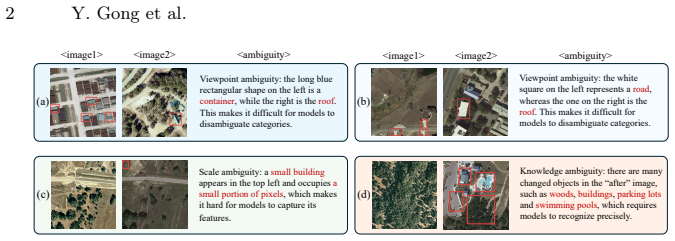
Remote sensing image change captioning (RSICC) aims to describe the difference between two remote sensing images. While recent methods have explored video modeling, they largely overlook the inherent ambiguities in viewpoint, scale, and prior knowledge, lacking effective constraints on the encoder. In this paper, we present STAND, a Semantic Anchoring Constraint with Dual-Granularity Disambiguation for RSICC, to progressively resolve these ambiguities. Specifically, to establish a reliable feature foundation, we first introduce an interpretable constraint to regularize temporal representations. Operating on these purified features, a dual-granularity disambiguation module resolves spatial uncertainties by coupling macro-level global context aggregation for viewpoint confusion with micro-level frequency-refocused attention for small-object scale enhancement. Ultimately, to translate these visually disambiguated features into precise text, a semantic concept anchoring module leverages language categorical priors to tackle knowledge ambiguity during decoding. Extensive experiments verify the superiority of STAND and its effectiveness in addressing ambiguities.
Editorial analysis
A structured set of objections, weighed in public.
Referee Report
Summary. The paper proposes STAND, a framework for remote sensing image change captioning (RSICC) that progressively resolves ambiguities in viewpoint, scale, and prior knowledge. It introduces an interpretable temporal constraint to regularize temporal representations in the encoder, a dual-granularity disambiguation module that couples macro-level global context aggregation with micro-level frequency-refocused attention, and a semantic concept anchoring module that leverages language categorical priors during decoding. The central claim is that these components, when combined, purify features and anchor semantics to yield superior captioning performance, as verified by experiments and ablations on standard RSICC benchmarks.
Significance. If the results hold, this work offers a meaningful contribution by providing an interpretable, modular pipeline for addressing common error sources in RSICC. Explicit formulations (temporal regularization loss, macro-micro fusion, concept-embedding anchoring) and ablation tables demonstrating additive gains without regressions are strengths that support the design's internal consistency and direct targeting of the stated ambiguities.
minor comments (3)
- [Abstract] Abstract: While the abstract summarizes the modules and claims superiority, it would help readers to briefly note the specific datasets (e.g., LEVIR-CC or similar) and primary metrics used in the experiments.
- [§3.2] §3.2 (Dual-Granularity Disambiguation): The fusion step between macro global aggregation and micro frequency-refocused attention is described at a high level; adding an explicit equation for the combined feature representation would improve clarity and reproducibility.
- [Ablation studies] Ablation tables: The reported gains are additive, but including standard deviations across multiple runs or seeds would strengthen confidence that the improvements are not due to random variation.
Simulated Author's Rebuttal
We thank the referee for the positive and detailed summary of our STAND framework for remote sensing image change captioning, as well as for recognizing its contributions in addressing viewpoint, scale, and knowledge ambiguities through interpretable constraints and modular components. The recommendation for minor revision is noted, and we appreciate the acknowledgment of the paper's internal consistency via explicit formulations and ablation studies. As no specific major comments were enumerated in the report, we have no individual points to address point-by-point at this stage. We remain ready to incorporate any minor clarifications or adjustments in the revised version.
Circularity Check
No significant circularity in derivation chain
full rationale
The paper introduces STAND as an engineering architecture with three explicitly formulated modules (temporal regularization loss, dual-granularity spatial disambiguation via macro aggregation + micro attention, and semantic concept anchoring) motivated by listed ambiguities. Each component is defined with independent equations and fusion mechanisms, then validated via additive ablation gains on standard RSICC benchmarks. No step reduces a claimed prediction to a fitted parameter by construction, no self-definitional loop exists in the module definitions, and no load-bearing self-citation or uniqueness theorem is invoked to force the design. The chain is self-contained with external empirical support.
Axiom & Free-Parameter Ledger
invented entities (2)
-
Dual-Granularity Disambiguation module
no independent evidence
-
Semantic concept anchoring module
no independent evidence
Reference graph
Works this paper leans on
-
[1]
IEEE Journal of Selected Topics in Applied Earth Observations and Remote Sensing (2025)
Bai, Q., Wang, X.: Cross-temporal remote sensing image change captioning: A manifold mapping and bayesian diffusion approach for land use monitoring. IEEE Journal of Selected Topics in Applied Earth Observations and Remote Sensing (2025)
2025
-
[2]
In: Proceedings of the acl workshop on intrinsic and extrinsic evaluation measures for machine translation and/or summa- rization
Banerjee, S., Lavie, A.: Meteor: An automatic metric for mt evaluation with im- proved correlation with human judgments. In: Proceedings of the acl workshop on intrinsic and extrinsic evaluation measures for machine translation and/or summa- rization. pp. 65–72 (2005)
2005
-
[3]
IEEE Transactions on Geoscience and Remote Sensing (2026)
Cao, X., Dong, W., Qu, J., Li, Y.: Rmnet: Dual-dimensional difference recalibration-guided cnn-vmamba synergistic network for remote sensing image change captioning. IEEE Transactions on Geoscience and Remote Sensing (2026)
2026
-
[4]
In: proceedings of the IEEE Conference on Computer Vision and Pattern Recognition
Carreira, J., Zisserman, A.: Quo vadis, action recognition? a new model and the kinetics dataset. In: proceedings of the IEEE Conference on Computer Vision and Pattern Recognition. pp. 6299–6308 (2017)
2017
-
[5]
IEEE Transactions on Image Processing32, 6047–6060 (2023)
Chang, S., Ghamisi, P.: Changes to captions: An attentive network for remote sensing change captioning. IEEE Transactions on Image Processing32, 6047–6060 (2023)
2023
-
[6]
In: 2024 IEEE International Symposium on Cir- cuits and Systems (ISCAS)
Chen, C., Wang, Y., Yap, K.H.: Multi-scale attentive fusion network for remote sensing image change captioning. In: 2024 IEEE International Symposium on Cir- cuits and Systems (ISCAS). pp. 1–5. IEEE (2024)
2024
-
[7]
In: Proceedings of the IEEE/CVF winter conference on applications of computer vision
Dai, Y., Gieseke, F., Oehmcke, S., Wu, Y., Barnard, K.: Attentional feature fusion. In: Proceedings of the IEEE/CVF winter conference on applications of computer vision. pp. 3560–3569 (2021)
2021
-
[8]
In: Proceedings of the IEEE/CVF conference on computer vision and pattern recog- nition
Feichtenhofer, C.: X3d: Expanding architectures for efficient video recognition. In: Proceedings of the IEEE/CVF conference on computer vision and pattern recog- nition. pp. 203–213 (2020)
2020
-
[9]
He,K.,Zhang,X.,Ren,S.,Sun,J.:Deepresiduallearningforimagerecognition.In: Proceedings of the IEEE conference on computer vision and pattern recognition. pp. 770–778 (2016)
2016
-
[10]
In: Proceedings of the IEEE/CVF Conference on Computer Vision and Pattern Recognition
Hosseinzadeh, M., Wang, Y.: Image change captioning by learning from an auxil- iary task. In: Proceedings of the IEEE/CVF Conference on Computer Vision and Pattern Recognition. pp. 2725–2734 (2021)
2021
-
[11]
IEEE Journal of Selected Topics in Applied Earth Observations and Remote Sensing (2025)
Karaca, A.C., Ozelbas, E., Berber, S., Karimli, O., Yildirim, T., Amasyali, M.F.: Robust change captioning in remote sensing: Second-cc dataset and mmodalcc framework. IEEE Journal of Selected Topics in Applied Earth Observations and Remote Sensing (2025)
2025
-
[12]
In: Proceedings of the IEEE/CVF International Conference on Computer Vision
Kim, H., Kim, J., Lee, H., Park, H., Kim, G.: Agnostic change captioning with cycle consistency. In: Proceedings of the IEEE/CVF International Conference on Computer Vision. pp. 2095–2104 (2021)
2095
-
[13]
LLaVA-OneVision: Easy Visual Task Transfer
Li, B., Zhang, Y., Guo, D., Zhang, R., Li, F., Zhang, H., Zhang, K., Zhang, P., Li, Y., Liu, Z., et al.: Llava-onevision: Easy visual task transfer. arXiv preprint arXiv:2408.03326 (2024)
work page internal anchor Pith review arXiv 2024
-
[14]
In: Proceedings of the AAAI Conference on Artificial Intelligence
Li, R., Li, L., Zhang, J., Zhao, Q., Wang, H., Yan, C.: Region-aware difference distilling with attribute-guided contrastive regularization for change captioning. In: Proceedings of the AAAI Conference on Artificial Intelligence. vol. 39, pp. 4887–4895 (2025)
2025
-
[15]
IEEE Journal of Selected Topics in Applied Earth Observations and Remote Sensing (2025) 16 Y
Li, X., Sun, B., Wu, Z., Li, S., Guo, H.: Cd4c: Change detection for remote sens- ing image change captioning. IEEE Journal of Selected Topics in Applied Earth Observations and Remote Sensing (2025) 16 Y. Gong et al
2025
-
[16]
IEEE Transactions on Geoscience and Remote Sensing (2024)
Li, Y., Zhang, X., Cheng, X., Chen, P., Jiao, L.: Inter-temporal interaction and symmetric difference learning for remote sensing image change captioning. IEEE Transactions on Geoscience and Remote Sensing (2024)
2024
-
[17]
In: Text sum- marization branches out
Lin, C.Y.: Rouge: A package for automatic evaluation of summaries. In: Text sum- marization branches out. pp. 74–81 (2004)
2004
-
[18]
In: IGARSS 2023-2023 IEEE International Geoscience and Remote Sensing Symposium
Liu, C., Yang, J., Qi, Z., Zou, Z., Shi, Z.: Progressive scale-aware network for re- mote sensing image change captioning. In: IGARSS 2023-2023 IEEE International Geoscience and Remote Sensing Symposium. pp. 6668–6671. IEEE (2023)
2023
-
[19]
IEEE Geoscience and Remote Sensing Magazine (2025)
Liu, C., Zhang, J., Chen, K., Wang, M., Zou, Z., Shi, Z.: Remote sensing spa- tiotemporal vision–language models: A comprehensive survey. IEEE Geoscience and Remote Sensing Magazine (2025)
2025
-
[20]
IEEE Transactions on Geoscience and Remote Sensing60, 1–20 (2022)
Liu, C., Zhao, R., Chen, H., Zou, Z., Shi, Z.: Remote sensing image change cap- tioning with dual-branch transformers: A new method and a large scale dataset. IEEE Transactions on Geoscience and Remote Sensing60, 1–20 (2022)
2022
-
[21]
IEEE Transactions on Geoscience and Remote Sensing61, 1–18 (2023)
Liu, C., Zhao, R., Chen, J., Qi, Z., Zou, Z., Shi, Z.: A decoupling paradigm with prompt learning for remote sensing image change captioning. IEEE Transactions on Geoscience and Remote Sensing61, 1–18 (2023)
2023
-
[22]
Advances in neural information processing systems36, 34892–34916 (2023)
Liu, H., Li, C., Wu, Q., Lee, Y.J.: Visual instruction tuning. Advances in neural information processing systems36, 34892–34916 (2023)
2023
-
[23]
arXiv preprint arXiv:2410.23946 (2024)
Liu, R., Li, K., Song, J., Sun, D., Cao, X.: Mv-cc: Mask enhanced video model for remote sensing change caption. arXiv preprint arXiv:2410.23946 (2024)
-
[24]
In: Proceedings of the IEEE/CVF conference on computer vision and pat- tern recognition
Liu, Z., Ning, J., Cao, Y., Wei, Y., Zhang, Z., Lin, S., Hu, H.: Video swin trans- former. In: Proceedings of the IEEE/CVF conference on computer vision and pat- tern recognition. pp. 3202–3211 (2022)
2022
-
[25]
In: Proceedings of the AAAI Conference on Artificial Intelligence
Lv,F.,Wang,R.,Jing,L.:Revisitingchangecaptioningfromself-supervisedglobal- part alignment. In: Proceedings of the AAAI Conference on Artificial Intelligence. vol. 39, pp. 5892–5900 (2025)
2025
-
[26]
Representation Learning with Contrastive Predictive Coding
Oord, A.v.d., Li, Y., Vinyals, O.: Representation learning with contrastive predic- tive coding. arXiv preprint arXiv:1807.03748 (2018)
work page internal anchor Pith review arXiv 2018
-
[27]
In: Proceedings of the 40th annual meeting of the Association for Computational Linguistics
Papineni, K., Roukos, S., Ward, T., Zhu, W.J.: Bleu: a method for automatic evaluation of machine translation. In: Proceedings of the 40th annual meeting of the Association for Computational Linguistics. pp. 311–318 (2002)
2002
-
[28]
In: Proceedings of the IEEE/CVF International Conference on Computer Vision
Park, D.H., Darrell, T., Rohrbach, A.: Robust change captioning. In: Proceedings of the IEEE/CVF International Conference on Computer Vision. pp. 4624–4633 (2019)
2019
-
[29]
In: Proceedings of the AAAI conference on artificial intelligence
Perez, E., Strub, F., De Vries, H., Dumoulin, V., Courville, A.: Film: Visual rea- soning with a general conditioning layer. In: Proceedings of the AAAI conference on artificial intelligence. vol. 32 (2018)
2018
-
[30]
IEEE Transactions on Geoscience and Remote Sensing63, 1–16 (2025)
Qin, P., Liu, J., Li, L., Tian, C., Cao, X.: Dgat: Dynamic gaussian attenuate transformer for remote sensing image change captioning. IEEE Transactions on Geoscience and Remote Sensing63, 1–16 (2025)
2025
-
[31]
IEEE Transactions on Geoscience and Remote Sensing (2024)
Shi, J., Zhang, M., Hou, Y., Zhi, R., Liu, J.: A multi-task network and two large scale datasets for change detection and captioning in remote sensing images. IEEE Transactions on Geoscience and Remote Sensing (2024)
2024
-
[32]
In: European conference on com- puter vision
Shi, X., Yang, X., Gu, J., Joty, S., Cai, J.: Finding it at another side: A viewpoint- adapted matching encoder for change captioning. In: European conference on com- puter vision. pp. 574–590. Springer (2020)
2020
-
[33]
Advances in neural information processing systems27(2014) STAND for Remote Sensing Image Change Captioning 17
Simonyan, K., Zisserman, A.: Two-stream convolutional networks for action recog- nition in videos. Advances in neural information processing systems27(2014) STAND for Remote Sensing Image Change Captioning 17
2014
-
[34]
IEEE Transactions on Geoscience and Remote Sensing (2026)
Sun, D., Wang, Y., Yao, J., Yu, W., Cao, X., Ghamisi, P.: Scnet: Lightweight spatial-channel attention network for remote sensing change captioning. IEEE Transactions on Geoscience and Remote Sensing (2026)
2026
-
[35]
IEEE Transactions on Geoscience and Remote Sensing (2025)
Sun, D., Yao, J., Xue, W., Zhou, C., Ghamisi, P., Cao, X.: Mask approximation net: A novel diffusion model approach for remote sensing change captioning. IEEE Transactions on Geoscience and Remote Sensing (2025)
2025
-
[36]
IEEE Transactions on Circuits and Systems for Video Technology (2025)
Tang, Y., Bi, J., Xu, S., Song, L., Liang, S., Wang, T., Zhang, D., An, J., Lin, J., Zhu, R., et al.: Video understanding with large language models: A survey. IEEE Transactions on Circuits and Systems for Video Technology (2025)
2025
-
[37]
In: Proceedings of the IEEE inter- national conference on computer vision
Tran, D., Bourdev, L., Fergus, R., Torresani, L., Paluri, M.: Learning spatiotem- poral features with 3d convolutional networks. In: Proceedings of the IEEE inter- national conference on computer vision. pp. 4489–4497 (2015)
2015
-
[38]
In: Proceedings of the IEEE conference on Computer Vision and Pattern Recognition
Tran, D., Wang, H., Torresani, L., Ray, J., LeCun, Y., Paluri, M.: A closer look at spatiotemporal convolutions for action recognition. In: Proceedings of the IEEE conference on Computer Vision and Pattern Recognition. pp. 6450–6459 (2018)
2018
-
[39]
IEEE Transactions on Image Processing 32, 2620–2635 (2023)
Tu, Y., Li, L., Su, L., Du, J., Lu, K., Huang, Q.: Adaptive representation disentan- glement network for change captioning. IEEE Transactions on Image Processing 32, 2620–2635 (2023)
2023
-
[40]
IEEE Transactions on Pattern Analysis and Machine Intelligence46(7), 4926–4943 (2024)
Tu, Y., Li, L., Su, L., Zha, Z.J., Huang, Q.: Smart: Syntax-calibrated multi-aspect relation transformer for change captioning. IEEE Transactions on Pattern Analysis and Machine Intelligence46(7), 4926–4943 (2024)
2024
-
[41]
Tu, Y., Li, L., Su, L., Zha, Z.J., Yan, C., Huang, Q.: Self-supervised cross-view rep- resentationreconstructionforchangecaptioning.In:ProceedingsoftheIEEE/CVF international conference on computer vision. pp. 2805–2815 (2023)
2023
-
[42]
In: Proceedings of the 62nd Annual Meeting of the Association for Computational Linguistics (Volume 1: Long Papers)
Tu, Y., Li, L., Su, L., Zha, Z.J., Yan, C., Huang, Q.: Context-aware difference distilling for multi-change captioning. In: Proceedings of the 62nd Annual Meeting of the Association for Computational Linguistics (Volume 1: Long Papers). pp. 7941–7956 (2024)
2024
-
[43]
In: Findings of the asso- ciation for computational linguistics: ACL-IJCNLP 2021
Tu, Y., Yao, T., Li, L., Lou, J., Gao, S., Yu, Z., Yan, C.: Semantic relation-aware difference representation learning for change captioning. In: Findings of the asso- ciation for computational linguistics: ACL-IJCNLP 2021. pp. 63–73 (2021)
2021
-
[44]
In: Proceedings of the IEEE conference on computer vision and pattern recognition
Vedantam, R., Lawrence Zitnick, C., Parikh, D.: Cider: Consensus-based image description evaluation. In: Proceedings of the IEEE conference on computer vision and pattern recognition. pp. 4566–4575 (2015)
2015
-
[45]
Wang, H., Zhang, B., Gong, Y., Fang, S., Qi, Z., Xu, Y., Liu, X., Zhang, W.: Aifind: Artifact-aware interpreting fine-grained alignment for incremental face forgery de- tection (2026),https://arxiv.org/abs/2604.16207
work page internal anchor Pith review Pith/arXiv arXiv 2026
-
[46]
arXiv preprint arXiv:2410.10047 (2024)
Wang, Y., Yu, W., Kopp, M., Ghamisi, P.: Changeminds: Multi-task frame- work for detecting and describing changes in remote sensing. arXiv preprint arXiv:2410.10047 (2024)
-
[47]
Remote Sensing17(13), 2285 (2025)
Wu, R., Ye, H., Liu, X., Li, Z., Sun, C., Wu, J.: A cross-spatial differential localiza- tion network for remote sensing change captioning. Remote Sensing17(13), 2285 (2025)
2025
-
[48]
IEEE Transactions on Multimedia (2026)
Xian, T., Zhou, Z., Zhou, W., Zeng, D., Li, B.: Cross-view and multi-step interac- tion for change captioning. IEEE Transactions on Multimedia (2026)
2026
-
[49]
In: Proceedings of the AAAI Conference on Artificial Intelligence
Xiao, Y., Xu, T., Xin, Y., Li, J.: Fbrt-yolo: Faster and better for real-time aerial image detection. In: Proceedings of the AAAI Conference on Artificial Intelligence. vol. 39, pp. 8673–8681 (2025)
2025
-
[50]
IEEE Transactions on Image Process- ing (2025) 18 Y
Yang, C., Li, Z., Jiao, H., Gao, Z., Zhang, L.: Enhancing perception of key changes in remote sensing image change captioning. IEEE Transactions on Image Process- ing (2025) 18 Y. Gong et al
2025
-
[51]
Remote Sensing 16(21), 4083 (2024)
Yang, Y., Liu, T., Pu, Y., Liu, L., Zhao, Q., Wan, Q.: Remote sensing image change captioning using multi-attentive network with diffusion model. Remote Sensing 16(21), 4083 (2024)
2024
-
[52]
IEEE Transactions on Multimedia25, 8828–8841 (2023)
Yue, S., Tu, Y., Li, L., Yang, Y., Gao, S., Yu, Z.: I3n: Intra-and inter-representation interaction network for change captioning. IEEE Transactions on Multimedia25, 8828–8841 (2023)
2023
-
[53]
In: Proceedings of the AAAI Conference on Artificial Intelligence
Zhong, G., Hu, J., Chen, J., Yuan, J., Pan, W.: Decider: Difference-aware con- trastive diffusion model with adversarial perturbations for image change caption- ing. In: Proceedings of the AAAI Conference on Artificial Intelligence. vol. 39, pp. 10662–10670 (2025)
2025
-
[54]
IEEE Transactions on Geoscience and Remote Sensing62, 1–14 (2024)
Zhou, Q., Gao, J., Yuan, Y., Wang, Q.: Single-stream extractor network with contrastive pre-training for remote-sensing change captioning. IEEE Transactions on Geoscience and Remote Sensing62, 1–14 (2024)
2024
-
[55]
MiniGPT-4: Enhancing Vision-Language Understanding with Advanced Large Language Models
Zhu, D., Chen, J., Shen, X., Li, X., Elhoseiny, M.: Minigpt-4: Enhancing vision- language understanding with advanced large language models. arXiv preprint arXiv:2304.10592 (2023)
work page internal anchor Pith review arXiv 2023
-
[56]
In: Proceedings of the Computer Vision and Pattern Recognition Conference
Zhu, D., Huang, X., Huang, H., Zhou, H., Shao, Z.: Change3d: Revisiting change detection and captioning from a video modeling perspective. In: Proceedings of the Computer Vision and Pattern Recognition Conference. pp. 24011–24022 (2025)
2025
-
[57]
Remote Sensing17(8), 1463 (2025)
Zou, S., Wei, Y., Xie, Y., Luan, X.: Frequency–spatial–temporal domain fusion network for remote sensing image change captioning. Remote Sensing17(8), 1463 (2025)
2025
discussion (0)
Sign in with ORCID, Apple, or X to comment. Anyone can read and Pith papers without signing in.