Recognition: unknown
Toller matrices and the Feynman ivarepsilon in spinfoams
Pith reviewed 2026-05-08 01:49 UTC · model grok-4.3
The pith
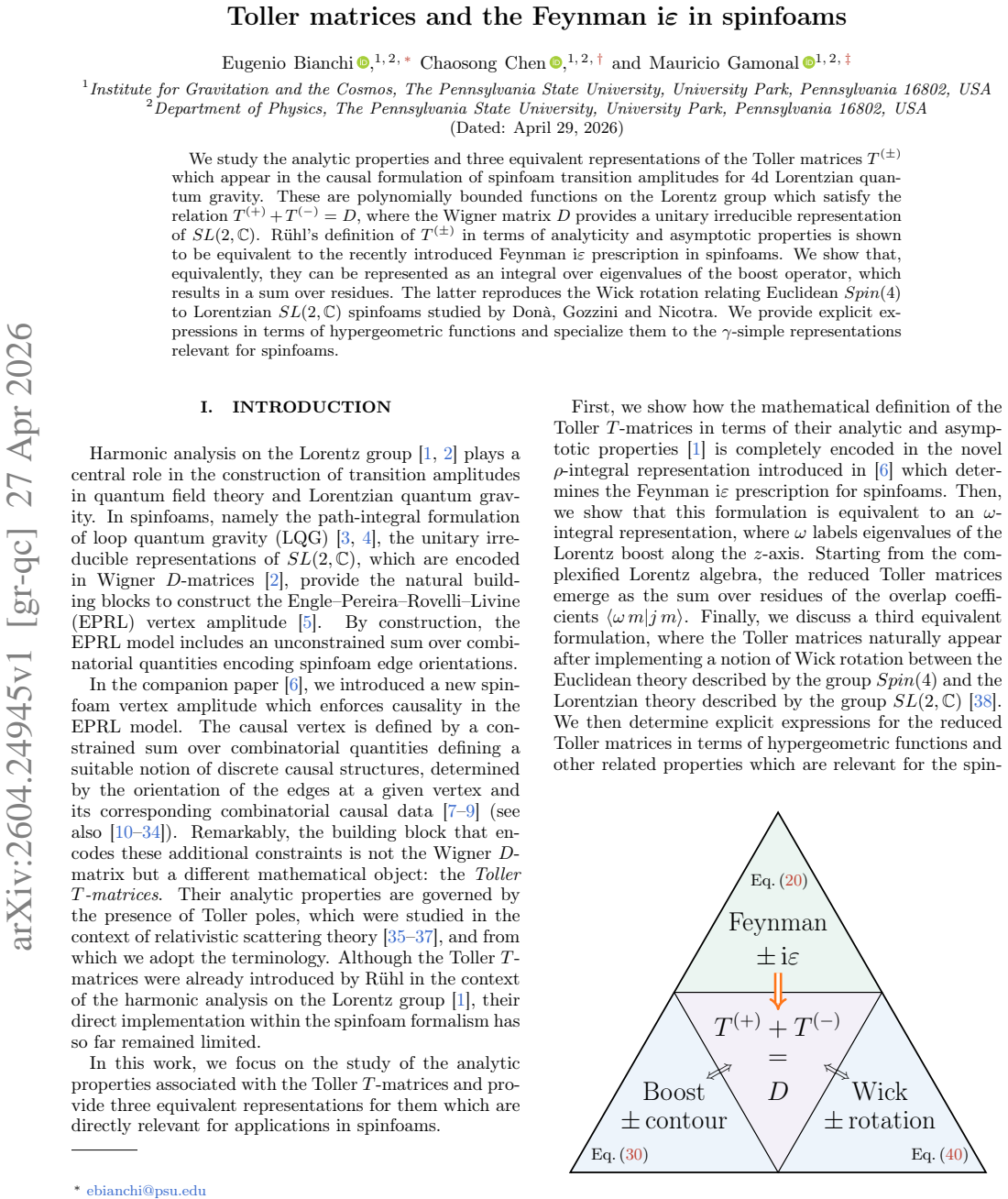
Toller matrices in spinfoams admit three equivalent definitions: Ruhl analyticity, the Feynman iε prescription, and a boost-eigenvalue integral whose residues recover the Wick rotation.
A machine-rendered reading of the paper's core claim, the machinery that carries it, and where it could break.
Core claim
We study the analytic properties and three equivalent representations of the Toller matrices T^(±) which appear in the causal formulation of spinfoam transition amplitudes for 4d Lorentzian quantum gravity. These are polynomially bounded functions on the Lorentz group which satisfy the relation T^(+) + T^(-) = D, where the Wigner matrix D provides a unitary irreducible representation of SL(2,C). Ruhl's definition of T^(±) in terms of analyticity and asymptotic properties is shown to be equivalent to the recently introduced Feynman iε prescription in spinfoams. We show that, equivalently, they can be represented as an integral over eigenvalues of the boost operator, which results in a sum of
What carries the argument
The Toller matrices T^(±), polynomially bounded functions on the Lorentz group satisfying T^(+) + T^(-) = D, whose analytic properties, iε prescription, and boost-eigenvalue integral representations carry the equivalence proofs.
If this is right
- The Feynman iε prescription gains justification through equivalence to Ruhl's analytic definition.
- The residue sum directly reproduces the Wick rotation connecting Euclidean Spin(4) to Lorentzian SL(2,C) spinfoams.
- Hypergeometric expressions become available for explicit calculations in γ-simple representations.
- Any of the three representations can be substituted into causal spinfoam transition amplitudes.
Where Pith is reading between the lines
- The equivalences may allow choosing the representation that best avoids singularities for numerical work on specific spinfoam amplitudes.
- Similar analytic-integral equivalences could appear in other quantum gravity models that rely on causal prescriptions.
- The result ties the spinfoam iε rule to standard contour techniques used in flat-space QFT propagators.
Load-bearing premise
The Toller matrices are polynomially bounded on the Lorentz group and belong to the γ-simple representations, which justifies the contour deformations and residue sums.
What would settle it
An explicit computation of the residue sum from the boost-eigenvalue integral for a specific γ-simple representation that fails to match the result from the iε prescription.
Figures


read the original abstract
We study the analytic properties and three equivalent representations of the Toller matrices $T^{(\pm)}$ which appear in the causal formulation of spinfoam transition amplitudes for 4d Lorentzian quantum gravity. These are polynomially bounded functions on the Lorentz group which satisfy the relation $T^{(+)}+T^{(-)}=D$, where the Wigner matrix $D$ provides a unitary irreducible representation of $SL(2,C)$. Ruhl's definition of $T^{(\pm)}$ in terms of analyticity and asymptotic properties is shown to be equivalent to the recently introduced Feynman $i\varepsilon$ prescription in spinfoams. We show that, equivalently, they can be represented as an integral over eigenvalues of the boost operator, which results in a sum over residues. The latter reproduces the Wick rotation relating Euclidean $Spin(4)$ to Lorentzian $SL(2,C)$ spinfoams studied by Dona, Gozzini and Nicotra. We provide explicit expressions in terms of hypergeometric functions and specialize them to the $\gamma$-simple representations relevant for spinfoams.
Editorial analysis
A structured set of objections, weighed in public.
Referee Report
Summary. The manuscript establishes three equivalent representations for the Toller matrices T^(±) in the causal formulation of 4d Lorentzian spinfoam transition amplitudes: Ruhl's definition via analyticity and asymptotic properties, the Feynman iε prescription, and an integral over eigenvalues of the boost operator that evaluates to a sum over residues. The residue sum is shown to reproduce the Wick rotation relating Euclidean Spin(4) to Lorentzian SL(2,C) spinfoams. Explicit expressions in hypergeometric functions are derived and specialized to the γ-simple representations relevant for spinfoams, with the relation T^(+) + T^(-) = D holding for the Wigner matrix D.
Significance. If the equivalences hold under the stated assumptions, the paper supplies a rigorous analytic bridge between representation-theoretic definitions of Toller matrices and the practical iε prescription used in spinfoam models. The explicit hypergeometric forms and residue-sum representation offer concrete tools for computations and clarify the connection to Euclidean spinfoams via Wick rotation. The work relies on standard tools of representation theory and contour integration with no free parameters or ad-hoc entities, which strengthens the mathematical foundations of Lorentzian quantum gravity amplitudes.
major comments (2)
- [section deriving the hypergeometric expressions and the equivalence proofs] The central equivalences (Ruhl definition ↔ iε prescription ↔ boost-eigenvalue integral plus residues) rely on polynomial boundedness of T^(±) on the Lorentz group together with the γ-simple representation condition to license contour deformations and residue extraction. While the abstract and the derivations assert these properties, the manuscript does not contain an explicit asymptotic analysis of the provided hypergeometric expressions confirming that the growth remains polynomially bounded in the directions required for the deformations. If the actual growth exceeds polynomial order for any sequence of γ-simple labels, extra contributions would appear in the residue sum and the claimed equivalences would fail.
- [section on the boost-eigenvalue integral representation] In the derivation of the integral representation over boost eigenvalues, the contour choices and the justification for shifting contours to extract the residue sum are not specified with sufficient detail. In particular, it is unclear how the γ-simple condition alone guarantees that no additional poles or contributions arise outside the asserted polynomial boundedness.
minor comments (2)
- The relation T^(+) + T^(-) = D is stated but a brief reminder of the definition of the Wigner matrix D and its unitarity would improve readability for readers outside the immediate spinfoam literature.
- Notation for the Toller matrices T^(±) could be introduced with an explicit reference to their appearance in the causal formulation of the transition amplitudes, to make the opening paragraphs self-contained.
Simulated Author's Rebuttal
We thank the referee for the careful reading of our manuscript and for the constructive comments. We address each major point below and will incorporate the suggested clarifications and additions in a revised version.
read point-by-point responses
-
Referee: [section deriving the hypergeometric expressions and the equivalence proofs] The central equivalences (Ruhl definition ↔ iε prescription ↔ boost-eigenvalue integral plus residues) rely on polynomial boundedness of T^(±) on the Lorentz group together with the γ-simple representation condition to license contour deformations and residue extraction. While the abstract and the derivations assert these properties, the manuscript does not contain an explicit asymptotic analysis of the provided hypergeometric expressions confirming that the growth remains polynomially bounded in the directions required for the deformations. If the actual growth exceeds polynomial order for any sequence of γ-simple labels, extra contributions would appear in the residue sum and the claimed equivalences would fail.
Authors: We agree that an explicit asymptotic analysis of the hypergeometric expressions is needed to rigorously confirm polynomial boundedness in the directions relevant for contour deformation. Although the manuscript states that T^(±) are polynomially bounded (as required by Ruhl's definition and standard for SL(2,C) matrix elements), we did not provide a dedicated verification for the derived hypergeometric forms. In the revised manuscript we will add a short appendix containing this analysis, using the known large-boost asymptotics of hypergeometric functions for γ-simple representations and verifying that growth remains at most polynomial, thereby ensuring the contour deformations and residue sums are justified without extraneous contributions. revision: yes
-
Referee: [section on the boost-eigenvalue integral representation] In the derivation of the integral representation over boost eigenvalues, the contour choices and the justification for shifting contours to extract the residue sum are not specified with sufficient detail. In particular, it is unclear how the γ-simple condition alone guarantees that no additional poles or contributions arise outside the asserted polynomial boundedness.
Authors: We acknowledge that the contour choices and deformation arguments could be presented with greater explicitness. The original derivation relies on the analytic properties established via the iε prescription and the γ-simple condition to restrict the locations of poles, but the precise paths and the absence of other singularities were not spelled out step by step. In the revision we will expand the relevant section to specify the initial and deformed contours, the regions where the integrand is analytic, and how the γ-simple condition together with polynomial boundedness excludes additional poles or non-residue contributions when the contour is shifted. revision: yes
Circularity Check
No circularity: equivalences derived from analytic properties and integral representations
full rationale
The paper establishes three equivalent representations of the Toller matrices T^(±) by showing that Ruhl's analytic/asymptotic definition matches the Feynman iε prescription and an eigenvalue integral plus residue sum. These steps rely on explicit assumptions of polynomial boundedness on the Lorentz group and γ-simple representations to license contour deformations, together with hypergeometric formulae after specialization. No step reduces a claimed result to a fitted parameter, self-definition, or load-bearing self-citation chain; the central equivalences remain independent of the inputs once the growth and representation conditions are granted. References to prior spinfoam literature provide context but do not substitute for the derivations performed here.
Axiom & Free-Parameter Ledger
axioms (2)
- domain assumption Toller matrices are polynomially bounded functions on the Lorentz group satisfying T^(+) + T^(-) = D where D is a Wigner matrix for an irreducible representation of SL(2,C).
- standard math Standard contour integration and residue calculus apply to the integral representation over boost eigenvalues.
Reference graph
Works this paper leans on
-
[1]
(See also [41]), and are reported explicitly in (B7). By inserting the resolution of the identity (27) into the definition of the reduced Wignerd-matrix, we can write d(ρ,k) jlm (β) =D (ρ,k) jmlm(e βσz 2 ) =⟨j m|e −iβ ˆKz |l m⟩ = Z ∞ −∞ dω⟨j m|e −iβKz |ω m⟩ ⟨ω m|l m⟩ = Z ∞ −∞ dωe −iβω ⟨ω m|j m⟩ ⟨ω m|l m⟩.(28) 5 The overlap coefficients⟨ω m|j m⟩have four f...
-
[2]
Coefficient-level continuation and compact-support thresholds TheWickrotationusedinthemaintextisimplementedonthetwoequivalentEuclideanClebsch-Gordanexpansions of the Biedenharn-Dolginov function as d(p,q) L jlm(t) = 2jLX n=0 eit(2n−2jL−m) C jm jL(n−jL)j R(m−n+jL) C lm jL(n−jL)j R(m−n+jL) ,(C20) d(p,q) R jlm(t) = 2jRX r=0 eit(m−2jR+2r) C jm jL(m−jR+r)j R(j...
-
[3]
Inverse Wick rotation The coefficient-level Wick rotation can be inverted, branch by branch. The inverse maps on the representation labels are W −1 + :ρ→ −ip , k→q , β→ −it ,(C28) W −1 − :ρ→+ip , k→ −q , β→ −it .(C29) Under these maps, the Lorentzian infinite sums truncate by the compactSU(2)support conditions. Before removing the convention factors, one ...
-
[4]
Rühl,The Lorentz Group and Harmonic Analysis, Mathematical physics monograph series, W
W. Rühl,The Lorentz Group and Harmonic Analysis, Mathematical physics monograph series, W. A. Benjamin (1970)
1970
-
[5]
Martin-Dussaud,A Primer of Group Theory for Loop Quantum Gravity and Spin-foams,Gen
P. Martin-Dussaud,A Primer of Group Theory for Loop Quantum Gravity and Spin-foams,Gen. Rel. Grav.51110 (2019) [arXiv:1902.08439]
-
[6]
Rovelli and F
C. Rovelli and F. Vidotto,Covariant Loop Quantum Gravity, Cambridge University Press (2014), DOI
2014
-
[7]
A. Ashtekar and E. Bianchi,A short review of Loop Quantum Gravity,Rept. Prog. Phys.84042001 (2021) [arXiv:2104.04394]
- [8]
-
[9]
E. Bianchi, C. Chen and M. Gamonal,Causal spinfoam vertex for 4d Lorentzian quantum gravity, [arXiv:2601.23162]
-
[10]
E.R. Livine and D. Oriti,Implementing causality in the spin foam quantum geometry,Nucl. Phys. B663 231 (2003) [arXiv:gr-qc/0210064]
-
[11]
Oriti,The Feynman propagator for spin foam quantum gravity,Phys
D. Oriti,The Feynman propagator for spin foam quantum gravity,Phys. Rev. Lett.94111301 (2005) [arXiv:gr-qc/0410134]
-
[12]
Causal structure in spin-foams
E. Bianchi and P. Martin-Dussaud,Causal Structure in Spin Foams,Universe10181 (2024) [arXiv:2109.00986]
work page internal anchor Pith review Pith/arXiv arXiv 2024
-
[13]
M.P. Reisenberger and C. Rovelli,’Sum over surfaces’ form of loop quantum gravity,Phys. Rev. D563490 (1997) [arXiv:gr-qc/9612035]
-
[14]
F. Markopoulou and L. Smolin,Causal evolution of spin networks,Nucl. Phys. B508409 (1997) [arXiv:gr-qc/9702025]
-
[15]
F. Markopoulou and L. Smolin,Quantum geometry with intrinsic local causality,Phys. Rev. D58084032 (1998) [arXiv:gr-qc/9712067]
-
[16]
Markopoulou,Quantum causal histories,Class
F. Markopoulou,Quantum causal histories,Class. Quant. Grav.172059 (2000) [arXiv:hep-th/9904009]
-
[17]
Gupta,Causality in spin foam models,Phys
S. Gupta,Causality in spin foam models,Phys. Rev. D 61064014 (2000) [arXiv:gr-qc/9908018]
-
[18]
H. Pfeiffer,On the causal Barrett-Crane model: Measure, coupling constant, Wick rotation, symmetries and observables,Phys. Rev. D67064022 (2003) [arXiv:gr-qc/0212049]
-
[19]
E. Hawkins, F. Markopoulou and H. Sahlmann, Evolution in quantum causal histories,Class. Quant. Grav.203839 (2003) [arXiv:hep-th/0302111]
-
[20]
L. Freidel and E.R. Livine,Ponzano-Regge model revisited III: Feynman diagrams and effective field theory,Class. Quant. Grav.232021 (2006) [arXiv:hep-th/0502106]
-
[21]
Oriti,Generalised group field theories and quantum gravity transition amplitudes,Phys
D. Oriti,Generalised group field theories and quantum gravity transition amplitudes,Phys. Rev. D73061502 (2006) [arXiv:gr-qc/0512069]
-
[22]
D. Oriti and T. Tlas,Causality and matter propagation in 3-D spin foam quantum gravity,Phys. Rev. D74 104021 (2006) [arXiv:gr-qc/0608116]
-
[23]
E.R. Livine and D.R. Terno,Quantum causal histories in the light of quantum information,Phys. Rev. D75 084001 (2007) [arXiv:gr-qc/0611135]
-
[24]
C. Rovelli and E. Wilson-Ewing,Discrete Symmetries in Covariant LQG,Phys. Rev. D86064002 (2012) [arXiv:1205.0733]
-
[25]
E. Bianchi and F. Hellmann,The Construction of Spin Foam Vertex Amplitudes,SIGMA9008 (2013) [arXiv:1207.4596]
-
[26]
Oriti,Group field theory as the 2nd quantization of Loop Quantum Gravity,Class
D. Oriti,Group field theory as the 2nd quantization of Loop Quantum Gravity,Class. Quant. Grav.33 085005 (2016) [arXiv:1310.7786]
-
[27]
Immirzi,A note on the spinor construction of Spin Foam amplitudes,Class
G. Immirzi,A note on the spinor construction of Spin Foam amplitudes,Class. Quant. Grav.31095016 (2014) [arXiv:1311.6942]
-
[28]
M. Cortês and L. Smolin,Spin foam models as energetic causal sets,Phys. Rev. D93084039 (2016) [arXiv:1407.0032]
-
[29]
Wieland,A new action for simplicial gravity in four dimensions,Class
W.M. Wieland,A new action for simplicial gravity in four dimensions,Class. Quant. Grav.32015016 (2015) [arXiv:1407.0025]
-
[30]
Immirzi,Causal spin foams, [arXiv:1610.04462]
G. Immirzi,Causal spin foams, [arXiv:1610.04462]
-
[31]
M. Finocchiaro and D. Oriti,Spin foam models and the Duflo map,Class. Quant. Grav.37015010 (2020) [arXiv:1812.03550]
-
[32]
A.F. Jercher, D. Oriti and A.G.A. Pithis,Complete Barrett-Crane model and its causal structure,Phys. Rev. D106066019 (2022) [arXiv:2206.15442]
-
[33]
A.F. Jercher, J.D. Simão and S. Steinhaus,Partial absence of cosine problem in 3D Lorentzian spin foams,Class. Quant. Grav.42017001 (2025) [arXiv:2404.16943]
-
[34]
Simão,A new 2+1 coherent spin-foam vertex for quantum gravity,Class
J.D. Simão,A new 2+1 coherent spin-foam vertex for quantum gravity,Class. Quant. Grav.41195015 (2024) [arXiv:2402.05993]
-
[35]
Oriti,Quantum information elements in Quantum Gravity states and processes, [arXiv:2502.21234]
D. Oriti,Quantum information elements in Quantum Gravity states and processes, [arXiv:2502.21234]
-
[36]
S.K. Asante and B. Borgolte,Causal structure and topology change in (2+1)-dimensional simplicial gravity,Phys. Rev. D112126001 (2025) 20 [arXiv:2507.10697]
-
[37]
Beltrán,Causal Structure for Generalized Spinfoams, [arXiv:2603.22661]
C.E. Beltrán,Causal Structure for Generalized Spinfoams, [arXiv:2603.22661]
-
[38]
Toller,On the group-theoretical approach to complex angular momentum and signature,Nuovo Cim
M. Toller,On the group-theoretical approach to complex angular momentum and signature,Nuovo Cim. A54295 (1968)
1968
-
[39]
Toller,An expansion of the scattering amplitude at vanishing four-momentum transfer using the representations of the Lorentz group,Nuovo Cim
M. Toller,An expansion of the scattering amplitude at vanishing four-momentum transfer using the representations of the Lorentz group,Nuovo Cim. A53 671 (1968)
1968
-
[40]
Sciarrino and M
A. Sciarrino and M. Toller,Decomposition of the unitary irreducible representations of the group SL(2C) restricted to the subgroup SU(1, 1),Journal of Mathematical Physics81252 (1967)
1967
- [41]
-
[42]
Speziale,Boosting Wigner’s nj-symbols,J
S. Speziale,Boosting Wigner’s nj-symbols,J. Math. Phys.58032501 (2017) [arXiv:1609.01632]
-
[43]
Huszár,Angular momentum and unitary spinor bases of the Lorentz group,Acta Phys
M. Huszár,Angular momentum and unitary spinor bases of the Lorentz group,Acta Phys. Hung.30241 (1971)
1971
-
[44]
Rashid,Boost Matrix Elements of the Homogeneous Lorentz groups,J
M.A. Rashid,Boost Matrix Elements of the Homogeneous Lorentz groups,J. Math. Phys.201514 (1979)
1979
-
[45]
Biedenharn,Wigner Coefficients for the R4 Group and Some Applications,J
L.C. Biedenharn,Wigner Coefficients for the R4 Group and Some Applications,J. Math. Phys.2433 (1961)
1961
-
[46]
Barut and R
A.O. Barut and R. Wilson,Some New Identities of Clebsch-Gordan Coefficients and Representation Functions of SO(2,1) and SO(4),J. Math. Phys.17 900 (1976)
1976
-
[47]
M. Lorente and P.D. Kramer,Tensor and spin representations of SO(4) and discrete quantum gravity, in8th International Symposium Symmetries in Science, 10, 2003, DOI [arXiv:gr-qc/0402050]
-
[48]
J.W. Barrett and L. Crane,A Lorentzian signature model for quantum general relativity,Class. Quant. Grav.173101 (2000) [arXiv:gr-qc/9904025]
-
[49]
J.W. Barrett, R.J. Dowdall, W.J. Fairbairn, H. Gomes and F. Hellmann,Asymptotic analysis of the EPRL four-simplex amplitude,J. Math. Phys.50112504 (2009) [arXiv:0902.1170]
-
[50]
J.W. Barrett, R.J. Dowdall, W.J. Fairbairn, F. Hellmann and R. Pereira,Lorentzian spin foam amplitudes: Graphical calculus and asymptotics,Class. Quant. Grav.27165009 (2010) [arXiv:0907.2440]
-
[51]
Han,On Spinfoam Models in Large Spin Regime, Class
M. Han,On Spinfoam Models in Large Spin Regime, Class. Quant. Grav.31015004 (2014) [arXiv:1304.5627]
- [52]
-
[53]
P. Dona and S. Speziale,Asymptotics of lowest unitary SL(2,C) invariants on graphs,Phys. Rev. D102 086016 (2020) [arXiv:2007.09089]
-
[54]
Dona,Geometry from local flatness in Lorentzian spin foam theories,Phys
P. Dona,Geometry from local flatness in Lorentzian spin foam theories,Phys. Rev. D107066011 (2023) [arXiv:2211.04743]
- [55]
- [56]
-
[57]
Bianchi,Entropy of Non-Extremal Black Holes from Loop Gravity, [arXiv:1204.5122]
E. Bianchi,Entropy of Non-Extremal Black Holes from Loop Gravity, [arXiv:1204.5122]
-
[58]
E. Bianchi and R.C. Myers,On the Architecture of Spacetime Geometry,Class. Quant. Grav.31214002 (2014) [arXiv:1212.5183]
-
[59]
M. Geiller and K. Noui,Near-Horizon Radiation and Self-Dual Loop Quantum Gravity,EPL10560001 (2014) [arXiv:1402.4138]
-
[60]
Rovelli,Graviton propagator from background-independent quantum gravity,Phys
C. Rovelli,Graviton propagator from background-independent quantum gravity,Phys. Rev. Lett.97151301 (2006) [arXiv:gr-qc/0508124]
-
[61]
E. Bianchi, L. Modesto, C. Rovelli and S. Speziale, Graviton propagator in loop quantum gravity,Class. Quant. Grav.236989 (2006) [arXiv:gr-qc/0604044]
-
[62]
E. Bianchi, E. Magliaro and C. Perini,LQG propagator from the new spin foams,Nucl. Phys. B 822245 (2009) [arXiv:0905.4082]
-
[63]
E. Bianchi and Y. Ding,Lorentzian spinfoam propagator,Phys. Rev. D86104040 (2012) [arXiv:1109.6538]
-
[64]
Vidotto,Spinfoam Cosmology: quantum cosmology from the full theory,J
F. Vidotto,Spinfoam Cosmology: quantum cosmology from the full theory,J. Phys. Conf. Ser.314012049 (2011) [arXiv:1011.4705]
-
[65]
E. Bianchi, C. Rovelli and F. Vidotto,Towards Spinfoam Cosmology,Phys. Rev. D82084035 (2010) [arXiv:1003.3483]
-
[66]
C. Roken,First-order quantum-gravitational correction from covariant, holomorphic spinfoam cosmology,Int. J. Mod. Phys. D221350005 (2015) [arXiv:1011.3335]
-
[67]
A. Henderson, C. Rovelli, F. Vidotto and E. Wilson-Ewing,Local spinfoam expansion in loop quantum cosmology,Class. Quant. Grav.28025003 (2011) [arXiv:1010.0502]
-
[68]
E. Bianchi, T. Krajewski, C. Rovelli and F. Vidotto, Cosmological constant in spinfoam cosmology,Phys. Rev. D83104015 (2011) [arXiv:1101.4049]
-
[69]
E.R. Livine and M. Martin-Benito,Classical Setting and Effective Dynamics for Spinfoam Cosmology, Class. Quant. Grav.30035006 (2013) [arXiv:1111.2867]
-
[70]
J. Rennert and D. Sloan,Anisotropic Spinfoam Cosmology,Class. Quant. Grav.31015017 (2014) [arXiv:1308.0687]
-
[71]
J. Rennert and D. Sloan,A Homogeneous Model of Spinfoam Cosmology,Class. Quant. Grav.30235019 (2013) [arXiv:1304.6688]
-
[72]
Vilensky,Spinfoam cosmology with the proper vertex amplitude,Class
I. Vilensky,Spinfoam cosmology with the proper vertex amplitude,Class. Quant. Grav.34225015 (2017) [arXiv:1611.01508]
-
[73]
M. Kisielowski and J. Lewandowski,Spin-foam model for gravity coupled to massless scalar field,Class. Quant. Grav.36075006 (2019) [arXiv:1807.06098]
-
[74]
F. Gozzini and F. Vidotto,Primordial Fluctuations From Quantum Gravity,Front. Astron. Astrophys. Cosmol.7629466 (2021) [arXiv:1906.02211]
-
[75]
P. Frisoni, F. Gozzini and F. Vidotto,Markov chain Monte Carlo methods for graph refinement in spinfoam cosmology,Class. Quant. Grav.40105001 (2023) [arXiv:2207.02881]
-
[76]
P. Frisoni, F. Gozzini and F. Vidotto,Primordial fluctuations from quantum gravity: 16-cell topological model, [arXiv:2312.02399]. 21
- [77]
-
[78]
Spinfoams, $\gamma$-duality and parity violation in primordial gravitational waves
E. Bianchi and M. Rincon-Ramirez,Spinfoams, γ-duality and parity violation in primordial gravitational waves, [arXiv:2403.06053]
work page internal anchor Pith review Pith/arXiv arXiv
-
[79]
H.M. Haggard and C. Rovelli,Quantum-gravity effects outside the horizon spark black to white hole tunneling, Phys. Rev. D92104020 (2015) [arXiv:1407.0989]
-
[80]
M. Christodoulou, C. Rovelli, S. Speziale and I. Vilensky,Planck star tunneling time: An astrophysically relevant observable from background-free quantum gravity,Phys. Rev. D94 084035 (2016) [arXiv:1605.05268]
discussion (0)
Sign in with ORCID, Apple, or X to comment. Anyone can read and Pith papers without signing in.