Networked Realization of Quantum LDPC Codes
Pith reviewed 2026-05-08 03:59 UTC · model grok-4.3
The pith
Bivariate bicycle QLDPC codes can be split across networked nodes while retaining error suppression close to monolithic versions.
A machine-rendered reading of the paper's core claim, the machinery that carries it, and where it could break.
Core claim
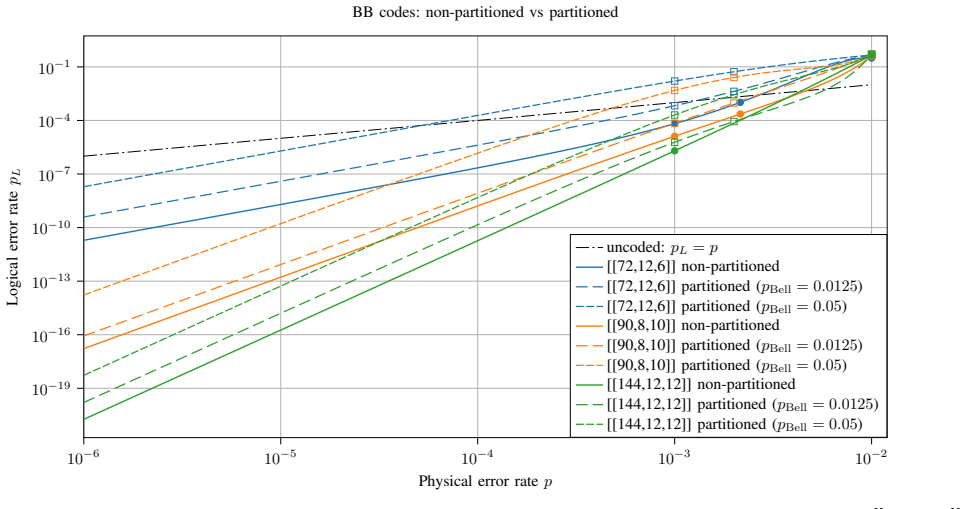
By partitioning bivariate bicycle codes into two nodes via balanced min-cut on the combined X-Z Tanner graph and executing stabilizers that span nodes through teleported CNOTs with tunable Bell-pair fidelity, the authors obtain circuit-level error rates under BP-OSD decoding that are competitive with the same codes run monolithically, while also recreating and extending networked surface-code results in Stim.
What carries the argument
Balanced min-cut partitioning on the combined X-Z Tanner graph to obtain near-optimal bipartitions, together with teleported CNOT gates whose noise scales with Bell-pair fidelity.
If this is right
- Networked surface codes with one qubit per node can be simulated in Stim and yield additional performance benchmarks beyond prior studies.
- Bipartite splits of bivariate bicycle codes become implementable once stabilizers crossing nodes are replaced by teleported CNOTs.
- Varying Bell-pair fidelity in the model directly tunes the effective noise of networked gates and reveals sensitivity to entanglement quality.
- BP-OSD decoding applied to the full circuit-level noise model supplies the first quantitative comparison between networked and monolithic QLDPC performance.
- The outlined advantages and limitations of the approach point to concrete hardware constraints that must be met for the networked realization to remain advantageous.
Where Pith is reading between the lines
- Modular quantum processor architectures could adopt these bipartitioning techniques to relax on-chip connectivity requirements while preserving fault-tolerance thresholds.
- Extending the same min-cut method to multi-way partitions or to other families of QLDPC codes would test whether the competitive performance generalizes beyond two nodes.
- Hardware teams could use the reported sensitivity to Bell-pair fidelity to set entanglement-generation targets before attempting physical networked implementations.
- If better graph-partitioning algorithms reduce the cut size further, the gap between networked and monolithic logical error rates would shrink even more.
Load-bearing premise
The balanced min-cut method yields splits close enough to optimal that the resulting performance reflects what networked hardware could actually achieve, and the teleported-CNOT noise model with variable Bell-pair fidelity matches real device behavior.
What would settle it
A circuit-level simulation that replaces min-cut partitioning with an exhaustive or heuristic search for a lower-cut bipartition, or that substitutes measured hardware noise parameters for the Bell-pair fidelity model, would show whether the reported error rates rise or fall substantially.
Figures


read the original abstract
Quantum low-density parity-check (QLDPC) codes with good parameters are promising candidates for low-overhead fault-tolerant quantum computing, but their non-local stabilizers require long-range connectivity and frequent qubit movement, introducing practical challenges. Prior work has studied the networked implementation of topological codes, where each node only holds one or a few qubits of the entire code, and demonstrated competitive performance under practical constraints such as the quality of network-provided entanglement. However, since these codes are already geometrically local, such a networked setting might not be essential. In this work, we propose and study the networked implementation of better QLDPC codes, specifically bivariate bicycle codes due to their similarity to surface codes and the controlled amount of long-range connections in their stabilizers. We begin by recreating networked surface codes in Stim, with one code qubit per node, and provide additional insights into their circuit-level noise performance. We then extend this approach to bipartitions of bivariate bicycle codes, using balanced min-cut partitioning on their combined X-Z Tanner graph to identify optimal qubit splits. For stabilizers spanning nodes, we implement teleported CNOTs and vary the Bell pair fidelity enabling these gates. Through circuit-level noise simulations with BP-OSD decoding, we provide the first insights into networked realizations of these codes and compare their performance with monolithic implementations. We conclude by outlining advantages, limitations, and future directions.
Editorial analysis
A structured set of objections, weighed in public.
Referee Report
Summary. The manuscript proposes and studies networked realizations of bivariate bicycle QLDPC codes. It recreates networked surface codes with one qubit per node in Stim, then extends to bipartitions of bivariate bicycle codes via balanced min-cut partitioning on the combined X-Z Tanner graph to minimize inter-node connections. Stabilizers spanning nodes are implemented with teleported CNOTs whose noise is modeled by varying Bell-pair fidelity. Circuit-level simulations with BP-OSD decoding are used to compare error performance against monolithic implementations and to provide initial insights into networked QLDPC behavior under practical network constraints.
Significance. If the modeling choices prove accurate, the work supplies the first simulation-based comparison of networked versus monolithic bivariate bicycle codes, extending prior networked-surface-code studies to higher-rate QLDPC families. This could help assess whether the controlled long-range connectivity in these codes remains advantageous once network entanglement overhead is included. The use of standard Stim + BP-OSD tooling is a positive, reproducible element, but the absence of raw data, error bars, and validation of the two core modeling assumptions limits immediate impact.
major comments (3)
- [Abstract] Abstract and simulation workflow: the central performance claims rest on circuit-level Stim simulations, yet no error bars, exact noise parameters, or complete partitioning results are supplied. Without these, the reported comparisons between networked and monolithic implementations cannot be verified or reproduced.
- [Bipartitioning approach] Bipartitioning section: the claim that balanced min-cut partitioning on the combined X-Z Tanner graph yields near-optimal qubit-to-node assignments (minimizing teleported CNOTs) is presented without any comparison to alternative partitioners or hardware-aware metrics such as stabilizer-weight distribution across the cut.
- [Teleported CNOT implementation] Teleported-CNOT noise model: performance curves are generated by varying only Bell-pair fidelity while holding other network effects fixed. No sensitivity analysis or hardware reference is given to justify that this single-parameter model captures the dominant error sources (e.g., latency or multi-qubit entanglement distribution) that would appear in real networked hardware.
minor comments (1)
- [Abstract] The abstract would benefit from explicitly naming the specific bivariate bicycle codes examined and the numerical range of Bell-pair fidelities simulated.
Simulated Author's Rebuttal
We thank the referee for their careful reading of the manuscript and constructive feedback. We address each major comment point by point below, indicating planned revisions where appropriate.
read point-by-point responses
-
Referee: [Abstract] Abstract and simulation workflow: the central performance claims rest on circuit-level Stim simulations, yet no error bars, exact noise parameters, or complete partitioning results are supplied. Without these, the reported comparisons between networked and monolithic implementations cannot be verified or reproduced.
Authors: We agree that error bars, explicit noise parameters, and partitioning details are necessary for reproducibility. In the revised manuscript we will add statistical error bars to all Stim simulation curves, include a table specifying the exact physical error rates, depolarizing noise strengths, and Bell-pair fidelities used, and append the complete bipartitioning results (including cut sizes and node assignments) for the bivariate bicycle codes examined. revision: yes
-
Referee: [Bipartitioning approach] Bipartitioning section: the claim that balanced min-cut partitioning on the combined X-Z Tanner graph yields near-optimal qubit-to-node assignments (minimizing teleported CNOTs) is presented without any comparison to alternative partitioners or hardware-aware metrics such as stabilizer-weight distribution across the cut.
Authors: The balanced min-cut was selected because it explicitly minimizes the number of crossing edges in the combined X-Z Tanner graph, which directly reduces the count of teleported CNOTs. While the original submission did not contain side-by-side comparisons with other partitioners, we will add a short justification paragraph citing the suitability of min-cut for this objective and note that metrics such as stabilizer-weight distribution across the cut represent valuable extensions for future study. revision: partial
-
Referee: [Teleported CNOT implementation] Teleported-CNOT noise model: performance curves are generated by varying only Bell-pair fidelity while holding other network effects fixed. No sensitivity analysis or hardware reference is given to justify that this single-parameter model captures the dominant error sources (e.g., latency or multi-qubit entanglement distribution) that would appear in real networked hardware.
Authors: Our model isolates Bell-pair fidelity as the primary network parameter because it governs the quality of the entanglement resource enabling teleported gates. We acknowledge that latency and multi-qubit distribution effects are not varied. The revision will add a dedicated paragraph discussing these modeling choices, reference recent experimental literature on quantum-network noise, and include a limited sensitivity study by re-running a subset of simulations with small additional latency-like delays. revision: yes
- Supplying the complete raw simulation datasets, which are voluminous and not stored in a readily shareable format at present.
Circularity Check
No circularity; results are direct outputs of independent circuit simulations
full rationale
The paper's central claims rest on explicit circuit-level noise simulations performed in Stim using BP-OSD decoding, with modeling choices (balanced min-cut partitioning on the X-Z Tanner graph and teleported CNOTs parameterized by Bell-pair fidelity) stated as inputs rather than derived quantities. No equations, predictions, or first-principles results are presented that reduce by construction to fitted parameters, self-citations, or ansatzes. The performance comparisons between networked and monolithic implementations are computed outputs under the stated noise model, not tautological re-expressions of the inputs. This is self-contained empirical work with no load-bearing self-referential steps.
Axiom & Free-Parameter Ledger
free parameters (1)
- Bell pair fidelity
axioms (1)
- domain assumption Circuit-level depolarizing noise model for gates and measurements
Reference graph
Works this paper leans on
-
[1]
Topological quantum computing with a very noisy network and local error rates approaching one percent,
N. H. Nickerson, Y . Li, and S. C. Benjamin, “Topological quantum computing with a very noisy network and local error rates approaching one percent,”Nature Commun., vol. 4, no. 1, p. 1756, 2013
2013
-
[2]
Thresholds for the distributed surface code in the presence of memory decoherence,
S. de Bone, P. M ¨oller, C. E. Bradley, T. H. Taminiau, and D. Elkouss, “Thresholds for the distributed surface code in the presence of memory decoherence,”arXiv preprint arXiv:2401.10770, 2024
-
[3]
Hierarchical surface code for network quantum computing with modules of arbitrary size,
Y . Li and S. C. Benjamin, “Hierarchical surface code for network quantum computing with modules of arbitrary size,”Physical Review A, vol. 94, p. 042303, 10 2016
2016
-
[4]
Fault-tolerant connection of error-corrected qubits with noisy links,
J. Ramette, J. Sinclair, N. P. Breuckmann, and V . Vuleti´c, “Fault-tolerant connection of error-corrected qubits with noisy links,”npj Quantum Information, vol. 10, no. 1, p. 58, 2024
2024
-
[5]
Long-range- enhanced surface codes,
Y . Hong, M. Marinelli, A. M. Kaufman, and A. Lucas, “Long-range- enhanced surface codes,”arXiv preprint arXiv:2309.11719, 2023
-
[6]
An architecture for improved surface code connectivity in neutral atoms,
J. Viszlai, S. F. Lin, S. Dangwal, J. M. Baker, and F. T. Chong, “An architecture for improved surface code connectivity in neutral atoms,” arXiv preprint arXiv:2309.13507, 2023
- [7]
-
[8]
Distributed realization of color codes for quantum error correction,
N. K. Chandra, D. Tipper, R. Nejabati, E. Kaur, and K. P. Seshadreesan, “Distributed realization of color codes for quantum error correction,” 2025
2025
-
[9]
Surface codes: Towards practical large-scale quantum computation,
A. G. Fowler, M. Mariantoni, J. M. Martinis, and A. N. Cleland, “Surface codes: Towards practical large-scale quantum computation,”Physical Review A, vol. 86, no. 3, 2012
2012
-
[10]
Optimized entanglement purification,
S. Krastanov, V . V . Albert, and L. Jiang, “Optimized entanglement purification,”Quantum, vol. 3, p. 123, 2019
2019
-
[11]
Protocols for creating and distilling multipartite ghz states with bell pairs,
S. de Bone, R. Ouyang, K. Goodenough, and D. Elkouss, “Protocols for creating and distilling multipartite ghz states with bell pairs,”IEEE Transactions on Quantum Engineering, vol. 1, p. 1–10, 2020
2020
-
[12]
Stim: a fast stabilizer circuit simulator,
C. Gidney, “Stim: a fast stabilizer circuit simulator,”Quantum, vol. 5, p. 497, July 2021
2021
-
[13]
Sparse blossom: correcting a million errors per core second with minimum-weight matching,
O. Higgott and C. Gidney, “Sparse blossom: correcting a million errors per core second with minimum-weight matching,”Quantum, vol. 9, p. 1600, Jan. 2025
2025
-
[14]
Tour de gross: A modular quantum computer based on bivariate bicycle codes,
T. J. Yoder, E. Schoute, P. Rall, E. Pritchett, J. M. Gambetta, A. W. Cross, M. Carroll, and M. E. Beverland, “Tour de gross: A modular quantum computer based on bivariate bicycle codes,” 2025
2025
-
[15]
High-threshold and low-overhead fault-tolerant quantum memory,
S. Bravyi, A. W. Cross, J. M. Gambetta, D. Maslov, P. Rall, and T. J. Yoder, “High-threshold and low-overhead fault-tolerant quantum memory,”Nature, vol. 627, p. 778–782, Mar. 2024
2024
-
[16]
Toward a 2D Local Implementation of Quantum Low-Density Parity-Check Codes,
N. Berthusen, D. Devulapalli, E. Schoute, A. M. Childs, M. J. Gullans, A. V . Gorshkov, and D. Gottesman, “Toward a 2D Local Implementation of Quantum Low-Density Parity-Check Codes,”PRX Quantum, vol. 6, p. 010306, 1 2025
2025
-
[17]
Good quantum error-correcting codes exist,
A. R. Calderbank and P. W. Shor, “Good quantum error-correcting codes exist,”Phys. Rev. A, vol. 54, pp. 1098–1105, Aug 1996
1996
-
[18]
Multiple-particle interference and quantum error correc- tion,
A. M. Steane, “Multiple-particle interference and quantum error correc- tion,”Proceedings of the Royal Society of London. Series A: Mathe- matical, Physical and Engineering Sciences, vol. 452, pp. 2551 – 2577, 1996
1996
-
[19]
Fault-tolerant quantum computation by anyons,
A. Kitaev, “Fault-tolerant quantum computation by anyons,”Annals of Physics, vol. 303, p. 2–30, Jan. 2003
2003
-
[20]
How to factor 2048 bit rsa integers in 8 hours using 20 million noisy qubits,
C. Gidney and M. Eker ˚a, “How to factor 2048 bit rsa integers in 8 hours using 20 million noisy qubits,”Quantum, vol. 5, p. 433, Apr. 2021
2048
-
[21]
Quantum kronecker sum-product low-density parity-check codes with finite rate,
A. A. Kovalev and L. P. Pryadko, “Quantum kronecker sum-product low-density parity-check codes with finite rate,”Phys. Rev. A, vol. 88, p. 012311, Jul 2013
2013
-
[22]
Degenerate quantum ldpc codes with good finite length performance,
P. Panteleev and G. Kalachev, “Degenerate quantum ldpc codes with good finite length performance,”Quantum, vol. 5, p. 585, Nov. 2021
2021
-
[23]
Karypis and V
G. Karypis and V . Kumar,METIS: A Software Package for Partition- ing Unstructured Graphs, Partitioning Meshes, and Computing Fill- Reducing Orderings of Sparse Matrices, September 1998
1998
-
[24]
Logical operators of quantum codes,
M. M. Wilde, “Logical operators of quantum codes,”Physical Review A, vol. 79, no. 6, 2009
2009
-
[25]
Network requirements for distributed quantum computation,
H. Jacinto, E. Gouzien, and N. Sangouard, “Network requirements for distributed quantum computation,”Physical Review Research, vol. 8, Feb. 2026
2026
discussion (0)
Sign in with ORCID, Apple, or X to comment. Anyone can read and Pith papers without signing in.