Recognition: unknown
Asteroseismic analysis of RY Leporis: the post-main sequence HADS in a binary system
Pith reviewed 2026-05-07 15:06 UTC · model grok-4.3
The pith
Seismic models using two identified pulsation modes place RY Lep at a mass of 2 solar masses and an age of 730 million years in the hydrogen shell-burning phase.
A machine-rendered reading of the paper's core claim, the machinery that carries it, and where it could break.
Core claim
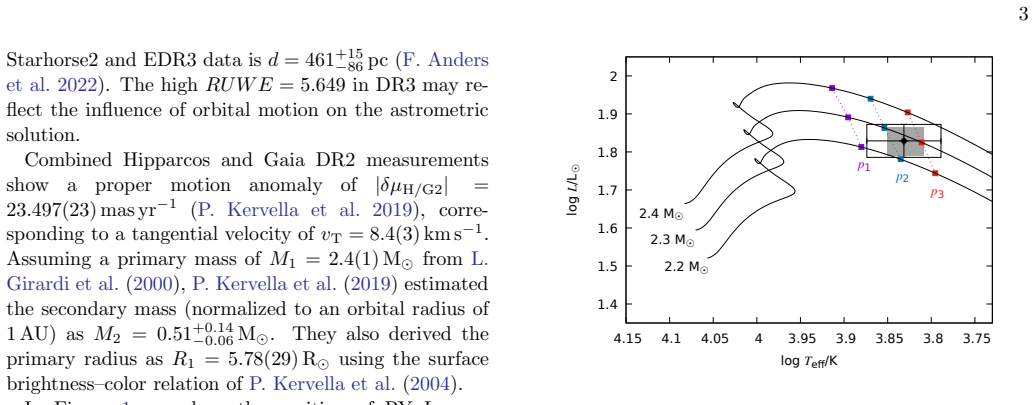
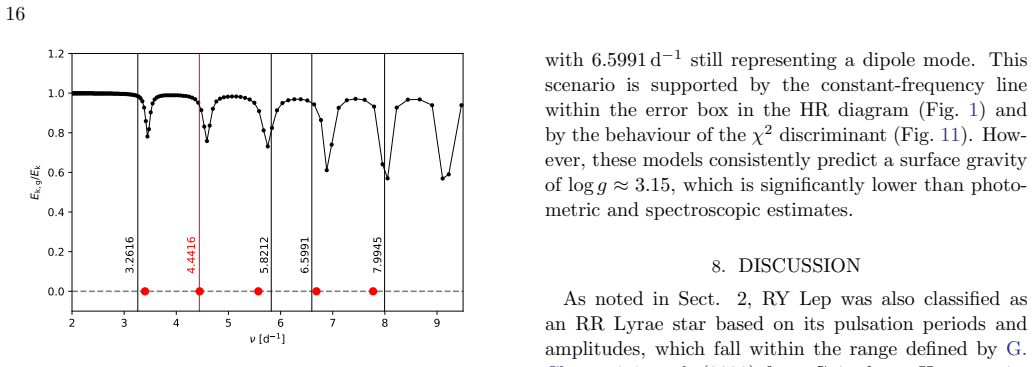
Seismic modeling of the dominant frequency at 4.4415 d^{-1} identified as the first radial overtone together with the secondary frequency at 6.5991 d^{-1} (treated as either the third radial overtone or a dipole mode) yields through Bayesian inference based on Monte Carlo simulations a stellar mass of approximately 2.0 solar masses and an age of approximately 730 million years. All viable seismic models place RY Lep in the hydrogen shell-burning evolutionary phase, with a metallicity consistent with the spectroscopic determination of [m/H] ≈ -0.4.
What carries the argument
Asteroseismic fitting of two pulsation frequencies (dominant radial overtone plus secondary as third overtone or dipole) through Bayesian Monte Carlo sampling to constrain mass, age, and evolutionary stage.
If this is right
- All acceptable models locate the star after core hydrogen exhaustion but still burning hydrogen in a shell.
- The derived mass near 2 solar masses and age near 730 million years remain consistent across both possible identifications of the secondary frequency.
- The overall metallicity from seismology matches the spectroscopic value of [m/H] ≈ -0.4.
- The absence of detectable spectral lines from the companion supports its identification as a white dwarf.
- Additional frequencies detected only in TESS data can be tested against the same family of models in future refinements.
Where Pith is reading between the lines
- Similar mode identifications applied to other high-amplitude delta Scuti stars in binaries could yield routine determinations of their post-main-sequence status.
- The reported enhancement of neutron-capture elements may trace to past mass transfer from the white-dwarf progenitor in this long-period system.
- The derived parameters offer a benchmark for testing how binary interactions alter the pulsational and evolutionary tracks of intermediate-mass stars.
Load-bearing premise
The dominant frequency must be the first radial overtone and the secondary frequency at 6.5991 d^{-1} must be either the third radial overtone or a dipole mode for the seismic models to converge on the reported mass and age.
What would settle it
Future high-precision photometry that reveals additional independent frequencies or revised mode identifications incompatible with any model near 2 solar masses and 730 million years old would rule out the current seismic solution.
Figures




read the original abstract
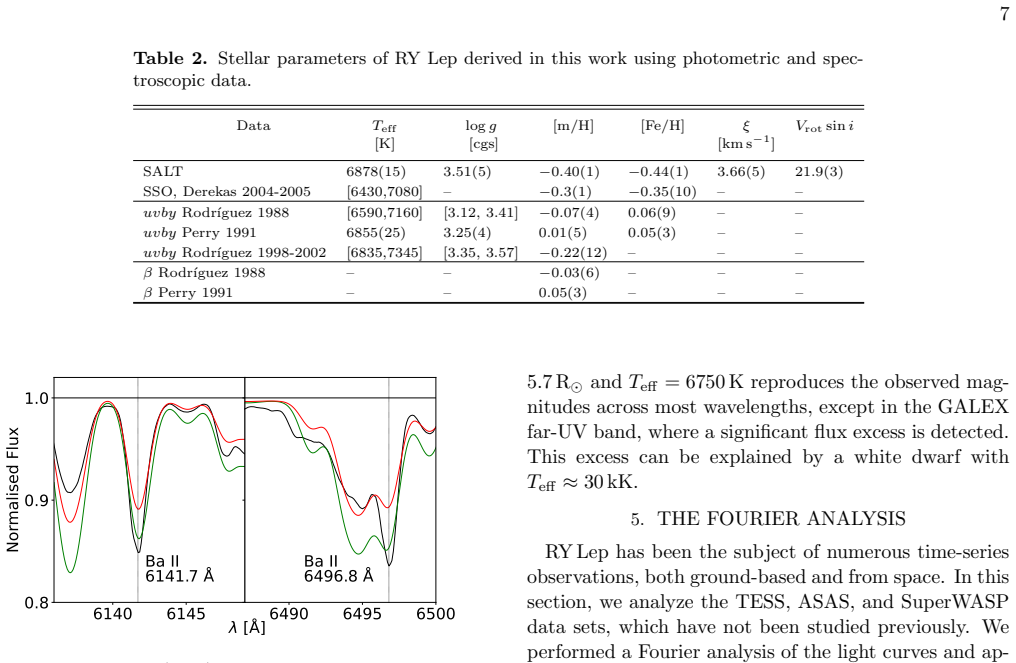
We present a comprehensive study of the pulsating primary component of the long-period binary system RY Lep. The spectral energy distribution and the absence of detectable lines indicate that the companion is likely a white dwarf. Atmospheric parameters and chemical abundances were determined from a high-resolution spectrum obtained with the the Southern African Large Telescope (SALT). The spectroscopic analysis reveals an underabundance of iron-group elements and an enhancement of neutron-capture elements, including barium and europium, with an overall metallicity of [m/H]$\approx -0.4$. In the next step, we performed the first Fourier analysis of long-term photometric data from ASAS, SuperWASP, and TESS. In the TESS observations, we identify several additional frequencies not present in the ground-based data. The dominant frequency at 4.4415 d$^{-1}$ is identified as a radial mode, most likely the first radial overtone. Finally, seismic modeling of RY Lep was carried out by fitting the dominant mode together with the secondary frequency at 6.5991 d$^{-1}$, considering two possible identification for the latter: the third radial overtone or a dipole mode. Bayesian inference based on Monte Carlo simulations yields a stellar mass of $\sim 2.0 $M$_\odot$ and an age of $\sim 730$ Myr. All viable seismic models place RY Lep in the hydrogen shell-burning evolutionary phase, with a metallicity consistent with the spectroscopic determination.
Editorial analysis
A structured set of objections, weighed in public.
Referee Report
Summary. The manuscript presents a spectroscopic analysis of the primary in the long-period binary RY Lep using SALT high-resolution spectra, deriving atmospheric parameters, chemical abundances (including [m/H] ≈ -0.4 with iron-group underabundances and neutron-capture enhancements), and inferring a white-dwarf companion from the SED. It performs Fourier analysis on combined ASAS, SuperWASP, and TESS photometry, identifying the dominant frequency at 4.4415 d^{-1} as a radial mode (most likely first overtone) and a secondary frequency at 6.5991 d^{-1}. Seismic modeling fits these two frequencies under two mode identifications for the secondary (third radial overtone or dipole) via Bayesian Monte Carlo sampling of stellar evolution and pulsation models, yielding a mass of ∼2.0 M⊙, age of ∼730 Myr, and placement in the hydrogen shell-burning phase, consistent with spectroscopy.
Significance. If the mode identifications are robust, the work delivers the first asteroseismic mass, age, and evolutionary-phase constraints for a high-amplitude δ Scuti star in a binary with a probable white-dwarf companion. The multi-instrument photometric baseline, detailed abundance analysis, and use of Bayesian Monte Carlo sampling to propagate uncertainties constitute clear strengths that would make the result a useful benchmark for post-main-sequence HADS evolution.
major comments (2)
- [Seismic modeling section] Seismic modeling section: The reported mass (∼2.0 M⊙), age (∼730 Myr), and hydrogen shell-burning phase are obtained exclusively by fitting the dominant frequency (assumed first radial overtone) together with the secondary frequency under only two allowed identifications. No alternative identifications (e.g., dominant frequency as the radial fundamental or secondary as quadrupole) are tested against the same model grid, even though the abstract notes additional TESS frequencies that could in principle discriminate. Because the posterior depends directly on these identifications, the central claims are not shown to be robust to plausible changes in mode assignment.
- [Frequency analysis and modeling description] Frequency analysis and modeling description: The abstract and modeling section provide no formal uncertainties on the extracted frequencies, no description of the stellar-model grid boundaries or input physics (e.g., convective overshooting, opacity tables), and no explicit statement of the priors or likelihood function used in the Monte Carlo sampling. These omissions prevent independent assessment of whether the reported posterior is unique or whether other combinations of mass, age, and evolutionary phase could reproduce the same two frequencies within the observational errors.
minor comments (3)
- [Abstract] Abstract: 'the the Southern African Large Telescope' contains a duplicated article.
- [Abstract] Abstract: 'two possible identification for the latter' should read 'two possible identifications for the latter'.
- [Abstract] Abstract: The statement that 'all viable seismic models' place the star in the H-shell-burning phase would be strengthened by reporting the number of viable models retained and the quantitative acceptance criteria applied.
Simulated Author's Rebuttal
We thank the referee for the constructive and detailed comments, which have helped us improve the clarity and robustness of the manuscript. We address each major comment point by point below.
read point-by-point responses
-
Referee: [Seismic modeling section] Seismic modeling section: The reported mass (∼2.0 M⊙), age (∼730 Myr), and hydrogen shell-burning phase are obtained exclusively by fitting the dominant frequency (assumed first radial overtone) together with the secondary frequency under only two allowed identifications. No alternative identifications (e.g., dominant frequency as the radial fundamental or secondary as quadrupole) are tested against the same model grid, even though the abstract notes additional TESS frequencies that could in principle discriminate. Because the posterior depends directly on these identifications, the central claims are not shown to be robust to plausible changes in mode assignment.
Authors: We agree that explicitly testing alternative mode identifications would further demonstrate robustness. The dominant frequency is identified as the first radial overtone based on its large amplitude (typical for HADS stars) and the observed period ratio with the secondary frequency; assigning it as the fundamental leads to inconsistent evolutionary models that violate the spectroscopic constraints and produce period ratios outside the observed range. For the secondary frequency we limited the analysis to the two identifications (third radial overtone or dipole) that yield viable solutions within the computed grid. The additional TESS frequencies have lower amplitudes and possible aliasing, rendering them less reliable for primary modeling, though we have added a paragraph discussing their potential future use for discrimination. In the revised manuscript we include a new subsection justifying the chosen identifications and showing that the rejected alternatives fail to reproduce the data within uncertainties. This is a partial revision: the core modeling remains unchanged but the justification and discussion of alternatives have been strengthened. revision: partial
-
Referee: [Frequency analysis and modeling description] Frequency analysis and modeling description: The abstract and modeling section provide no formal uncertainties on the extracted frequencies, no description of the stellar-model grid boundaries or input physics (e.g., convective overshooting, opacity tables), and no explicit statement of the priors or likelihood function used in the Monte Carlo sampling. These omissions prevent independent assessment of whether the reported posterior is unique or whether other combinations of mass, age, and evolutionary phase could reproduce the same two frequencies within the observational errors.
Authors: We acknowledge these omissions and have revised the manuscript to correct them. Formal uncertainties on the frequencies (obtained from least-squares Fourier fitting) are now stated explicitly. The model grid is described in detail: masses 1.8–2.2 M⊙ (step 0.05 M⊙), metallicities −0.5 to −0.3, with ages set by the evolutionary tracks. Input physics include OPAL opacities, convective overshooting of 0.2 pressure scale heights, and mixing-length parameter α = 1.8. The Bayesian Monte Carlo procedure uses uniform priors on mass, age, and metallicity within the grid boundaries; the likelihood is a χ² statistic comparing observed and model frequencies, weighted by the observational uncertainties. These additions, together with a supplementary table of grid parameters, now allow independent evaluation of posterior uniqueness. revision: yes
Circularity Check
No circularity: mass and age are outputs of independent model fitting to observed frequencies under stated mode IDs.
full rationale
The derivation proceeds as: extract frequencies via Fourier analysis of photometric data, assign preliminary mode identifications (dominant as first radial overtone; secondary as third overtone or dipole), then perform Bayesian Monte Carlo fitting of stellar evolution/pulsation models to those two frequencies. The reported mass (~2.0 M⊙), age (~730 Myr), and H-shell-burning phase are direct outputs of the fit to the observed frequencies and chosen IDs; they are not equivalent to the inputs by construction, nor do any equations or self-citations reduce the result to a renamed fit. Mode IDs are explicit assumptions that could be tested with additional frequencies, but this is standard modeling practice rather than circularity. The paper is self-contained against external benchmarks (spectroscopic metallicity, TESS data) with no load-bearing self-citation or ansatz smuggling.
Axiom & Free-Parameter Ledger
free parameters (2)
- mode identification for secondary frequency
- stellar mass and age
axioms (2)
- domain assumption Standard linear adiabatic pulsation theory accurately predicts observed frequencies for the identified modes
- domain assumption Stellar evolution models with given metallicity and physics inputs correctly describe the star's structure at the observed pulsation frequencies
Reference graph
Works this paper leans on
-
[1]
Ammons, S. M., Robinson, S. E., Strader, J., et al. 2006, ApJ, 638, 1004, doi: 10.1086/498490
-
[2]
2019, , 628, A94, 10.1051/0004-6361/201935765
Anders, F., Khalatyan, A., Chiappini, C., et al. 2019, A&A, 628, A94, doi: 10.1051/0004-6361/201935765
-
[3]
Anders, F., Khalatyan, A., Queiroz, A. B. A., et al. 2022, A&A, 658, A91, doi: 10.1051/0004-6361/202142369
-
[4]
Arlandini, C., K¨ appeler, F., Wisshak, K., et al. 1999, ApJ, 525, 886, doi: 10.1086/307938
-
[5]
Asplund, M., Grevesse, N., Sauval, A. J., & Scott, P. 2009, ARA&A, 47, 481, doi: 10.1146/annurev.astro.46.060407.145222 Astropy Collaboration, Robitaille, T. P., Tollerud, E. J., et al. 2013, A&A, 558, A33, doi: 10.1051/0004-6361/201322068 Astropy Collaboration, Price-Whelan, A. M., Sip˝ ocz, B. M., et al. 2018, AJ, 156, 123, doi: 10.3847/1538-3881/aabc4f
-
[6]
Ayres, T. R. 1991, ApJ, 375, 704, doi: 10.1086/170236
-
[7]
Balona, L. A. 2013, MNRAS, 431, 2240, doi: 10.1093/mnras/stt322
-
[8]
Baran, A. S., & Koen, C. 2021, AcA, 71, 113, doi: 10.32023/0001-5237/71.2.3
-
[9]
1990, A&A, 236, 440
Berthet, S. 1990, A&A, 236, 440
1990
-
[10]
2014, ApJ, 787, 10, doi: 10.1088/0004-637X/787/1/10
Bisterzo, S., Travaglio, C., Gallino, R., Wiescher, M., & K¨ appeler, F. 2014, ApJ, 787, 10, doi: 10.1088/0004-637X/787/1/10
-
[11]
2019, MNRAS, 486, 2075, doi: 10.1093/mnras/stz549
Blanco-Cuaresma, S. 2019, MNRAS, 486, 2075, doi: 10.1093/mnras/stz549
-
[12]
2014, A&A, 569, A111, doi: 10.1051/0004-6361/201423945
Blanco-Cuaresma, S., Soubiran, C., Heiter, U., & Jofr´ e, P. 2014, A&A, 569, A111, doi: 10.1051/0004-6361/201423945
-
[13]
Bowman, D. M., Kurtz, D. W., Breger, M., Murphy, S. J., & Holdsworth, D. L. 2016, MNRAS, 460, 1970, doi: 10.1093/mnras/stw1153
-
[14]
2000, in Astronomical Society of the Pacific Conference Series, Vol
Breger, M. 2000, in Astronomical Society of the Pacific Conference Series, Vol. 210, Delta Scuti and Related Stars, ed. M. Breger & M. Montgomery, 3
2000
-
[15]
Breger, M., & Pamyatnykh, A. A. 1998, A&A, 332, 958, doi: 10.48550/arXiv.astro-ph/9802076
work page internal anchor Pith review doi:10.48550/arxiv.astro-ph/9802076 1998
-
[16]
M., Goldman, I., & Mazzitelli, I
Canuto, V. M., Goldman, I., & Mazzitelli, I. 1996, ApJ, 473, 550, doi: 10.1086/178166
-
[17]
M., Sillanpaa, A., & Takalo, L
Carraro, G., Ng, Y. K., & Portinari, L. 1998, MNRAS, 296, 1045, doi: 10.1046/j.1365-8711.1998.01460.x
-
[18]
Cayrel, R., Depagne, E., Spite, M., et al. 2004, A&A, 416, 1117, doi: 10.1051/0004-6361:20034074
-
[19]
Chadid, M., Sneden, C., & Preston, G. W. 2017, ApJ, 835, 187, doi: 10.3847/1538-4357/835/2/187
-
[20]
1971, A&A, 14, 24
Chevalier, C. 1971, A&A, 14, 24
1971
-
[21]
2022, A&A, 667, A155, doi: 10.1051/0004-6361/202244360
Choplin, A., Siess, L., & Goriely, S. 2022, A&A, 667, A155, doi: 10.1051/0004-6361/202244360
-
[22]
2024, A&A, 684, A206, doi: 10.1051/0004-6361/202348957
Choplin, A., Siess, L., Goriely, S., & Martinet, S. 2024, A&A, 684, A206, doi: 10.1051/0004-6361/202348957
-
[23]
2000, A&A, 363, 1081
Claret, A. 2000, A&A, 363, 1081
2000
-
[24]
Clementini, G., Ripepi, V., Garofalo, A., et al. 2023, A&A, 674, A18, doi: 10.1051/0004-6361/202243964
-
[25]
Colgan, J., Kilcrease, D. P., Magee, N. H., et al. 2016, ApJ, 817, 116, doi: 10.3847/0004-637X/817/2/116
-
[26]
Crawford, D. L. 1975, AJ, 80, 955, doi: 10.1086/111828
-
[27]
Crawford, D. L. 1979, AJ, 84, 1858, doi: 10.1086/112617
-
[28]
7737, Observatory Operations: Strategies, Processes, and Systems III, ed
Crawford, S. M., Still, M., Schellart, P., et al. 2010, in Society of Photo-Optical Instrumentation Engineers (SPIE) Conference Series, Vol. 7737, Observatory Operations: Strategies, Processes, and Systems III, ed. D. R. Silva, A. B. Peck, & B. T. Soifer, 773725, doi: 10.1117/12.857000 Daszy´ nska, J., & Cugier, H. 2003, Advances in Space Research, 31, 38...
-
[29]
Pamyatnykh, A. A. 2003, A&A, 407, 999, doi: 10.1051/0004-6361:20030947 Daszy´ nska-Daszkiewicz, J., Pamyatnykh, A. A., Walczak, P., & Szewczuk, W. 2020, MNRAS, 499, 3034, doi: 10.1093/mnras/staa3056 Daszy´ nska-Daszkiewicz, J., Walczak, P., Pamyatnykh, A.,
-
[30]
Szewczuk, W., & Niewiadomski, W. 2023a, ApJL, 942, L38, doi: 10.3847/2041-8213/acade2 Daszy´ nska-Daszkiewicz, J., Walczak, P., Pamyatnykh, A. A., & Szewczuk, W. 2022, MNRAS, 512, 3551, doi: 10.1093/mnras/stac646 Daszy´ nska-Daszkiewicz, J., Walczak, P., Szewczuk, W., &
-
[31]
2023b, MNRAS, 526, 1951, doi: 10.1093/mnras/stad2797
Niewiadomski, W. 2023b, MNRAS, 526, 1951, doi: 10.1093/mnras/stad2797
-
[32]
Derekas, A., Kiss, L. L., Bedding, T. R., et al. 2009, MNRAS, 394, 995, doi: 10.1111/j.1365-2966.2008.14381.x
-
[33]
1985, A&A, 149, 465
Diethelm, R. 1985, A&A, 149, 465
1985
-
[34]
1977, AcA, 27, 95
Dziembowski, W. 1977, AcA, 27, 95
1977
-
[35]
Dziembowski, W. A., & Pamyatnykh, A. A. 2008, MNRAS, 385, 2061, doi: 10.1111/j.1365-2966.2008.12964.x Gaia Collaboration, Brown, A. G. A., Vallenari, A., et al. 2018, A&A, 616, A1, doi: 10.1051/0004-6361/201833051 Gaia Collaboration, Vallenari, A., Brown, A. G. A., et al. 2023, A&A, 674, A1, doi: 10.1051/0004-6361/202243940
-
[36]
Girardi, L., Bressan, A., Bertelli, G., & Chiosi, C. 2000, A&AS, 141, 371, doi: 10.1051/aas:2000126
-
[37]
Gray, R. O., & Corbally, C. J. 1994, AJ, 107, 742, doi: 10.1086/116893
-
[38]
, year = 2019, month = dec, volume =
Finkbeiner, D. 2019, ApJ, 887, 93, doi: 10.3847/1538-4357/ab5362 28
-
[39]
Harris, C. R., Millman, K. J., van der Walt, S. J., et al. 2020, Nature, 585, 357, doi: 10.1038/s41586-020-2649-2
-
[40]
2002, A&A, 392, 619, doi: 10.1051/0004-6361:20020788 Høg, E., Fabricius, C., Makarov, V
Heiter, U., Kupka, F., van’t Veer-Menneret, C., et al. 2002, A&A, 392, 619, doi: 10.1051/0004-6361:20020788 Høg, E., Fabricius, C., Makarov, V. V., et al. 2000, A&A, 355, L27
-
[41]
The Geneva-Copenhagen survey of the Solar neighbourhood II
Holmberg, J., Nordstr¨ om, B., & Andersen, J. 2007, A&A, 475, 519, doi: 10.1051/0004-6361:20077221
-
[42]
2009, A&A, 501, 941, doi: 10.1051/0004-6361/200811191
Holmberg, J., Nordstr¨ om, B., & Andersen, J. 2009, A&A, 501, 941, doi: 10.1051/0004-6361/200811191
-
[43]
1988, Michigan Catalogue of Two-dimensional Spectral Types for the HD Stars
Houk, N., & Smith-Moore, M. 1988, Michigan Catalogue of Two-dimensional Spectral Types for the HD Stars. Volume 4, Declinations -26°.0 to -12°.0., Vol. 4
1988
-
[44]
Hunter, J. D. 2007, Computing in Science and Engineering, 9, 90, doi: 10.1109/MCSE.2007.55
-
[45]
Iglesias, C. A., & Rogers, F. J. 1996, ApJ, 464, 943, doi: 10.1086/177381
-
[46]
Binarity from proper motion anomaly
Kervella, P., Arenou, F., Mignard, F., & Th´ evenin, F. 2019, A&A, 623, A72, doi: 10.1051/0004-6361/201834371
-
[47]
Surface brightness relations calibrated by interferometry
Kervella, P., Th´ evenin, F., Di Folco, E., & S´ egransan, D. 2004, A&A, 426, 297, doi: 10.1051/0004-6361:20035930
-
[48]
2010, Mem
Koester, D. 2010, Mem. Soc. Astron. Italiana, 81, 921
2010
-
[49]
Landstreet, J. D. 1998, A&A, 338, 1041
1998
-
[50]
D., Joner, M., & Rodriguez, E
Laney, C. D., Joner, M., & Rodriguez, E. 2003, in Astronomical Society of the Pacific Conference Series, Vol. 292, Interplay of Periodic, Cyclic and Stochastic Variability in Selected Areas of the H-R Diagram, ed. C. Sterken, 203
2003
-
[51]
2018, A&A, 616, A2, doi: 10.1051/0004-6361/201832727
Lindegren, L., Hern´ andez, J., Bombrun, A., et al. 2018, A&A, 616, A2, doi: 10.1051/0004-6361/201832727
-
[52]
2024, MNRAS, 527, 8234, doi: 10.1093/mnras/stad3687
Mashonkina, L. 2024, MNRAS, 527, 8234, doi: 10.1093/mnras/stad3687
-
[53]
2012, MNRAS, 423, 600, doi: 10.1111/j.1365-2966.2012.20901.x
McDonald, I., Zijlstra, A. A., & Boyer, M. L. 2012, MNRAS, 427, 343, doi: 10.1111/j.1365-2966.2012.21873.x
-
[54]
McGahee, C., Gray, R. O., Griffin, R. E. M., Birchard, M., & Day, J. 2020, AJ, 160, 52, doi: 10.3847/1538-3881/ab974c
-
[55]
1997, PASP, 109, 1221, doi: 10.1086/133999
McNamara, D. 1997, PASP, 109, 1221, doi: 10.1086/133999
-
[56]
2007, in Astronomical Society of the Pacific Conference Series, Vol
Mohamed, S., & Podsiadlowski, P. 2007, in Astronomical Society of the Pacific Conference Series, Vol. 372, 15th European Workshop on White Dwarfs, ed. R. Napiwotzki & M. R. Burleigh, 397
2007
-
[57]
Muraveva, T., Giannetti, A., Clementini, G., Garofalo, A., & Monti, L. 2025, MNRAS, 536, 2749, doi: 10.1093/mnras/stae2679 Paczy´ nski, B. 1969, AcA, 19, 1
-
[58]
Pamyatnykh, A. A. 1999, AcA, 49, 119
1999
-
[59]
W., van Genderen, A
Pel, J. W., van Genderen, A. M., & Lub, J. 1981, A&A, 99, L1
1981
-
[60]
Perry, C. L. 1991, PASP, 103, 494, doi: 10.1086/132849
-
[61]
O., & Christensen-Dalsgaard, J
Petersen, J. O., & Christensen-Dalsgaard, J. 1996, A&A, 312, 463
1996
-
[62]
O., & Jørgensen, H
Petersen, J. O., & Jørgensen, H. E. 1972, A&A, 17, 367
1972
-
[63]
Popper, D. M. 1966, AJ, 71, 175, doi: 10.1086/110139
-
[64]
2000, ApJ, 529, 338, doi: 10.1086/308274
Richer, J., Michaud, G., & Turcotte, S. 2000, ApJ, 529, 338, doi: 10.1086/308274
-
[65]
Ricker, G. R., Winn, J. N., Vanderspek, R., et al. 2015, Journal of Astronomical Telescopes, Instruments, and Systems, 1, 014003, doi: 10.1117/1.JATIS.1.1.014003 Rodr´ ıguez, E. 1989, PhD thesis, University of Granada, Spain Rodr´ ıguez, E., & Breger, M. 2001, A&A, 366, 178, doi: 10.1051/0004-6361:20000205
-
[66]
Rodriguez, E., Laney, C. D., Amado, P. J., Lopez-Gonzalez, M. J., & Joner, M. 2004, Communications in Asteroseismology, 145, 48, doi: 10.1553/cia145s46 Rodr´ ıguez, E., Rolland, A., Costa, V., & Mart´ ın, S. 1995, MNRAS, 277, 965, doi: 10.1093/mnras/277.3.965 Rodr´ ıguez, E., Rolland, A., & Lopez de Coca, P. 1990, Ap&SS, 169, 113, doi: 10.1007/BF00640695
-
[67]
Rogers, F. J., & Nayfonov, A. 2002, ApJ, 576, 1064, doi: 10.1086/341894
-
[68]
Rogers, F. J., Swenson, F. J., & Iglesias, C. A. 1996, ApJ, 456, 902, doi: 10.1086/176705 R´ o˙ za´ nski, T., Niemczura, E., Lemiesz, J., Posi lek, N., & R´ o˙ za´ nski, P. 2022, A&A, 659, A199, doi: 10.1051/0004-6361/202141480
-
[69]
1993, AJ, 106, 703, doi: 10.1086/116676
Sandage, A. 1993, AJ, 106, 703, doi: 10.1086/116676
-
[70]
Seaton, M. J. 2005, MNRAS, 362, L1, doi: 10.1111/j.1365-2966.2005.00019.x
-
[71]
1993, A&A, 274, 391
Smalley, B. 1993, A&A, 274, 391
1993
-
[72]
2016, A&A, 591, A118, doi: 10.1051/0004-6361/201628497
Soubiran, C., Le Campion, J.-F., Brouillet, N., & Chemin, L. 2016, A&A, 591, A118, doi: 10.1051/0004-6361/201628497
-
[73]
1964, Information Bulletin on Variable Stars, 51, 1
Strohmeier, W. 1964, Information Bulletin on Variable Stars, 51, 1
1964
-
[74]
Fracassini, L. E. 1989, ApJ, 343, 916, doi: 10.1086/167761 29
-
[75]
2009, ApJ, 696, 1755, doi: 10.1088/0004-637X/696/2/1755 van Leeuwen, F., de Bruijne, J
Tremblay, P.-E., & Bergeron, P. 2009, ApJ, 696, 1755, doi: 10.1088/0004-637X/696/2/1755 van Leeuwen, F., de Bruijne, J. H. J., Arenou, F., et al. 2018, Gaia DR2 documentation,, Gaia DR2 documentation, European Space Agency; Gaia Data Processing and Analysis Consortium
discussion (0)
Sign in with ORCID, Apple, or X to comment. Anyone can read and Pith papers without signing in.