Linear response from tilted Dirac cones under strain-induced pseudomagnetic fields
Pith reviewed 2026-05-07 15:24 UTC · model grok-4.3
The pith
Strain-induced pseudomagnetic fields make pseudo-Landau levels dispersive in tilted Dirac cones, yielding nonzero longitudinal linear responses.
A machine-rendered reading of the paper's core claim, the machinery that carries it, and where it could break.
Core claim
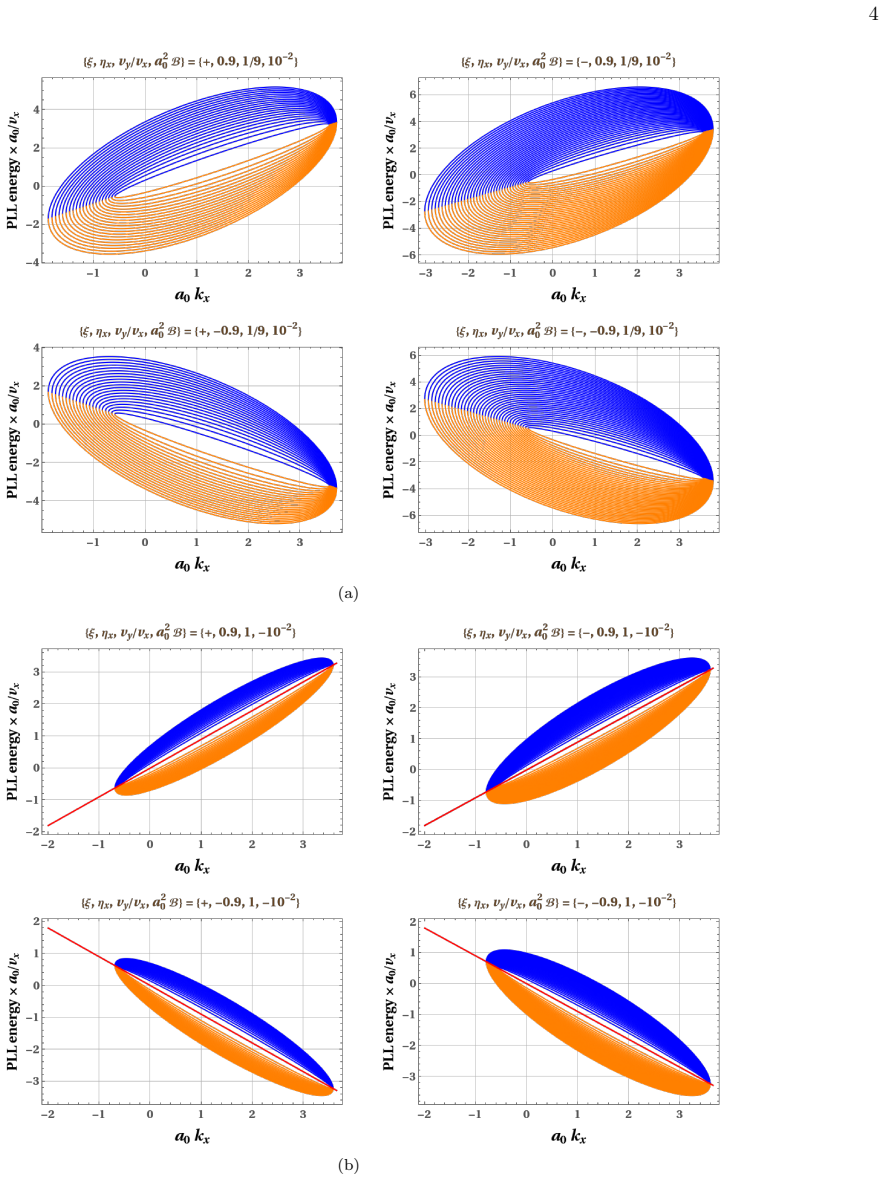
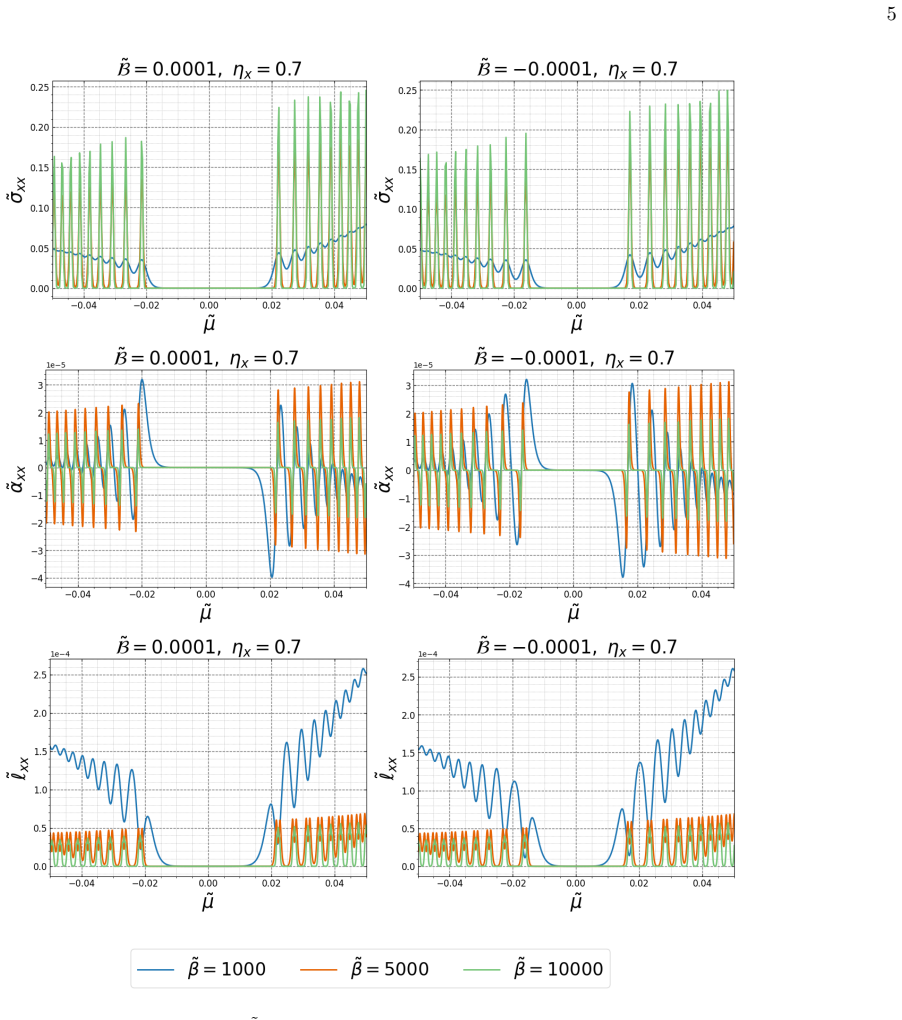
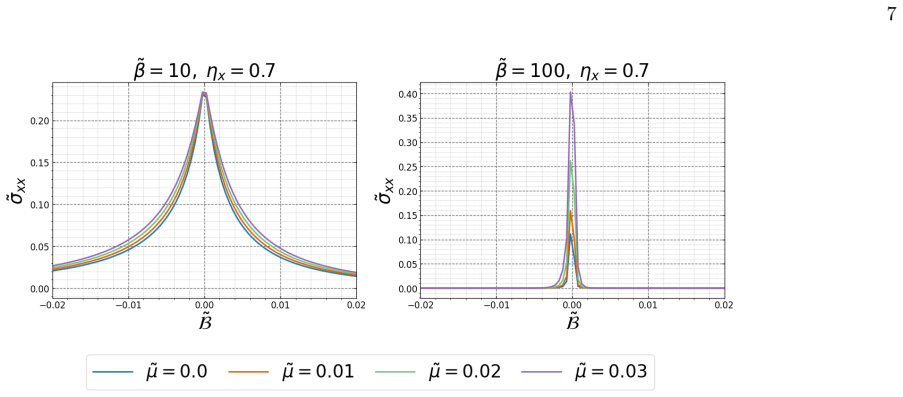
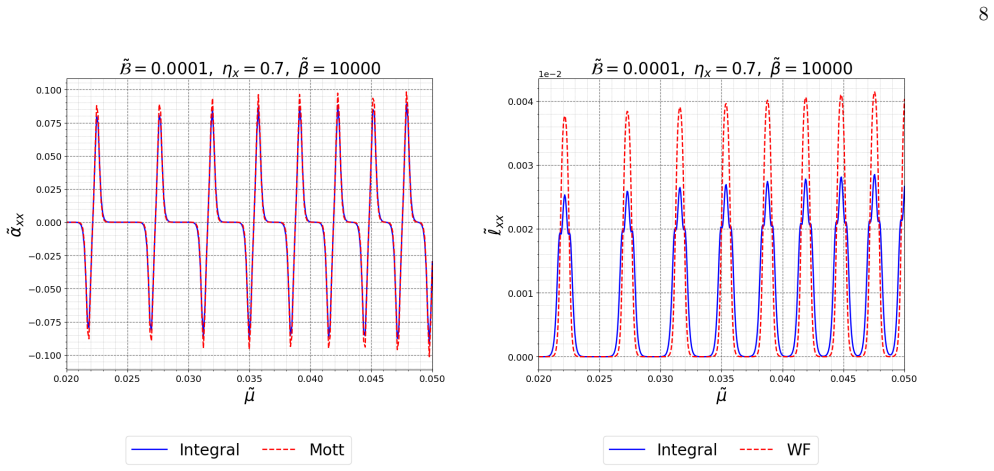
In contrast to conventional Landau quantization, the pseudo-Landau levels in tilted Dirac cones under strain-induced pseudogauge fields exhibit explicit momentum dependence. This dispersion produces finite longitudinal group velocities. Consequently, the linear electrical, thermoelectric, and thermal responses computed within the semiclassical Boltzmann framework acquire nonzero longitudinal components. The paper also examines the validity of the Mott relation and the Wiedemann-Franz law in this setting.
What carries the argument
Dispersive pseudo-Landau levels generated by the interplay of cone tilt and strain-induced pseudogauge fields, treated within the semiclassical Boltzmann transport equation.
If this is right
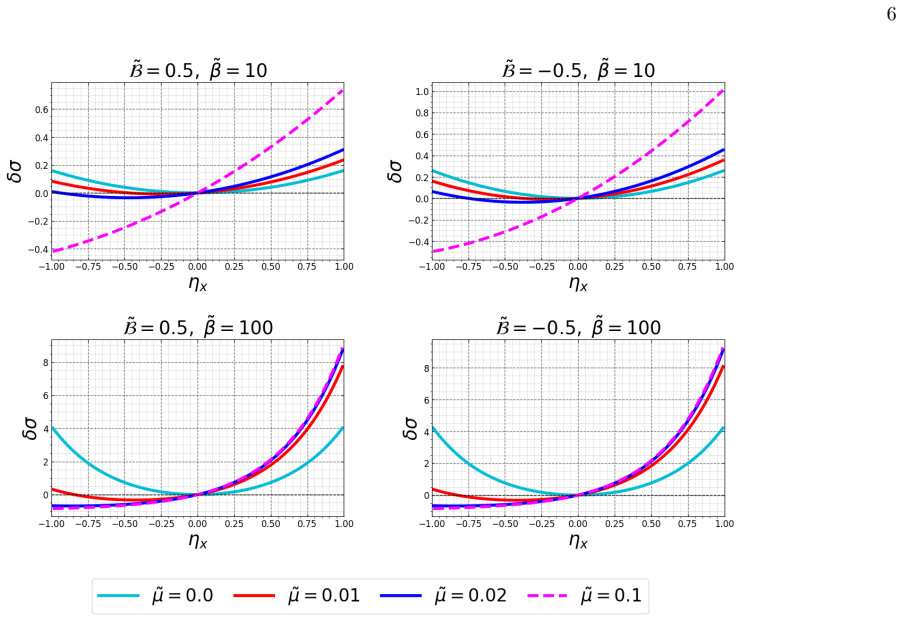
- The electrical conductivity acquires a nonzero longitudinal component due to finite group velocities along the pseudofield direction.
- The thermoelectric response develops a nonzero longitudinal component.
- The thermal conductivity includes a nonzero longitudinal contribution.
- The Mott relation and the Wiedemann-Franz law are examined and remain applicable in the presence of both tilt and pseudofields.
Where Pith is reading between the lines
- Strain can induce anisotropic longitudinal transport without the need for real external magnetic fields.
- Controlled variation of strain strength or tilt angle would tune the size of the longitudinal responses in experiment.
- The same mechanism may appear in other anisotropic Dirac systems that combine structural deformation with band tilting.
Load-bearing premise
The semiclassical Boltzmann transport framework remains valid for the dispersive pseudo-Landau levels without significant quantum corrections or inter-level scattering.
What would settle it
An experimental measurement or direct calculation showing that the longitudinal components of the linear conductivity tensors vanish would indicate that the pseudo-Landau levels lack the predicted momentum dependence or that the group velocities do not contribute to transport as described.
Figures
read the original abstract
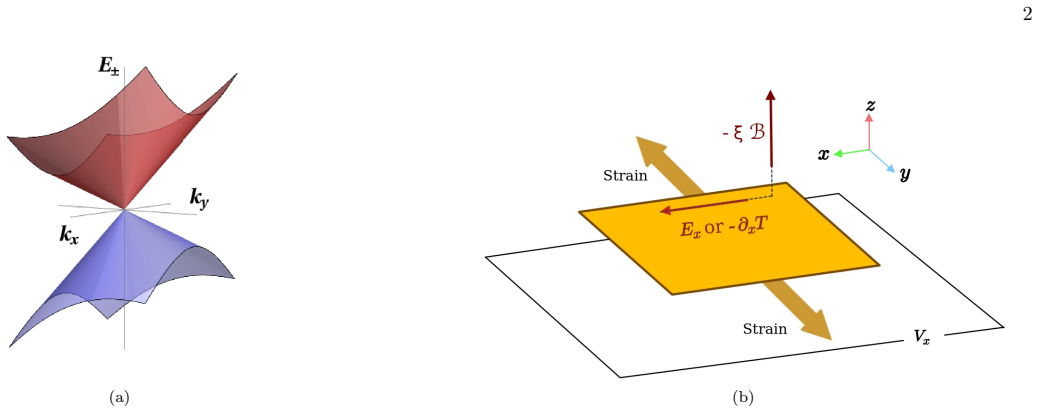
We investigate the transport signatures of pseudo-Landau levels (PLLs) in two-dimensional anisotropic Dirac systems with tilted cones, whose effective bandstructure results from strain-induced pseudogauge fields. In contrast to conventional Landau quantisation, the PLLs exhibit explicit momentum-dependence by being dispersive, leading to finite longitudinal group-velocities. We analyse the transport properties within the semiclassical Boltzmann framework by computing the electrical, thermoelectric, and thermal response in the linear regime, which acquire nonzero longitudinal components. We also check the validity of the Mott relation and Wiedemann-Franz law in our system. Our results provide a unified framework for understanding the interplay between tilted spectrum and structural deformation in affecting quantum transport, and suggest unambiguous experimental signatures in strain-engineered systems.
Editorial analysis
A structured set of objections, weighed in public.
Referee Report
Summary. The manuscript investigates linear transport in two-dimensional anisotropic Dirac systems with tilted cones under strain-induced pseudogauge fields. It claims that the resulting pseudo-Landau levels (PLLs) are dispersive with explicit momentum dependence, yielding finite longitudinal group velocities. Within the semiclassical Boltzmann framework, the authors compute the electrical, thermoelectric, and thermal conductivities in the linear regime, reporting nonzero longitudinal components, and verify the Mott relation and Wiedemann-Franz law.
Significance. If the semiclassical treatment is justified, the results provide a unified description of how tilt and pseudogauge fields together produce longitudinal responses absent in untilted cases, with potential implications for experiments in strain-engineered Dirac materials such as graphene. The explicit momentum dependence of the PLLs is a notable distinction from conventional Landau quantization.
major comments (2)
- [Abstract and Boltzmann transport section] Abstract and the section on the Boltzmann transport framework: The nonzero longitudinal responses are derived by applying the semiclassical Boltzmann equation to the dispersive PLLs, but the manuscript provides no quantitative estimates (e.g., comparison of pseudomagnetic level spacing to temperature, scattering rate, or broadening) to justify neglecting quantum corrections such as inter-level transitions or Berry-phase effects.
- [Response functions section] Section on response functions and relation checks: The reported checks of the Mott relation and Wiedemann-Franz law are performed entirely within the assumed Boltzmann framework; without an independent assessment (e.g., against Kubo-formula results or disorder-averaged quantum calculations), they do not address whether the semiclassical approximation itself holds for the tilted, strained spectrum.
minor comments (1)
- Figure captions would benefit from explicit listing of the numerical values chosen for the tilt parameter and strain strength to allow direct reproduction of the plotted conductivities.
Simulated Author's Rebuttal
We thank the referee for the careful reading of our manuscript and the constructive comments. We address each major comment below and outline the revisions we will make.
read point-by-point responses
-
Referee: [Abstract and Boltzmann transport section] Abstract and the section on the Boltzmann transport framework: The nonzero longitudinal responses are derived by applying the semiclassical Boltzmann equation to the dispersive PLLs, but the manuscript provides no quantitative estimates (e.g., comparison of pseudomagnetic level spacing to temperature, scattering rate, or broadening) to justify neglecting quantum corrections such as inter-level transitions or Berry-phase effects.
Authors: We agree that explicit quantitative estimates would strengthen the justification for applying the semiclassical Boltzmann framework. In the revised manuscript we will add a dedicated paragraph in the Boltzmann transport section providing order-of-magnitude estimates for realistic strain-induced pseudomagnetic fields in graphene-like systems. These estimates will compare the characteristic PLL spacing to k_B T and to typical scattering rates, thereby delineating the regime in which inter-level transitions and other quantum corrections remain negligible. We will also clarify that the dispersive nature of the PLLs is already incorporated through the momentum-dependent velocities and density of states in the semiclassical treatment, and that Berry-phase contributions enter via the modified band structure. revision: yes
-
Referee: [Response functions section] Section on response functions and relation checks: The reported checks of the Mott relation and Wiedemann-Franz law are performed entirely within the assumed Boltzmann framework; without an independent assessment (e.g., against Kubo-formula results or disorder-averaged quantum calculations), they do not address whether the semiclassical approximation itself holds for the tilted, strained spectrum.
Authors: We acknowledge that the verifications of the Mott relation and Wiedemann-Franz law are performed inside the Boltzmann framework. These relations hold by construction within the relaxation-time approximation for elastic scattering in the linear-response regime considered here. To address the broader question of whether the semiclassical approximation is justified for the tilted, strained spectrum, the quantitative estimates added in response to the first comment will also serve to establish the applicable parameter window. A complete Kubo-formula or disorder-averaged quantum calculation lies beyond the scope of the present work, which focuses on the semiclassical signatures; however, we will add a concise discussion of the expected validity range and limitations of the approach in the revised manuscript. revision: partial
Circularity Check
No circularity: derivation proceeds from tilted Dirac Hamiltonian with pseudogauge fields to independent semiclassical responses
full rationale
The paper begins with the effective low-energy Hamiltonian for anisotropic tilted Dirac cones under strain-induced pseudogauge fields, derives the resulting dispersive pseudo-Landau levels (with explicit momentum dependence and finite group velocities), and then applies the semiclassical Boltzmann transport equation to obtain the linear electrical, thermoelectric, and thermal conductivities. The nonzero longitudinal components follow directly from the dispersive nature of the PLLs without any fitted parameters being relabeled as predictions or any load-bearing step reducing to a self-citation. The Mott and Wiedemann-Franz checks are performed as internal consistency tests inside the same framework rather than as external validation that would close a loop. No self-definitional, fitted-input, or ansatz-smuggling patterns appear in the derivation chain, making the result self-contained against the stated inputs.
Axiom & Free-Parameter Ledger
free parameters (2)
- tilt parameter
- strain strength
axioms (2)
- domain assumption semiclassical Boltzmann transport equation remains valid for dispersive pseudo-Landau levels
- standard math linear response regime applies
Reference graph
Works this paper leans on
-
[1]
S. Katayama, A. Kobayashi, and Y. Suzumura, Pressure-induced zero-gap semiconducting state in organic conductorα-(BEDT- TTF)2I3 salt, Journal of the Physical Society of Japan75, 054705 (2006)
work page 2006
-
[2]
R. Kondo, S. Kagoshima, N. Tajima, and R. Kato, Crystal and electronic structures of the quasi-two-dimensional organic conductorα-(BEDT-TTF) 2I3 and its selenium analogueα-(BEDT-TSeF) 2I3 under hydrostatic pressure at room temperature, Journal of the Physical Society of Japan78, 114714 (2009). 11
work page 2009
-
[3]
M. O. Goerbig, J.-N. Fuchs, G. Montambaux, and F. Pi´ echon, Tilted anisotropic Dirac cones in quinoid-type graphene and α-(BEDT-TTF)2I3, Phys. Rev. B78, 045415 (2008)
work page 2008
- [4]
-
[5]
E. Lantagne-Hurtubise, X.-X. Zhang, and M. Franz, Dispersive Landau levels and valley currents in strained graphene nanorib- bons, Phys. Rev. B101, 085423 (2020)
work page 2020
-
[6]
I. Mandal, Linear response of tilted anisotropic two-dimensional Dirac cones, The European Physical Journal B98, 123 (2025)
work page 2025
-
[7]
V. M. Pereira, A. H. Castro Neto, and N. M. R. Peres, Tight-binding approach to uniaxial strain in graphene, Phys. Rev. B 80, 045401 (2009)
work page 2009
-
[8]
B. Amorim, A. Cortijo, F. de Juan, A. Grushin, F. Guinea, A. Guti´ errez-Rubio, H. Ochoa, V. Parente, R. Rold´ an, P. San-Jose, J. Schiefele, M. Sturla, and M. Vozmediano, Novel effects of strains in graphene and other two dimensional materials, Physics Reports617, 1 (2016), novel effects of strains in graphene and other two dimensional materials
work page 2016
-
[9]
G. G. Naumis, S. Barraza-Lopez, M. Oliva-Leyva, and H. Terrones, Electronic and optical properties of strained graphene and other strained 2D materials: A review, Reports on Progress in Physics80, 096501 (2017)
work page 2017
- [10]
-
[11]
J. L. Ma˜ nes, Symmetry-based approach to electron-phonon interactions in graphene, Phys. Rev. B76, 045430 (2007)
work page 2007
- [12]
- [13]
- [14]
-
[15]
D. I. Pikulin, A. Chen, and M. Franz, Chiral anomaly from strain-induced gauge fields in Dirac and Weyl semimetals, Phys. Rev. X6, 041021 (2016)
work page 2016
-
[16]
R. Ghosh and I. Mandal, Electric and thermoelectric response for Weyl and multi-Weyl semimetals in planar Hall configurations including the effects of strain, Physica E: Low-dimensional Systems and Nanostructures159, 115914 (2024)
work page 2024
- [17]
- [18]
-
[19]
F. Haidar, M. Jaffar A., and I. Mandal, Interplay of strain-induced axial gauge fields and intrinsic band-topology in the magnetoelectric conductivity of gapped nodal rings, arXiv e-prints (2026), arXiv:2604.12275 [cond-mat.mes-hall]
work page internal anchor Pith review Pith/arXiv arXiv 2026
-
[20]
Arovas,Lecture Notes on Condensed Matter Physics(CreateSpace Independent Publishing Platform, 2014)
D. Arovas,Lecture Notes on Condensed Matter Physics(CreateSpace Independent Publishing Platform, 2014)
work page 2014
-
[21]
I. Mandal and K. Saha, Thermoelectric response in nodal-point semimetals, Ann. Phys. (Berlin)536, 2400016 (2024)
work page 2024
-
[22]
I. Mandal, Effects of time-periodic drive in the linear response for planar-Hall set-ups with Weyl and multi-Weyl semimetals, Canadian Journal of Physics103, 1147 (2025)
work page 2025
discussion (0)
Sign in with ORCID, Apple, or X to comment. Anyone can read and Pith papers without signing in.