Interplay of strain-induced axial gauge fields and intrinsic band-topology in the magnetoelectric conductivity of gapped nodal rings
Pith reviewed 2026-05-10 16:01 UTC · model grok-4.3
The pith
Strain leaves one component of planar-Hall conductivity untouched in gapped nodal rings.
A machine-rendered reading of the paper's core claim, the machinery that carries it, and where it could break.
Core claim
In an ideal gapped nodal ring the strain-induced axial pseudomagnetic field B5 has vortex lines co-aligned with Berry curvature and orbital magnetic moment; their dot product is therefore angle-independent on the Fermi surface, generating a nonzero integral linear in B5 that is absent for monopole Berry curvature at isotropic points, and as a direct result one part of the planar-Hall conductivity remains completely immune to strain.
What carries the argument
Co-alignment of the vortex-like strain-induced axial pseudomagnetic field lines with Berry curvature and orbital magnetic moment on the toroidal Fermi surface, which makes the relevant dot products strictly angle-independent.
If this is right
- A term linear in the axial-field strength appears in the conductivity tensor, which cannot occur for ordinary isotropic nodal points with Berry monopoles.
- The three planar-Hall setups acquire qualitatively different strain responses because of the toroidal geometry and field alignment.
- The strain-immune conductivity component supplies a built-in reference that isolates topological contributions without separate strain calibration.
- The derived analytic expressions give concrete, measurable predictions for transport experiments on gapped nodal ring materials.
Where Pith is reading between the lines
- If the immunity survives modest deviations from ideal ring geometry, the same strain-insensitive reference could be engineered in other toroidal or ring-like topological bands.
- Real-device calibration of topological transport signals could use this component to subtract strain artifacts in situ.
- Scattering or disorder that preserves the average alignment might still leave the linear term intact, offering a route to test robustness beyond the clean-limit calculation.
Load-bearing premise
The gapped nodal ring is ideal and the axial-field lines remain perfectly co-aligned with Berry curvature and orbital moment so that their dot product is angle-independent everywhere on the Fermi surface.
What would settle it
Apply tunable strain to a gapped nodal ring sample, measure the planar-Hall conductivity in the first configuration, and check whether one specific component stays exactly constant while other components vary with strain amplitude.
Figures
read the original abstract
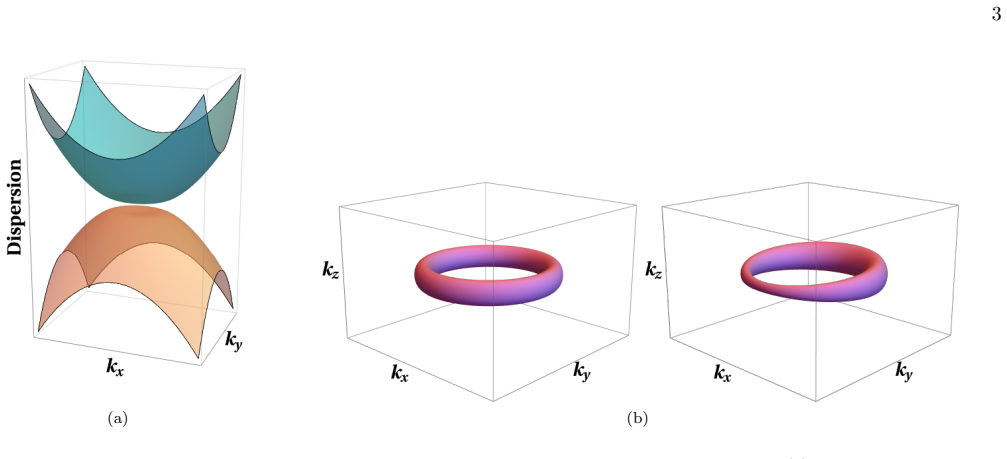
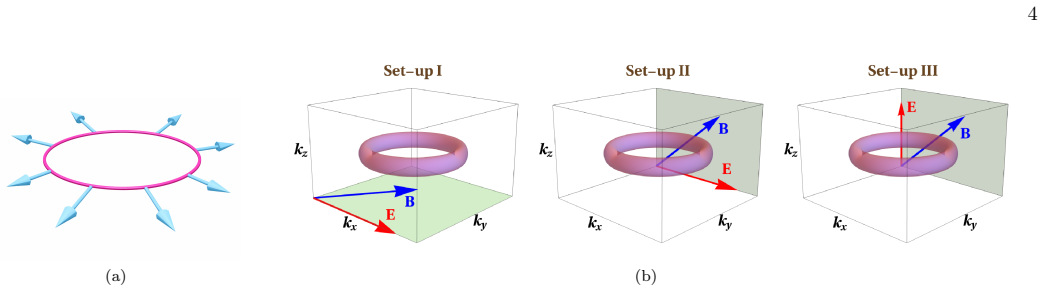
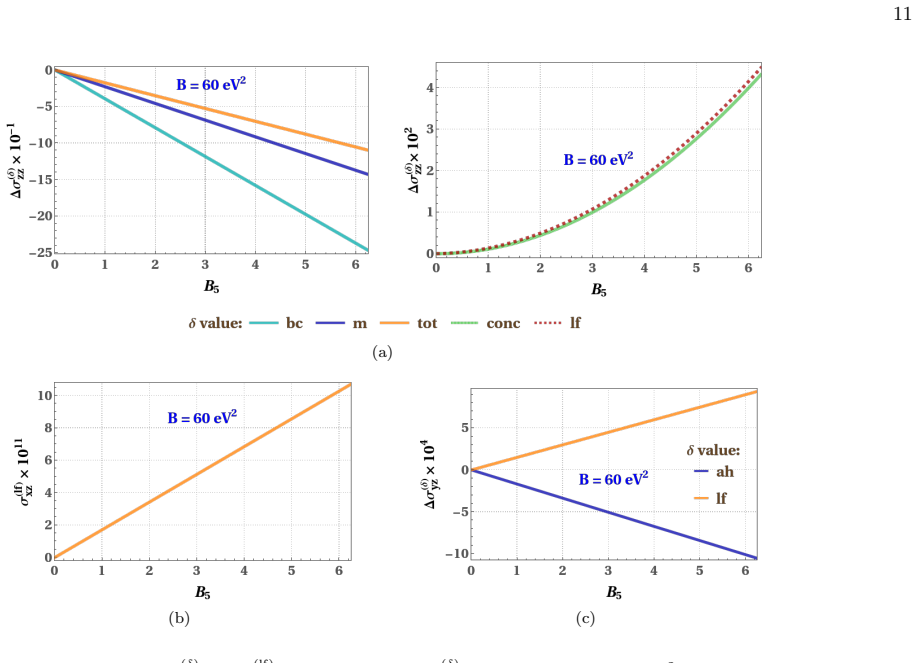
We compute the magnetoelectric conductivity of a semimetal hosting an ideal gapped nodal ring (GNR) in three distinct planar-Hall configurations, in the simultaneous presence of an external electric field $\boldsymbol{E}$, a magnetic field $\boldsymbol{B}$, and a strain-induced axial pseudomagnetic field $\boldsymbol{B}_5$. The latter arises from a nonuniform lattice deformation and couples to antipodal points on the toroidal Fermi surface with opposite signs, reflecting its chiral nature. Extending our earlier analysis to include $\boldsymbol{B}_5$, we demonstrate how its vortex-like field lines -- co-aligned with the Berry curvature (BC) and orbital magnetic moment (OMM) -- imprint qualitatively distinct signatures on the conductivity tensor. In particular, this alignment causes the dot product of $\boldsymbol{B}_5$ with the BC or OMM-induced quantities to be angle-independent on the Fermi surface, generating a nonvanishing integral linear-in-$B_5$, which is not possible for isotropic nodal points harbouring BC-monopoles. We show that a part of the planar-Hall conductivity in the first set-up remains completely immune to strain, providing a strain-insensitive internal reference for topological transport. Our explicit analytical expressions offer concrete and experimentally testable predictions for identifying strain-induced signatures in transport measurements on GNR materials.
Editorial analysis
A structured set of objections, weighed in public.
Referee Report
Summary. The paper computes the magnetoelectric conductivity tensor for an ideal gapped nodal ring semimetal in three planar-Hall setups under simultaneous E, B, and strain-induced axial pseudomagnetic field B5. Extending prior analysis, it shows that B5 vortex lines co-aligned with Berry curvature and orbital magnetic moment yield angle-independent dot products on the Fermi surface, producing a linear-in-B5 term absent in isotropic nodal points. A key result is that part of the planar-Hall conductivity in the first configuration is completely immune to strain, providing a strain-insensitive reference for topological transport, with explicit analytical expressions derived for experimental tests.
Significance. If the analytical results hold, the identification of a strain-immune conductivity component supplies a concrete internal benchmark for topological transport measurements in GNR materials. The work provides falsifiable predictions via closed-form expressions and demonstrates how axial gauge fields imprint distinct signatures due to the toroidal Fermi surface geometry, extending the authors' earlier results with independent grounding from the B5 inclusion.
minor comments (2)
- The three planar-Hall configurations are referenced repeatedly (e.g., 'first set-up') but lack an explicit diagram or table summarizing the relative orientations of E, B, and B5; adding one would improve readability of the distinct signatures.
- Notation for the conductivity tensor components (e.g., how the strain-immune term is isolated in the first configuration) could be cross-referenced more clearly to the Fermi-surface integrals in the main text.
Simulated Author's Rebuttal
We thank the referee for their careful reading of the manuscript and for the positive assessment, including recognition of the strain-immune conductivity component as a potential internal benchmark and the value of the closed-form expressions. The referee summary correctly reflects the main results on the interplay between B5, Berry curvature, and orbital magnetic moment in the gapped nodal ring geometry. No specific major comments were provided in the report.
Circularity Check
No significant circularity identified
full rationale
The paper's central results derive from explicit analytical evaluation of the magnetoelectric conductivity tensor for the ideal GNR model under simultaneous E, B, and strain-induced B5. The stated co-alignment of B5 vortex lines with BC and OMM is presented as an intrinsic geometric property of the model (leading to angle-independent dot products on the Fermi surface), and the strain-immune planar-Hall term follows directly from the derived expressions lacking B5 dependence in that component. Although the abstract references extending 'our earlier analysis,' this self-citation supports the model setup rather than load-bearing the new claims on distinct B5 signatures or the internal reference; the conductivity integrals and immunity are computed independently here without reduction to prior results by construction. No self-definitional loops, fitted inputs renamed as predictions, or ansatz smuggling appear in the provided derivation chain.
Axiom & Free-Parameter Ledger
axioms (2)
- domain assumption The dot product of B5 with Berry curvature or orbital magnetic moment is angle-independent on the Fermi surface of the ideal gapped nodal ring.
- domain assumption The strain-induced axial field B5 couples with opposite signs to antipodal points on the toroidal Fermi surface.
Forward citations
Cited by 1 Pith paper
-
Linear response from tilted Dirac cones under strain-induced pseudomagnetic fields
In tilted Dirac cone systems, strain-induced pseudomagnetic fields create dispersive pseudo-Landau levels that yield finite longitudinal components in linear response functions while preserving the Mott relation and W...
Reference graph
Works this paper leans on
-
[1]
Longitudinal conductivity: ¯σxx 12
-
[2]
Planar-Hall conductivity: ¯σyx 13
-
[3]
LF-induced in-plane contributions:σ (lf) xx andσ (lf) yx 13
- [4]
-
[5]
Longitudinal conductivity: ¯σxx 13
-
[6]
LF-induced contributions:σ (lf) xx andσ (lf) zx 14
- [7]
-
[8]
Longitudinal conductivity: ¯σzz 14
-
[9]
LF-induced in-plane contributions:σ (lf) zz andσ (lf) xz 14
-
[10]
Out-of-plane conductivity:σ yz 15 V. Summary, concluding remarks, and future perspectives 15 A. Full expressions for the OMM-induced corrections to band-velocities 16 B. Details for the current density originating from the action of the Lorentz-force operator 17 1.n= 1: Terms originating from linear action of the Lorentz-force operator 17 2.n= 2: Terms or...
work page internal anchor Pith review Pith/arXiv arXiv 2026
-
[11]
Set-up III 21 References 22 I. INTRODUCTION The discovery of three-dimensional (3d) semimetals with symmetry-protected band-crossings has opened a direct path- way from the abstract mathematics of topology to the concrete physics of material band structures. These remarkable systems exemplify materials whose Brillouin zones (BZs), viewed as closed manifol...
-
[12]
The generic expression for the in-plane components of the magnetoelectric conductivity tensor contributed by the band with indexs, is given by ¯σs ij =−e 2 τ Z d3k (2π) 3 Ds (vs)i +e(v s ·Ω s)B tot i h (vs)j +e(v s ·Ω s)B tot j i ∂f0(Es) ∂Es .(15) For the ease of calculations, we decompose is as ¯σs ij =σ (s,1) ij +σ (s,2) ij +σ (s,3) ij +σ (s,4) ij , whe...
-
[13]
The out-of-plane components are captured by the so-called anomalous-Hall part (denoted byσ AH,s) and the Lorentz- force-operator contributions [17, 19, 63]. Expanding up toO |Btot|3 , we find that (σ(ah) s )ij =−e 2 ϵijl Z d3k (2π) 3 Ωl s f0(εs) +ε (m) f ′ 0(εs) + 1 2 ε(m) 2 f ′′ 0 (εs) + 1 6 ε(m) 3 f ′′′ 0 (εs) +O |Btot|4 .(19) Clearly, the first term is...
-
[14]
+B 5-term 0 Υ3 Bx 1 + Υ4 (B2 x + 4B 2 5) +B 5-term (b) Set-up I:B 5- andB i-dependence in LF-induced terms, organised by the values ofnand physical origins. σlf,(h) σlf,(bc) σlf,(m) σlf, (conc) n= 1,σ zx By By B5, B y B2 5 , B y (B2 x +B 2 y) By B5, By B2 5 , B y (B2 x +B 2 y) By B2 5 , B y (B2 x +B 2 y) n= 2,σ xx B2 5 , B 2 x, B 2 y B5 B2 x, B 5 B2 y, B ...
-
[15]
Therefore, it is the OMM that dictates the sign of the total non-Drude longitudinal response
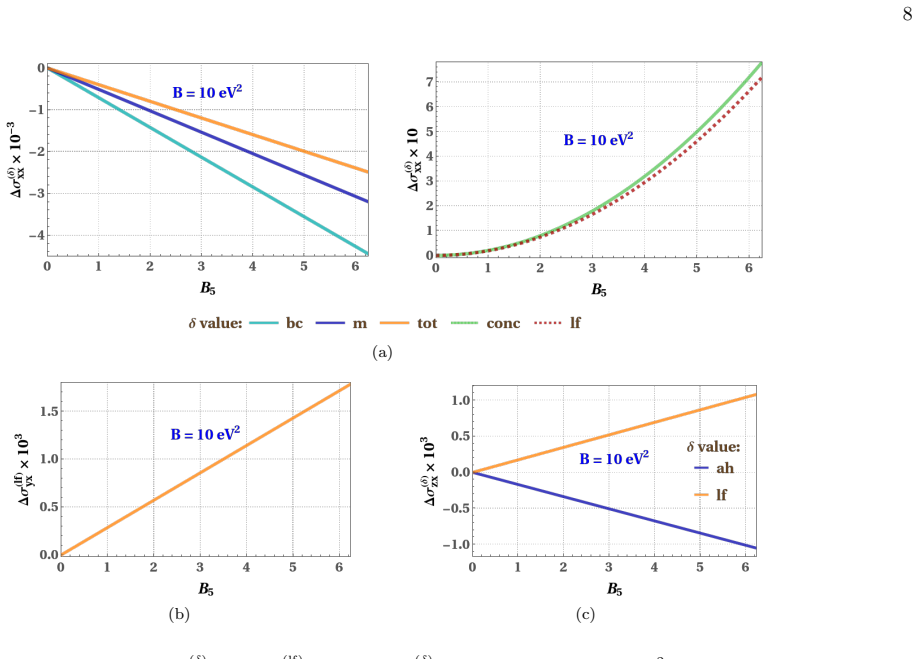
Longitudinal conductivity:¯σ xx In the absence of strain (i.e.,B 5 =0),σ (bc) xx is positive and∝(B 2 x + 3B 2 y).σ (m) xx shows the same∝(B 2 x + 3B 2 y)- dependence, but with a larger coefficient of opposite sign.σ (conc) xx is also negative. Therefore, it is the OMM that dictates the sign of the total non-Drude longitudinal response. In the presence of...
-
[16]
Overall, the BC-only part is opposite in sign to the OMM-only and concurrent contributions
for the BC-only part while the OMM-only parts gets two competing contributions, i.e., a negative contribution from − B2 x + 3B 2 y + 4B 2 5 k0 6µ 2 −5 ∆2 and a positive contribution weighted by 2(B2 x+3B 2 y)µ4 v0 ζ . Overall, the BC-only part is opposite in sign to the OMM-only and concurrent contributions
-
[17]
Planar-Hall conductivity:¯σ yx ¯σyx iscompletely blindto the pseudomagnetic field. EveryB 5-dependent integrand for this component depends onϕ in a way which yields zero uponϕ-integration. As a result, ¯σ yx retains precisely the form ¯σyx ∝B x By found in Ref. [39]. From an experimental point of view, ¯σyx thus provides a clean reference that is decouple...
-
[18]
Strain induces additional terms (cf
LF-induced in-plane contributions:σ (lf ) xx andσ (lf ) yx ForB 5 =0, the only in-plane LF-induced parts arise from then= 2 term inY s [39]. Strain induces additional terms (cf. Appendix C 1): (I) FromN 2,2, a term∝B 2 5 (∆2 −µ 2)<0 appears inσ lf,(h) xx . (II) FromN 2,3, terms proportional to B5 emerge in bothσ lf,(bc) xx andσ lf,(m) xx . Inσ lf,(bc) xx ...
-
[19]
Eqs (26) and (28)] are preserved with respect to theB 5 =0results [39]: then= 1,3 terms of Eq
Out-of-plane conductivity:σ zx The overall structures of the anomalous-Hall and LF-induced response [cf. Eqs (26) and (28)] are preserved with respect to theB 5 =0results [39]: then= 1,3 terms of Eq. (20) produce out-of-plane response, whilen= 2 produces in-plane (longitudinal and transverse) response (cf. Appendix C 1). On turning onB 5, we observe the f...
-
[20]
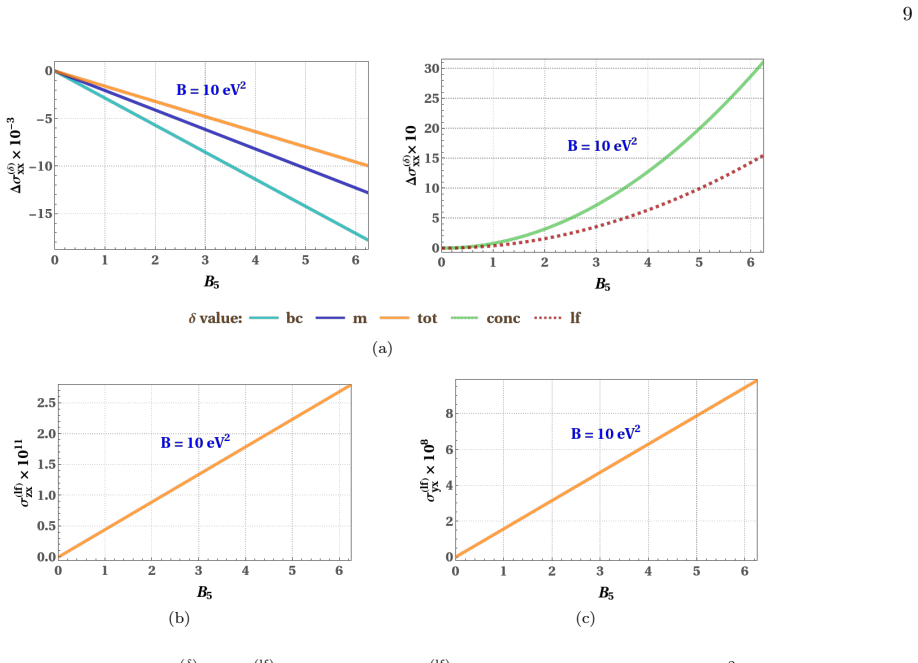
Longitudinal conductivity:¯σ xx ForB 5 =0, the BC-only part is positive, the OMM-only part is negative and dominant. The concurrent part is also negative, resulting in a net negative value for the non-Drude part of ¯σxx [39]. Strain introduces the following extra terms [cf. Eq. (29)]: 1.Linear-in-B 5 terms:Bothσ (bc) xx andσ (m) xx acquire terms linear-in...
-
[21]
Their coefficients in the BC-only term are opposite to those of OMM-only and concurrent parts
in the terms not having aµ 4-dependence. Their coefficients in the BC-only term are opposite to those of OMM-only and concurrent parts. 14
-
[22]
Strain adds nonzero LF-induced contributions as follows (cf
LF-induced contributions:σ (lf ) xx andσ (lf ) zx ForB 5 =0, the sole in-plane contribution is obtained forn= 2, such thatσ lf,(bc) xx =σ lf,(m) xx =σ lf,(conc) xx = 0 — only σlf,(h) xx is nonzero [39]. Strain adds nonzero LF-induced contributions as follows (cf. Appendix C 2): (I) FromN 2,2, a term ∝B 2 5 (∆2 −µ 2)<0 is added toσ lf,(h) xx in the same ma...
-
[23]
Here, theN 1,1 part for the unstrained case is zero [39], unlike set-ups I and III
Out-of-plane conductivity:σ yx Set-up II is the only configuration where the out-of-plane response is entirely of LF origin (i.e., has no contribution from anomalous-Hall effect). Here, theN 1,1 part for the unstrained case is zero [39], unlike set-ups I and III. This makes it parametrically weaker than that in set-ups I and III. Overall, then= 1,3 terms ...
-
[24]
Longitudinal conductivity:¯σ zz ForB 5 =0, the non-Drude part of ¯σzz has a positive BC-only part∝B 2 x, whileσ (m) zz comes with an opposite sign with a larger magnitude. Sinceσ (conc) zz is also negative, the net non-Drude response is negative and dominated by the by OMM, analogous to set-ups I and II. ¯σ xz vanishes identically, irrespective of the pre...
-
[25]
is observed in all three non-Drude parts. The B2 5 coefficient of 2 (rather than 4, which appear in the first 2 set-ups) is a direct consequence ofE∥ˆz— only one of the two in-plane components ofB 5 contributes to the integral, compared to both in-plane components contributing in thexxresponse of set-ups I and II. The BC-only contribution fromB 2 5 is pos...
-
[26]
Unlike set-up II, there is noB 2 z contribution fromN 2,2
LF-induced in-plane contributions:σ (lf) zz andσ (lf) xz ForB 5 =0, the sole in-plane LF-induced contributions appear fromN 2,2 [39], being∝B 2 x ∆2 −µ 2 <0, with σlf,(bc) zz =σ lf,(m) zz =σ lf,(conc) zz = 0. Unlike set-up II, there is noB 2 z contribution fromN 2,2. Strain introduces additional terms as follows (cf. Appendix C 3):
-
[27]
ForN 2,2,B 2 x is replaced by (B 2 x + 2B 2 5), accompanying (∆2 −µ 2)
-
[28]
These are proportional toB 5 B2 x,B 5 B2 z, andB 3
ForN 2,3, linear-in-B5 and cubic-in-B5 terms emerge inσ lf,(bc) zz andσ lf,(m) zz . These are proportional toB 5 B2 x,B 5 B2 z, andB 3
-
[29]
Additionally,N 2,3 generates contributions inσ lf,(bc) xz andσ lf,(m) xz , which are∝B 5 Bx Bz. 15
-
[30]
Eqs (34) and (36)] are preserved with respect to theB 5 =0results [39]: then= 1,3 terms of Eq
Out-of-plane conductivity:σ yz The anomalous-Hall and LF-induced response [cf. Eqs (34) and (36)] are preserved with respect to theB 5 =0results [39]: then= 1,3 terms of Eq. (20) produce out-of-plane response, whilen= 2 produces in-plane (longitudinal and transverse) response (cf. Appendix C 3). On turning onB 5, we observe the following: 1.Anomalous-Hall...
-
[31]
Linear-in-|B|: N 1,1 =v (0,s) f ′ 0(εs) v(0,s) ×B · ∇k v(0,s) ·E .(B6)
-
[32]
Quadratic-in-|B|: N 1,2 =v (0,s) v(0,s) ·E f ′ 0(εs)(v(0,s) ×B)· ∇ k [−e(Ω s ·B)] +v (0,s) f ′ 0 (εs) v(0,s) ×B · ∇k h v(m) +V s ·E i + hn −2e(Ω s ·B)v (0,s) + v(m) +V s o f ′ 0(εs)−(m s ·B)v (0,s) f ′′ 0 (εs) i v(0,s) ×B · ∇k v(0,s) ·E +v (0,s) f ′ 0(εs) v(m) ×B · ∇k v(0,s) ·E .(B7)
-
[33]
Cubic-in-|B|: N 1,3 = hn −e(Ω s ·B)v (0,s) v(0,s) ·E +v (0,s) v(m) +V s ·E+ v(0,s) ·E v(m) +V s o f ′ 0(εs) −(m s ·B)v (0,s) v(0,s) ·E f ′′ 0 (εs) i × h v(0,s) ×B · ∇k {−e(Ω s ·B)} i +v (0,s) v(0,s) ·E f ′ 0(εs) h v(0,s) ×B · ∇k h e2 (Ωs ·B) 2 i + v(m) ×B · ∇k {−e(Ω s ·B)} i + v(0,s) ×B · ∇k v(0,s) ·E hn 3e 2 (Ωs ·B) 2 v(0,s) −2e(Ω s ·B) v(m) +V s +U (m) ...
-
[34]
Quadratic-in-|B|: N 2,2 =v (0,s) f ′ 0(εs) v(0,s) ×B · ∇k h v(0,s) ×B · ∇k v(0,s) ·E i .(B11)
-
[35]
Cubic-in-|B|: N 2,3 =v (0,s) f ′ 0(εs) v(0,s) ×B · ∇k h −e(Ω s ·B) v(0,s) ×B · ∇k v(0,s) ·E + v(0,s) ×B · ∇k n v(m) +V s ·E o + v(m) ×B · ∇k v(0,s) ·E i +v (0,s) f ′ 0(εs) v(m) ×B · ∇k h v(0,s) ×B · ∇k v(0,s) ·E i +v (0,s) f ′ 0(εs) v(0,s) ×B · ∇k h v(0,s) ·E v(0,s) ×B · ∇k {−e(Ω s ·B)} i + hn −2ev (0,s) (Ωs ·B) +v (m) +V s o f ′ 0(εs)−(m s ·B)v (0,s) f ′...
-
[36]
Set-up I The individual expressions shown here feed into the final expressions summarised in Sec. III A. 1.n= 1 — This part comprises 3 sub-parts, which give us nonzero values for the out-of-plane conductivity.N 1,1 contributes to σlf,(h) zx = τ 2 e3 v0 vz k0 By 8π µ 2 ∆2 −µ 2 .(C1) N 1,2 contributes to σlf,(bc) zx =− τ 2 e4 k0 v2 0 v2 z ∆ ∆2 −µ 2 B5 By 4...
-
[37]
Set-up II The individual expressions shown here feed into the final expressions summarised in Sec. III B. 1.n= 1 — Only the out-of-plane conductivity is nonzero, sourced by 2 sub-parts.N 1,2 contributes to σlf,(h) yx =σ lf,(bc) yx =σ lf, (conc) yx = 0, σ lf,(m) yx =− e4 k0 v4 0 ∆B 5 Bz (ζ−k 0 v0)τ 2 8π µ 3 ζ .(C8) The last one is zero for zero strain.N 1,...
-
[38]
Set-up III The individual expressions shown here feed into the final expressions summarised in Sec. III C. 1.n= 1 — The surviving ones are the out-of-plane components, which arise from three parts.N 1,1 contributes to σlf,(h) yz = τ 2 e3 vz v0 k0 Bx 8π µ 2 ∆2 −µ 2 .(C13) N 1,2 contributes to σlf,(bc) yz =− τ 2 e4 v2 z v2 0 k0 ∆B 5 Bx ∆2 −µ 2 4π µ 5 , σ lf...
-
[39]
A. A. Burkov and L. Balents, Weyl semimetal in a topological insulator multilayer, Phys. Rev. Lett.107, 127205 (2011)
work page 2011
- [40]
-
[41]
B. Bradlyn, J. Cano, Z. Wang, M. G. Vergniory, C. Felser, R. J. Cava, and B. A. Bernevig, Beyond Dirac and Weyl fermions: Unconventional quasiparticles in conventional crystals, Science353(2016)
work page 2016
-
[42]
A. A. Burkov, M. D. Hook, and L. Balents, Topological nodal semimetals, Phys. Rev. B84, 235126 (2011)
work page 2011
-
[43]
W. B. Rui, Y. X. Zhao, and A. P. Schnyder, Topological transport in Dirac nodal-line semimetals, Phys. Rev. B97, 161113 (2018)
work page 2018
-
[44]
Q. Wu, A. A. Soluyanov, and T. Bzduˇ sek, Non-abelian band topology in noninteracting metals, Science365, 1273 (2019)
work page 2019
-
[45]
C. Fang, Y. Chen, H.-Y. Kee, and L. Fu, Topological nodal line semimetals with and without spin-orbital coupling, Phys. Rev. B92, 081201 (2015)
work page 2015
-
[46]
B. Yang, Y. Bi, R.-X. Zhang, R.-Y. Zhang, O. You, Z. Zhu, J. Feng, H. Sun, C. T. Chan, C.-X. Liu, and S. Zhang, Momentum space toroidal moment in a photonic metamaterial, Nature Communications12, 1784 (2021)
work page 2021
-
[47]
D. Xiao, M.-C. Chang, and Q. Niu, Berry phase effects on electronic properties, Rev. Mod. Phys.82, 1959 (2010)
work page 1959
-
[48]
G. Sundaram and Q. Niu, Wave-packet dynamics in slowly perturbed crystals: Gradient corrections and Berry-phase effects, Phys. Rev. B59, 14915 (1999)
work page 1999
- [49]
-
[50]
R. Ghosh and I. Mandal, Electric and thermoelectric response for Weyl and multi-Weyl semimetals in planar Hall configurations including the effects of strain, Physica E: Low-dimensional Systems and Nanostructures159, 115914 (2024)
work page 2024
-
[51]
A. Graf and F. Pi´ echon, Berry curvature and quantum metric inN-band systems: An eigenprojector approach, Phys. Rev. B 104, 085114 (2021)
work page 2021
-
[52]
R. Ghosh and I. Mandal, Direction-dependent conductivity in planar Hall set-ups with tilted Weyl/multi-Weyl semimetals, Journal of Physics: Condensed Matter36, 275501 (2024)
work page 2024
-
[53]
I. Mandal and K. Saha, Thermoelectric response in nodal-point semimetals, Ann. Phys. (Berlin)536, 2400016 (2024)
work page 2024
- [54]
- [55]
-
[56]
I. Mandal, Anisotropic conductivity for the type-I and type-II phases of Weyl/multi-Weyl semimetals in planar Hall set-ups, Annals of Physics482, 170181 (2025)
work page 2025
-
[57]
F. Haidar and I. Mandal, Reflections of topological properties in the planar-Hall response for semimetals carrying pseudospin-1 quantum numbers, Annals of Physics478, 170010 (2025)
work page 2025
-
[58]
F. D. M. Haldane, Berry curvature on the Fermi surface: Anomalous Hall effect as a topological Fermi-liquid property, Phys. Rev. Lett.93, 206602 (2004)
work page 2004
-
[59]
P. Goswami and S. Tewari, Axionic field theory of (3 + 1)-dimensional Weyl semimetals, Phys. Rev. B88, 245107 (2013)
work page 2013
-
[60]
A. A. Burkov, Anomalous Hall effect in Weyl metals, Phys. Rev. Lett.113, 187202 (2014)
work page 2014
-
[61]
S.-B. Zhang, H.-Z. Lu, and S.-Q. Shen, Linear magnetoconductivity in an intrinsic topological Weyl semimetal, New Journal of Phys.18, 053039 (2016)
work page 2016
-
[62]
Q. Chen and G. A. Fiete, Thermoelectric transport in double-Weyl semimetals, Phys. Rev. B93, 155125 (2016)
work page 2016
- [63]
- [64]
-
[65]
O. Pal, B. Dey, and T. K. Ghosh, Berry curvature induced magnetotransport in 3D noncentrosymmetric metals, Journal of Phys.: Condensed Matter34, 025702 (2022)
work page 2022
-
[66]
L. X. Fu and C. M. Wang, Thermoelectric transport of multi-Weyl semimetals in the quantum limit, Phys. Rev. B105, 035201 (2022)
work page 2022
-
[67]
Y. P. Mizuta and F. Ishii, Contribution of Berry curvature to thermoelectric effects,Proceedings of the International Conference on Strongly Correlated Electron Systems (SCES2013), JPS Conf. Proc.3, 017035 (2014)
work page 2014
-
[68]
I. Mandal, Effects of time-periodic drive in the linear response for planar-Hall set-ups with Weyl and multi-Weyl semimetals, Canadian Journal of Physics103, 1147 (2025)
work page 2025
-
[69]
F. Balduini, A. Molinari, L. Rocchino, V. Hasse, C. Felser, M. Sousa, C. Zota, H. Schmid, A. G. Grushin, and B. Gotsmann, Intrinsic negative magnetoresistance from the chiral anomaly of multifold fermions, Nature Communications15, 6526 (2024)
work page 2024
-
[70]
L. Li, J. Cao, C. Cui, Z.-M. Yu, and Y. Yao, Planar Hall effect in topological Weyl and nodal-line semimetals, Phys. Rev. B 108, 085120 (2023)
work page 2023
-
[71]
M.-X. Yang, H. Geng, W. Luo, L. Sheng, W. Chen, and D. Y. Xing, Sign reversal of magnetoresistivity in massive nodal-line semimetals due to the Lifshitz transition of the Fermi surface, Phys. Rev. B104, 165149 (2021)
work page 2021
-
[72]
W. L. Min-Xue Yang and W. Chen, Quantum transport in topological nodal-line semimetals, Advances in Physics: X7, 2065216 (2022)
work page 2022
-
[73]
M. N. Chen, W. C. Chen, and Y. Zhou, Topological hybrid semimetal phases and anomalous Hall effects in a three dimensional magnetic topological insulator, Journal of Physics: Condensed Matter34, 025502 (2021)
work page 2021
-
[74]
S. Sekh and I. Mandal, Magnus Hall effect in three-dimensional topological semimetals, Eur. Phys. J. Plus137, 736 (2022)
work page 2022
-
[75]
J. Noky, Q. Xu, C. Felser, and Y. Sun, Large anomalous Hall and Nernst effects from nodal line symmetry breaking in Fe 2MnX 23 (X = P, As, Sb), Phys. Rev. B99, 165117 (2019)
work page 2019
-
[76]
E. Liu, Y. Sun, N. Kumar, L. Muechler, A. Sun, L. Jiao, S.-Y. Yang, D. Liu, A. Liang, Q. Xu, J. Kroder, V. S¨ uß, H. Borrmann, C. Shekhar, Z. Wang, C. Xi, W. Wang, W. Schnelle, S. Wirth, Y. Chen, S. T. B. Goennenwein, and C. Felser, Giant anomalous Hall effect in a ferromagnetic Kagome-lattice semimetal, Nature Physics14, 1125 (2018)
work page 2018
-
[77]
F. Hussain Rather, M. Jaffar A., and I. Mandal, Direction-dependent linear response for gapped nodal-line semimetals in planar-Hall configurations, Eur. Phys. J. B99, 41 (2026)
work page 2026
- [78]
-
[79]
M. M. Hosen, G. Dhakal, B. Wang, N. Poudel, K. Dimitri, F. Kabir, C. Sims, S. Regmi, K. Gofryk, D. Kaczorowski, A. Bansil, and M. Neupane, Experimental observation of drumhead surface states in SrAs 3, Scientific Reports10, 2776 (2020)
work page 2020
-
[80]
L. S. Xie, L. M. Schoop, E. M. Seibel, Q. D. Gibson, W. Xie, and R. J. Cava, A new form of Ca 3P2 with a ring of Dirac nodes, APL Materials3, 083602 (2015)
work page 2015
discussion (0)
Sign in with ORCID, Apple, or X to comment. Anyone can read and Pith papers without signing in.