Recognition: unknown
When JIMWLK evolution really matters: the example of incoherent diffraction
Pith reviewed 2026-05-07 15:28 UTC · model grok-4.3
The pith
JIMWLK evolution leads to larger cross sections than Gaussian approximation for incoherent diffraction
A machine-rendered reading of the paper's core claim, the machinery that carries it, and where it could break.
Core claim
The JIMWLK evolution of Wilson lines leads to cross sections for incoherent diffraction which are systematically larger than those from the Gaussian Approximation in all kinematic regimes, because the approximation fails for four-gluon correlators while working for two-gluon ones.
What carries the argument
The JIMWLK evolution equation applied to four-point Wilson line correlators in the Color Glass Condensate, which cannot be approximated by a Gaussian for processes like incoherent diffraction.
If this is right
- The Gaussian Approximation underestimates cross sections for incoherent diffraction in photon-nucleus collisions.
- The difference between JIMWLK and GA appears in the weak scattering limit and persists with unitarity corrections.
- Accurate predictions for high-energy nuclear collisions require the full JIMWLK treatment for multi-gluon correlators.
- This affects the interpretation of diffraction data in terms of gluon distributions.
Where Pith is reading between the lines
- The results may indicate that non-Gaussian correlations in the gluon fields are important for a wider class of observables.
- Future experiments at electron-ion colliders could test these predictions by measuring diffraction cross sections.
- Similar considerations could apply to other high-energy processes involving higher-order gluon exchanges in nuclei.
Load-bearing premise
That the observed failure of the Gaussian Approximation for four-gluon correlators is general and not specific to the chosen initial conditions or numerical implementation of the JIMWLK evolution.
What would settle it
A measurement of the incoherent diffractive photon-nucleus cross section that is closer to the smaller Gaussian Approximation value rather than the larger JIMWLK result would falsify the claim.
Figures


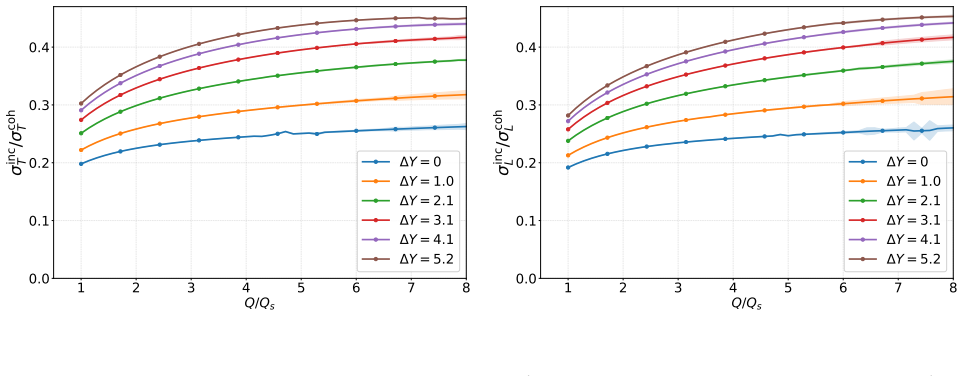
read the original abstract
We consider high energy scattering in the effective theory of the Color Glass Condensate. The most convenient degrees of freedom are Wilson lines encoding multiple gluon exchanges, whose evolution with energy follows the JIMWLK equation. Instead of using the latter, very often one resorts to a Gaussian Approximation (GA), which is known to be remarkably accurate in describing a wide class of multi-gluon correlators whose expansion in the weak scattering limit starts with an exchange of only two gluons. Here we demonstrate, both analytically and numerically, that such an approximation is not valid for correlators which start with an exchange of four gluons. As a main example, we focus on incoherent diffraction in photon-nucleus collisions and we show that the discrepancy between the JIMWLK and the GA results is driven by weak scattering and further persists in the regime where unitarity corrections begin to become important. The JIMWLK calculation leads to cross sections which are systematically larger in all kinematic regimes of interest.
Editorial analysis
A structured set of objections, weighed in public.
Referee Report
Summary. The manuscript demonstrates analytically that the Gaussian Approximation (GA) to the JIMWLK equation fails for multi-gluon correlators whose weak-scattering expansion begins at four-gluon exchange. Using incoherent diffraction in photon-nucleus collisions as the main example, it provides numerical evidence that full JIMWLK evolution produces systematically larger cross sections than the GA across kinematic regimes from weak scattering through the onset of unitarity corrections.
Significance. If the central results hold, the work is significant because it identifies a concrete class of observables where the commonly employed GA breaks down, thereby clarifying when the full JIMWLK evolution must be retained. The analytic demonstration combined with parameter-free numerical comparisons strengthens the case for using JIMWLK in diffractive calculations relevant to the EIC and LHC. The absence of fitted parameters and the direct head-to-head comparison are particular strengths.
Simulated Author's Rebuttal
We thank the referee for the positive assessment of our manuscript, the recognition of its significance for EIC and LHC phenomenology, and the recommendation to accept. We appreciate the emphasis placed on the parameter-free nature of the comparison and the analytic demonstration that the Gaussian Approximation fails for four-gluon correlators.
Circularity Check
No significant circularity identified
full rationale
The paper compares the full JIMWLK evolution equation against the Gaussian Approximation for four-gluon correlators in the context of incoherent diffraction. The analytical demonstration that the GA fails for correlators whose weak-scattering expansion begins at four-gluon exchange follows directly from the explicit definitions of the Wilson-line correlators and the functional form of the GA; it does not presuppose the numerical outcome. The numerical results are obtained by solving the JIMWLK equation with stated initial conditions and computing the cross sections, without any parameter fitting that would force agreement or disagreement with the GA. No load-bearing step reduces to a self-citation chain, a fitted input renamed as a prediction, or an ansatz smuggled via prior work. The derivation remains self-contained and externally falsifiable through the explicit evolution equations and the reported kinematic regimes.
Axiom & Free-Parameter Ledger
axioms (1)
- domain assumption JIMWLK equation correctly describes the rapidity evolution of Wilson-line correlators in the Color Glass Condensate.
Reference graph
Works this paper leans on
-
[1]
The BFKL Equation from the Wilson Renormalization Group
J. Jalilian-Marian, A. Kovner, A. Leonidov and H. Weigert,The BFKL equation from the Wilson renormalization group,Nucl. Phys. B504(1997) 415 [arXiv:hep-ph/9701284]. 33
work page Pith review arXiv 1997
-
[2]
The Wilson renormalization group for low x physics: towards the high density regime
J. Jalilian-Marian, A. Kovner, A. Leonidov and H. Weigert,The Wilson renormalization group for low x physics: Towards the high density regime,Phys. Rev. D59(1998) 014014 [arXiv:hep-ph/9706377]
work page Pith review arXiv 1998
-
[3]
H. Weigert,Unitarity at small Bjorken x,Nucl. Phys. A703(2002) 823 [arXiv:hep-ph/0004044]
work page Pith review arXiv 2002
-
[4]
Nonlinear Gluon Evolution in the Color Glass Condensate: I
E. Iancu, A. Leonidov and L. D. McLerran,Nonlinear gluon evolution in the color glass condensate. 1.,Nucl. Phys. A692(2001) 583 [arXiv:hep-ph/0011241]
work page Pith review arXiv 2001
- [5]
-
[6]
Operator expansion for high-energy scattering
I. Balitsky,Operator expansion for high-energy scattering,Nucl. Phys. B463(1996) 99 [arXiv:hep-ph/9509348]
work page Pith review arXiv 1996
-
[7]
High-Energy QCD and Wilson Lines
I. Balitsky,High-energy QCD and Wilson lines,arXiv:hep-ph/0101042
-
[8]
Y. V. Kovchegov,Small x F(2) structure function of a nucleus including multiple pomeron exchanges,Phys. Rev. D60(1999) 034008 [arXiv:hep-ph/9901281]
work page Pith review arXiv 1999
-
[9]
Y. V. Kovchegov,Unitarization of the BFKL pomeron on a nucleus,Phys. Rev. D61(2000) 074018 [arXiv:hep-ph/9905214]
work page Pith review arXiv 2000
- [10]
- [11]
-
[12]
E. Iancu and D. N. Triantafyllopoulos,Higher-point correlations from the JIMWLK evolution, JHEP11(2011) 105 [arXiv:1109.0302 [hep-ph]]
-
[13]
E. Iancu and D. N. Triantafyllopoulos,JIMWLK evolution in the Gaussian approximation, JHEP04(2012) 025 [arXiv:1112.1104 [hep-ph]]
-
[14]
A. Dumitru, J. Jalilian-Marian, T. Lappi, B. Schenke and R. Venugopalan,Renormalization group evolution of multi-gluon correlators in high energy QCD,Phys. Lett. B706(2011) 219 [arXiv:1108.4764 [hep-ph]]
-
[15]
L. D. McLerran and R. Venugopalan,Computing quark and gluon distribution functions for very large nuclei,Phys. Rev. D49(1994) 2233 [arXiv:hep-ph/9309289]
work page Pith review arXiv 1994
-
[16]
L. D. McLerran and R. Venugopalan,Gluon distribution functions for very large nuclei at small transverse momentum,Phys. Rev. D49(1994) 3352 [arXiv:hep-ph/9311205]
work page Pith review arXiv 1994
- [17]
- [18]
-
[19]
Weigert,Evolution at small x(bj): The Color glass condensate,Prog
H. Weigert,Evolution at small x(bj): The Color glass condensate,Prog. Part. Nucl. Phys.55 (2005) 461 [arXiv:hep-ph/0501087]
-
[20]
F. Dominguez, C. Marquet and B. Wu,On multiple scatterings of mesons in hot and cold QCD matter,Nucl. Phys. A823(2009) 99 [arXiv:0812.3878 [nucl-th]]. 34
-
[21]
Universality of Unintegrated Gluon Distributions at small x
F. Dominguez, C. Marquet, B.-W. Xiao and F. Yuan,Universality of Unintegrated Gluon Distributions at small x,Phys. Rev. D83(2011) 105005 [arXiv:1101.0715 [hep-ph]]
work page Pith review arXiv 2011
-
[22]
T. Lappi and H. Mantysaari,Forward dihadron correlations in deuteron-gold collisions with the Gaussian approximation of JIMWLK,Nucl. Phys. A908(2013) 51 [arXiv:1209.2853 [hep-ph]]
- [23]
-
[24]
H. M¨ antysaari, N. Mueller, F. Salazar and B. Schenke,Multigluon Correlations and Evidence of Saturation from Dijet Measurements at an Electron-Ion Collider,Phys. Rev. Lett.124(2020) 112301 [arXiv:1912.05586 [nucl-th]]
-
[25]
C. Marquet, E. Petreska and C. Roiesnel,Transverse-momentum-dependent gluon distributions from JIMWLK evolution,JHEP10(2016) 065 [arXiv:1608.02577 [hep-ph]]
- [26]
-
[27]
Lappi,Gluon spectrum in the glasma from JIMWLK evolution,Phys
T. Lappi,Gluon spectrum in the glasma from JIMWLK evolution,Phys. Lett. B703(2011) 325 [arXiv:1105.5511 [hep-ph]]
-
[28]
S. Schlichting and B. Schenke,The shape of the proton at high energies,Phys. Lett. B739 (2014) 313 [arXiv:1407.8458 [hep-ph]]
-
[29]
B. Schenke, S. Schlichting and P. Singh,Rapidity dependence of initial state geometry and momentum correlations in p+Pb collisions,Phys. Rev. D105(2022) 094023 [arXiv:2201.08864 [nucl-th]]
-
[30]
H. M¨ antysaari and P. Singh,Energy dependence of the deformed nuclear structure at small-x, Eur. Phys. J. C85(2025) 1449 [arXiv:2411.14934 [nucl-th]]
-
[31]
H. M¨ antysaari, N. Mueller and B. Schenke,Diffractive Dijet Production and Wigner Distributions from the Color Glass Condensate,Phys. Rev. D99(2019) 074004 [arXiv:1902.05087 [hep-ph]]
- [32]
-
[33]
E. A. Kuraev, L. N. Lipatov and V. S. Fadin,The Pomeranchuk singularity in nonabelian gauge theories,Sov. Phys. JETP45(1977) 199
1977
-
[34]
I. I. Balitsky and L. N. Lipatov,The Pomeranchuk Singularity in Quantum Chromodynamics, Sov. J. Nucl. Phys.28(1978) 822
1978
-
[35]
S. Demirci, T. Lappi and S. Schlichting,Proton hot spots and exclusive vector meson production,Phys. Rev. D106(2022) 074025 [arXiv:2206.05207 [hep-ph]]
-
[36]
A. H. Mueller,Soft gluons in the infinite momentum wave function and the BFKL pomeron, Nucl. Phys. B415(1994) 373
1994
-
[37]
J. Jalilian-Marian and Y. V. Kovchegov,Inclusive two-gluon and valence quark-gluon production in DIS and pA,Phys. Rev. D70(2004) 114017 [arXiv:hep-ph/0405266]. [Erratum: Phys.Rev.D 71, 079901 (2005)]. 35
-
[38]
J.-P. Blaizot, E. Iancu and H. Weigert,Nonlinear gluon evolution in path integral form,Nucl. Phys. A713(2003) 441 [arXiv:hep-ph/0206279]
-
[39]
K. Rummukainen and H. Weigert,Universal features of JIMWLK and BK evolution at small x, Nucl. Phys. A739(2004) 183 [arXiv:hep-ph/0309306]
-
[40]
T. Lappi and H. M¨ antysaari,On the running coupling in the JIMWLK equation,Eur. Phys. J. C73(2013) 2307 [arXiv:1212.4825 [hep-ph]]
- [41]
-
[42]
M. Alvioli, G. Soyez and D. N. Triantafyllopoulos,Testing the Gaussian Approximation to the JIMWLK Equation,Phys. Rev. D87(2013) 014016 [arXiv:1212.1656 [hep-ph]]
-
[43]
C. Marquet and H. Weigert,New observables to test the Color Glass Condensate beyond the large-N c limit,Nucl. Phys. A843(2010) 68 [arXiv:1003.0813 [hep-ph]]
-
[44]
B. Rodriguez-Aguilar, D. N. Triantafyllopoulos and S. Y. Wei,Incoherent diffractive dijet production in electron DIS off nuclei at high energy,Phys. Rev. D107(2023) 114007 [arXiv:2302.01106 [hep-ph]]
-
[45]
B. Rodriguez-Aguilar, D. N. Triantafyllopoulos and S. Y. Wei,Incoherent diffractive production of jets in electron DIS off nuclei at high energy,Phys. Rev. D110(2024) 074018 [arXiv:2407.17665 [hep-ph]]
-
[46]
T. Lappi and H. Mantysaari,Incoherent diffractive J/Psi-production in high energy nuclear DIS,Phys. Rev. C83(2011) 065202 [arXiv:1011.1988 [hep-ph]]
-
[47]
H. M¨ antysaari and B. Schenke,Evidence of strong proton shape fluctuations from incoherent diffraction,Phys. Rev. Lett.117(2016) 052301 [arXiv:1603.04349 [hep-ph]]
-
[48]
E. Iancu and D. N. Triantafyllopoulos,A Langevin equation for high energy evolution with pomeron loops,Nucl. Phys. A756(2005) 419 [arXiv:hep-ph/0411405]
-
[49]
E. Iancu and D. N. Triantafyllopoulos,Non-linear QCD evolution with improved triple-pomeron vertices,Phys. Lett. B610(2005) 253 [arXiv:hep-ph/0501193]
-
[50]
A. Kovner and M. Lublinsky,In pursuit of pomeron loops: The JIMWLK equation and the Wess-Zumino term,Phys. Rev.D71(2005) 085004 [arXiv:hep-ph/0501198]
- [51]
-
[52]
A. Bzdak and K. Dusling,Probing proton fluctuations with asymmetric rapidity correlations, Phys. Rev. C93(2016) 031901 [arXiv:1511.03620 [hep-ph]]
-
[53]
L. McLerran and P. Tribedy,Intrinsic Fluctuations of the Proton Saturation Momentum Scale in High Multiplicity p+p Collisions,Nucl. Phys. A945(2016) 216 [arXiv:1508.03292 [hep-ph]]
- [54]
- [55]
-
[56]
T. Lappi,Wilson line correlator in the MV model: Relating the glasma to deep inelastic scattering,Eur. Phys. J. C55(2008) 285 [arXiv:0711.3039 [hep-ph]]
- [57]
-
[58]
K. J. Golec-Biernat and M. Wusthoff,Saturation effects in deep inelastic scattering at low Q**2 and its implications on diffraction,Phys. Rev. D59(1998) 014017 [arXiv:hep-ph/9807513]
work page Pith review arXiv 1998
- [59]
-
[60]
H. M¨ antysaari and B. Schenke,Probing subnucleon scale fluctuations in ultraperipheral heavy ion collisions,Phys. Lett. B772(2017) 832 [arXiv:1703.09256 [hep-ph]]
-
[61]
T. Lappi and A. Ramnath,Unequal rapidity correlators in the dilute limit of the JIMWLK evolution,Phys. Rev. D100(2019) 054003 [arXiv:1904.00782 [hep-ph]]
- [62]
- [63]
-
[64]
S. Hauksson, E. Iancu, A. H. Mueller, D. N. Triantafyllopoulos and S. Y. Wei,TMD factorisation for diffractive jets in photon-nucleus interactions,JHEP06(2024) 180 [arXiv:2402.14748 [hep-ph]]
-
[65]
K. Dusling, F. Gelis, T. Lappi and R. Venugopalan,Long range two-particle rapidity correlations in A+A collisions from high energy QCD evolution,Nucl. Phys. A836(2010) 159 [arXiv:0911.2720 [hep-ph]]
-
[66]
K. Dusling and R. Venugopalan,Comparison of the color glass condensate to dihadron correlations in proton-proton and proton-nucleus collisions,Phys. Rev. D87(2013) 094034 [arXiv:1302.7018 [hep-ph]]
-
[67]
E. Iancu and D. N. Triantafyllopoulos,JIMWLK evolution for multi-particle production in Langevin form,JHEP11(2013) 067 [arXiv:1307.1559 [hep-ph]]. 37
discussion (0)
Sign in with ORCID, Apple, or X to comment. Anyone can read and Pith papers without signing in.