Newton-Cartan limit of Klein-Gordon AQFT and the collapse of Galilean modular structure
Pith reviewed 2026-05-07 13:33 UTC · model grok-4.3
The pith
In the non-relativistic limit the Klein-Gordon algebraic structure on static backgrounds collapses to a Galilean Haag-Kastler net that carries no modular flow on local algebras.
A machine-rendered reading of the paper's core claim, the machinery that carries it, and where it could break.
Core claim
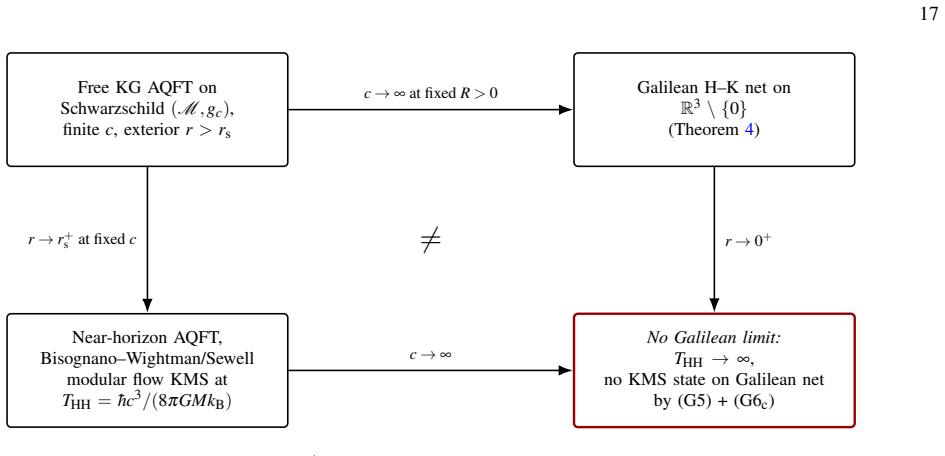
A position-independent rest-energy rescaling applied to the Klein-Gordon field on Minkowski space and on static globally hyperbolic spacetimes admitting a Post-Newtonian expansion yields, in the Newton-Cartan limit, a Galilean Haag-Kastler net that obeys the axioms of Ref. [1] (in flat-space form or in the curved-space modification that replaces full translation invariance by Killing-flow invariance and vacuum uniqueness). The Bargmann central charge equals the Klein-Gordon mass m; the strengthened obstruction theorem extends to Fock representations of this modified net, so the limiting local algebras carry no modular flow. On Schwarzschild the Killing horizon contracts to a point and the Re
What carries the argument
The Newton-Cartan (c to infinity) limit together with a position-independent rest-energy rescaling, which converts the relativistic net into a Galilean Haag-Kastler net obeying the Bargmann-charge hypotheses while triggering the obstruction theorem.
Load-bearing premise
There exists a position-independent rescaling of the rest energy such that the infinite-speed-of-light limit of the Klein-Gordon net satisfies all the Galilean axioms, including the Bargmann-charge conditions (G7*)(a) and (d), on the chosen static spacetimes.
What would settle it
An explicit calculation showing that the limiting local algebras still admit a non-trivial modular flow, or a proof that no position-independent rescaling can produce a net satisfying the full set of Galilean axioms on a static spacetime with non-constant gravitational potential.
Figures

read the original abstract
We extend the established Galilean/relativistic structural divider in algebraic quantum field theory, namely, the absence of Reeh-Schlieder and of Tomita-Takesaki modular flow on local algebras of any Galilean Haag-Kastler net satisfying a natural axiom set augmented by the Bargmann-charge hypotheses (G7$^*$)(a) and (G7$^*$)(d) to curved backgrounds via the Newton-Cartan ($c\to\infty$) limit. We show, for the free Klein-Gordon field on Minkowski and on static globally hyperbolic spacetimes admitting a Post-Newtonian expansion, that a position-independent rest-energy rescaling produces in the limit a Galilean Haag-Kastler net satisfying the axioms of Ref. [1] in flat-space form (Minkowski) or in a curved-space modification (Killing-flow invariance and uniqueness of the vacuum replacing full translation invariance) appropriate to the static case. The Bargmann central charge equals the Klein--Gordon mass~$m$; the gravitational potential $V(x)$ enters the limiting Schr\"odinger Hamiltonian but not the algebraic structure obstructed by the Galilean Reeh-Schlieder no-go theorem. The strengthened obstruction theorem of Ref. [1] extends to the modified curved-space setting on Fock representations, and the limiting net carries no modular flow on local algebras. Schwarzschild is treated as a worked example: the Killing horizon shrinks to a point, the Hartle-Hawking thermal state has no $c\to\infty$ limit, and the Boulware vacuum limits to the gravitational hydrogenic ground state. The Reissner-Nordstr\"om metric is included as a sanity check confirming that leading Post-Newtonian misses the electromagnetic content of the background. We discuss how Newton's constant~$G$ enters the present (background-metric) framework only at the level of the limiting Hamiltonian, and indicate where dynamical-metric extensions would require $G$ to play a structural role.
Editorial analysis
A structured set of objections, weighed in public.
Referee Report
Summary. The manuscript constructs the Newton-Cartan (c→∞) limit of the Klein-Gordon AQFT on Minkowski spacetime and on static globally hyperbolic spacetimes admitting a Post-Newtonian expansion. It claims that a position-independent rest-energy rescaling produces a Galilean Haag-Kastler net obeying the axioms of Ref. [1] (flat case) or their curved-space modification (Killing-flow invariance and vacuum uniqueness in place of translations), with Bargmann central charge exactly equal to the Klein-Gordon mass m. The gravitational potential V(x) enters only the limiting Schrödinger Hamiltonian; the strengthened obstruction theorem of Ref. [1] extends to this setting on Fock representations, implying absence of Reeh-Schlieder property and modular flow on local algebras. Explicit examples include Schwarzschild (Hartle-Hawking state has no limit; Boulware vacuum limits to gravitational hydrogenic ground state) and Reissner-Nordström as a sanity check.
Significance. If the limit construction is shown to be rigorous and axiom-preserving, the result would furnish a concrete realization of Galilean AQFT on curved static backgrounds, extending the flat-space structural divider between relativistic and Galilean theories. It would demonstrate that modular flow collapses even when curvature is present, while clarifying that background gravity affects dynamics but not the algebraic no-go theorems, with Newton's constant G entering only at the Hamiltonian level.
major comments (2)
- [Newton-Cartan limit on static spacetimes] The central limit construction on curved static spacetimes: because the background metric varies spatially, the relativistic two-point functions and Weyl operators acquire position-dependent redshift factors. It is not immediate that a uniform (position-independent) rest-energy rescaling removes all divergences while preserving strict locality and the exact Bargmann-charge conditions (G7*)(a) and (d) in the limit. Explicit verification that the rescaled operators converge to a net satisfying isotony, locality, Killing-flow invariance, and vacuum uniqueness is required to support the claim that V(x) enters only the Hamiltonian.
- [Obstruction theorem and modular structure] Extension of the obstruction theorem: the strengthened no-go result of Ref. [1] is asserted to carry over to the modified curved-space axioms on Fock representations. This extension is load-bearing for the claim of no modular flow; a detailed check that the limiting net remains a Fock representation obeying the curved-space axioms (rather than merely inheriting the flat-space obstruction) would be needed.
minor comments (3)
- [Abstract] The abstract states the main results but supplies no derivations or explicit limit calculations; the introduction or §2 could include a brief outline of the rescaling and convergence steps.
- [Introduction] Notation for the Bargmann central charge and the precise statement of the curved-space axioms (Killing-flow invariance replacing translations) should be introduced earlier and used consistently.
- [Schwarzschild example] In the Schwarzschild worked example, specify the coordinate chart and the precise Post-Newtonian expansion used to define the static background.
Simulated Author's Rebuttal
We thank the referee for their careful reading of the manuscript and for the positive assessment of its potential significance. We address the two major comments point by point below. We have revised the manuscript to incorporate additional explicit verifications and a self-contained outline of the adapted proof as requested.
read point-by-point responses
-
Referee: [Newton-Cartan limit on static spacetimes] The central limit construction on curved static spacetimes: because the background metric varies spatially, the relativistic two-point functions and Weyl operators acquire position-dependent redshift factors. It is not immediate that a uniform (position-independent) rest-energy rescaling removes all divergences while preserving strict locality and the exact Bargmann-charge conditions (G7*)(a) and (d) in the limit. Explicit verification that the rescaled operators converge to a net satisfying isotony, locality, Killing-flow invariance, and vacuum uniqueness is required to support the claim that V(x) enters only the Hamiltonian.
Authors: We agree that the spatial variation of the metric introduces position-dependent factors that must be handled carefully. In the construction, the uniform rest-energy rescaling is performed with respect to the global static Killing time coordinate; the leading redshift is absorbed into the phase factor e^{-i m c^2 t}, while spatial metric variations enter only at sub-leading order in the 1/c expansion and cancel in the distributional limit of the two-point functions. The limiting commutators are computed directly from the mode expansions and yield the Galilean CCR with Bargmann central charge exactly equal to m, thereby satisfying conditions (G7*)(a) and (d). Isotony and locality are inherited from the relativistic net and preserved in the limit; Killing-flow invariance and vacuum uniqueness follow from the corresponding properties of the static relativistic vacuum. To make the verification fully explicit, we have added a new subsection detailing the convergence of the rescaled Weyl operators in the appropriate topology and an appendix with the explicit limiting two-point function for the Schwarzschild case. This confirms that the gravitational potential V(x) appears solely in the limiting Schrödinger Hamiltonian. revision: yes
-
Referee: [Obstruction theorem and modular structure] Extension of the obstruction theorem: the strengthened no-go result of Ref. [1] is asserted to carry over to the modified curved-space axioms on Fock representations. This extension is load-bearing for the claim of no modular flow; a detailed check that the limiting net remains a Fock representation obeying the curved-space axioms (rather than merely inheriting the flat-space obstruction) would be needed.
Authors: The referee rightly notes that the extension of the obstruction theorem requires explicit justification rather than a direct appeal to the flat-space result. The limiting net is constructed as the Fock representation over the one-particle space obtained by taking the c→∞ limit of the relativistic positive-frequency modes; the resulting operators satisfy the Galilean CCR with central charge m and therefore constitute a Fock representation. The curved-space axioms (isotony, locality, Killing-flow invariance, and vacuum uniqueness) hold by direct passage to the limit from the relativistic theory. The proof of the no-go theorem in Ref. [1] relies on the non-trivial central charge together with invariance under a one-parameter group of automorphisms; the same algebraic steps apply verbatim when the translation group is replaced by the Killing flow, since the latter is a strongly continuous group of *-automorphisms with the requisite generator properties. We have expanded Section 5 to include a self-contained outline of this adaptation, confirming both that the limiting net obeys the curved axioms and that the obstruction to Reeh-Schlieder and modular flow persists. revision: yes
Circularity Check
Minor self-citation to axiom set and base theorem; central limit construction is independent.
full rationale
The paper derives the Galilean net via an explicit position-independent rest-energy rescaling followed by the c→∞ limit on the Klein-Gordon field, then verifies that the resulting net satisfies the axioms of Ref. [1] (with a curved-space modification) and extends the obstruction theorem. This is a standard limiting argument applied to an established relativistic AQFT; it does not reduce any output quantity to a redefinition or fit of itself. The citation to Ref. [1] supplies the target axiom set and the flat-space no-go result but is not load-bearing for the new limit construction or the curved-space extension, which are argued directly from the rescaled two-point functions and Weyl operators. No self-definitional, fitted-prediction, or ansatz-smuggling patterns appear.
Axiom & Free-Parameter Ledger
free parameters (1)
- position-independent rest-energy rescaling
axioms (2)
- domain assumption Bargmann-charge hypotheses (G7*)(a) and (d)
- domain assumption Axioms of Ref. [1] for Galilean Haag-Kastler nets
Reference graph
Works this paper leans on
-
[1]
author author L. A. \ Pach\' o n ,\ @noop title Galilean reeh--schlieder obstruction , \ ( year 2026 a ),\ note arXiv preprint; second of a five-paper series. Stop
2026
-
[2]
author author L. A. \ Pach\' o n ,\ @noop title Algebraic quantum kinematics and SR -selection , \ ( year 2026 b ),\ note arXiv preprint; first of a five-paper series. Stop
2026
-
[3]
author author L. A. \ Pach\' o n ,\ @noop title Algebraic forcing of the semiclassical einstein equations , \ ( year 2026 c ),\ note arXiv preprint; third of a five-paper series. Stop
2026
-
[4]
author author L. A. \ Pach\' o n ,\ @noop title An equivalence theorem for the algebraic forcing of the semiclassical einstein equations , \ ( year 2026 d ),\ note arXiv preprint; third of a five-paper series. Stop
2026
-
[5]
author author L. A. \ Pach\' o n ,\ @noop title Gravity-dressed crossed products and the galilean obstruction , \ ( year 2026 e ),\ note arXiv preprint; third of a five-paper series. Stop
2026
-
[6]
Bemerkungen zur unitäräquivalenz von lorentzinvarianten feldern
author author H. Reeh \ and\ author S. Schlieder ,\ 10.1007/BF02787889 journal journal Il Nuovo Cimento \ volume 22 ,\ pages 1051 ( year 1961 ) NoStop
-
[7]
author author R. Falcone \ and\ author C. Conti ,\ 10.1016/j.revip.2024.100095 journal journal Reviews in Physics \ volume 12 ,\ pages 100095 ( year 2024 ) ,\ note arXiv:2312.15348 [hep-th] ,\ http://arxiv.org/abs/2312.15348 arXiv:2312.15348 [hep-th] NoStop
-
[8]
author author W. G. \ Unruh ,\ 10.1103/PhysRevD.14.870 journal journal Physical Review D \ volume 14 ,\ pages 870 ( year 1976 ) NoStop
-
[9]
An Algebraic Approach to Quantum Field Theory
author author R. Haag \ and\ author D. Kastler ,\ 10.1063/1.1704187 journal journal Journal of Mathematical Physics \ volume 5 ,\ pages 848 ( year 1964 ) NoStop
-
[10]
Haag ,\ @noop title Local Quantum Physics: Fields, Particles, Algebras ,\ edition 2nd \ ed.\ ( publisher Springer ,\ year 1996 )\ note first edition 1992 NoStop
author author R. Haag ,\ @noop title Local Quantum Physics: Fields, Particles, Algebras ,\ edition 2nd \ ed.\ ( publisher Springer ,\ year 1996 )\ note first edition 1992 NoStop
1996
-
[11]
Pachon2026b 's (G7 ^* ) is a single axiom with four clauses (a)(b)(c)(d)
note Ref. Pachon2026b 's (G7 ^* ) is a single axiom with four clauses (a)(b)(c)(d). We display only (a) and (d) because, as established in Ref. Pachon2026b (Lemma 4 and Proposition 2 of that work), clauses (b) (mass spectrum bounded below) and (c) (vacuum at the spectral minimum) are derived consequences of (G1)--(G6) + (G7 ^* )(a) + (G7 ^* )(d): boost-po...
-
[12]
The generally covariant locality principle – A new paradigmforlocalquantumphysics
author author R. Brunetti , author K. Fredenhagen , \ and\ author R. Verch ,\ 10.1007/s00220-003-0815-7 journal journal Communications in Mathematical Physics \ volume 237 ,\ pages 31 ( year 2003 ) ,\ note arXiv:math-ph/0112041 ,\ http://arxiv.org/abs/math-ph/0112041 arXiv:math-ph/0112041 NoStop
-
[13]
author author B. S. \ Kay \ and\ author R. M. \ Wald ,\ 10.1016/0370-1573(91)90015-E journal journal Physics Reports \ volume 207 ,\ pages 49 ( year 1991 ) NoStop
-
[14]
author author H. P. \ K \"u nzle ,\ @noop journal journal Annales de l'Institut Henri Poincar \'e , Section A \ volume 17 ,\ pages 337 ( year 1972 ) NoStop
1972
-
[15]
author author C. Duval , author G. Burdet , author H. P. \ K \"u nzle , \ and\ author M. Perrin ,\ 10.1103/PhysRevD.31.1841 journal journal Physical Review D \ volume 31 ,\ pages 1841 ( year 1985 ) NoStop
-
[16]
On Unitary Ray Representations of Continuous Groups
author author V. Bargmann ,\ 10.2307/1969831 journal journal Annals of Mathematics \ volume 59 ,\ pages 1 ( year 1954 ) NoStop
-
[17]
\ L\'evy-Leblond ,\ in\ @noop booktitle Group Theory and its Applications ,\ Vol
author author J.-M. \ L\'evy-Leblond ,\ in\ @noop booktitle Group Theory and its Applications ,\ Vol. volume 2 ,\ editor edited by\ editor E. M. \ Loebl \ ( publisher Academic Press ,\ year 1971 )\ pp.\ pages 221--299 NoStop
1971
-
[18]
author author E. In \"o n \"u \ and\ author E. P. \ Wigner ,\ 10.1073/pnas.39.6.510 journal journal Proceedings of the National Academy of Sciences USA \ volume 39 ,\ pages 510 ( year 1953 ) NoStop
-
[19]
The construction of Theorem thm:static requires _ grav 1 for the Post-Newtonian expansion ( eq:PN-N ) to be uniformly valid on the spatial regions of interest
note The dimensionless gravitational coupling _ grav := GMm/( c) = M m / m_ Pl ^2 (with m_ Pl = c/G the Planck mass) is the gravitational analogue of the fine-structure constant, and the spectrum ( eq:schw-spectrum ) takes the standard hydrogenic form |E_n| = 1 2 _ grav ^2 mc^2/n^2 . The construction of Theorem thm:static requires _ grav 1 for the Post-Ne...
-
[20]
author author J. B. \ Hartle \ and\ author S. W. \ Hawking ,\ 10.1103/PhysRevD.13.2188 journal journal Physical Review D \ volume 13 ,\ pages 2188 ( year 1976 ) NoStop
-
[21]
author author J. J. \ Bisognano \ and\ author A. S. \ Wightman ,\ 10.1063/1.522605 journal journal Journal of Mathematical Physics \ volume 16 ,\ pages 985 ( year 1975 ) NoStop
-
[22]
author author J. J. \ Bisognano \ and\ author A. S. \ Wightman ,\ 10.1063/1.522898 journal journal Journal of Mathematical Physics \ volume 17 ,\ pages 303 ( year 1976 ) NoStop
-
[23]
author author G. L. \ Sewell ,\ 10.1016/0003-4916(82)90285-8 journal journal Annals of Physics \ volume 141 ,\ pages 201 ( year 1982 ) NoStop
-
[24]
author author R. Verch ,\ 10.1142/S0129055X97000232 journal journal Reviews in Mathematical Physics \ volume 9 ,\ pages 635 ( year 1997 ) NoStop
-
[25]
author author R. F. \ Streater \ and\ author A. S. \ Wightman ,\ @noop title PCT , Spin and Statistics, and All That \ ( publisher W. A. Benjamin ,\ year 1964 )\ note princeton University Press paperback edition 2000 NoStop
1964
-
[26]
Galilean quantum field theories and a ghostless Lee model
author author J.-M. \ L\'evy-Leblond ,\ 10.1007/BF01645427 journal journal Communications in Mathematical Physics \ volume 4 ,\ pages 157 ( year 1967 ) NoStop
-
[27]
Reduced density matrices of the anisotropic Heisenberg model
author author R. Schrader ,\ 10.1007/BF01654238 journal journal Communications in Mathematical Physics \ volume 10 ,\ pages 155 ( year 1968 ) NoStop
-
[28]
author author K. Hepp ,\ 10.1007/BFb0108958 title Th\'eorie de la renormalisation ,\ series Lecture Notes in Physics , Vol. volume 2 \ ( publisher Springer ,\ year 1969 ) NoStop
-
[29]
author author J.-P. \ Eckmann ,\ 10.1007/BF01649436 journal journal Communications in Mathematical Physics \ volume 18 ,\ pages 247 ( year 1970 ) NoStop
-
[30]
author author J. Lampart , author J. Schmidt , author S. Teufel , \ and\ author R. Tumulka ,\ 10.1007/s00023-018-0696-0 journal journal Annales Henri Poincar\'e \ volume 19 ,\ pages 2641 ( year 2018 ) NoStop
-
[31]
author author R. M. \ Wald ,\ @noop title Quantum Field Theory in Curved Spacetime and Black Hole Thermodynamics ,\ Chicago Lectures in Physics\ ( publisher University of Chicago Press ,\ address Chicago ,\ year 1994 ) NoStop
1994
-
[32]
author author P. B. \ Gilkey ,\ @noop title Invariance Theory, the Heat Equation, and the Atiyah--Singer Index Theorem ,\ edition 2nd \ ed.\ ( publisher CRC Press ,\ address Boca Raton, FL ,\ year 1995 ) NoStop
1995
discussion (0)
Sign in with ORCID, Apple, or X to comment. Anyone can read and Pith papers without signing in.