Recognition: unknown
Long-lived local quantum coherences from hydrodynamic large deviations
Pith reviewed 2026-05-07 09:15 UTC · model grok-4.3
The pith
Quantum coherences bind to rare voids and live parametrically longer in 1D charge-conserving dynamics
A machine-rendered reading of the paper's core claim, the machinery that carries it, and where it could break.
Core claim
Conditional on surviving, the quantum coherence and its surrounding void form a collective polaron-like object. In one dimension, even at infinite temperature, the lifetime of coherences is parametrically enhanced because they bind to voids. This framework shows that gapped Ruelle-Pollicott resonances are absent in the weak-noise limit and computes the spacetime asymptotics of the dynamical single-particle Green's function, including subdiffusion of the polaron in the noiseless case.
What carries the argument
The void-coherence polaron, a collective bound state in which a surviving quantum coherence attaches to a rare hydrodynamic void of low charge entropy.
If this is right
- The spectral gap vanishes nonperturbatively with noise strength in every sector of operator space.
- The dynamical single-particle Green's function exhibits specific spacetime asymptotics in both weak-noise and noiseless regimes.
- In the absence of noise the void-coherence polaron undergoes subdiffusion with a calculable exponent.
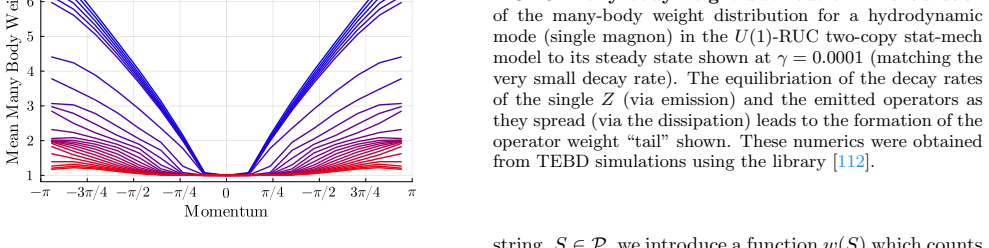
- Microscopic derivations for random charge-conserving circuits and tensor-network simulations confirm the long-lived behavior.
Where Pith is reading between the lines
- The same binding may control relaxation rates in other low-dimensional systems with conservation laws.
- The predicted subdiffusion exponent offers a concrete target for experiments in ultracold atoms or superconducting circuits.
- The framework suggests that engineering rare low-entropy regions could be used to extend coherence times in quantum devices.
Load-bearing premise
The nonperturbative interactions between quantum coherences and hydrodynamic large deviations are accurately captured by binding to voids.
What would settle it
A measurement or simulation of local coherence lifetime versus noise strength in a one-dimensional charge-conserving circuit that fails to show parametric enhancement would falsify the central claim.
Figures


read the original abstract
We develop a framework to describe how quantum coherences between distinct charge sectors evolve under generic charge-conserving dynamics. Our framework captures the nonperturbative interactions between quantum coherences and hydrodynamic large deviations -- i.e., rare ``voids'' of low charge entropy. Conditional on surviving, the quantum coherence and its surrounding void form a collective polaron-like object. In one dimension, even at infinite temperature, we show that the lifetime of coherences is parametrically enhanced because they bind to voids. We use our framework to address two fundamental questions about generic quantum dynamics with a conserved charge. First, we argue that gapped Ruelle-Pollicott resonances are absent in the weak-noise limit, even in sectors of operator space that contain no hydrodynamic slow modes: instead, the spectral gap in all sectors vanishes nonperturbatively in the noise strength. Second, we compute the spacetime asymptotics of the dynamical single-particle Green's function, both in the weak-noise regime and in the absence of noise. In the noiseless case, we find that the void-coherence polaron undergoes subdiffusion, with an exponent we calculate. We support our general arguments with a microscopic derivation for random charge-conserving circuits, as well as numerical evidence from tensor-network simulations.
Editorial analysis
A structured set of objections, weighed in public.
Referee Report
Summary. The paper develops a framework for the evolution of quantum coherences between distinct charge sectors under generic charge-conserving dynamics. It emphasizes nonperturbative interactions between these coherences and hydrodynamic large deviations (rare voids of low charge entropy), arguing that surviving coherences bind to voids to form collective polaron-like objects. In one dimension, this binding parametrically enhances coherence lifetimes even at infinite temperature. The framework is applied to show the absence of gapped Ruelle-Pollicott resonances in the weak-noise limit across operator sectors and to derive spacetime asymptotics of the dynamical single-particle Green's function (subdiffusive in the noiseless case). Claims are supported by a microscopic derivation in random charge-conserving circuits and tensor-network numerics.
Significance. If the central claims hold, the work offers a novel nonperturbative perspective on how rare hydrodynamic fluctuations stabilize quantum coherences in conserved systems, with implications for operator growth, spectral gaps in open quantum dynamics, and large-deviation effects in many-body physics. The explicit microscopic derivation for random circuits and the polaron analogy provide concrete strengths; the parametric lifetime enhancement at infinite temperature would be a notable result if robustly established.
major comments (3)
- [§4] §4 (tensor-network simulations): The central claim of parametrically enhanced lifetimes relies on coherences binding to rare low-entropy voids. Standard TEBD or contraction methods sample typical trajectories whose probability of containing a large-deviation void is exponentially small in system size; without explicit conditioning, importance sampling, or void-sector projection described in the numerics, the observed decay rates cannot confirm the nonperturbative binding mechanism or the claimed scaling, as they primarily probe the unbound sector.
- [§3] §3 (framework derivation): The argument that gapped Ruelle-Pollicott resonances are absent in the weak-noise limit (even in sectors without hydrodynamic modes) follows from the nonperturbative void-coherence interaction. A more explicit calculation of the resonance spectrum in the small-noise expansion, showing how the gap closes nonperturbatively rather than perturbatively, would make this load-bearing step verifiable.
- [§5] Abstract and §5 (Green's function asymptotics): The subdiffusive exponent for the void-coherence polaron in the noiseless case is stated to be calculated, but the derivation of the exponent from the large-deviation principle and binding condition is not fully detailed in the provided sections; an explicit formula or scaling argument tied to the void probability would strengthen the result.
minor comments (2)
- Notation for the void-coherence polaron is introduced without a clear definition of its effective mass or binding energy; adding a short paragraph or equation defining these quantities would improve readability.
- The manuscript would benefit from a brief comparison table or paragraph contrasting the predicted lifetime scaling with standard perturbative decoherence rates in charge-conserving systems.
Simulated Author's Rebuttal
We thank the referee for their careful reading of our manuscript and for the constructive comments, which have helped us strengthen the presentation. We address each major comment below and have revised the manuscript to incorporate clarifications and additional details where appropriate.
read point-by-point responses
-
Referee: [§4] §4 (tensor-network simulations): The central claim of parametrically enhanced lifetimes relies on coherences binding to rare low-entropy voids. Standard TEBD or contraction methods sample typical trajectories whose probability of containing a large-deviation void is exponentially small in system size; without explicit conditioning, importance sampling, or void-sector projection described in the numerics, the observed decay rates cannot confirm the nonperturbative binding mechanism or the claimed scaling, as they primarily probe the unbound sector.
Authors: We agree that standard TEBD and contraction methods primarily sample typical trajectories, for which the probability of large-deviation voids is exponentially small in system size, and that without conditioning or importance sampling the numerics cannot directly visualize the binding mechanism. Our tensor-network results were intended only as qualitative supporting evidence for the overall parametric lifetime enhancement predicted by the analytic framework, rather than as a direct probe of the polaron sector. In the revised manuscript we have added an explicit discussion of this limitation in §4, clarified that the primary evidence for the binding mechanism comes from the microscopic derivation in random circuits, and noted that future work with importance sampling would be valuable to isolate the void-bound sector. revision: partial
-
Referee: [§3] §3 (framework derivation): The argument that gapped Ruelle-Pollicott resonances are absent in the weak-noise limit (even in sectors without hydrodynamic modes) follows from the nonperturbative void-coherence interaction. A more explicit calculation of the resonance spectrum in the small-noise expansion, showing how the gap closes nonperturbatively rather than perturbatively, would make this load-bearing step verifiable.
Authors: We thank the referee for this suggestion. Our claim is that the gap closure is intrinsically nonperturbative because it is driven by the large-deviation cost of rare voids, which cannot be captured by any finite-order expansion in the noise strength. In the revised §3 we have added an explicit scaling calculation of the resonance spectrum in the small-noise limit. This shows that the leading contribution to the gap arises from the non-analytic dependence on the noise strength induced by the exponential suppression of the voids, thereby confirming the nonperturbative character of the closure. revision: yes
-
Referee: [§5] Abstract and §5 (Green's function asymptotics): The subdiffusive exponent for the void-coherence polaron in the noiseless case is stated to be calculated, but the derivation of the exponent from the large-deviation principle and binding condition is not fully detailed in the provided sections; an explicit formula or scaling argument tied to the void probability would strengthen the result.
Authors: We apologize for the insufficient detail. The subdiffusive exponent follows from optimizing the large-deviation cost of a void of linear size ℓ against the diffusive spreading of the coherence inside the void. Balancing the rate function I(δ) for the void probability (which scales as exp(−ℓ I)) with the time t required for the coherence to explore the void yields the optimal scaling ℓ ∼ t^{1/3} and therefore a subdiffusive Green's function with exponent 1/3. We have inserted this explicit scaling argument, tied directly to the large-deviation principle and the binding condition, into the revised §5. revision: yes
Circularity Check
Derivation chain is self-contained from conservation laws and large-deviation principles
full rationale
The paper constructs its framework directly from charge conservation and hydrodynamic large-deviation principles, then derives the polaron binding, parametric lifetime enhancement, absence of gapped resonances, and subdiffusive asymptotics via explicit arguments and a microscopic circuit derivation. No equation or claim reduces by construction to a fitted parameter, self-citation, or renamed input; the central results follow from the stated assumptions without tautological closure. Tensor-network numerics are presented as supporting evidence rather than the load-bearing derivation.
Axiom & Free-Parameter Ledger
axioms (2)
- domain assumption Dynamics conserve charge
- domain assumption Hydrodynamic large deviations describe rare voids
invented entities (1)
-
void-coherence polaron
no independent evidence
Reference graph
Works this paper leans on
-
[1]
Y. Le, Y. Zhang, S. Gopalakrishnan, M. Rigol, and D. S. Weiss, Observation of hydrodynamization and lo- cal prethermalization in 1d bose gases, Nature618, 494 (2023)
2023
-
[2]
Gross and I
C. Gross and I. Bloch, Quantum simulations with ultra- cold atoms in optical lattices, Science357, 995 (2017)
2017
-
[3]
Arute, K
F. Arute, K. Arya, R. Babbush, D. Bacon, J. C. Bardin, R. Barends, R. Biswas, S. Boixo, F. G. Bran- dao, D. A. Buell,et al., Quantum supremacy using a programmable superconducting processor, Nature574, 505 (2019)
2019
-
[4]
Scholl, H
P. Scholl, H. J. Williams, G. Bornet, F. Wallner, D. Barredo, L. Henriet, A. Signoles, C. Hainaut, T. Franz, S. Geier, A. Tebben, A. Salzinger, G. Z¨ urn, T. Lahaye, M. Weidem¨ uller, and A. Browaeys, Mi- crowave engineering of programmable XXZ hamilto- nians in arrays of rydberg atoms, PRX Quantum3, 020303 (2022)
2022
- [5]
-
[6]
J. Koepsell, S. Hirthe, D. Bourgund, P. Sompet, J. Vi- jayan, G. Salomon, C. Gross, and I. Bloch, Robust Bi- layer Charge Pumping for Spin- and Density-Resolved Quantum Gas Microscopy, Phys. Rev. Lett.125, 010403 (2020), arXiv:2002.07577 [cond-mat.quant-gas]
-
[7]
J.-Y. Ollitrault, Relativistic hydrodynamics for heavy- ion collisions, European Journal of Physics29, 275 (2008), arXiv:0708.2433 [nucl-th]
-
[8]
Relativistic hydrodynamics in heavy-ion collisions: general aspects and recent developments
A. Jaiswal and V. Roy, Relativistic hydrodynamics in heavy-ion collisions: general aspects and recent de- velopments, arXiv e-prints , arXiv:1605.08694 (2016), arXiv:1605.08694 [nucl-th]
work page Pith review arXiv 2016
-
[9]
M. M¨ uller and S. Sachdev, Collective cyclotron motion of the relativistic plasma in graphene, Phys. Rev. B78, 115419 (2008), arXiv:0801.2970 [cond-mat.str-el]
- [10]
-
[11]
Lucas, Sound waves and resonances in electron- hole plasma, Phys
A. Lucas, Sound waves and resonances in electron- hole plasma, Phys. Rev. B93, 245153 (2016), arXiv:1604.03955 [cond-mat.str-el]
-
[12]
J. Crossno, J. K. Shi, K. Wang, X. Liu, A. Harzheim, A. Lucas, S. Sachdev, P. Kim, T. Taniguchi, K. Watan- abe, T. A. Ohki, and K. C. Fong, Observation of the Dirac fluid and the breakdown of the Wiedemann- Franz law in graphene, Science351, 1058 (2016), arXiv:1509.04713 [cond-mat.mes-hall]
- [13]
-
[14]
A. Lucas and K. Chung Fong, Hydrodynamics of elec- trons in graphene, Journal of Physics Condensed Matter 30, 053001 (2018), arXiv:1710.08425 [cond-mat.str-el]
- [15]
-
[16]
McCulloch, J
E. McCulloch, J. De Nardis, S. Gopalakrishnan, and R. Vasseur, Full counting statistics of charge in chaotic many-body quantum systems, Phys. Rev. Lett.131, 210402 (2023)
2023
- [17]
-
[18]
S. Gopalakrishnan, E. McCulloch, and R. Vasseur, Non-gaussian diffusive fluctuations in dirac fluids, Proceedings of the National Academy of Sciences121, e2403327121 (2024), https://www.pnas.org/doi/pdf/10.1073/pnas.2403327121
- [19]
-
[20]
D. Bernard and T. Jin, Open Quantum Symmetric Sim- ple Exclusion Process, Phys. Rev. Lett.123, 080601 (2019), arXiv:1904.01406 [cond-mat.stat-mech]
-
[21]
D. Bernard and T. Jin, Solution to the Quantum Sym- metric Simple Exclusion Process: The Continuous Case, Communications in Mathematical Physics384, 1141 (2021), arXiv:2006.12222 [math-ph]
-
[22]
M. Albert, D. Bernard, T. Jin, S. Scopa, and S. Wei, Universal classical and quantum fluctuations in the large deviations of current of noisy quantum sys- tems: The case of QSSEP and QSSIP, arXiv e-prints , arXiv:2601.16883 (2026), arXiv:2601.16883 [cond- mat.stat-mech]
-
[23]
Forster,Hydrodynamic fluctuations, broken symme- try, and correlation functions(CRC Press, 2018)
D. Forster,Hydrodynamic fluctuations, broken symme- try, and correlation functions(CRC Press, 2018)
2018
-
[24]
Spohn,Large scale dynamics of interacting particles (Springer Science & Business Media, 2012)
H. Spohn,Large scale dynamics of interacting particles (Springer Science & Business Media, 2012)
2012
-
[25]
Spohn, Nonlinear fluctuating hydrodynamics for an- harmonic chains, Journal of Statistical Physics154, 1191 (2014)
H. Spohn, Nonlinear fluctuating hydrodynamics for an- harmonic chains, Journal of Statistical Physics154, 1191 (2014)
2014
-
[26]
Doyon, Diffusion and superdiffusion from hydrody- namic projections, Journal of Statistical Physics186, 25 (2022)
B. Doyon, Diffusion and superdiffusion from hydrody- namic projections, Journal of Statistical Physics186, 25 (2022)
2022
-
[27]
X. Chen-Lin, L. V. Delacr´ etaz, and S. A. Hartnoll, The- ory of Diffusive Fluctuations, Phys. Rev. Lett.122, 091602 (2019), arXiv:1811.12540 [hep-th]
-
[28]
Mukerjee, V
S. Mukerjee, V. Oganesyan, and D. Huse, Statisti- cal theory of transport by strongly interacting lattice fermions, Phys. Rev. B73, 035113 (2006)
2006
-
[30]
D’Alessio and M
L. D’Alessio and M. Rigol, Long-time behavior of iso- lated periodically driven interacting lattice systems, Phys. Rev. X4, 041048 (2014)
2014
-
[31]
Bukov, M
M. Bukov, M. Heyl, D. A. Huse, and A. Polkovnikov, Heating and many-body resonances in a periodically driven two-band system, Phys. Rev. B93, 155132 (2016)
2016
-
[32]
Lazarides, A
A. Lazarides, A. Das, and R. Moessner, Equilibrium states of generic quantum systems subject to periodic driving, Phys. Rev. E90, 012110 (2014)
2014
-
[33]
Nahum, J
A. Nahum, J. Ruhman, S. Vijay, and J. Haah, Quantum entanglement growth under random unitary dynamics, Phys. Rev. X7, 031016 (2017)
2017
-
[34]
Prosen, Ruelle resonances in kicked quantum spin chain, Physica D: Nonlinear Phenomena187, 244 (2004), microscopic Chaos and Transport in Many- Particle Systems
T. Prosen, Ruelle resonances in kicked quantum spin chain, Physica D: Nonlinear Phenomena187, 244 (2004), microscopic Chaos and Transport in Many- Particle Systems
2004
-
[35]
Mori, Liouvillian-gap analysis of open quantum many-body systems in the weak dissipation limit, Phys
T. Mori, Liouvillian-gap analysis of open quantum many-body systems in the weak dissipation limit, Phys. Rev. B109, 064311 (2024)
2024
-
[36]
Local quantum overlapping tomography,
M. ˇZnidariˇ c, Momentum-dependent quantum ruelle- pollicott resonances in translationally invariant many- body systems, Physical Review E110, 10.1103/phys- reve.110.054204 (2024)
- [37]
-
[38]
J. A. Jacoby, D. A. Huse, and S. Gopalakrishnan, Spectral gaps of local quantum channels in the weak- dissipation limit, Phys. Rev. B111, 104303 (2025)
2025
-
[39]
Nahum, S
A. Nahum, S. Roy, S. Vijay, and T. Zhou, Real-time cor- relators in chaotic quantum many-body systems, Phys. Rev. B106, 224310 (2022)
2022
-
[40]
A. Teretenkov, F. Uskov, and O. Lychkovskiy, Pseu- domode expansion of many-body correlation functions (2025), arXiv:2407.12495 [cond-mat.str-el]
-
[41]
Ruelle, Resonances of chaotic dynamical systems, Phys
D. Ruelle, Resonances of chaotic dynamical systems, Phys. Rev. Lett.56, 405 (1986)
1986
-
[42]
Pollicott, On the rate of mixing of axiom a flows, Inventiones mathematicae81, 413 (1985)
M. Pollicott, On the rate of mixing of axiom a flows, Inventiones mathematicae81, 413 (1985)
1985
-
[43]
T. Schuster, C. Yin, X. Gao, and N. Y. Yao, A polynomial-time classical algorithm for noisy quantum circuits, arXiv preprint arXiv:2407.12768 (2024)
-
[44]
G. Gonz´ alez-Garc´ ıa, J. I. Cirac, and R. Trivedi, Pauli path simulations of noisy quantum circuits beyond av- erage case, arXiv preprint arXiv:2407.16068 (2024)
-
[45]
T. Beguˇ si´ c, J. Gray, and G. K.-L. Chan, Fast and converged classical simulations of evidence for the utility of quantum computing before fault tolerance, Science Advances10, eadk4321 (2024), https://www.science.org/doi/pdf/10.1126/sciadv.adk4321
-
[46]
Aharonov, X
D. Aharonov, X. Gao, Z. Landau, Y. Liu, and U. Vazi- rani, A polynomial-time classical algorithm for noisy 31 random circuit sampling, inProceedings of the 55th An- nual ACM Symposium on Theory of Computing(2023) pp. 945–957
2023
-
[47]
K. Noh, L. Jiang, and B. Fefferman, Efficient classical simulation of noisy random quantum circuits in one di- mension, Quantum4, 318 (2020)
2020
-
[48]
E. McCulloch, J. A. Jacoby, C. von Keyserlingk, and S. Gopalakrishnan, Subexponential decay of lo- cal correlations from diffusion-limited dephasing (2025), arXiv:2504.05380 [quant-ph]
-
[49]
L. Bertini, A. De Sole, D. Gabrielli, G. Jona- Lasinio, and C. Landim, Macroscopic fluctuation the- ory, Reviews of Modern Physics87, 593 (2015), arXiv:1404.6466 [cond-mat.stat-mech]
-
[50]
B. Derrida, Lecture notes on large deviations in non- equilibrium diffusive systems, SciPost Physics Lecture Notes 10.21468/scipostphyslectnotes.106 (2025)
-
[51]
Nahum, S
A. Nahum, S. Vijay, and J. Haah, Operator spreading in random unitary circuits, Phys. Rev. X8, 021014 (2018)
2018
-
[52]
Operator Hydrodynamics, OTOCs, and Entanglement Growth in Systems without Conservation Laws
C. von Keyserlingk, T. Rakovszky, F. Pollmann, and S. Sondhi, Operator hydrodynamics, otocs, and en- tanglement growth in systems without conservation laws, Physical Review X8, 10.1103/physrevx.8.021013 (2018)
-
[53]
Prosen, Ruelle resonances in quantum many-body dynamics, Journal of Physics A: Mathematical and Gen- eral35, L737 (2002)
T. Prosen, Ruelle resonances in quantum many-body dynamics, Journal of Physics A: Mathematical and Gen- eral35, L737 (2002)
2002
-
[54]
T. Yoshimura and L. S´ a, Theory of irreversibility in quantum many-body systems, Physical Review E111, 10.1103/82f6-qdyd (2025)
-
[55]
Rakovszky, F
T. Rakovszky, F. Pollmann, and C. W. von Keyserlingk, Diffusive hydrodynamics of out-of-time-ordered correla- tors with charge conservation, Phys. Rev. X8, 031058 (2018)
2018
-
[56]
Buˇ ca and T
B. Buˇ ca and T. Prosen, A note on symmetry reductions of the lindblad equation: transport in constrained open spin chains, New Journal of Physics14, 073007 (2012)
2012
-
[57]
V. V. Albert and L. Jiang, Symmetries and conserved quantities in lindblad master equations, Phys. Rev. A 89, 022118 (2014)
2014
-
[58]
P. Sala, S. Gopalakrishnan, M. Oshikawa, and Y. You, Spontaneous strong symmetry breaking in open sys- tems: Purification perspective, Phys. Rev. B110, 155150 (2024)
2024
-
[59]
Strong-to-weak sym- metry breaking phases in steady states of quantum operations,
N. Ziereis, S. Moudgalya, and M. Knap, Strong-to- weak symmetry breaking phases in steady states of quantum operations (2025), arXiv:2509.09669 [cond- mat.stat-mech]
-
[60]
J. L. Doob, Conditional brownian motion and the boundary limits of harmonic functions, Bulletin de la Soci´ et´ e Math´ ematique de France85, 431 (1957)
1957
-
[61]
J. L. Doob,Classical potential theory and its probabilis- tic counterpart, Grundlehren der Mathematischen Wis- senschaften [Fundamental Principles of Mathematical Sciences], Vol. 262 (Springer-Verlag, New York, 1984) pp. xxiv+846
1984
-
[62]
J. P. Garrahan, R. L. Jack, V. Lecomte, E. Pitard, K. van Duijvendijk, and F. van Wijland, Dynamical first-order phase transition in kinetically constrained models of glasses, Phys. Rev. Lett.98, 195702 (2007)
2007
-
[63]
J. P. Garrahan, R. L. Jack, V. Lecomte, E. Pitard, K. van Duijvendijk, and F. van Wijland, First-order dynamical phase transition in models of glasses: an approach based on ensembles of histories, Journal of Physics A: Mathematical and Theoretical42, 075007 (2009)
2009
-
[64]
Chetrite and H
R. Chetrite and H. Touchette, Nonequilibrium micro- canonical and canonical ensembles and their equiva- lence, Phys. Rev. Lett.111, 120601 (2013)
2013
-
[65]
Lecomte, C
V. Lecomte, C. Appert-Rolland, and F. van Wijland, Chaotic properties of systems with markov dynamics, Phys. Rev. Lett.95, 010601 (2005)
2005
-
[66]
Chetrite and H
R. Chetrite and H. Touchette, Nonequilibrium markov processes conditioned on large deviations, Annales Henri Poincar´ e16, 2005 (2015)
2005
- [67]
-
[68]
R. L. Jack and J. P. Garrahan, Metastable states and space-time phase transitions in a spin-glass model, Phys. Rev. E81, 011111 (2010)
2010
-
[69]
van Duijvendijk, R
K. van Duijvendijk, R. L. Jack, and F. van Wijland, Second-order dynamic transition in ap= 2 spin-glass model, Phys. Rev. E81, 011110 (2010)
2010
-
[70]
Touchette and R
H. Touchette and R. J. Harris, Large deviation approach to nonequilibrium systems, inNonequilibrium Statistical Physics of Small Systems(John Wiley & Sons, Ltd,
-
[71]
Chap. 11, pp. 335–360
-
[72]
Gopalakrishnan, E
S. Gopalakrishnan, E. McCulloch, and R. Vasseur, Mon- itored fluctuating hydrodynamics, Phys. Rev. X16, 011024 (2026)
2026
-
[73]
Mallick, H
K. Mallick, H. Moriya, and T. Sasamoto, Exact solution of the macroscopic fluctuation theory for the symmetric exclusion process, Phys. Rev. Lett.129, 040601 (2022)
2022
- [74]
-
[75]
Hauschild, J
J. Hauschild, J. Unfried, S. Anand, B. Andrews, M. Bintz, U. Borla, S. Divic, M. Drescher, J. Geiger, M. Hefel, K. H´ emery, W. Kadow, J. Kemp, N. Kirchner, V. S. Liu, G. M¨ oller, D. Parker, M. Rader, A. Romen, S. Scalet, L. Schoonderwoerd, M. Schulz, T. Soejima, P. Thoma, Y. Wu, P. Zechmann, L. Zweng, R. S. K. Mong, M. P. Zaletel, and F. Pollmann, Tenso...
2024
-
[76]
Grabsch, H
A. Grabsch, H. Moriya, K. Mallick, T. Sasamoto, and O. B´ enichou, Semi-infinite simple exclusion process: From current fluctuations to target survival, Phys. Rev. Lett.133, 117102 (2024)
2024
-
[77]
Microscopically, the coherence does not literally absorb charge: each individual history still conserves charge. The effective sink is an ensemble-level effect: start- ing from an infinite-temperature initial ensemble, con- ditioning reweights fluid histories and can therefore change the ensemble-averaged charge without violating charge conservation on an...
-
[78]
Vidal, Efficient simulation of one-dimensional quan- tum many-body systems, Phys
G. Vidal, Efficient simulation of one-dimensional quan- tum many-body systems, Phys. Rev. Lett.93, 040502 (2004)
2004
-
[79]
Verstraete, J
F. Verstraete, J. J. Garc´ ıa-Ripoll, and J. I. Cirac, Ma- trix product density operators: Simulation of finite- temperature and dissipative systems, Phys. Rev. Lett. 93, 207204 (2004)
2004
-
[80]
S. R. White and A. E. Feiguin, Real-time evolution 32 using the density matrix renormalization group, Phys. Rev. Lett.93, 076401 (2004)
2004
-
[81]
Rakovszky, F
T. Rakovszky, F. Pollmann, and C. W. von Keyserlingk, Sub-ballistic growth of r´ enyi entropies due to diffusion, Phys. Rev. Lett.122, 250602 (2019)
2019
discussion (0)
Sign in with ORCID, Apple, or X to comment. Anyone can read and Pith papers without signing in.