Quantum Anonymous Secret Sharing with Permutation Invariant Codes
Pith reviewed 2026-05-07 10:26 UTC · model grok-4.3
The pith
Permutation-invariant codes enable sender-anonymous quantum secret sharing.
A machine-rendered reading of the paper's core claim, the machinery that carries it, and where it could break.
Core claim
Using permutation-invariant QEC codes along with a set of anonymous quantum transmission algorithms constructs a quantum anonymous secret sharing scheme that achieves sender-anonymity. Information leakage in ramp quantum secret sharing schemes is quantified via the quantum conditional min-entropy, justified as a valid measure by relating it to the Knill-Laflamme quantum error correction conditions. Several permutation-invariant codes are evaluated using this measure to observe the information leakage of intermediate shares for each scheme.
What carries the argument
Permutation-invariant quantum error-correcting codes, which remain unchanged under any reordering of their qubits, combined with anonymous quantum transmission algorithms that hide the sender's identity while delivering the shares.
Load-bearing premise
That permutation-invariant codes can be combined with anonymous transmission algorithms to achieve sender anonymity without introducing new leakage or violating security, and that the conditional min-entropy measure validly captures leaked information when related to Knill-Laflamme conditions.
What would settle it
An explicit protocol execution or calculation in which the sender identity can be recovered from the received shares despite the anonymous transmission step, or a concrete code where the reported min-entropy value contradicts the leakage predicted by the Knill-Laflamme conditions.
Figures


read the original abstract
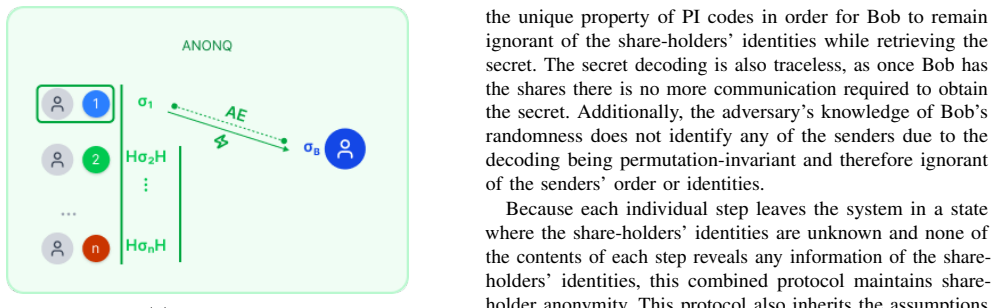
Quantum secret sharing schemes are a family of quantum cryptographic protocols which provide secure quantum encodings, mapping one secret to multiple shares of information such that the original secret cannot be accessed without an authorized set of shares present for decoding. In this work, we describe a protocol that enables sender-anonymity during the secret decoding process. By using permutation-invariant QEC codes along with a set of anonymous quantum transmission algorithms, we construct a quantum anonymous secret sharing scheme that achieves sender-anonymity. We quantify information leakage in ramp quantum secret sharing schemes via the quantum conditional min-entropy, justifying it as a valid measure of leaked information by relating it to the Knill-Laflamme quantum error correction conditions. Finally, we evaluate several permutation-invariant codes using this measure to make observations on the information leakage of intermediate shares for each quantum anonymous secret sharing scheme.
Editorial analysis
A structured set of objections, weighed in public.
Referee Report
Summary. The manuscript proposes a protocol for quantum anonymous secret sharing that achieves sender anonymity by combining permutation-invariant quantum error-correcting codes with anonymous quantum transmission algorithms. It quantifies information leakage in ramp quantum secret sharing schemes via the quantum conditional min-entropy, justifies this measure by relating it to the Knill-Laflamme conditions, and evaluates several permutation-invariant codes to observe leakage properties of intermediate shares.
Significance. If the central construction is sound and the min-entropy quantification is rigorously justified, the work would contribute a concrete framework for sender-anonymous quantum secret sharing with measurable leakage bounds in ramp schemes. The use of established permutation-invariant codes and the provision of explicit code evaluations are strengths that allow falsifiable observations on leakage; these elements support reproducibility and could inform future quantum cryptographic protocols requiring anonymity.
major comments (1)
- The justification that quantum conditional min-entropy validly measures leaked information in ramp schemes by relating it to Knill-Laflamme conditions is load-bearing for the leakage claims but lacks an explicit derivation. While KL conditions characterize perfect error correction with no environment information gain, ramp schemes permit partial leakage to intermediate (neither authorized nor fully unauthorized) sets; the manuscript must show how KL satisfaction in the relevant subspace implies a concrete min-entropy lower bound on that partial leakage, rather than assuming the relation carries over directly.
minor comments (2)
- The description of the anonymous quantum transmission algorithms should include explicit references or a brief self-contained definition to clarify whether they are drawn from prior literature or newly adapted for this setting.
- Notation for the conditional min-entropy and the specific permutation-invariant codes evaluated should be introduced with a table or equation reference early in the manuscript for reader convenience.
Simulated Author's Rebuttal
We thank the referee for their careful reading of the manuscript and for highlighting the need for a more explicit justification of the leakage measure. We address the major comment below and have prepared revisions to strengthen the presentation.
read point-by-point responses
-
Referee: The justification that quantum conditional min-entropy validly measures leaked information in ramp schemes by relating it to Knill-Laflamme conditions is load-bearing for the leakage claims but lacks an explicit derivation. While KL conditions characterize perfect error correction with no environment information gain, ramp schemes permit partial leakage to intermediate (neither authorized nor fully unauthorized) sets; the manuscript must show how KL satisfaction in the relevant subspace implies a concrete min-entropy lower bound on that partial leakage, rather than assuming the relation carries over directly.
Authors: We agree that an explicit derivation is required to rigorously connect the Knill-Laflamme (KL) conditions to a concrete lower bound on the quantum conditional min-entropy for partial leakage in ramp schemes. In the revised manuscript we will insert a dedicated derivation subsection. The argument proceeds by considering the action of the intermediate-share projectors on the code subspace: when the KL conditions hold for the relevant error operators (i.e., the inner products satisfy the required orthogonality and proportionality on that subspace), the post-measurement state of the environment is independent of the secret up to a bounded distinguishability. We then invoke the definition of conditional min-entropy in terms of the maximum guessing probability and obtain an explicit lower bound H_min(S|E) ≥ -log(1 - δ), where δ quantifies the residual overlap permitted by the partial KL violation for intermediate sets. This bound is derived directly from the code’s permutation-invariance properties and does not rely on perfect correction. The new subsection will also include a short example with the [[4,2,2]] permutation-invariant code to illustrate the numerical evaluation of the bound. revision: yes
Circularity Check
No significant circularity detected
full rationale
The paper constructs a quantum anonymous secret sharing scheme by combining permutation-invariant QEC codes with anonymous quantum transmission algorithms, both treated as established external components. Leakage in ramp schemes is quantified using quantum conditional min-entropy and justified via relation to the standard Knill-Laflamme conditions (an independent, externally defined criterion for perfect error correction and zero environment information). No load-bearing step reduces by definition, by fitting a parameter then relabeling it a prediction, or by a self-citation chain that supplies the result. The derivation chain is therefore self-contained against external benchmarks and receives the default non-circularity finding.
Axiom & Free-Parameter Ledger
axioms (1)
- standard math Standard principles of quantum mechanics, quantum error correction, and information theory including Knill-Laflamme conditions
Reference graph
Works this paper leans on
-
[1]
How to share a secret,
A. Shamir, “How to share a secret,”Communications of the ACM, vol. 22, no. 11, pp. 612–613, 1979
1979
-
[2]
Safeguarding cryptographic keys,
G. R. Blakley, “Safeguarding cryptographic keys,” in1979 International workshop on managing requirements knowledge. IEEE Computer Society, 1979, pp. 313–318
1979
-
[3]
General Secure Multi-party Computation from any Linear Secret-Sharing Scheme,
R. Cramer, I. Damg ˚ard, and U. Maurer, “General Secure Multi-party Computation from any Linear Secret-Sharing Scheme,” inAdvances in Cryptology — EUROCRYPT 2000, B. Preneel, Ed. Berlin, Heidelberg: Springer Berlin Heidelberg, 2000, pp. 316–334
2000
-
[4]
Nist special publication 800-57 part 1, revision 4,
E. Barker and Q. Dang, “Nist special publication 800-57 part 1, revision 4,”NIST, Tech. Rep, vol. 16, p. 51, 2016
2016
-
[5]
SIAM Journal on Computing 26(5), 1484– 1509 (Oct 1997)
P. W. Shor, “Polynomial-Time Algorithms for Prime Factorization and Discrete Logarithms on a Quantum Computer,”SIAM J. Comput., vol. 26, no. 5, p. 1484–1509, Oct. 1997. [Online]. Available: http://dx.doi.org/10.1137/S0097539795293172
-
[6]
Status Report on the Third Round of the NIST Post-Quantum Cryptography Standardization Process,
G. Alagicet al., “Status Report on the Third Round of the NIST Post-Quantum Cryptography Standardization Process,” 2022-07-05 04:07:00 2022. [Online]. Available: https://tsapps.nist.gov/publication/ get pdf.cfm?pub id=934458
2022
-
[7]
Quantum cryptography: Public-key distribution and coin tossing,
C. H. Bennett and G. Brassard, “Quantum cryptography: Public-key distribution and coin tossing,” inProc. IEEE Conf. Comput., Syst. Signal Process., 1984, pp. 175–179
1984
-
[8]
Quantum cryptography based on Bell’s theorem
A. K. Ekert, “Quantum cryptography based on Bell’s theorem,”Phys. Rev. Lett., vol. 67, pp. 661–663, Aug 1991. [Online]. Available: https://link.aps.org/doi/10.1103/PhysRevLett.67.661
-
[9]
M. Hillery, V . Buˇzek, and A. Berthiaume, “Quantum secret sharing,” Phys. Rev. A, vol. 59, no. 3, p. 1829–1834, Mar. 1999. [Online]. Available: http://dx.doi.org/10.1103/PhysRevA.59.1829
-
[10]
Theory of quantum secret sharing,
D. Gottesman, “Theory of quantum secret sharing,”Phys. Rev. A, vol. 61, no. 4, p. 042311, 2000
2000
-
[11]
Quantum entanglement for secret sharing and secret splitting,
A. Karlsson, M. Koashi, and N. Imoto, “Quantum entanglement for secret sharing and secret splitting,”Phys. Rev. A, vol. 59, pp. 162–168, Jan 1999. [Online]. Available: https://link.aps.org/doi/10.1103/PhysRevA.59.162
-
[12]
Advance Sharing of Quantum Shares for Classical Secrets,
R. Miyajima and R. Matsumoto, “Advance Sharing of Quantum Shares for Classical Secrets,”IEEE Access, vol. 10, p. 94458–94468, 2022. [Online]. Available: http://dx.doi.org/10.1109/ACCESS.2022.3204389
-
[13]
A Four-Qubits Code that is a Quantum Deletion Error-Correcting Code with the Optimal Length,
M. Hagiwara and A. Nakayama, “A Four-Qubits Code that is a Quantum Deletion Error-Correcting Code with the Optimal Length,”
-
[14]
Available: https://arxiv.org/abs/2001.08405
[Online]. Available: https://arxiv.org/abs/2001.08405
-
[15]
Permutation-Invariant Quantum Codes for Deletion Errors,
T. Shibayama and M. Hagiwara, “Permutation-Invariant Quantum Codes for Deletion Errors,” in2021 IEEE Int. Symp. Inf. Theory (ISIT). IEEE, Jul. 2021, p. 1493–1498. [Online]. Available: http://dx.doi.org/10.1109/ISIT45174.2021.9517870
-
[16]
Measurement-free reconstruction circuit of quantum secrets in quantum secret sharing,
S. Chiwaki and R. Matsumoto, “Measurement-free reconstruction circuit of quantum secrets in quantum secret sharing,”Quantum Inf. Process., vol. 24, no. 10, Sep. 2025. [Online]. Available: http://dx.doi.org/10.1007/s11128-025-04943-y
-
[17]
Advance Sharing with Ogawa et al.’s Ramp Quantum Secret Sharing Scheme,
S. Masumori and R. Matsumoto, “Advance Sharing with Ogawa et al.’s Ramp Quantum Secret Sharing Scheme,” 2024. [Online]. Available: https://arxiv.org/abs/2404.15646
-
[18]
Fully Anonymous Secret Sharing,
A. Bishop, M. Green, Y . Ishai, A. Jain, and P. Lou, “Fully Anonymous Secret Sharing,” inCRYPTO 2025. Berlin, Heidelberg: Springer-Verlag, 2025, p. 356–389. [Online]. Available: https: //doi.org/10.1007/978-3-032-01884-7 12
-
[19]
Anonymous Shamir’s Secret-Sharing via Reed–Solomon Codes Against Permutations, Insertions, and Deletions,
R. Con, “Anonymous Shamir’s Secret-Sharing via Reed–Solomon Codes Against Permutations, Insertions, and Deletions,”IEEE Trans. Inf. Theory, vol. 71, no. 12, pp. 9534–9547, 2025
2025
-
[20]
Anonymous secret sharing schemes,
C. Blundo and D. Stinson, “Anonymous secret sharing schemes,” Discrete Appl. Math., vol. 77, no. 1, pp. 13–28, 1997. [Online]. Available: https://www.sciencedirect.com/science/article/pii/S0166218X97892086
1997
-
[21]
Enhanced quantum secret sharing protocol for anonymous secure communication utilizing W states,
L. Guo-Dong, C. Wen-Chuan, W. Qing-Le, C. Long, M. Ying, and J. Heng-Yue, “Enhanced quantum secret sharing protocol for anonymous secure communication utilizing W states,”iScience, vol. 27, no. 6, p. 109836, 2024. [Online]. Available: https: //www.sciencedirect.com/science/article/pii/S2589004224010587
2024
-
[22]
A Novel Authenticated Quantum Anonymous Secret Sharing for Classical and Quantum Information,
Q. Wang, Y . Xu, G. Li, Y . Han, Y . Zhou, X. Li, and L. Cheng, “A Novel Authenticated Quantum Anonymous Secret Sharing for Classical and Quantum Information,”Advanced Quantum Technologies, vol. 7, no. 12, p. 2400295, 2024. [Online]. Available: https: //advanced.onlinelibrary.wiley.com/doi/abs/10.1002/qute.202400295
-
[23]
Anonymous Quantum Secret Sharing,
Y . Yang, D. Yang, Y . Wang, G.-B. Xu, and D.-H. Jiang, “Anonymous Quantum Secret Sharing,”Adv. Quantum Technol., 07 2025
2025
-
[24]
M. Christandl and S. Wehner,Quantum Anonymous Transmissions. Springer Berlin Heidelberg, 2005, p. 217–235. [Online]. Available: http://dx.doi.org/10.1007/11593447 12
-
[25]
The Operational Meaning of Min- and Max-Entropy,
R. Konig, R. Renner, and C. Schaffner, “The Operational Meaning of Min- and Max-Entropy,”IEEE Trans. Inf. Theory, vol. 55, no. 9, p. 4337–4347, Sep. 2009. [Online]. Available: http://dx.doi.org/10.1109/ TIT.2009.2025545
-
[26]
Theory of Quantum Error Correction for General Noise
E. Knill, R. Laflamme, and L. Viola, “Theory of Quantum Error Correction for General Noise,”Phys. Rev. Lett., vol. 84, no. 11, p. 2525–2528, Mar. 2000. [Online]. Available: http: //dx.doi.org/10.1103/PhysRevLett.84.2525
-
[27]
Multi-Party Quantum Secret Sharing Based on GHZ State,
Z. Li, X. Jiang, and L. Liu, “Multi-Party Quantum Secret Sharing Based on GHZ State,”Entropy-switz., vol. 24, no. 10, 2022. [Online]. Available: https://www.mdpi.com/1099-4300/24/10/1433
2022
-
[28]
Quantum Secret Sharing in Noisy Environment,
M.-M. Wang, Z.-G. Qu, and M. Elhoseny, “Quantum Secret Sharing in Noisy Environment,” inCloud Computing and Security, X. Sun, H.-C. Chao, X. You, and E. Bertino, Eds. Cham: Springer International Publishing, 2017, pp. 100–112
2017
-
[29]
Quantum secret sharing schemes and reversibility of quantum operations,
T. Ogawa, A. Sasaki, M. Iwamoto, and H. Yamamoto, “Quantum secret sharing schemes and reversibility of quantum operations,” Phys. Rev. A, vol. 72, no. 3, Sep. 2005. [Online]. Available: http://dx.doi.org/10.1103/PhysRevA.72.032318
-
[30]
Improving quantum secret-sharing schemes,
A. C. A. Nascimento, J. Mueller-Quade, and H. Imai, “Improving quantum secret-sharing schemes,”Phys. Rev. A, vol. 64, p. 042311, Sep
-
[31]
Quantum authen- tication of classical messages
[Online]. Available: https://link.aps.org/doi/10.1103/PhysRevA.64. 042311
-
[32]
Generalized quantum secret sharing,
S. K. Singh and R. Srikanth, “Generalized quantum secret sharing,” Phys. Rev. A, vol. 71, p. 012328, Jan 2005. [Online]. Available: https://link.aps.org/doi/10.1103/PhysRevA.71.012328
-
[33]
Private quantum channels,
Ambainis, A. and Mosca, M. and Tapp, A. and De Wolf, R., “Private quantum channels,” inProc. Annu. IEEE Symp. F ound. Comput. Sci. (FOCS 2000), 2000, pp. 547–553
2000
-
[34]
Optimal encryption of quantum bits,
P. O. Boykin and V . Roychowdhury, “Optimal encryption of quantum bits,”Phys. Rev. A, vol. 67, p. 042317, Apr 2003. [Online]. Available: https://link.aps.org/doi/10.1103/PhysRevA.67.042317
-
[35]
Scheme for reducing de- coherence in quantum computer memory
P. W. Shor, “Scheme for reducing decoherence in quantum computer memory,”Phys. Rev. A, vol. 52, pp. R2493–R2496, Oct 1995. [Online]. Available: https://link.aps.org/doi/10.1103/PhysRevA.52.R2493
-
[36]
H., Brassard, G., Crépeau, C., Jozsa, R., Peres, A., & Wootters, W
C. H. Bennett, G. Brassard, C. Cr ´epeau, R. Jozsa, A. Peres, and W. K. Wootters, “Teleporting an unknown quantum state via dual classical and Einstein-Podolsky-Rosen channels,”Phys. Rev. Lett., vol. 70, pp. 1895–1899, Mar 1993. [Online]. Available: https://link.aps.org/doi/10.1103/PhysRevLett.70.1895
-
[37]
Unconditional Sender and Recipient Untraceability in Spite of Active Attacks,
M. Waidner, “Unconditional Sender and Recipient Untraceability in Spite of Active Attacks,” inAdvances in Cryptology — EUROCRYPT ’89, J.-J. Quisquater and J. Vandewalle, Eds. Berlin, Heidelberg: Springer Berlin Heidelberg, 1990, pp. 302–319
1990
-
[38]
Quantum data processing and error correction,
B. Schumacher and M. A. Nielsen, “Quantum data processing and error correction,”Phys. Rev. A, vol. 54, no. 4, p. 2629–2635, Oct. 1996. [Online]. Available: http://dx.doi.org/10.1103/PhysRevA.54.2629
-
[39]
Security of quantum key distribution,
R. Renner, “Security of quantum key distribution,”International Journal of Quantum Information, vol. 6, no. 01, pp. 1–127, 2008
2008
-
[40]
A no-go theorem for a two-dimensional self-correcting quantum memory based on stabilizer codes,
S. Bravyi and B. Terhal, “A no-go theorem for a two-dimensional self-correcting quantum memory based on stabilizer codes,”New J. Phys., vol. 11, no. 4, p. 043029, Apr. 2009. [Online]. Available: http://dx.doi.org/10.1088/1367-2630/11/4/043029
-
[41]
Generalized semiquantum secret-sharing schemes,
V . Gheorghiu, “Generalized semiquantum secret-sharing schemes,” Phys. Rev. A, vol. 85, no. 5, May 2012. [Online]. Available: http://dx.doi.org/10.1103/PhysRevA.85.052309
-
[42]
NP-hardness of decoding quantum error-correction codes,
M.-H. Hsieh and F. Le Gall, “NP-hardness of decoding quantum error-correction codes,”Phys. Rev. A, vol. 83, no. 5, May 2011. [Online]. Available: http://dx.doi.org/10.1103/PhysRevA.83.052331
-
[43]
On the hardness of decoding quantum stabilizer codes under the depolarizing channel,
K.-Y . Kuo and C.-C. Lu, “On the hardness of decoding quantum stabilizer codes under the depolarizing channel,” inProc. 2012 IEEE Int. Symp. Inf. Theory (ISIT), 2012, pp. 208–211
2012
-
[44]
Calderbank-Shor-Steane holographic quantum error-correcting codes,
R. J. Harris, N. A. McMahon, G. K. Brennen, and T. M. Stace, “Calderbank-Shor-Steane holographic quantum error-correcting codes,” Phys. Rev. A, vol. 98, no. 5, Nov. 2018. [Online]. Available: http://dx.doi.org/10.1103/PhysRevA.98.052301
-
[45]
Fidelity of Finite Length Quantum Codes in Qubit Erasure Channel,
A. Ashikhmin, “Fidelity of Finite Length Quantum Codes in Qubit Erasure Channel,” inProc. 2020 IEEE Int. Symp. Inf. Theory (ISIT), 2020, pp. 1880–1885
2020
-
[46]
Approximate quantum error correction can lead to better codes,
D. W. Leung, M. A. Nielsen, I. L. Chuang, and Y . Yamamoto, “Approximate quantum error correction can lead to better codes,”Phys. Rev. A, vol. 56, no. 4, p. 2567–2573, Oct. 1997. [Online]. Available: http://dx.doi.org/10.1103/PhysRevA.56.2567
-
[47]
Permutation-invariant quantum coding for quantum deletion channels,
Y . Ouyang, “Permutation-invariant quantum coding for quantum deletion channels,”2021 IEEE Int. Symp. Inf. Theory (ISIT), pp. 1499–1503, 2021
2021
-
[48]
A family of permutationally invariant quantum codes,
A. Aydin, M. A. Alekseyev, and A. Barg, “A family of permutationally invariant quantum codes,”Quantum, vol. 8, p. 1321, Apr. 2024. [Online]. Available: http://dx.doi.org/10.22331/q-2024-04-30-1321
-
[49]
Permutationally invariant codes for quantum error correction,
H. Pollatsek and M. B. Ruskai, “Permutationally invariant codes for quantum error correction,”Linear algebra and its applications, vol. 392, pp. 255–288, 2004
2004
-
[50]
Pauli exchange errors in quantum computation,
M. B. Ruskai, “Pauli Exchange Errors in Quantum Computation,”Phys. Rev. Lett., vol. 85, no. 1, p. 194–197, Jul. 2000. [Online]. Available: http://dx.doi.org/10.1103/PhysRevLett.85.194
-
[51]
E. Kubischta and I. Teixeira, “Family of Quantum Codes with Exotic Transversal Gates,”Phys. Rev. Lett., vol. 131, no. 24, Dec. 2023. [Online]. Available: http://dx.doi.org/10.1103/PhysRevLett.131.240601
-
[52]
Permutation-invariant quantum codes,
Y . Ouyang, “Permutation-invariant quantum codes,”Phys. Rev. A, vol. 90, p. 062317, Dec 2014. [Online]. Available: https: //link.aps.org/doi/10.1103/PhysRevA.90.062317
-
[53]
Anonymous voting by two-round public discussion,
F. Hao, P. Y . Ryan, and P. Zielinski, “Anonymous voting by two-round public discussion,”IET Inf. Secur ., vol. 4, no. 2, pp. 62–67, 2010
2010
-
[54]
Quantum protocols for anonymous voting and surveying,
J. A. Vaccaro, J. Spring, and A. Chefles, “Quantum protocols for anonymous voting and surveying,”Phys. Rev. A: At. Mol. Opt. Phys., vol. 75, no. 1, p. 012333, 2007
2007
-
[55]
Anonymous and secret communication in quantum networks,
C. Thalacker, F. Hahn, J. de Jong, A. Pappa, and S. Barz, “Anonymous and secret communication in quantum networks,”New Journal of Physics, vol. 23, no. 8, p. 083026, Aug. 2021. [Online]. Available: http://dx.doi.org/10.1088/1367-2630/ac1808
-
[56]
Anonymous transmission in a noisy quantum network using the W state,
V . Lipinska, G. Murta, and S. Wehner, “Anonymous transmission in a noisy quantum network using the W state,”Phys. Rev. A, vol. 98, no. 5, p. 052320, 2018
2018
-
[57]
Anonymous quantum communication,
G. Brassard, A. Broadbent, J. Fitzsimons, S. Gambs, and A. Tapp, “Anonymous quantum communication,” inASIACRYPT 2007. Springer, 2007, pp. 460–473
2007
-
[58]
Anonymity for Practical Quantum Networks,
A. Unnikrishnan, I. J. MacFarlane, R. Yi, E. Diamanti, D. Markham, and I. Kerenidis, “Anonymity for Practical Quantum Networks,” Phys. Rev. Lett., vol. 122, p. 240501, Jun 2019. [Online]. Available: https://link.aps.org/doi/10.1103/PhysRevLett.122.240501
-
[59]
Approximate Quantum Error-Correcting Codes and Secret Sharing Schemes,
C. Crepeau, D. Gottesman, and A. Smith, “Approximate Quantum Error-Correcting Codes and Secret Sharing Schemes,” 2005. [Online]. Available: https://arxiv.org/abs/quant-ph/0503139
-
[60]
Approximate reconstructability of quantum states and noisy quantum secret sharing schemes,
Y . Ouyang, K. Goswami, J. Romero, B. C. Sanders, M.-H. Hsieh, and M. Tomamichel, “Approximate reconstructability of quantum states and noisy quantum secret sharing schemes,”Phys. Rev. A, vol. 108, p. 012425, Jul 2023. [Online]. Available: https://link.aps.org/doi/10.1103/PhysRevA.108.012425
-
[61]
Asymptotically good bosonic Fock state codes
D. Elimelech, A. Aydin, and A. Barg, “Asymptotically good bosonic Fock state codes,” 2026. [Online]. Available: https://arxiv.org/abs/2603.15190
work page internal anchor Pith review Pith/arXiv arXiv 2026
-
[62]
Semidefinite Programming Bounds on the Size of Entanglement-Assisted Codeword Stabilized Quantum Codes,
C.-Y . Lai, P.-C. Tseng, and W.-H. Yu, “Semidefinite Programming Bounds on the Size of Entanglement-Assisted Codeword Stabilized Quantum Codes,”IEEE Trans. Inf. Theory, vol. 70, no. 11, pp. 7867–7881, 2024
2024
-
[63]
G. A. Munn ´e, A. Nemec, and F. Huber, “SDP bounds on quantum codes,” 2025. [Online]. Available: https://arxiv.org/abs/2408.10323
discussion (0)
Sign in with ORCID, Apple, or X to comment. Anyone can read and Pith papers without signing in.