Recognition: unknown
Generalized Category Discovery under Domain Shifts: From Vision to Vision-Language Models
Pith reviewed 2026-05-09 20:14 UTC · model grok-4.3
The pith
Adapting foundation models via feature disentanglement enables generalized category discovery under domain shifts.
A machine-rendered reading of the paper's core claim, the machinery that carries it, and where it could break.
Core claim
Generalized Category Discovery under domain shifts is addressed by proposing HiLo for self-supervised vision models through multi-level feature extraction and mutual information minimization combined with PatchMix and curriculum sampling, HLPrompt which adds semantic-aware spatial prompt tuning, and VLPrompt for vision-language models using factorized textual prompts and cross-modal consistency regularization, all yielding consistent improvements over strong baselines in experiments on synthetic corruptions and real-world multi-domain shifts.
What carries the argument
The HiLo disentanglement process that extracts features at multiple levels and minimizes mutual information to separate domain noise from semantic content.
If this is right
- Vision and vision-language foundation models can be effectively adapted for GCD tasks involving domain shifts using shared principles.
- Multi-level feature disentanglement with mutual information minimization reliably improves performance on shifted data.
- Semantic-aware prompt tuning suppresses domain and background noise to aid discovery.
- Cross-modal regularization in vision-language models enhances consistency for category discovery.
Where Pith is reading between the lines
- Similar disentanglement strategies could be applied to other computer vision tasks affected by domain shifts, such as object detection in varying environments.
- Exploring the combination of these methods with emerging foundation models might yield further gains in robustness.
- Validating on datasets with more severe or novel domain shifts would test the limits of the approach.
Load-bearing premise
That multi-level feature disentanglement via mutual information minimization and semantic-aware prompt tuning can reliably separate domain noise from semantic content without discarding discriminative information needed for category discovery.
What would settle it
Experiments on a new set of domain-shifted datasets where the proposed methods show no advantage or underperform compared to standard GCD baselines without the disentanglement components would falsify the central claim.
Figures


read the original abstract
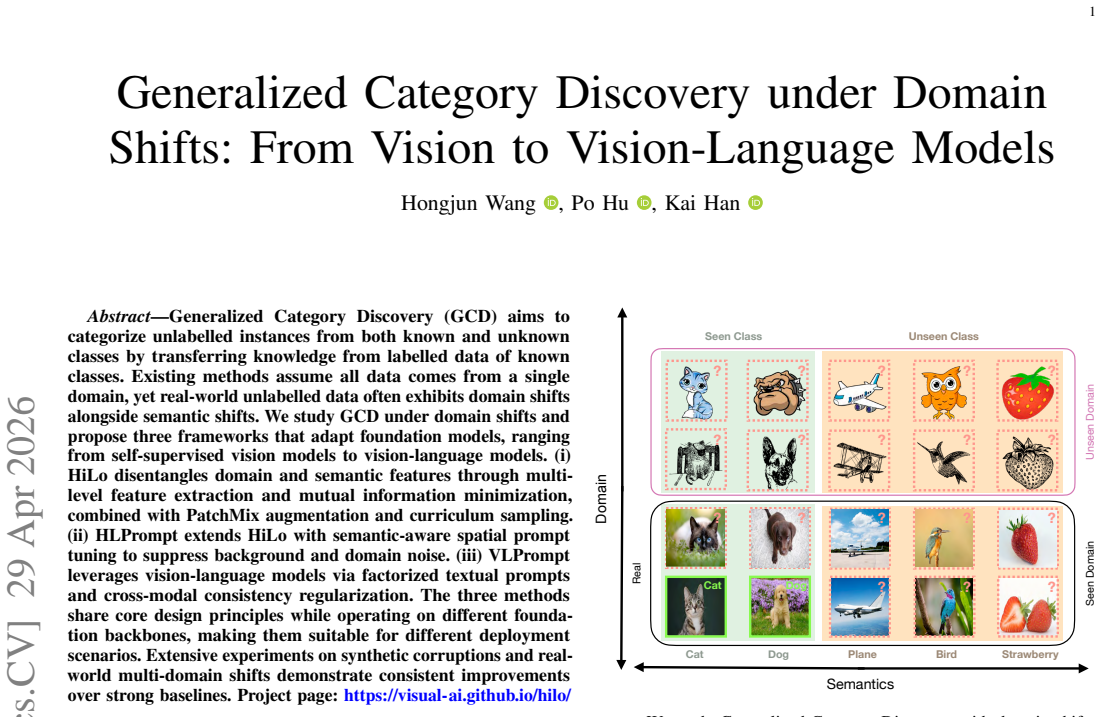
Generalized Category Discovery (GCD) aims to categorize unlabelled instances from both known and unknown classes by transferring knowledge from labelled data of known classes. Existing methods assume all data comes from a single domain, yet real-world unlabelled data often exhibits domain shifts alongside semantic shifts. We study GCD under domain shifts and propose three frameworks that adapt foundation models, ranging from self-supervised vision models to vision-language models. (i) HiLo disentangles domain and semantic features through multi-level feature extraction and mutual information minimization, combined with PatchMix augmentation and curriculum sampling. (ii) HLPrompt extends HiLo with semantic-aware spatial prompt tuning to suppress background and domain noise. (iii) VLPrompt leverages vision-language models via factorized textual prompts and cross-modal consistency regularization. The three methods share core design principles while operating on different foundation backbones, making them suitable for different deployment scenarios. Extensive experiments on synthetic corruptions and real-world multi-domain shifts demonstrate consistent improvements over strong baselines. Project page: https://visual-ai.github.io/hilo/
Editorial analysis
A structured set of objections, weighed in public.
Referee Report
Summary. The paper studies Generalized Category Discovery (GCD) under domain shifts and introduces three frameworks adapting foundation models: HiLo, which disentangles domain and semantic features using multi-level extraction and mutual information minimization along with PatchMix augmentation and curriculum sampling; HLPrompt, extending HiLo with semantic-aware spatial prompt tuning; and VLPrompt, leveraging vision-language models through factorized textual prompts and cross-modal consistency regularization. The authors claim that these methods, sharing core design principles, achieve consistent improvements over strong baselines in experiments involving synthetic corruptions and real-world multi-domain shifts.
Significance. If the results hold, this work would be significant for extending GCD to realistic scenarios with both semantic and domain shifts. The provision of adaptable frameworks for different backbones (vision to VLM) is a positive aspect, allowing flexibility in deployment. The focus on disentanglement and prompt-based approaches could inspire further research in robust category discovery.
major comments (2)
- [Abstract] Abstract: The claim of 'consistent improvements over strong baselines' is not accompanied by any quantitative metrics, specific baseline comparisons, or ablation studies, which is critical for substantiating the effectiveness of the proposed disentanglement and regularization techniques.
- [§3 (HiLo framework)] §3 (HiLo framework): The mutual information minimization for multi-level feature disentanglement is load-bearing for the claim that domain noise is separated from semantic content without loss of discriminative signals for novel classes. However, no ablations isolate this component's contribution, and no metrics (e.g., mutual information with ground-truth labels) are mentioned to verify preservation of semantic information, particularly when domain shifts may correlate with class boundaries.
Simulated Author's Rebuttal
We thank the referee for their constructive comments, which help clarify how to better substantiate our claims. We provide point-by-point responses to the major comments below and outline the revisions we will make to the manuscript.
read point-by-point responses
-
Referee: [Abstract] Abstract: The claim of 'consistent improvements over strong baselines' is not accompanied by any quantitative metrics, specific baseline comparisons, or ablation studies, which is critical for substantiating the effectiveness of the proposed disentanglement and regularization techniques.
Authors: We agree that the abstract would benefit from greater specificity to support the high-level claim. The current abstract is intentionally concise, with all quantitative results, baseline comparisons, and ablations reserved for Section 4 and the associated tables/figures. In the revised manuscript we will update the abstract to briefly reference the scale of improvements (e.g., consistent gains across synthetic and real multi-domain benchmarks) while directing readers to the detailed experimental evidence. This change preserves abstract length while addressing the concern. revision: yes
-
Referee: [§3 (HiLo framework)] §3 (HiLo framework): The mutual information minimization for multi-level feature disentanglement is load-bearing for the claim that domain noise is separated from semantic content without loss of discriminative signals for novel classes. However, no ablations isolate this component's contribution, and no metrics (e.g., mutual information with ground-truth labels) are mentioned to verify preservation of semantic information, particularly when domain shifts may correlate with class boundaries.
Authors: We concur that an isolated ablation of the mutual information (MI) minimization term and supporting disentanglement metrics would strengthen the paper. The manuscript currently ablates the full HiLo pipeline and auxiliary components (PatchMix, curriculum sampling), but does not isolate MI removal. We will add a targeted ablation that removes only the MI term and reports the resulting drop in GCD accuracy for both known and novel classes. We will also include quantitative verification metrics, such as estimated MI between learned features and domain labels (expected reduction) versus class labels (expected preservation). Finally, we will add a short analysis discussing the case where domain shifts correlate with class boundaries and its implications for the method. revision: yes
Circularity Check
No circularity: empirical method proposals with experimental validation
full rationale
The paper proposes three new frameworks (HiLo, HLPrompt, VLPrompt) for GCD under domain shifts, describing their components (multi-level feature extraction with MI minimization, PatchMix, prompt tuning, cross-modal regularization) and supporting performance claims solely via experiments on synthetic corruptions and real multi-domain data. No equations, predictions, or first-principles results are presented that reduce by construction to fitted parameters, self-definitions, or self-citation chains; improvements are reported as observed outcomes, not quantities defined from the inputs. The derivation chain is therefore self-contained and non-circular.
Axiom & Free-Parameter Ledger
axioms (1)
- domain assumption Foundation model features contain separable domain-style and semantic-content components that can be isolated by mutual information minimization and prompt tuning.
Reference graph
Works this paper leans on
-
[1]
Category discovery: An open-world perspective,
Z. He, Y . Liu, and K. Han, “Category discovery: An open-world perspective,”arXiv preprint arXiv:2509.22542, 2025
-
[2]
Learning to discover novel visual categories via deep transfer clustering,
K. Han, A. Vedaldi, and A. Zisserman, “Learning to discover novel visual categories via deep transfer clustering,” inICCV, 2019
2019
-
[3]
Generalized category discovery,
S. Vaze, K. Han, A. Vedaldi, and A. Zisserman, “Generalized category discovery,” inCVPR, 2022
2022
-
[4]
Parametric classification for generalized category discovery: A baseline study,
X. Wen, B. Zhao, and X. Qi, “Parametric classification for generalized category discovery: A baseline study,” inICCV, 2023
2023
-
[5]
Promptcal: Contrastive affinity learning via auxiliary prompts for generalized novel category discovery,
S. Zhang, S. Khan, Z. Shen, M. Naseer, G. Chen, and F. Khan, “Promptcal: Contrastive affinity learning via auxiliary prompts for generalized novel category discovery,” inCVPR, 2023
2023
-
[6]
Dynamic conceptional contrastive learning for generalized category discovery,
N. Pu, Z. Zhong, and N. Sebe, “Dynamic conceptional contrastive learning for generalized category discovery,” inCVPR, 2023
2023
-
[7]
Domain-adversarial training of neural networks,
Y . Ganin, E. Ustinova, H. Ajakan, P. Germain, H. Larochelle, F. Lavio- lette, M. Marchand, and V . Lempitsky, “Domain-adversarial training of neural networks,”JMLR, 2016
2016
-
[8]
Deep transfer learning with joint adaptation networks,
M. Long, H. Zhu, J. Wang, and M. I. Jordan, “Deep transfer learning with joint adaptation networks,” inICML, 2017
2017
-
[9]
Patch-mix transformer for unsupervised domain adaptation: A game perspective,
J. Zhu, H. Bai, and L. Wang, “Patch-mix transformer for unsupervised domain adaptation: A game perspective,” inCVPR, 2023
2023
-
[10]
Domain generalization with mixstyle,
K. Zhou, Y . Yang, Y . Qiao, and T. Xiang, “Domain generalization with mixstyle,” inICLR, 2021
2021
-
[11]
Gradient matching for domain generalization,
Y . Shi, J. Seely, P. H. S. Torr, N. Siddharth, A. Hannun, N. Usunier, and G. Synnaeve, “Gradient matching for domain generalization,” in ICLR, 2022
2022
-
[12]
Emerging properties in self-supervised vision transformers,
M. Caron, H. Touvron, I. Misra, H. J ´egou, J. Mairal, P. Bojanowski, and A. Joulin, “Emerging properties in self-supervised vision transformers,” inICCV, 2021
2021
-
[13]
DINOv2: Learning Robust Visual Features without Supervision
M. Oquab, T. Darcet, T. Moutakanni, H. V o, M. Szafraniec, V . Khalidov, P. Fernandez, D. Haziza, F. Massa, A. El-Nouby, M. Assran, N. Ballas, W. Galuba, R. Howes, P.-Y . Huang, S.-W. Li, I. Misra, M. Rabbat, V . Sharma, G. Synnaeve, H. Xu, H. J ´egou, J. Mairal, P. Labatut, A. Joulin, and P. Bojanowski, “Dinov2: Learning robust visual features without su...
work page internal anchor Pith review Pith/arXiv arXiv 2023
-
[14]
O. Sim ´eoni, H. V . V o, M. Seitzer, F. Baldassarre, M. Oquab, C. Jose, V . Khalidov, M. Szafraniec, S. Yi, M. Ramamonjisoa, F. Massa, D. Haziza, L. Wehrstedt, J. Wang, T. Darcet, T. Moutakanni, L. Sentana, C. Roberts, A. Vedaldi, J. Tolan, J. Brandt, C. Couprie, J. Mairal, H. J ´egou, P. Labatut, and P. Bojanowski, “DINOv3,”arXiv preprint arXiv:2508.10104, 2025
work page internal anchor Pith review Pith/arXiv arXiv 2025
-
[15]
Learning transferable visual models from natural language supervision,
A. Radford, J. W. Kim, C. Hallacy, A. Ramesh, G. Goh, S. Agarwal, G. Sastry, A. Askell, P. Mishkin, J. Clark, G. Krueger, and I. Sutskever, “Learning transferable visual models from natural language supervision,” inICML, 2021
2021
-
[16]
Normalized cuts and image segmentation,
J. Shi and J. Malik, “Normalized cuts and image segmentation,”IEEE TPAMI, 2000
2000
-
[17]
Hilo: A learning framework for generalized category discovery robust to domain shifts,
H. Wang, S. Vaze, and K. Han, “Hilo: A learning framework for generalized category discovery robust to domain shifts,” inICLR, 2025
2025
-
[18]
Automatically discovering and learning new visual categories with ranking statistics,
K. Han, S.-A. Rebuffi, S. Ehrhardt, A. Vedaldi, and A. Zisserman, “Automatically discovering and learning new visual categories with ranking statistics,”ICLR, 2020
2020
-
[19]
Autonovel: Automatically discovering and learning novel visual categories,
——, “Autonovel: Automatically discovering and learning novel visual categories,”IEEE TPAMI, 2021
2021
-
[20]
Neighborhood contrastive learning for novel class discovery,
Z. Zhong, E. Fini, S. Roy, Z. Luo, E. Ricci, and N. Sebe, “Neighborhood contrastive learning for novel class discovery,” inCVPR, 2021
2021
-
[21]
A unified objective for novel class discovery,
E. Fini, E. Sangineto, S. Lathuili `ere, Z. Zhong, M. Nabi, and E. Ricci, “A unified objective for novel class discovery,” inICCV, 2021. 13
2021
-
[22]
Joint representation learning and novel category discovery on single- and multi-modal data,
X. Jia, K. Han, Y . Zhu, and B. Green, “Joint representation learning and novel category discovery on single- and multi-modal data,” inICCV, 2021
2021
-
[23]
Openmix: Reviving known knowledge for discovering novel visual categories in an open world,
Z. Zhong, L. Zhu, Z. Luo, S. Li, Y . Yang, and N. Sebe, “Openmix: Reviving known knowledge for discovering novel visual categories in an open world,” inCVPR, 2021
2021
-
[24]
Class-relation knowledge distillation for novel class discovery,
P. Gu, C. Zhang, R. Xu, and X. He, “Class-relation knowledge distillation for novel class discovery,” inICCV, 2023
2023
-
[25]
Novel visual category discovery with dual ranking statistics and mutual knowledge distillation,
B. Zhao and K. Han, “Novel visual category discovery with dual ranking statistics and mutual knowledge distillation,” inNeurIPS, 2021
2021
-
[26]
Novel class discovery without forgetting,
K. J. Joseph, S. Paul, G. Aggarwal, S. Biswas, P. Rai, K. Han, and V . N. Balasubramanian, “Novel class discovery without forgetting,” in ECCV, 2022
2022
-
[27]
Learning semi-supervised gaussian mixture models for generalized category discovery,
B. Zhao, X. Wen, and K. Han, “Learning semi-supervised gaussian mixture models for generalized category discovery,” inICCV, 2023
2023
-
[28]
Cipr: An efficient framework with cross-instance positive relations for generalized category discovery,
S. Hao, K. Han, and K.-Y . K. Wong, “Cipr: An efficient framework with cross-instance positive relations for generalized category discovery,” TMLR, 2023
2023
-
[29]
SEAL: Semantic-aware hierarchical learning for generalized category discovery,
Z. He, Y . Liu, and K. Han, “SEAL: Semantic-aware hierarchical learning for generalized category discovery,” inNeurIPS, 2025
2025
-
[30]
Hyperbolic category discovery,
Y . Liu, Z. He, and K. Han, “Hyperbolic category discovery,” inCVPR, 2025
2025
-
[31]
Debgcd: Debiased learning with distribution guidance for generalized category discovery,
Y . Liu and K. Han, “Debgcd: Debiased learning with distribution guidance for generalized category discovery,” inICLR, 2025
2025
-
[32]
Learn to categorize or categorize to learn? self-coding for generalized category discovery,
S. Rastegar, H. Doughty, and C. Snoek, “Learn to categorize or categorize to learn? self-coding for generalized category discovery,” inNeurIPS, 2024
2024
-
[33]
Partco: Part-level correspondence priors enhance category discovery,
F. J. Cendra and K. Han, “Partco: Part-level correspondence priors enhance category discovery,”arXiv preprint arXiv:2509.22769, 2025
-
[34]
R. Ouldnoughi, C.-W. Kuo, and Z. Kira, “CLIP-GCD: Simple language guided generalized category discovery,”arXiv preprint arXiv:2305.10420, 2023
-
[35]
Consistent prompt tuning for generalized category discovery,
M. Yang, J. Yin, Y . Gu, C. Deng, H. Zhang, and H. Zhu, “Consistent prompt tuning for generalized category discovery,”IJCV, 2025
2025
-
[36]
GET: Unlocking the multi-modal potential of CLIP for generalized category discovery,
E. Wang, Z. Peng, Z. Xie, F. Yang, X. Liu, and M.-M. Cheng, “GET: Unlocking the multi-modal potential of CLIP for generalized category discovery,” inCVPR, 2025
2025
-
[37]
Learning to prompt for vision-language models,
K. Zhou, J. Yang, C. C. Loy, and Z. Liu, “Learning to prompt for vision-language models,”IJCV, 2022
2022
-
[38]
Conditional prompt learning for vision-language models,
——, “Conditional prompt learning for vision-language models,” in CVPR, 2022
2022
-
[39]
Visual prompt tuning,
M. Jia, L. Tang, B.-C. Chen, C. Cardie, S. Belongie, B. Hariharan, and S.-N. Lim, “Visual prompt tuning,” inECCV, 2022
2022
-
[40]
Sptnet: An efficient alternative framework for generalized category discovery with spatial prompt tuning,
H. Wang, S. Vaze, and K. Han, “Sptnet: An efficient alternative framework for generalized category discovery with spatial prompt tuning,” inICLR, 2024
2024
-
[41]
Promptccd: Learning gaussian mixture prompt pool for continual category discovery,
F. J. Cendra, B. Zhao, and K. Han, “Promptccd: Learning gaussian mixture prompt pool for continual category discovery,” inECCV, 2024
2024
-
[42]
Generalized category discovery under domain shift: A frequency domain perspective,
W. Feng and Z. Ge, “Generalized category discovery under domain shift: A frequency domain perspective,” inNeurIPS, 2025
2025
-
[43]
Deep Domain Confusion: Maximizing for Domain Invariance
E. Tzeng, J. Hoffman, N. Zhang, K. Saenko, and T. Darrell, “Deep domain confusion: Maximizing for domain invariance,”arXiv preprint arXiv:1412.3474, 2014
work page Pith review arXiv 2014
-
[44]
Learning transferable features with deep adaptation networks,
M. Long, Y . Cao, J. Wang, and M. Jordan, “Learning transferable features with deep adaptation networks,” inICML, 2015
2015
-
[45]
Open set domain adaptation,
P. Panareda Busto and J. Gall, “Open set domain adaptation,” inICCV, 2017
2017
-
[46]
Deep coral: Correlation alignment for deep domain adaptation,
B. Sun and K. Saenko, “Deep coral: Correlation alignment for deep domain adaptation,” inECCV Workshop, 2016
2016
-
[47]
Adversarial discriminative domain adaptation,
E. Tzeng, J. Hoffman, K. Saenko, and T. Darrell, “Adversarial discriminative domain adaptation,” inCVPR, 2017
2017
-
[48]
Discriminative adversarial domain adaptation,
H. Tang and K. Jia, “Discriminative adversarial domain adaptation,” in AAAI, 2020
2020
-
[49]
Conditional adversarial domain adaptation,
M. Long, Z. Cao, J. Wang, and M. I. Jordan, “Conditional adversarial domain adaptation,” inNeurIPS, 2018
2018
-
[50]
Sliced wasserstein discrepancy for unsupervised domain adaptation,
C.-Y . Lee, T. Batra, M. H. Baig, and D. Ulbricht, “Sliced wasserstein discrepancy for unsupervised domain adaptation,” inCVPR, 2019
2019
-
[51]
Unsupervised domain adaptation for semantic segmentation via class-balanced self-training,
Y . Zou, Z. Yu, B. V . Kumar, and J. Wang, “Unsupervised domain adaptation for semantic segmentation via class-balanced self-training,” inECCV, 2018
2018
-
[52]
Model adaptation: Unsupervised domain adaptation without source data,
R. Li, Q. Jiao, W. Cao, H.-S. Wong, and S. Wu, “Model adaptation: Unsupervised domain adaptation without source data,” inCVPR, 2020
2020
-
[53]
Fixbi: Bridging domain spaces for unsupervised domain adaptation,
J. Na, H. Jung, H. J. Chang, and W. Hwang, “Fixbi: Bridging domain spaces for unsupervised domain adaptation,” inCVPR, 2021
2021
-
[54]
Reusing the task-specific classifier as a discriminator: Discriminator-free adversarial domain adaptation,
L. Chen, H. Chen, Z. Wei, X. Jin, X. Tan, Y . Jin, and E. Chen, “Reusing the task-specific classifier as a discriminator: Discriminator-free adversarial domain adaptation,” inCVPR, 2022
2022
-
[55]
Cross-domain gradient discrepancy minimization for unsupervised domain adaptation,
Z. Du, J. Li, H. Su, L. Zhu, and K. Lu, “Cross-domain gradient discrepancy minimization for unsupervised domain adaptation,” in CVPR, 2021
2021
-
[56]
Minimum class confusion for versatile domain adaptation,
Y . Jin, X. Wang, M. Long, and J. Wang, “Minimum class confusion for versatile domain adaptation,” inECCV, 2020
2020
-
[57]
Learning to generalize: Meta-learning for domain generalization,
D. Li, Y . Yang, Y .-Z. Song, and T. Hospedales, “Learning to generalize: Meta-learning for domain generalization,” inAAAI, 2018
2018
-
[58]
Domain generalization via invariant feature representation,
K. Muandet, D. Balduzzi, and B. Sch ¨olkopf, “Domain generalization via invariant feature representation,” inICML, 2013
2013
-
[59]
Swad: Domain generalization by seeking flat minima,
J. Cha, S. Chun, K. Lee, H.-C. Cho, S. Park, Y . Lee, and S. Park, “Swad: Domain generalization by seeking flat minima,” inNeurIPS, 2021
2021
-
[60]
Domain generalization using causal matching,
D. Mahajan, S. Tople, and A. Sharma, “Domain generalization using causal matching,” inICML, 2021
2021
-
[61]
Domain randomization for transferring deep neural networks from simulation to the real world,
J. Tobin, R. Fong, A. Ray, J. Schneider, W. Zaremba, and P. Abbeel, “Domain randomization for transferring deep neural networks from simulation to the real world,” inIROS, 2017
2017
-
[62]
Representation Learning with Contrastive Predictive Coding
A. v. d. Oord, Y . Li, and O. Vinyals, “Representation learning with contrastive predictive coding,”arXiv preprint arXiv:1807.03748, 2018
work page internal anchor Pith review Pith/arXiv arXiv 2018
-
[63]
Dynamic few-shot visual learning without forgetting,
S. Gidaris and N. Komodakis, “Dynamic few-shot visual learning without forgetting,” inCVPR, 2018
2018
-
[64]
Masked siamese networks for label-efficient learning,
M. Assran, M. Caron, I. Misra, P. Bojanowski, F. Bordes, P. Vincent, A. Joulin, M. Rabbat, and N. Ballas, “Masked siamese networks for label-efficient learning,” inECCV, 2022
2022
-
[65]
Learning deep representations by mutual information estimation and maximization,
R. D. Hjelm, A. Fedorov, S. Lavoie-Marchildon, K. Grewal, P. Bachman, A. Trischler, and Y . Bengio, “Learning deep representations by mutual information estimation and maximization,” inICLR, 2018
2018
-
[66]
Transmix: Attend to mix for vision transformers,
J.-N. Chen, S. Sun, J. He, P. H. Torr, A. Yuille, and S. Bai, “Transmix: Attend to mix for vision transformers,” inCVPR, 2022
2022
-
[67]
Rethinking the inception architecture for computer vision,
C. Szegedy, V . Vanhoucke, S. Ioffe, J. Shlens, and Z. Wojna, “Rethinking the inception architecture for computer vision,” inCVPR, 2016
2016
-
[68]
Scheduled sampling for sequence prediction with recurrent neural networks,
S. Bengio, O. Vinyals, N. Jaitly, and N. Shazeer, “Scheduled sampling for sequence prediction with recurrent neural networks,” inNeurIPS, 2015
2015
-
[69]
Exploring visual prompts for adapting large- scale models
H. Bahng, A. Jahanian, S. Sankaranarayanan, and P. Isola, “Explor- ing visual prompts for adapting large-scale models,”arXiv preprint arXiv:2203.17274, 2022
-
[70]
Open-set recognition: A good closed-set classifier is all you need,
S. Vaze, K. Han, A. Vedaldi, and A. Zisserman, “Open-set recognition: A good closed-set classifier is all you need,” inICLR, 2021
2021
-
[71]
Benchmarking neural network robustness to common corruptions and perturbations,
D. Hendrycks and T. Dietterich, “Benchmarking neural network robustness to common corruptions and perturbations,” inICLR, 2019
2019
-
[72]
The Caltech-UCSD Birds-200-2011 dataset,
C. Wah, S. Branson, P. Welinder, P. Perona, and S. Belongie, “The Caltech-UCSD Birds-200-2011 dataset,” California Institute of Tech- nology, Tech. Rep., 2011
2011
-
[73]
3d object representations for fine-grained categorization,
J. Krause, M. Stark, J. Deng, and L. Fei-Fei, “3d object representations for fine-grained categorization,” inICCV workshop, 2013
2013
-
[74]
Fine-Grained Visual Classification of Aircraft
S. Maji, E. Rahtu, J. Kannala, M. Blaschko, and A. Vedaldi, “Fine- grained visual classification of aircraft,”arXiv preprint arXiv:1306.5151, 2013
work page internal anchor Pith review arXiv 2013
-
[75]
Moment matching for multi-source domain adaptation,
X. Peng, Q. Bai, X. Xia, Z. Huang, K. Saenko, and B. Wang, “Moment matching for multi-source domain adaptation,” inICCV, 2019
2019
-
[76]
Open-world semi-supervised learning,
K. Cao, M. Brbic, and J. Leskovec, “Open-world semi-supervised learning,” inICLR, 2021
2021
-
[77]
In search of forgotten domain generaliza- tion,
P. Mayilvahanan, R. S. Zimmermann, T. Wiedemer, E. Rusak, A. Juhos, M. Bethge, and W. Brendel, “In search of forgotten domain generaliza- tion,” inICLR, 2025
2025
-
[78]
Does clip’s generalization performance mainly stem from high train-test similarity?
P. Mayilvahanan, T. Wiedemer, E. Rusak, M. Bethge, and W. Brendel, “Does clip’s generalization performance mainly stem from high train-test similarity?” inICLR, 2024
2024
-
[79]
Analysis of representations for domain adaptation,
S. Ben-David, J. Blitzer, K. Crammer, and F. Pereira, “Analysis of representations for domain adaptation,” inNeurIPS, 2006
2006
-
[80]
A theory of learning from different domains,
S. Ben-David, J. Blitzer, K. Crammer, A. Kulesza, F. Pereira, and J. W. Vaughan, “A theory of learning from different domains,”Machine Learning, 2010
2010
discussion (0)
Sign in with ORCID, Apple, or X to comment. Anyone can read and Pith papers without signing in.