Recognition: unknown
Generative Modeling with Orbit-Space Particle Flow Matching
Pith reviewed 2026-05-08 02:11 UTC · model grok-4.3
The pith
Orbit-space canonicalization in particle flow matching lets models generate accurate 3D shapes with up to 5x fewer steps and 26x fewer parameters.
A machine-rendered reading of the paper's core claim, the machinery that carries it, and where it could break.
Core claim
OGPP shows that orbit-space canonicalization of probability-path terminal endpoints, combined with particle index embeddings and geometric paths whose terminal velocities are aware of arc length, reduces per-particle target variance and lets the learned flow encode surface normals as a byproduct, yielding particle generators that match prior accuracy on ShapeNet and minimal surfaces while using 5x fewer steps and up to 26x fewer parameters.
What carries the argument
Orbit-Space Geometric Probability Paths (OGPP), a framework that performs orbit-space canonicalization of flow endpoints, supplies index embeddings for particle specialization, and defines arc-length-aware terminal velocities that generate normals directly from the flow.
If this is right
- Metric error on minimal-surface benchmarks drops by up to two orders of magnitude after a single inference step.
- ShapeNet generation reaches state-of-the-art quality using 5 times fewer steps than previous flow-matching methods.
- Airplane EMD scores become comparable to DiT-3D while using 26 times fewer parameters and 5 times fewer steps.
- Single-shape encoding produces normals and reconstructions competitive with 6D generators while staying entirely in 3D.
Where Pith is reading between the lines
- The same orbit-space treatment could be applied to other permutation-invariant particle tasks such as molecular conformation generation to test variance reduction outside graphics.
- Because normals emerge from the flow without supervision, the approach might be extended to predict higher-order geometric fields like mean curvature by redefining the terminal velocity accordingly.
- If the arc-length conditioning proves robust, the framework could support time-evolving particle systems such as fluid simulations where velocities already carry physical meaning.
Load-bearing premise
The assumption that orbit-space canonicalization plus index embeddings and arc-length-aware velocities will reliably cut target variance and allow the flow to encode normals without added supervision or post-processing.
What would settle it
A single ablation experiment on the minimal-surface benchmarks that removes only the orbit-space canonicalization step and measures whether the one-step metric error reduction falls below one order of magnitude.
Figures




read the original abstract
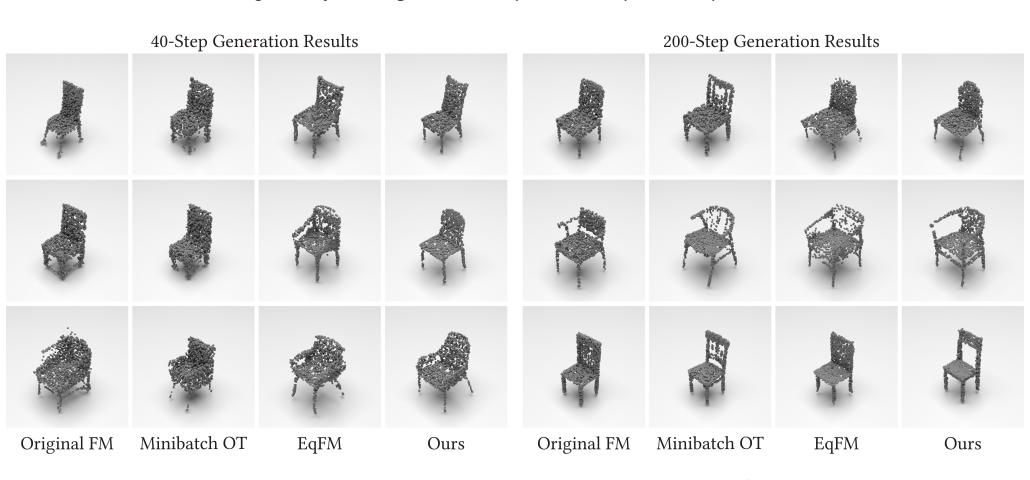
We present Orbit-Space Geometric Probability Paths (OGPP), a particle-native flow-matching framework for generative modeling of particle systems. OGPP is motivated by two insights: (i) particles are defined up to permutation symmetries, so anonymous indexing inflates per-index target variance and yields curved, hard-to-learn flows; and (ii) particles live in physical space, so the flow terminal velocity has physical meaning and can encode geometric attributes, e.g., surface normals. OGPP instantiates three key components: (1) orbit-space canonicalization of the probability-path terminal endpoint, (2) particle index embeddings for role specialization, and (3) geometric probability paths with arc-length-aware terminal velocities that generate normals as a byproduct of the flow. We evaluate OGPP on minimal-surface benchmarks, where it reduces metric error by up to two orders of magnitude in a single inference step; on ShapeNet, where it matches the state of the art with 5x fewer steps and reaches airplane EMD comparable to DiT-3D with 26x fewer parameters and 5x fewer steps; and on single-shape encoding, where it produces normals and reconstructions competitive with 6D generators while operating entirely in 3D.
Editorial analysis
A structured set of objections, weighed in public.
Referee Report
Summary. The manuscript introduces Orbit-Space Geometric Probability Paths (OGPP), a particle-native flow-matching framework for generative modeling of particle systems. It addresses permutation symmetries via orbit-space canonicalization of terminal endpoints, incorporates particle index embeddings for role specialization, and defines geometric probability paths with arc-length-aware terminal velocities intended to encode geometric attributes such as surface normals as a byproduct. Evaluations claim up to two orders of magnitude metric error reduction on minimal-surface benchmarks in a single inference step, state-of-the-art matching on ShapeNet with 5x fewer steps, airplane EMD comparable to DiT-3D with 26x fewer parameters and 5x fewer steps, and competitive normals/reconstructions on single-shape encoding while operating in 3D.
Significance. If the central claims hold under verification, the work could meaningfully advance efficient generative modeling for 3D point clouds and surfaces in computer graphics by exploiting symmetries to lower target variance and leveraging physical terminal velocities for implicit geometry capture, potentially enabling lower-parameter, fewer-step inference without post-processing or extra supervision.
major comments (2)
- [geometric probability paths component] The performance claims (two-order error reduction on minimal surfaces; competitive normals on single-shape encoding) depend on the arc-length-aware terminal velocities in the geometric probability paths reliably encoding surface normals without supervision. No derivation is supplied showing that the velocity vector at t=1 is forced to align with the surface normal rather than merely defining scalar speed along a position-only path; if the latter, observed normal quality could arise from benchmark-specific design rather than the flow itself. This assumption is load-bearing for the central claims and requires either a mathematical argument or targeted ablation (e.g., comparing velocity alignment metrics with and without the arc-length term).
- [method and results] The abstract and method description report large quantitative gains (e.g., 5x fewer steps on ShapeNet, 26x fewer parameters vs. DiT-3D) but supply no equations for the orbit-space canonicalization, index embeddings, or arc-length terminal velocity construction, nor training details or error bars. This makes it impossible to verify whether the three components jointly reduce per-particle variance as asserted or whether results are reproducible; the results section must include these to substantiate the efficiency and accuracy improvements.
minor comments (2)
- [Abstract] The abstract would benefit from a single key equation or schematic illustrating how orbit-space canonicalization interacts with the probability path to reduce variance.
- [Notation and preliminaries] Notation for particle indices, orbit representatives, and terminal velocities should be introduced once and used consistently to avoid reader confusion in the technical sections.
Simulated Author's Rebuttal
We thank the referee for their constructive comments, which help clarify the presentation of our work. We provide point-by-point responses below and indicate the revisions planned for the manuscript.
read point-by-point responses
-
Referee: [geometric probability paths component] The performance claims (two-order error reduction on minimal surfaces; competitive normals on single-shape encoding) depend on the arc-length-aware terminal velocities in the geometric probability paths reliably encoding surface normals without supervision. No derivation is supplied showing that the velocity vector at t=1 is forced to align with the surface normal rather than merely defining scalar speed along a position-only path; if the latter, observed normal quality could arise from benchmark-specific design rather than the flow itself. This assumption is load-bearing for the central claims and requires either a mathematical argument or targeted ablation (e.g., comparing velocity alignment metrics with and without the arc-length term).
Authors: We agree that a formal derivation is necessary to substantiate the claim that the arc-length-aware terminal velocities encode surface normals as a byproduct. The manuscript's description of geometric probability paths is intended to ensure that the terminal velocity aligns with the normal due to the arc-length parameterization, but we acknowledge the lack of explicit proof. In the revised manuscript, we will include a mathematical derivation demonstrating the alignment and add an ablation study on velocity alignment metrics with and without the arc-length term to address this concern. revision: yes
-
Referee: [method and results] The abstract and method description report large quantitative gains (e.g., 5x fewer steps on ShapeNet, 26x fewer parameters vs. DiT-3D) but supply no equations for the orbit-space canonicalization, index embeddings, or arc-length terminal velocity construction, nor training details or error bars. This makes it impossible to verify whether the three components jointly reduce per-particle variance as asserted or whether results are reproducible; the results section must include these to substantiate the efficiency and accuracy improvements.
Authors: We concur that the current version of the manuscript does not provide the explicit equations or sufficient implementation details. To enable verification and reproducibility, we will revise the method and results sections to include the equations for orbit-space canonicalization, particle index embeddings, and arc-length terminal velocity construction. We will also add training details and error bars computed over multiple runs. revision: yes
Circularity Check
No significant circularity; derivation is self-contained design choices with empirical validation
full rationale
The paper motivates OGPP via two insights on permutation symmetries and physical interpretability of velocities, then defines three components (orbit-space canonicalization, index embeddings, arc-length-aware paths) as explicit design choices. No equations, fitted parameters, or derivations are shown that reduce by construction to the inputs or to self-citations. Performance claims are presented as empirical results on benchmarks rather than tautological predictions. The framework remains independent of its own outputs; the arc-length construction is a stated modeling decision, not a renaming or self-definition of the target normals.
Axiom & Free-Parameter Ledger
axioms (2)
- domain assumption Particles are defined up to permutation symmetries, so anonymous indexing inflates per-index target variance
- domain assumption Particles live in physical space, so the flow terminal velocity has physical meaning and can encode geometric attributes
Reference graph
Works this paper leans on
-
[1]
2019 , publisher=
Computational optimal transport: With applications to data science , author=. 2019 , publisher=
2019
-
[2]
Naval research logistics quarterly , volume=
The Hungarian method for the assignment problem , author=. Naval research logistics quarterly , volume=. 1955 , publisher=
1955
-
[3]
Proceedings of the IEEE/CVF international conference on computer vision , pages=
3d shape generation and completion through point-voxel diffusion , author=. Proceedings of the IEEE/CVF international conference on computer vision , pages=
-
[4]
Proceedings of the IEEE/CVF conference on computer vision and pattern recognition , pages=
Diffusion probabilistic models for 3d point cloud generation , author=. Proceedings of the IEEE/CVF conference on computer vision and pattern recognition , pages=
-
[5]
Advances in Neural Information Processing Systems , volume=
Lion: Latent point diffusion models for 3d shape generation , author=. Advances in Neural Information Processing Systems , volume=
-
[6]
European Conference on Computer Vision , pages=
Frepolad: Frequency-rectified point latent diffusion for point cloud generation , author=. European Conference on Computer Vision , pages=. 2024 , organization=
2024
-
[7]
SIGGRAPH Asia 2022 conference papers , pages=
Neural wavelet-domain diffusion for 3d shape generation , author=. SIGGRAPH Asia 2022 conference papers , pages=
2022
-
[8]
ACM Transactions On Graphics (TOG) , volume=
3dshape2vecset: A 3d shape representation for neural fields and generative diffusion models , author=. ACM Transactions On Graphics (TOG) , volume=. 2023 , publisher=
2023
-
[9]
Advances in neural information processing systems , volume=
Dit-3d: Exploring plain diffusion transformers for 3d shape generation , author=. Advances in neural information processing systems , volume=
-
[10]
International conference on machine learning , pages=
Learning representations and generative models for 3d point clouds , author=. International conference on machine learning , pages=. 2018 , organization=
2018
-
[11]
Proceedings of the IEEE/CVF international conference on computer vision , pages=
Pointflow: 3d point cloud generation with continuous normalizing flows , author=. Proceedings of the IEEE/CVF international conference on computer vision , pages=
-
[12]
European Conference on Computer Vision , pages=
Discrete point flow networks for efficient point cloud generation , author=. European Conference on Computer Vision , pages=. 2020 , organization=
2020
-
[13]
Advances in Neural Information Processing Systems , volume=
Softflow: Probabilistic framework for normalizing flow on manifolds , author=. Advances in Neural Information Processing Systems , volume=
-
[14]
Proceedings of the IEEE/CVF Conference on Computer Vision and Pattern Recognition , pages=
Setvae: Learning hierarchical composition for generative modeling of set-structured data , author=. Proceedings of the IEEE/CVF Conference on Computer Vision and Pattern Recognition , pages=
-
[15]
European Conference on Computer Vision , pages=
Learning gradient fields for shape generation , author=. European Conference on Computer Vision , pages=. 2020 , organization=
2020
-
[16]
Improving and generalizing flow-based generative models with minibatch optimal transport
Improving and generalizing flow-based generative models with minibatch optimal transport , author=. arXiv preprint arXiv:2302.00482 , year=
work page internal anchor Pith review arXiv
-
[17]
arXiv preprint arXiv:2304.14772 , year=
Multisample flow matching: Straightening flows with minibatch couplings , author=. arXiv preprint arXiv:2304.14772 , year=
-
[18]
ShapeNet: An Information-Rich 3D Model Repository
Shapenet: An information-rich 3d model repository , author=. arXiv preprint arXiv:1512.03012 , year=
work page internal anchor Pith review arXiv
-
[19]
Stable Video Diffusion: Scaling Latent Video Diffusion Models to Large Datasets
Stable video diffusion: Scaling latent video diffusion models to large datasets , author=. arXiv preprint arXiv:2311.15127 , year=
work page internal anchor Pith review arXiv
-
[20]
OpenAI Blog , volume=
Video generation models as world simulators , author=. OpenAI Blog , volume=
-
[21]
Hierarchical Text-Conditional Image Generation with CLIP Latents
Hierarchical text-conditional image generation with clip latents , author=. arXiv preprint arXiv:2204.06125 , volume=
work page internal anchor Pith review arXiv
-
[22]
Proceedings of the IEEE/CVF conference on computer vision and pattern recognition , pages=
High-resolution image synthesis with latent diffusion models , author=. Proceedings of the IEEE/CVF conference on computer vision and pattern recognition , pages=
-
[23]
ACM SIGGRAPH 2023 Conference Proceedings , pages=
Iterative -(de) blending: A minimalist deterministic diffusion model , author=. ACM SIGGRAPH 2023 Conference Proceedings , pages=
2023
-
[24]
ACM SIGGRAPH 2024 conference papers , pages=
Blue noise for diffusion models , author=. ACM SIGGRAPH 2024 conference papers , pages=
2024
-
[25]
Score-Based Generative Modeling through Stochastic Differential Equations
Score-based generative modeling through stochastic differential equations , author=. arXiv preprint arXiv:2011.13456 , year=
work page internal anchor Pith review arXiv 2011
-
[26]
Thingi10K: A dataset of 10,000 3D-printing models , author=. arXiv preprint arXiv:1605.04797 , year=
-
[27]
Proceedings of the IEEE international conference on computer vision , pages=
Deep learning face attributes in the wild , author=. Proceedings of the IEEE international conference on computer vision , pages=
-
[28]
European Conference on Computer Vision , pages=
Convolutional occupancy networks , author=. European Conference on Computer Vision , pages=. 2020 , organization=
2020
-
[29]
Advances in Neural Information Processing Systems , volume=
3dilg: Irregular latent grids for 3d generative modeling , author=. Advances in Neural Information Processing Systems , volume=
-
[30]
Proceedings of the IEEE/CVF conference on computer vision and pattern recognition , pages=
Fast point cloud generation with straight flows , author=. Proceedings of the IEEE/CVF conference on computer vision and pattern recognition , pages=
-
[31]
arXiv preprint arXiv:2509.23822 , year=
Space group conditional flow matching , author=. arXiv preprint arXiv:2509.23822 , year=
-
[32]
Proceedings of the IEEE/CVF Conference on Computer Vision and Pattern Recognition , pages=
Generative pointnet: Deep energy-based learning on unordered point sets for 3d generation, reconstruction and classification , author=. Proceedings of the IEEE/CVF Conference on Computer Vision and Pattern Recognition , pages=
-
[33]
Advances in neural information processing systems , volume=
Point-voxel cnn for efficient 3d deep learning , author=. Advances in neural information processing systems , volume=
-
[34]
Proceedings of the IEEE/CVF international conference on computer vision , pages=
3d point cloud generative adversarial network based on tree structured graph convolutions , author=. Proceedings of the IEEE/CVF international conference on computer vision , pages=
-
[35]
ACM Transactions on Graphics (TOG) , volume=
SP-GAN: Sphere-guided 3D shape generation and manipulation , author=. ACM Transactions on Graphics (TOG) , volume=. 2021 , publisher=
2021
-
[36]
Auto-Encoding Variational Bayes
Auto-encoding variational bayes , author=. arXiv preprint arXiv:1312.6114 , year=
work page internal anchor Pith review arXiv
-
[37]
DreamFusion: Text-to-3D using 2D Diffusion
Dreamfusion: Text-to-3d using 2d diffusion , author=. arXiv preprint arXiv:2209.14988 , year=
work page internal anchor Pith review arXiv
-
[38]
Advances in neural information processing systems , volume=
Prolificdreamer: High-fidelity and diverse text-to-3d generation with variational score distillation , author=. Advances in neural information processing systems , volume=
-
[39]
Generative Human Geometry Distribution
Generative human geometry distribution , author=. arXiv preprint arXiv:2503.01448 , year=
work page internal anchor Pith review Pith/arXiv arXiv
-
[40]
arXiv preprint arXiv:2512.07459 , year=
Human Geometry Distribution for 3D Animation Generation , author=. arXiv preprint arXiv:2512.07459 , year=
-
[41]
1966 , publisher=
A computer oriented geodetic data base and a new technique in file sequencing , author=. 1966 , publisher=
1966
-
[42]
Hilbert, David , booktitle=
-
[43]
Proceedings of the IEEE/CVF conference on computer vision and pattern recognition , pages=
Point transformer v3: Simpler faster stronger , author=. Proceedings of the IEEE/CVF conference on computer vision and pattern recognition , pages=
-
[44]
ACM Transactions on Graphics (TOG) , volume=
Octformer: Octree-based transformers for 3d point clouds , author=. ACM Transactions on Graphics (TOG) , volume=. 2023 , publisher=
2023
-
[45]
Proceedings of the IEEE/CVF conference on computer vision and pattern recognition , pages=
Flatformer: Flattened window attention for efficient point cloud transformer , author=. Proceedings of the IEEE/CVF conference on computer vision and pattern recognition , pages=
-
[46]
ACM Transactions on Graphics (TOG) , volume=
3D Gaussian Splatting for Real-Time Radiance Field Rendering , author=. ACM Transactions on Graphics (TOG) , volume=. 2023 , publisher=
2023
-
[47]
arXiv preprint arXiv:2405.20283 , year=
Tetsphere splatting: Representing high-quality geometry with lagrangian volumetric meshes , author=. arXiv preprint arXiv:2405.20283 , year=
-
[48]
Proceedings Visualization, 2001
Point set surfaces , author=. Proceedings Visualization, 2001. VIS'01. , pages=. 2001 , organization=
2001
-
[49]
ACM Transactions on Graphics (TOG) , volume=
A material point method for snow simulation , author=. ACM Transactions on Graphics (TOG) , volume=. 2013 , publisher=
2013
-
[50]
ACM SIGGRAPH Asia 2009 papers , pages=
Aggregate dynamics for dense crowd simulation , author=. ACM SIGGRAPH Asia 2009 papers , pages=
2009
-
[51]
ACM siggraph 2007 papers , pages=
Algebraic point set surfaces , author=. ACM siggraph 2007 papers , pages=
2007
-
[52]
Advances in Neural Information Processing Systems , volume=
Shape as points: A differentiable poisson solver , author=. Advances in Neural Information Processing Systems , volume=
-
[53]
ACM Transactions on Graphics (TOG) , volume=
The affine particle-in-cell method , author=. ACM Transactions on Graphics (TOG) , volume=. 2015 , publisher=
2015
-
[54]
Journal of Visual Communication and Image Representation , volume=
Position based dynamics , author=. Journal of Visual Communication and Image Representation , volume=. 2007 , publisher=
2007
-
[55]
, author=
PLEdestrians: A Least-Effort Approach to Crowd Simulation. , author=. Symposium on computer animation , pages=
-
[56]
International Journal of Computer & Information Sciences , volume=
Two algorithms for constructing a Delaunay triangulation , author=. International Journal of Computer & Information Sciences , volume=. 1980 , publisher=
1980
-
[57]
Computer Methods in Applied Mechanics and Engineering , volume=
A feature-aware SPH for isotropic unstructured mesh generation , author=. Computer Methods in Applied Mechanics and Engineering , volume=. 2021 , publisher=
2021
-
[58]
Computer Methods in Applied Mechanics and Engineering , volume=
An isotropic unstructured mesh generation method based on a fluid relaxation analogy , author=. Computer Methods in Applied Mechanics and Engineering , volume=. 2019 , publisher=
2019
-
[59]
ACM computing surveys (CSUR) , volume=
Voronoi diagrams—a survey of a fundamental geometric data structure , author=. ACM computing surveys (CSUR) , volume=. 1991 , publisher=
1991
-
[60]
Proceedings of the 2003 ACM SIGGRAPH/Eurographics symposium on Computer animation , pages=
Particle-based fluid simulation for interactive applications , author=. Proceedings of the 2003 ACM SIGGRAPH/Eurographics symposium on Computer animation , pages=
2003
-
[61]
Proceedings of the 28th annual conference on Computer graphics and interactive techniques , pages=
Procedural modeling of cities , author=. Proceedings of the 28th annual conference on Computer graphics and interactive techniques , pages=
-
[62]
ACM SIGGRAPH 2008 papers , pages=
Interactive procedural street modeling , author=. ACM SIGGRAPH 2008 papers , pages=
2008
-
[63]
2010 , url =
Amit Patel , title =. 2010 , url =
2010
-
[64]
Computer Graphics Forum , volume=
Sample elimination for generating poisson disk sample sets , author=. Computer Graphics Forum , volume=. 2015 , organization=
2015
-
[65]
Proceedings of the fourth Eurographics symposium on Geometry processing , volume=
Poisson surface reconstruction , author=. Proceedings of the fourth Eurographics symposium on Geometry processing , volume=
-
[66]
ACM Transactions on Graphics (ToG) , volume=
Screened poisson surface reconstruction , author=. ACM Transactions on Graphics (ToG) , volume=. 2013 , publisher=
2013
-
[67]
ACM Transactions on Graphics (TOG) , volume=
Screen-space blue-noise diffusion of Monte Carlo sampling error via hierarchical ordering of pixels , author=. ACM Transactions on Graphics (TOG) , volume=. 2020 , publisher=
2020
-
[68]
ACM Transactions on Graphics (TOG) , volume=
Optimizing dyadic nets , author=. ACM Transactions on Graphics (TOG) , volume=. 2021 , publisher=
2021
-
[69]
Proceedings of the 2005 ACM SIGGRAPH/Eurographics symposium on Computer animation , pages=
Vortex fluid for gaseous phenomena , author=. Proceedings of the 2005 ACM SIGGRAPH/Eurographics symposium on Computer animation , pages=
2005
-
[70]
Proceedings of the 14th annual conference on Computer graphics and interactive techniques , pages=
Flocks, herds and schools: A distributed behavioral model , author=. Proceedings of the 14th annual conference on Computer graphics and interactive techniques , pages=
-
[71]
2012 , publisher=
Crowd simulation , author=. 2012 , publisher=
2012
-
[72]
2011 , publisher=
Intermolecular and surface forces , author=. 2011 , publisher=
2011
-
[73]
Science , volume=
Spectral consequences of photoreceptor sampling in the rhesus retina , author=. Science , volume=. 1983 , publisher=
1983
-
[74]
IEEE Proceedings , volume=
Dithering with blue noise , author=. IEEE Proceedings , volume=
-
[75]
ACM Transactions on Graphics (TOG) , volume=
Stochastic sampling in computer graphics , author=. ACM Transactions on Graphics (TOG) , volume=. 1986 , publisher=
1986
-
[76]
IEEE transactions on information theory , volume=
Least squares quantization in PCM , author=. IEEE transactions on information theory , volume=. 1982 , publisher=
1982
-
[77]
ACM Transactions on Graphics (TOG) , volume=
Capacity-constrained point distributions: A variant of Lloyd's method , author=. ACM Transactions on Graphics (TOG) , volume=. 2009 , publisher=
2009
-
[78]
ACM Transactions on Graphics (TOG) , volume=
Blue noise through optimal transport , author=. ACM Transactions on Graphics (TOG) , volume=. 2012 , publisher=
2012
-
[79]
ACM Transactions on Graphics (TOG) , volume=
Wasserstein blue noise sampling , author=. ACM Transactions on Graphics (TOG) , volume=. 2017 , publisher=
2017
-
[80]
ACM Transactions on Graphics (TOG) , volume=
Blue-noise point sampling using kernel density model , author=. ACM Transactions on Graphics (TOG) , volume=. 2011 , publisher=
2011
discussion (0)
Sign in with ORCID, Apple, or X to comment. Anyone can read and Pith papers without signing in.