Recognition: 3 theorem links
· Lean TheoremANO: A Principled Approach to Robust Policy Optimization
Pith reviewed 2026-05-08 19:30 UTC · model grok-4.3
The pith
Anchored Neighborhood Optimization replaces hard clipping with redescending gradients to stabilize policy learning.
A machine-rendered reading of the paper's core claim, the machinery that carries it, and where it could break.
Core claim
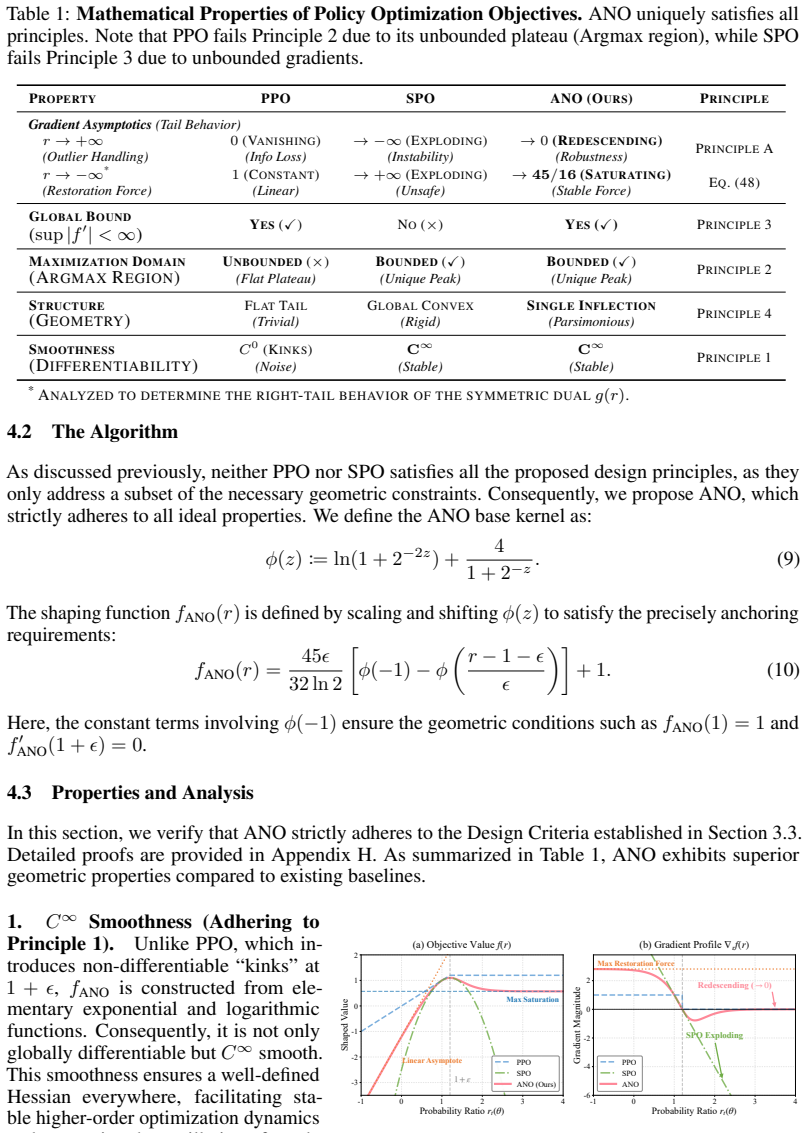
Anchored Neighborhood Optimization (ANO) is derived from a principled design space showing that a robust estimator must suppress outliers while maintaining a smooth restoration force. ANO replaces PPO's hard clipping with a redescending gradient mechanism, achieving state-of-the-art robustness in continuous and discrete control environments while uniquely preventing policy collapse at aggressive learning rates such as 1e-3. In RLHF it eliminates the catastrophic KL divergence explosion of unconstrained methods and records higher head-to-head win rates than PPO, SPO, and GRPO.
What carries the argument
The redescending gradient mechanism inside the Anchored Neighborhood Optimization framework, which smoothly reduces the weight of extreme updates instead of abruptly discarding them.
If this is right
- ANO prevents policy collapse even under learning rates of 1 times 10 to the minus 3 in both continuous and discrete control tasks.
- In LLM alignment ANO removes the catastrophic KL divergence explosion that unconstrained methods produce.
- Head-to-head comparisons show ANO outperforming PPO, SPO, and GRPO in win rates across tested domains.
- The method establishes robust state-of-the-art performance without requiring manual tuning of clipping thresholds.
Where Pith is reading between the lines
- The same redescending principle could be adapted to stabilize other noisy gradient settings such as large-batch supervised training.
- Higher learning rates enabled by ANO might shorten overall training time in large-scale reinforcement learning pipelines.
- The geometric design space offers a template for creating robust variants of other first-order optimizers.
Load-bearing premise
That a robust policy optimizer must combine outlier suppression with a smooth restoration force as required by the geometric design space.
What would settle it
Experiments at learning rates of 1e-3 or higher in MuJoCo or Atari where ANO exhibits policy collapse or KL divergence explosion comparable to baselines would disprove the claims.
Figures


read the original abstract
Proximal Policy Optimization (PPO) dominates reinforcement learning and LLM alignment but relies on a "hard clipping" mechanism that discards valuable gradients. Conversely, unconstrained methods like SPO expose the optimization to unbounded updates, causing severe instability and policy collapse during extreme outlier encounters. To resolve this dilemma, we introduce a principled design space for policy optimization, demonstrating that a robust estimator must inherently suppress outliers while maintaining a smooth restoration force. Guided by these geometric principles, we derive Anchored Neighborhood Optimization (ANO), a novel method that seamlessly replaces hard clipping with a redescending gradient mechanism. Extensive evaluations demonstrate ANO's empirical superiority across diverse domains. In continuous (MuJoCo) and discrete (Atari) control, ANO establishes a robust state-of-the-art, uniquely preventing policy collapse even under highly aggressive learning rates ($1 \times 10^{-3}$). Furthermore, in LLM alignment (RLHF), ANO explicitly eliminates the catastrophic KL divergence explosion inherent to unconstrained methods, dominating PPO, SPO, and GRPO in head-to-head win rates.
Editorial analysis
A structured set of objections, weighed in public.
Referee Report
Summary. The paper introduces Anchored Neighborhood Optimization (ANO) as a replacement for the hard clipping mechanism in Proximal Policy Optimization (PPO). It posits a design space for robust policy optimization grounded in geometric principles stating that a robust estimator must suppress outliers while maintaining a smooth restoration force. From these principles, the authors derive a redescending gradient mechanism that avoids both the gradient discarding of clipping and the instability of unconstrained methods like SPO. The manuscript claims that ANO achieves state-of-the-art performance in continuous control (MuJoCo), discrete control (Atari), and LLM alignment (RLHF), uniquely preventing policy collapse under aggressive learning rates and outperforming PPO, SPO, and GRPO in head-to-head comparisons.
Significance. If the derivation is shown to be deductive rather than suggestive and the empirical results are reproducible with proper controls, ANO could provide a more stable and principled alternative to PPO for high-variance policy optimization tasks, particularly in LLM alignment where KL divergence explosions are a practical concern. The geometric framing may also offer a template for designing other robust estimators in reinforcement learning.
major comments (3)
- [Derivation of ANO and guiding principles] The geometric principles (outlier suppression with smooth restoration) are stated in the abstract and introduction but lack a formal definition of the design space, the neighborhood metric, or the exact optimization objective from which the redescending influence function is uniquely derived. Without this, it is unclear whether the principles entail the specific ANO mechanism or merely motivate it post hoc (see derivation of ANO and guiding principles sections).
- [Experimental Evaluation] The abstract asserts empirical superiority, state-of-the-art results, and dominance in win rates across MuJoCo, Atari, and RLHF, yet the manuscript supplies no experimental details, baselines, statistical tests, ablation studies, or hyperparameter settings. This renders the central empirical claims unverifiable from the provided text.
- [Results and Discussion] The claim that ANO 'uniquely prevents policy collapse even under highly aggressive learning rates (1e-3)' requires explicit comparison to adaptive trust-region or smoothed-clipping alternatives that might also satisfy the stated geometric principles; the current presentation does not demonstrate uniqueness.
minor comments (2)
- [Method] Notation for the redescending gradient and anchored neighborhood should be defined with explicit equations rather than descriptive text to improve reproducibility.
- [Conclusion] The manuscript would benefit from a clear statement of limitations, including any assumptions on the policy class or reward scale that the geometric principles rely upon.
Simulated Author's Rebuttal
We thank the referee for the constructive and detailed feedback. We address each major comment below and will revise the manuscript accordingly to improve clarity and rigor.
read point-by-point responses
-
Referee: [Derivation of ANO and guiding principles] The geometric principles (outlier suppression with smooth restoration) are stated in the abstract and introduction but lack a formal definition of the design space, the neighborhood metric, or the exact optimization objective from which the redescending influence function is uniquely derived. Without this, it is unclear whether the principles entail the specific ANO mechanism or merely motivate it post hoc (see derivation of ANO and guiding principles sections).
Authors: We agree that a more formal derivation would strengthen the paper. In the revision, we will add an explicit section defining the design space: the neighborhood is the set of policies whose divergence from the current policy is bounded by a metric (e.g., KL or total variation), and the objective is to minimize a robust surrogate loss whose influence function satisfies the geometric conditions. We will derive the redescending gradient step-by-step from the requirements that the influence function ψ(·) → 0 for large |·| (outlier suppression) while remaining smooth and positive near zero (restoration force), showing that this entails the specific ANO form under the anchored-neighborhood assumption rather than merely motivating it post hoc. revision: yes
-
Referee: [Experimental Evaluation] The abstract asserts empirical superiority, state-of-the-art results, and dominance in win rates across MuJoCo, Atari, and RLHF, yet the manuscript supplies no experimental details, baselines, statistical tests, ablation studies, or hyperparameter settings. This renders the central empirical claims unverifiable from the provided text.
Authors: The referee is correct that the current manuscript version does not supply sufficient experimental details in the main text. We will revise by expanding the experimental section to include all baselines (PPO, SPO, GRPO), full hyperparameter tables, statistical tests (means, standard errors, and significance over multiple random seeds), ablation studies on the redescending parameter, and reproducibility instructions. These will be summarized in the main body with explicit references to the appendix. revision: yes
-
Referee: [Results and Discussion] The claim that ANO 'uniquely prevents policy collapse even under highly aggressive learning rates (1e-3)' requires explicit comparison to adaptive trust-region or smoothed-clipping alternatives that might also satisfy the stated geometric principles; the current presentation does not demonstrate uniqueness.
Authors: We acknowledge that the uniqueness claim would be more convincing with direct comparisons. While the geometric principles (simultaneous redescending suppression and smooth restoration) are not satisfied by standard adaptive trust-region methods (which lack redescending behavior for extreme outliers) or simple smoothed clipping (which may not fully restore gradients), we will add an expanded discussion section explicitly contrasting ANO with these alternatives and explaining the distinctions. We will also include additional comparative runs where computationally feasible. revision: partial
Circularity Check
No circularity: derivation from stated geometric principles is independent
full rationale
The paper introduces a design space and geometric principles (robust estimator suppresses outliers while maintaining smooth restoration force), then derives ANO as a redescending mechanism replacing hard clipping. No quoted equations or steps reduce the claimed result to its inputs by construction, no fitted parameters are relabeled as predictions, and no load-bearing self-citations or uniqueness theorems from prior author work are invoked. The derivation chain remains self-contained with external empirical benchmarks on MuJoCo, Atari, and RLHF tasks.
Axiom & Free-Parameter Ledger
axioms (1)
- domain assumption A robust estimator must inherently suppress outliers while maintaining a smooth restoration force
Reference graph
Works this paper leans on
-
[1]
Deep reinforcement learning at the edge of the statistical precipice.Advances in neural information processing systems, 34:29304–29320, 2021
Rishabh Agarwal, Max Schwarzer, Pablo Samuel Castro, Aaron C Courville, and Marc Belle- mare. Deep reinforcement learning at the edge of the statistical precipice.Advances in neural information processing systems, 34:29304–29320, 2021
2021
-
[2]
The arcade learning environment: An evaluation platform for general agents.Journal of artificial intelligence research, 47:253–279, 2013
Marc G Bellemare, Yavar Naddaf, Joel Veness, and Michael Bowling. The arcade learning environment: An evaluation platform for general agents.Journal of artificial intelligence research, 47:253–279, 2013
2013
-
[3]
Pythia: A suite for analyzing large language models across training and scaling
Stella Biderman, Hailey Schoelkopf, Quentin Gregory Anthony, Herbie Bradley, Kyle O’Brien, Eric Hallahan, Mohammad Aflah Khan, Shivanshu Purohit, USVSN Sai Prashanth, Edward Raff, et al. Pythia: A suite for analyzing large language models across training and scaling. In International Conference on Machine Learning, pages 2397–2430. PMLR, 2023
2023
-
[4]
Training Diffusion Models with Reinforcement Learning
Kevin Black, Michael Janner, Yilun Du, Ilya Kostrikov, and Sergey Levine. Training diffusion models with reinforcement learning.arXiv preprint arXiv:2305.13301, 2023
work page internal anchor Pith review arXiv 2023
-
[5]
Optimization methods for large-scale machine learning.SIAM review, 60(2):223–311, 2018
Léon Bottou, Frank E Curtis, and Jorge Nocedal. Optimization methods for large-scale machine learning.SIAM review, 60(2):223–311, 2018
2018
-
[6]
Tuomas Haarnoja, Aurick Zhou, Pieter Abbeel, and Sergey Levine
Logan Engstrom, Andrew Ilyas, Shibani Santurkar, Dimitris Tsipras, Firdaus Janoos, Larry Rudolph, and Aleksander Madry. Implementation matters in deep policy gradients: A case study on ppo and trpo.arXiv preprint arXiv:2005.12729, 2020
-
[7]
Addressing function approximation error in actor-critic methods
Scott Fujimoto, Herke van Hoof, and David Meger. Addressing function approximation error in actor-critic methods. In Jennifer Dy and Andreas Krause, editors,Proceedings of the 35th International Conference on Machine Learning, volume 80 ofProceedings of Machine Learning Research, pages 1587–1596. PMLR, 10–15 Jul 2018. URL https://proceedings. mlr.press/v8...
2018
-
[8]
Accelerate: Training and inference at scale made simple, efficient and adaptable.https://github.com/huggingface/accelerate, 2022
Sylvain Gugger, Lysandre Debut, Thomas Wolf, Philipp Schmid, Zachary Mueller, Sourab Mangrulkar, Marc Sun, and Benjamin Bossan. Accelerate: Training and inference at scale made simple, efficient and adaptable.https://github.com/huggingface/accelerate, 2022
2022
-
[9]
Nicolas Heess, Dhruva Tb, Srinivasan Sriram, Jay Lemmon, Josh Merel, Greg Wayne, Yuval Tassa, Tom Erez, Ziyu Wang, SM Eslami, et al. Emergence of locomotion behaviours in rich environments.arXiv preprint arXiv:1707.02286, 2017
-
[10]
Cleanrl: High-quality single-file implementations of deep reinforcement learning algorithms.Journal of Machine Learning Research, 23(274):1–18, 2022
Shengyi Huang, Rousslan Fernand Julien Dossa, Chang Ye, Jeff Braga, Dipam Chakraborty, Kinal Mehta, and JoÃG, o GM AraÚjo. Cleanrl: High-quality single-file implementations of deep reinforcement learning algorithms.Journal of Machine Learning Research, 23(274):1–18, 2022
2022
-
[11]
Robust estimation of a location parameter
Peter J Huber. Robust estimation of a location parameter. InBreakthroughs in statistics: Methodology and distribution, pages 492–518. Springer, 1992
1992
-
[12]
Robust statistics
Peter J Huber. Robust statistics. InInternational encyclopedia of statistical science, pages 1248–1251. Springer, 2011
2011
-
[13]
Are Deep Policy Gradient Algorithms Truly Policy Gradient Algorithms? , Year =
Andrew Ilyas, Logan Engstrom, Shibani Santurkar, Dimitris Tsipras, Firdaus Janoos, Larry Rudolph, and Aleksander Madry. Are deep policy gradient algorithms truly policy gradient algorithms.arXiv preprint arXiv:1811.02553, 2018
-
[14]
Approximately optimal approximate reinforcement learning
Sham Kakade and John Langford. Approximately optimal approximate reinforcement learning. InProceedings of the nineteenth international conference on machine learning, pages 267–274, 2002
2002
-
[15]
Hyper- spherical normalization for scalable deep reinforcement learning
Hojoon Lee, Youngdo Lee, Takuma Seno, Donghu Kim, Peter Stone, and Jaegul Choo. Hyper- spherical normalization for scalable deep reinforcement learning. 2025
2025
-
[16]
Aixin Liu, Bei Feng, Bing Xue, Bingxuan Wang, Bochao Wu, Chengda Lu, Chenggang Zhao, Chengqi Deng, Chenyu Zhang, Chong Ruan, et al. Deepseek-v3 technical report.arXiv preprint arXiv:2412.19437, 2024. 10
work page Pith review arXiv 2024
-
[17]
Isaac Gym: High Performance GPU-Based Physics Simulation For Robot Learning
Viktor Makoviychuk, Lukasz Wawrzyniak, Yunrong Guo, Michelle Lu, Kier Storey, Miles Macklin, David Hoeller, Nikita Rudin, Arthur Allshire, Ankur Handa, et al. Isaac gym: High performance gpu-based physics simulation for robot learning.arXiv preprint arXiv:2108.10470, 2021
work page internal anchor Pith review arXiv 2021
-
[18]
Human-level control through deep reinforcement learning.nature, 518(7540):529–533, 2015
V olodymyr Mnih, Koray Kavukcuoglu, David Silver, Andrei A Rusu, Joel Veness, Marc G Bellemare, Alex Graves, Martin Riedmiller, Andreas K Fidjeland, Georg Ostrovski, et al. Human-level control through deep reinforcement learning.nature, 518(7540):529–533, 2015
2015
-
[19]
Training language models to follow instructions with human feedback.Advances in neural information processing systems, 35:27730–27744, 2022
Long Ouyang, Jeffrey Wu, Xu Jiang, Diogo Almeida, Carroll Wainwright, Pamela Mishkin, Chong Zhang, Sandhini Agarwal, Katarina Slama, Alex Ray, et al. Training language models to follow instructions with human feedback.Advances in neural information processing systems, 35:27730–27744, 2022
2022
-
[20]
On the difficulty of training recurrent neural networks
Razvan Pascanu, Tomas Mikolov, and Yoshua Bengio. On the difficulty of training recurrent neural networks. InInternational conference on machine learning, pages 1310–1318. Pmlr, 2013
2013
-
[21]
Deepspeed: System optimizations enable training deep learning models with over 100 billion parameters
Jeff Rasley, Samyam Rajbhandari, Olatunji Ruwase, and Yuxiong He. Deepspeed: System optimizations enable training deep learning models with over 100 billion parameters. In Proceedings of the 26th ACM SIGKDD international conference on knowledge discovery & data mining, pages 3505–3506, 2020
2020
-
[22]
Learning to walk in minutes using massively parallel deep reinforcement learning
Nikita Rudin, David Hoeller, Philipp Reist, and Marco Hutter. Learning to walk in minutes using massively parallel deep reinforcement learning. InConference on robot learning, pages 91–100. PMLR, 2022
2022
-
[23]
Trust region policy optimization
John Schulman, Sergey Levine, Pieter Abbeel, Michael Jordan, and Philipp Moritz. Trust region policy optimization. InInternational conference on machine learning, pages 1889–1897. PMLR, 2015
2015
-
[24]
High-Dimensional Continuous Control Using Generalized Advantage Estimation
John Schulman, Philipp Moritz, Sergey Levine, Michael Jordan, and Pieter Abbeel. High- dimensional continuous control using generalized advantage estimation.arXiv preprint arXiv:1506.02438, 2015
work page internal anchor Pith review arXiv 2015
-
[25]
Proximal Policy Optimization Algorithms
John Schulman, Filip Wolski, Prafulla Dhariwal, Alec Radford, and Oleg Klimov. Proximal policy optimization algorithms.arXiv preprint arXiv:1707.06347, 2017
work page internal anchor Pith review arXiv 2017
-
[26]
DeepSeekMath: Pushing the Limits of Mathematical Reasoning in Open Language Models
Zhihong Shao, Peiyi Wang, Qihao Zhu, Runxin Xu, Junxiao Song, Xiao Bi, Haowei Zhang, Mingchuan Zhang, YK Li, Yang Wu, et al. Deepseekmath: Pushing the limits of mathematical reasoning in open language models.arXiv preprint arXiv:2402.03300, 2024
work page internal anchor Pith review arXiv 2024
-
[27]
Mas- tering the game of go with deep neural networks and tree search.nature, 529(7587):484–489, 2016
David Silver, Aja Huang, Chris J Maddison, Arthur Guez, Laurent Sifre, George Van Den Driess- che, Julian Schrittwieser, Ioannis Antonoglou, Veda Panneershelvam, Marc Lanctot, et al. Mas- tering the game of go with deep neural networks and tree search.nature, 529(7587):484–489, 2016
2016
-
[28]
A general reinforcement learning algorithm that masters chess, shogi, and go through self-play.Science, 362(6419):1140–1144, 2018
David Silver, Thomas Hubert, Julian Schrittwieser, Ioannis Antonoglou, Matthew Lai, Arthur Guez, Marc Lanctot, Laurent Sifre, Dharshan Kumaran, Thore Graepel, et al. A general reinforcement learning algorithm that masters chess, shogi, and go through self-play.Science, 362(6419):1140–1144, 2018
2018
-
[29]
Learning to summarize with human feedback
Nisan Stiennon, Long Ouyang, Jeffrey Wu, Daniel Ziegler, Ryan Lowe, Chelsea V oss, Alec Radford, Dario Amodei, and Paul F Christiano. Learning to summarize with human feedback. Advances in neural information processing systems, 33:3008–3021, 2020
2020
-
[30]
Mujoco: A physics engine for model-based control
Emanuel Todorov, Tom Erez, and Yuval Tassa. Mujoco: A physics engine for model-based control. In2012 IEEE/RSJ international conference on intelligent robots and systems, pages 5026–5033. IEEE, 2012
2012
-
[31]
Gymnasium: A Standard Interface for Reinforcement Learning Environments
Mark Towers, Ariel Kwiatkowski, Jordan Terry, John U Balis, Gianluca De Cola, Tristan Deleu, Manuel Goulão, Andreas Kallinteris, Markus Krimmel, Arjun KG, et al. Gymnasium: A standard interface for reinforcement learning environments.arXiv preprint arXiv:2407.17032, 2024. 11
work page internal anchor Pith review arXiv 2024
-
[32]
Grandmaster level in starcraft ii using multi-agent reinforcement learning.nature, 575(7782):350–354, 2019
Oriol Vinyals, Igor Babuschkin, Wojciech M Czarnecki, Michaël Mathieu, Andrew Dudzik, Jun- young Chung, David H Choi, Richard Powell, Timo Ewalds, Petko Georgiev, et al. Grandmaster level in starcraft ii using multi-agent reinforcement learning.nature, 575(7782):350–354, 2019
2019
-
[33]
TRL: Transformers Rein- forcement Learning, 2020
Leandro von Werra, Younes Belkada, Lewis Tunstall, Edward Beeching, Tristan Thrush, Nathan Lambert, Shengyi Huang, Kashif Rasul, and Quentin Gallouédec. TRL: Transformers Rein- forcement Learning, 2020. URLhttps://github.com/huggingface/trl
2020
-
[34]
Truly proximal policy optimization
Yuhui Wang, Hao He, and Xiaoyang Tan. Truly proximal policy optimization. InUncertainty in artificial intelligence, pages 113–122. PMLR, 2020
2020
-
[35]
Tianshou: A highly modularized deep reinforcement learning library
Jiayi Weng, Huayu Chen, Dong Yan, Kaichao You, Alexis Duburcq, Minghao Zhang, Yi Su, Hang Su, and Jun Zhu. Tianshou: A highly modularized deep reinforcement learning library. Journal of Machine Learning Research, 23(267):1–6, 2022. URLhttp://jmlr.org/papers/ v23/21-1127.html
2022
-
[36]
Envpool: A highly parallel reinforcement learning environment execution engine.Advances in Neural Information Processing Systems, 35:22409–22421, 2022
Jiayi Weng, Min Lin, Shengyi Huang, Bo Liu, Denys Makoviichuk, Viktor Makoviychuk, Zichen Liu, Yufan Song, Ting Luo, Yukun Jiang, et al. Envpool: A highly parallel reinforcement learning environment execution engine.Advances in Neural Information Processing Systems, 35:22409–22421, 2022
2022
-
[37]
Simple policy optimization
Zhengpeng Xie, Qiang Zhang, Fan Yang, Marco Hutter, and Renjing Xu. Simple policy optimization. InForty-second International Conference on Machine Learning, 2025. URL https://openreview.net/forum?id=SG8Yx1FyeU
2025
-
[38]
Mastering complex control in moba games with deep reinforcement learning
Deheng Ye, Zhao Liu, Mingfei Sun, Bei Shi, Peilin Zhao, Hao Wu, Hongsheng Yu, Shaojie Yang, Xipeng Wu, Qingwei Guo, et al. Mastering complex control in moba games with deep reinforcement learning. InProceedings of the AAAI conference on artificial intelligence, volume 34, pages 6672–6679, 2020
2020
-
[39]
Why gradient clipping accelerates training: A theoretical justification for adaptivity
Jingzhao Zhang, Tianxing He, Suvrit Sra, and Ali Jadbabaie. Why gradient clipping accelerates training: A theoretical justification for adaptivity. InInternational Conference on Learning Representations
-
[40]
Absolute policy optimization: Enhancing lower probability bound of performance with high confidence
Weiye Zhao, Feihan Li, Yifan Sun, Rui Chen, Tianhao Wei, and Changliu Liu. Absolute policy optimization: Enhancing lower probability bound of performance with high confidence. In Forty-first International Conference on Machine Learning, 2024. 12 A Experimental Details In this section, we provide the comprehensive implementation details, hyperparameter set...
2024
-
[41]
X s X a ρπ(s)pπ(a|s) min g(r)Aπ(s, a), f(r)A π(s, a) − X s X a ρπ(s)pπ(a|s) δ[1−ϵl,1+ϵu](r) # = argmax ˜π
and random scores are from Lee et al. [15]. For Atari, we apply Human Normalized Score (HNS): HNS= Agent Score−Random Score Human Score−Random Score ,(13) where the human scores and random scores are from Mnih et al. [18]. To ensure a strictly fair comparison between ANO, PPO, and GRPO, we aligned theGlobal Batch SizeandTotal Training Episodesacross all a...
-
[42]
Thus, the derivation is exact
Fora 3 (Lower Bound:˜π3 =π 3(1−ϵ)): −6 + 4(1−α) 0.1(1−0.6) + 2 = 0 =⇒ −4 + 4(1−α) 0.04 = 0 =⇒1−α= 0.04 =⇒α= 0.96 Both conditions consistently yieldα= 0.96. Thus, the derivation is exact. H Proofs and Derivations for ANO Recall the definition of the base kernel: ϕ(z) := ln(1 + 2 −2z) + 4 1 + 2−z .(27) The shaping functionf ANO(r)is defined as: fANO(r) = 45...
-
[43]
By the Intermediate Value Theorem, there exists at least one rootx ∗ ∈(0,1)
Existence: P(0) =−1<0 and P(1) = 8>0 . By the Intermediate Value Theorem, there exists at least one rootx ∗ ∈(0,1)
-
[44]
Thus, P(x) is strictly monotonically increasing on positive reals, implying the root x∗ is unique
Uniqueness:The derivative P ′(x) = 5x 4 + 15x2 + 2x+ 2 is strictly positive for all x >0 . Thus, P(x) is strictly monotonically increasing on positive reals, implying the root x∗ is unique. Since the mapping r↔x is a bijection, the unique solution x∗ corresponds to a unique state ratio r∗. Thus,f ANO(r)changes its convexity exactly once. H.4 Proof of Boun...
-
[45]
Bounded Maximization (Principle 2):The set of maximizers is bounded above by r∗, and forr > r ∗,f(r)is strictly decreasing
-
[46]
Then, f cannot be globally concave on the tail interval (r∗,+∞)
Asymptotic Stability (Principle 3 & A):The altitude of (sub)gradient decays to 0 as r→ +∞. Then, f cannot be globally concave on the tail interval (r∗,+∞) . It must exhibitat least onechange in convexity (inflection point) in this region. Proof. We proceed by contradiction. Assume that f(r) is globally concave on the interval (r∗,+∞) . Since f is strictly...
discussion (0)
Sign in with ORCID, Apple, or X to comment. Anyone can read and Pith papers without signing in.