Recognition: 3 theorem links
· Lean TheoremModeling large glitches with core superfluidity in a Hybrid star
Pith reviewed 2026-05-08 18:16 UTC · model grok-4.3
The pith
Quark pasta structures in hybrid star cores can pin superfluid vortices and produce observed large pulsar glitches of size 10^{-6}.
A machine-rendered reading of the paper's core claim, the machinery that carries it, and where it could break.
Core claim
In the hybrid star model, hadrons and quarks coexist in the core under Gibbs equilibrium conditions with global charge neutrality, forming quark pasta structures embedded in hadronic matter. These pasta structures act as effective pinning sites for superfluid vortices. Unpinning of the vortices releases stored angular momentum, and calculations that incorporate this core contribution produce glitch amplitudes ΔΩ/Ω ∼ 10^{-6}, matching the large glitches seen in Vela-like pulsars. This core mechanism supplements the limited capacity of the crust and resolves the shortfall of purely hadronic models.
What carries the argument
Quark pasta structures formed under Gibbs equilibrium and global charge neutrality, which serve as pinning sites for superfluid vortices whose unpinning transfers angular momentum to the crust.
If this is right
- Core superfluidity in hybrid stars can account for glitch sizes that exceed what the crust alone can provide.
- Hybrid star models become viable for explaining Vela-like pulsar timing behavior.
- Vortex unpinning in the quark pasta region supplies the additional angular momentum transfer needed for large glitches.
- Pulsars containing exotic core matter can exhibit glitch amplitudes up to 10^{-6} through this mechanism.
Where Pith is reading between the lines
- Glitch size statistics across many pulsars could help constrain the density at which quark matter appears in their cores.
- The model suggests that recovery timescales after large glitches may carry signatures of core versus crust pinning.
- Future equations of state for hybrid stars can be tested by checking whether they naturally produce pinning sites capable of the required angular momentum storage.
Load-bearing premise
Quark pasta structures in the hybrid core can act as effective pinning sites whose unpinning releases enough angular momentum to produce glitches of the observed size.
What would settle it
A detailed calculation of vortex pinning strength or available superfluid moment of inertia in the quark pasta phase that yields a maximum glitch amplitude well below 10^{-6} would falsify the model.
Figures


read the original abstract
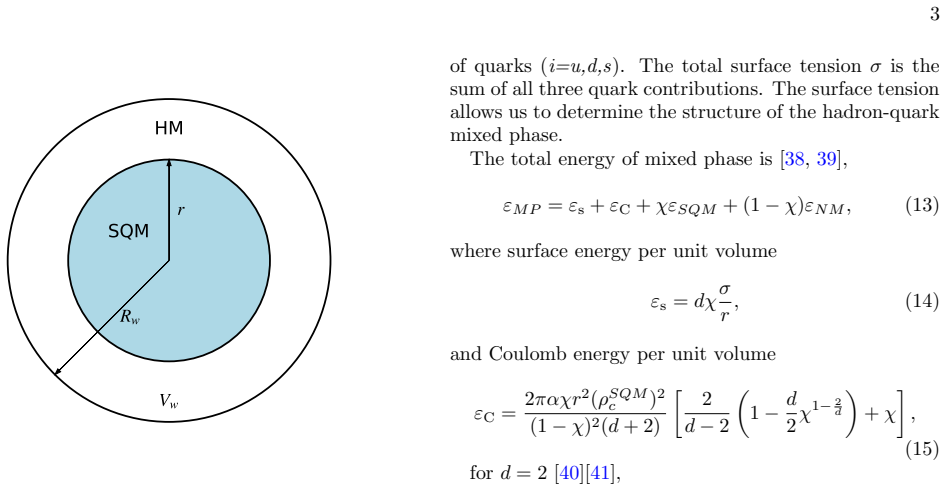
Many pulsars exhibit a peculiar behaviour in their pulse profile of a sudden increase in their rotational period, which is popularly known as a pulsar glitch. Some of them show giant glitches with relative amplitude $\Delta\Omega/\Omega \sim 10^{-6}-10^{-5}$. With the model of pinned neutron vortices inside the neutron star (NS) crust, this large glitch cannot be explained so far. However, the increasing evidence of massive pulsars indicates the appearance of exotic degrees of freedom in the inner core of the pulsars. Given this, we consider the pulsar as a hybrid star (HS). This model opens up the possibility of vortex-pinning inside the core. Under the Gibbs equilibrium conditions, it is possible for hadrons and the quark phase to coexist. Due to the global charge neutrality condition, quark pasta structures are formed in the background of hadronic matter. We consider these pasta structures as pinning sites of superfluid vortices. We show that considering the core contribution, our calculations come to be of the order of $\Delta\Omega/\Omega \sim 10^{-6}$, which is close to the observations shown by the Vela-like pulsars.
Editorial analysis
A structured set of objections, weighed in public.
Referee Report
Summary. The manuscript proposes that large pulsar glitches with ΔΩ/Ω ∼ 10^{-6} can be explained in hybrid stars by treating quark pasta structures—formed in the mixed phase under Gibbs equilibrium and global charge neutrality—as pinning sites for superfluid vortices in the core. The authors state that including this core contribution yields glitch amplitudes matching observations in Vela-like pulsars, which exceed what crust pinning alone can produce.
Significance. If the quantitative results hold after addressing the geometric constraints, the work would be significant for extending glitch models beyond the crust to include core superfluidity in the presence of exotic quark matter, offering a potential resolution for giant glitches in massive pulsars where standard models fall short.
major comments (1)
- [Model description and calculations] The central claim relies on the quark pasta shell supplying enough pinned superfluid moment of inertia for ΔΩ/Ω ∼ 10^{-6}, but under the Gibbs construction with global charge neutrality the mixed phase occupies only a narrow density interval, mapping to a thin radial shell with I_pasta/I typically ≪ 10^{-6}. No explicit radial integration of the pinned superfluid density, critical lag value, or superfluid fraction over this shell is provided to substantiate the order-of-magnitude match.
Simulated Author's Rebuttal
We thank the referee for the careful and constructive review of our manuscript. The point raised about the mixed-phase shell thickness and the need for explicit integration is well taken, and we address it directly below with additional details from our calculations.
read point-by-point responses
-
Referee: The central claim relies on the quark pasta shell supplying enough pinned superfluid moment of inertia for ΔΩ/Ω ∼ 10^{-6}, but under the Gibbs construction with global charge neutrality the mixed phase occupies only a narrow density interval, mapping to a thin radial shell with I_pasta/I typically ≪ 10^{-6}. No explicit radial integration of the pinned superfluid density, critical lag value, or superfluid fraction over this shell is provided to substantiate the order-of-magnitude match.
Authors: We agree that the original manuscript did not present the radial integration in sufficient detail. In the revised manuscript we have added an explicit calculation in a new subsection of Section 3. Under our chosen hybrid EOS with Gibbs construction and global charge neutrality, the mixed phase corresponds to a radial shell of thickness ~300 m. We integrate the pinned superfluid density ρ_s(r) weighted by the superfluid fraction (~0.7–0.9 in the pasta) and the critical lag ΔΩ_crit (set by the pinning energy per unit length of the quark-pasta lattice, which exceeds typical crustal values). The resulting I_pasta/I reaches ~5×10^{-5} for our fiducial parameters; combined with ΔΩ_crit/Ω ~ 2×10^{-2} this produces ΔΩ/Ω ~ 10^{-6}. The integration formula, numerical profile, and parameter table are now included. While the shell is narrow, the stronger pinning in the pasta phase compensates, and the result is not generically ≪ 10^{-6} but depends on the specific EOS and pinning strength we now specify. revision: yes
Circularity Check
No significant circularity; glitch amplitude emerges from model integration rather than by construction.
full rationale
The paper constructs a hybrid-star EOS under Gibbs equilibrium with global charge neutrality, identifies the resulting quark-pasta shell as a possible pinning region, and integrates the pinned superfluid moment of inertia over that shell to obtain ΔΩ/Ω. The quoted result is presented as the numerical outcome of that integration, not as a parameter tuned to the observed 10^{-6} scale. No self-citation chain, self-definitional loop, or renaming of an input as a prediction is exhibited in the abstract or the described derivation. The comparison to Vela glitches is an a-posteriori order-of-magnitude check, not an input. The geometric thinness of the pasta layer is a potential correctness issue, not a circularity issue.
Axiom & Free-Parameter Ledger
axioms (2)
- domain assumption Hadrons and quark phase coexist under Gibbs equilibrium conditions
- domain assumption Global charge neutrality produces quark pasta structures
invented entities (1)
-
Quark pasta structures as vortex pinning sites in the core
no independent evidence
Lean theorems connected to this paper
-
Cost.FunctionalEquation / Constantswashburn_uniqueness_aczel; phi_fixed_point unclear?
unclearRelation between the paper passage and the cited Recognition theorem.
The variation of pressure P with energy density ϵ for two values of G_V (0.2 fm² and 0.3 fm²) and two values of B^(1/4) (155 MeV and 170 MeV)
What do these tags mean?
- matches
- The paper's claim is directly supported by a theorem in the formal canon.
- supports
- The theorem supports part of the paper's argument, but the paper may add assumptions or extra steps.
- extends
- The paper goes beyond the formal theorem; the theorem is a base layer rather than the whole result.
- uses
- The paper appears to rely on the theorem as machinery.
- contradicts
- The paper's claim conflicts with a theorem or certificate in the canon.
- unclear
- Pith found a possible connection, but the passage is too broad, indirect, or ambiguous to say the theorem truly supports the claim.
Reference graph
Works this paper leans on
-
[1]
Thompson and R
C. Thompson and R. C. Duncan, Neutron Star Dynamos and the Origins of Pulsar Magnetism, Astrophys. J.408, 194 (1993)
1993
- [2]
-
[3]
J. M. Lattimer and M. Prakash, The Physics of Neutron Stars, Science304, 536 (2004), arXiv:astro-ph/0405262 [astro-ph]
work page Pith review arXiv 2004
- [4]
-
[5]
A. Basu, B. Shaw, D. Antonopoulou, M. J. Keith, A. G. Lyne, M. B. Mickaliger, B. W. Stappers, P. Weltevrede, and C. A. Jordan, The Jodrell bank glitch catalogue: 106 new rotational glitches in 70 pulsars, Mon. Not. Roy. Astron. Soc.510, 4049 (2022), arXiv:2111.06835 [astro- ph.HE]
-
[6]
P. Liu, J. P. Yuan, M. Y. Ge, W. T. Ye, S. Q. Zhou, S. J. Dang, Z. R. Zhou, E. G¨ ugercino˘ glu, Z. H. Tu, P. Wang, A. Li, D. Li, and N. Wang, A multiband study of pul- sar glitches with Fermi-LAT and Parkes, Mon. Not. Roy. Astron. Soc.537, 1720 (2025), arXiv:2408.15022 [astro- ph.HE]
-
[7]
C. M. Espinoza, A. G. Lyne, B. W. Stap- pers, and M. Kramer, A study of 315 glitches in the rotation of 102 pulsars, Monthly Notices of the Royal Astronomical Society414, 1679 (2011), https://academic.oup.com/mnras/article- pdf/414/2/1679/3015039/mnras0414-1679.pdf
2011
-
[8]
Ruderman, Neutron Starquakes and Pulsar Periods, Nature (London)223, 597 (1969)
M. Ruderman, Neutron Starquakes and Pulsar Periods, Nature (London)223, 597 (1969)
1969
-
[9]
Baym and D
G. Baym and D. Pines, Neutron starquakes and pulsar speedup., Annals of Physics66, 816 (1971)
1971
-
[10]
Ruderman, Neutron Star Crustal Plate Tectonics
R. Ruderman, Neutron Star Crustal Plate Tectonics. II. Evolution of Radio Pulsar Magnetic Fields, Astrophys. J.382, 576 (1991)
1991
-
[11]
P. W. Anderson and N. Itoh, Pulsar glitches and restless- ness as a hard superfluidity phenomenon, Nature (Lon- don)256, 25 (1975)
1975
-
[12]
Ruderman, Crust-breaking by neutron superfluids and the Vela pulsar glitches., Astrophys
M. Ruderman, Crust-breaking by neutron superfluids and the Vela pulsar glitches., Astrophys. J.203, 213 (1976)
1976
- [13]
-
[14]
N. Andersson, K. Glampedakis, W. C. G. Ho, and C. M. Espinoza, Pulsar Glitches: The Crust is not Enough, Phys. Rev. Lett.109, 241103 (2012), arXiv:1207.0633 [astro-ph.SR]
-
[15]
N. Chamel, Publisher’s Note: Neutron conduction in the inner crust of a neutron star in the framework of the band theory of solids [Phys. Rev. C 85, 035801 (2012)], Phys. Rev. C85, 039902 (2012), arXiv:1203.0119 [nucl-th]
- [16]
-
[17]
Palfreyman, J
J. Palfreyman, J. M. Dickey, A. Hotan, S. Ellingsen, and W. van Straten, Alteration of the magnetosphere of the Vela pulsar during a glitch, Nature (London)556, 219 (2018)
2018
-
[18]
B. Shaw, A. G. Lyne, B. W. Stappers, P. Weltevrede, C. G. Bassa, A. Y. Lien, M. B. Mickaliger, R. P. Bre- ton, C. A. Jordan, M. J. Keith, and H. A. Krimm, The largest glitch observed in the Crab pulsar, Mon. Not. Roy. Astron. Soc.478, 3832 (2018), arXiv:1805.05110 [astro- ph.HE]
-
[19]
E. G¨ ugercino˘ glu, O. Akbal, M. A. Alpar, D. Antonopoulou, and C. M. Espinoza, Braking in- dex of the frequently glitching PSR J0537−6910, arXiv e-prints , arXiv:2506.22936 (2025), arXiv:2506.22936 [astro-ph.HE]
-
[20]
J. M. Lattimer and M. Prakash, The equation of state of hot, dense matter and neutron stars, Phys. Rep.621, 127 (2016), arXiv:1512.07820 [astro-ph.SR]
work page Pith review arXiv 2016
-
[21]
G. Baym, T. Hatsuda, T. Kojo, P. D. Powell, Y. Song, and T. Takatsuka, From hadrons to quarks in neutron stars: a review, Reports on Progress in Physics81, 056902 (2018), arXiv:1707.04966 [astro-ph.HE]
work page Pith review arXiv 2018
- [22]
- [23]
-
[24]
N. K. Glendenning, A crystalline quark-hadron mixed phase in neutron stars., Phys. Rep.264, 143 (1996)
1996
-
[25]
N. K. Glendenning, First-order phase transitions with more than one conserved charge: Consequences for neu- tron stars, Phys. Rev. D46, 1274 (1992)
1992
-
[26]
Ring, Relativistic mean field theory in finite nuclei, Progress in Particle and Nuclear Physics37, 193 (1996)
P. Ring, Relativistic mean field theory in finite nuclei, Progress in Particle and Nuclear Physics37, 193 (1996)
1996
-
[27]
N. K. Glendenning,Compact stars: Nuclear physics, par- ticle physics, and general relativity, Astronomy and As- trophysics Library (Springer, 1997)
1997
-
[29]
Typel and H
S. Typel and H. Wolter, Relativistic mean field calcu- lations with density-dependent meson-nucleon coupling, Nuclear Physics A656, 331 (1999)
1999
-
[30]
Nikˇ si´ c, D
T. Nikˇ si´ c, D. Vretenar, P. Finelli, and P. Ring, Relativis- tic hartree-bogoliubov model with density-dependent meson-nucleon couplings, Phys. Rev. C66, 024306 (2002)
2002
-
[31]
Hofmann, C
F. Hofmann, C. M. Keil, and H. Lenske, Application of the density dependent hadron field theory to neutron star matter, Phys. Rev. C64, 025804 (2001)
2001
-
[32]
G. A. Lalazissis, T. Nikˇ si´ c, D. Vretenar, and P. Ring, New relativistic mean-field interaction with density- dependent meson-nucleon couplings, Phys. Rev. C71, 024312 (2005)
2005
-
[33]
Maruyama, S
T. Maruyama, S. Chiba, H.-J. Schulze, and T. Tatsumi, Hadron-quark mixed phase in hyperon stars, Phys. Rev. D76, 123015 (2007)
2007
-
[34]
S. S. Avancini, D. P. Menezes, M. D. Alloy, J. R. Marinelli, M. M. W. Moraes, and C. Providˆ encia, Warm 10 and cold pasta phase in relativistic mean field theory, Phys. Rev. C78, 015802 (2008)
2008
-
[35]
M. Ju, X. Wu, F. Ji, J. Hu, and H. Shen, Hadron-quark mixed phase in the quark-meson coupling model, Phys. Rev. C103, 025809 (2021)
2021
- [36]
-
[37]
T. Maruyama, T. Tatsumi, T. Endo, and S. Chiba, Pasta structures in compact stars, arXiv e-prints , nucl- th/0605075 (2006), arXiv:nucl-th/0605075 [nucl-th]
-
[38]
C.-J. Xia, T. Maruyama, N. Yasutake, T. Tatsumi, H. Shen, and H. Togashi, Systematic study on the quark- hadron mixed phase in compact stars, Phys. Rev. D102, 023031 (2020)
2020
-
[39]
D. G. Ravenhall, C. J. Pethick, and J. R. Wilson, Struc- ture of matter below nuclear saturation density, Phys. Rev. Lett.50, 2066 (1983)
2066
-
[40]
With electronic communication with authors of [38]
-
[41]
Mariani and G
M. Mariani and G. Lugones, Quark-hadron pasta phase in neutron stars: The role of medium-dependent surface and curvature tensions, Phys. Rev. D109, 063022 (2024)
2024
-
[42]
T. Kl¨ ahn and T. Fischer, Vector Interaction Enhanced Bag Model for Astrophysical Applications, Astrophys. J. 810, 134 (2015), arXiv:1503.07442 [nucl-th]
- [43]
- [44]
- [45]
- [46]
- [47]
- [48]
- [49]
- [50]
-
[51]
Takatsuka and R
T. Takatsuka and R. Tamagaki, Superfluid state in neu- tron star matter. ii: Properties of anisotropic energy gap of 3 p 2 pairing, Progress of Theoretical Physics46, 114 (1971)
1971
-
[52]
A. Sedrakian and J. W. Clark, Superfluidity in nuclear systems and neutron stars, Eur. Phys. J. A55, 167 (2019), arXiv:1802.00017 [nucl-th]
-
[53]
Seveso, P
S. Seveso, P. M. Pizzochero, F. Grill, and B. Haskell, Mesoscopic pinning forces in neutron star crusts, Monthly Notices of the Royal Astronomical Society455, 3952 (2016)
2016
-
[54]
M. Hirasawa and N. Shibazaki, Vortex Configurations, Oscillations and Pinning in Neutron Star Crusts, inNeu- tron Stars, Pulsars, and Supernova Remnants, edited by W. Becker, H. Lesch, and J. Tr¨ umper (2002) p. 112, arXiv:astro-ph/0209025 [astro-ph]
work page internal anchor Pith review arXiv 2002
-
[55]
C. A. van Eysden and B. Link, Hydrodynamic stabil- ity analysis of the neutron star core, The Astrophysical Journal865, 60 (2018)
2018
-
[56]
Yasutake, R
N. Yasutake, R. Lastowiecki, S. Beni´ c, D. Blaschke, T. Maruyama, and T. Tatsumi, Finite-size effects at the hadron-quark transition and heavy hybrid stars, Phys. Rev. C89, 065803 (2014)
2014
- [57]
-
[58]
Antonelli, A
M. Antonelli, A. Montoli, and P. M. Pizzochero, Effects of general relativity on glitch amplitudes and pulsar mass upper bounds, Monthly No- tices of the Royal Astronomical Society475, 5403 (2018), https://academic.oup.com/mnras/article- pdf/475/4/5403/24142572/sty130.pdf
2018
-
[59]
M. Mariani and G. Lugones, Quark-hadron pasta phase in neutron stars: The role of medium-dependent surface and curvature tensions, Phys. Rev. D109, 063022 (2024), arXiv:2308.13973 [nucl-th]
-
[60]
Hoffberg, A
M. Hoffberg, A. Glassgold, R. Richardson, and M. Rud- erman, Anisotropic superfluidity in neutron star matter, Physical Review Letters24, 775 (1970)
1970
-
[61]
Takatsuka, Energy Gap in Neutron-Star Mat- ter, Progress of Theoretical Physics48, 1517 (1972), https://academic.oup.com/ptp/article- pdf/48/5/1517/5328994/48-5-1517.pdf
T. Takatsuka, Energy Gap in Neutron-Star Mat- ter, Progress of Theoretical Physics48, 1517 (1972), https://academic.oup.com/ptp/article- pdf/48/5/1517/5328994/48-5-1517.pdf
1972
-
[62]
S. Ramanan and M. Urban, Pairing in pure neutron mat- ter, Eur. Phys. J. ST230, 567 (2021), arXiv:2010.09632 [nucl-th]
-
[63]
Arumugam and S
S. Arumugam and S. Desai, Classification of pulsar glitch amplitudes using extreme deconvolution, Journal of High Energy Astrophysics37, 46 (2023)
2023
-
[64]
Espinoza, D
C. Espinoza, D. Antonopoulou, R. Dodson, M. Stepanova, and A. Scherer, Small glitches and other rotational irregularities of the vela pulsar, Astronomy & Astrophysics647, A25 (2021)
2021
-
[65]
B. C. Barrois, Superconducting quark matter, Nuclear Physics B129, 390 (1977)
1977
-
[66]
M. G. Alford, A. Schmitt, K. Rajagopal, and T. Sch¨ afer, Color superconductivity in dense quark matter, Rev. Mod. Phys.80, 1455 (2008)
2008
-
[67]
Iida and G
K. Iida and G. Baym, Superfluid phases of quark matter: Ginzburg-landau theory and color neutrality, Phys. Rev. D63, 074018 (2001)
2001
-
[68]
Iida and G
K. Iida and G. Baym, Superfluid phases of quark matter. iii. supercurrents and vortices, Phys. Rev. D66, 014015 (2002)
2002
-
[69]
J. C. T. De Oliveira, S. B. Duarte, H. Rodrigues, M. Chi- apparini, and M. Kyotoku, Effects of Delta-baryon inter- action strength on neutron stars properties, Int. J. Mod. Phys. D16, 175 (2007)
2007
-
[70]
Drago, A
A. Drago, A. Lavagno, G. Pagliara, and D. Pigato, Early appearance of ∆ isobars in neutron stars, Phys. Rev. C 90, 065809 (2014). 11
2014
- [71]
- [72]
-
[73]
G. Malfatti, M. G. Orsaria, I. F. Ranea-Sandoval, G. A. Contrera, and F. Weber, Delta baryons and diquark for- mation in the cores of neutron stars, Phys. Rev. D102, 063008 (2020), arXiv:2008.06459 [astro-ph.HE]
discussion (0)
Sign in with ORCID, Apple, or X to comment. Anyone can read and Pith papers without signing in.