Bound States and Resonance Analysis of One-Dimensional Relativistic Parity-Symmetric Two Point Interactions
Pith reviewed 2026-05-08 18:28 UTC · model grok-4.3
The pith
Parity-symmetric two-point contact interactions in the one-dimensional Dirac equation support bound states, critical states, and scattering resonances.
A machine-rendered reading of the paper's core claim, the machinery that carries it, and where it could break.
Core claim
For even and odd parity two-point interactions the spectrum of the Dirac Hamiltonian contains bound states whose energies solve explicit transcendental equations derived from the boundary conditions at the support points, together with critical strengths at which the ground state reaches the continuum edge and supercritical regimes that produce confinement; scattering resonances appear as poles of the transmission amplitude whose locations are fixed by the same parameters.
What carries the argument
The parity operator restricted to the two-point interaction, which partitions the four-parameter family into even and odd sectors and thereby reduces the matching conditions at the two points to a pair of decoupled eigenvalue problems.
If this is right
- Bound states exist only inside finite intervals of the parameter space whose boundaries are the critical values.
- Confinement occurs precisely when the interaction strength exceeds the supercritical threshold.
- Scattering resonances appear at energies determined solely by the parity sector and the four interaction parameters.
- The transmission probability vanishes at the resonance poles for both even and odd cases.
Where Pith is reading between the lines
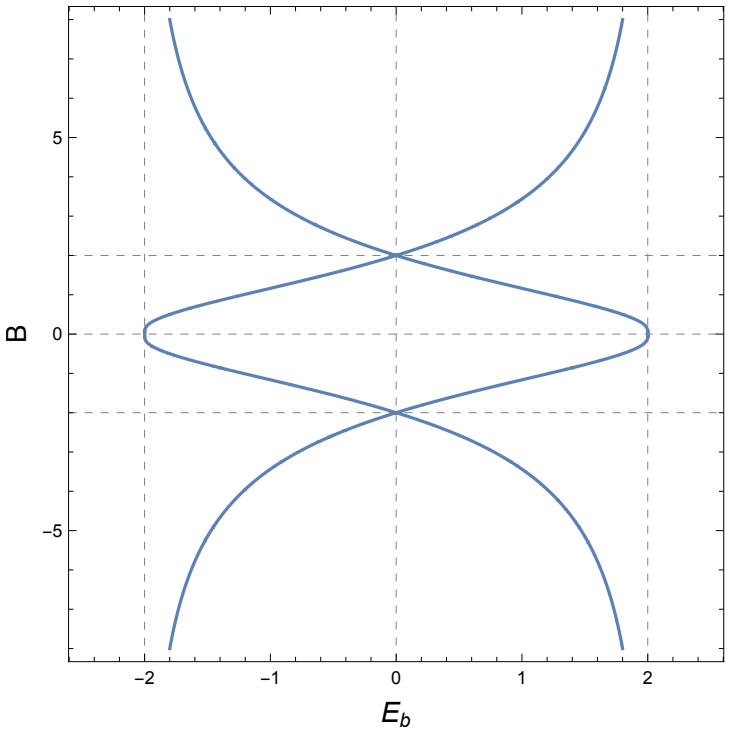
- The same parameterization could be used to construct solvable models of relativistic tunneling through two barriers.
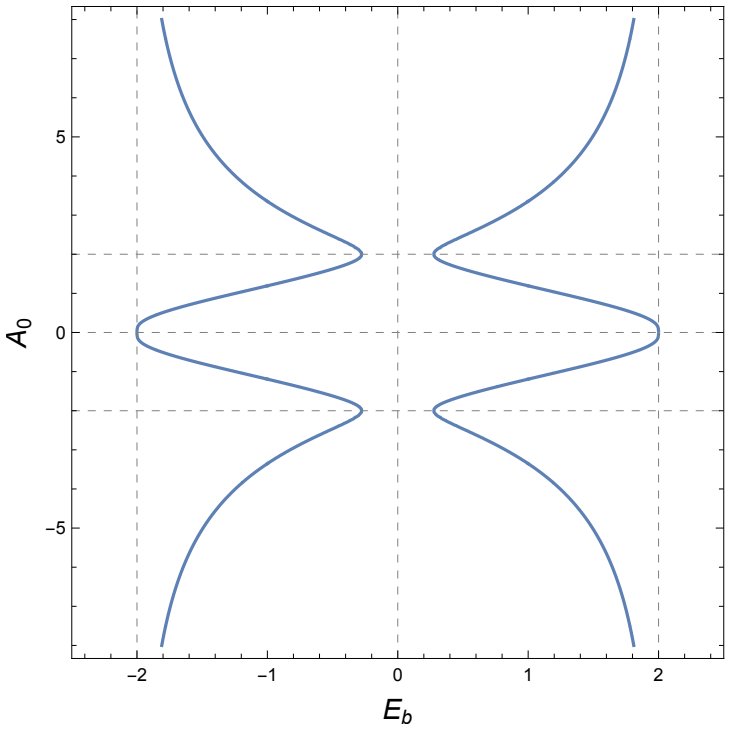
- Time-dependent versions of these interactions might produce controllable pair-creation rates in the supercritical regime.
Load-bearing premise
The distributional definition of the two-point contact interactions is equivalent to the self-adjoint extensions of the free Dirac operator on the punctured line.
What would settle it
For a chosen set of even-parity parameters, an independent numerical solution of the Dirac equation with regularized potentials at the two points yields a bound-state energy that lies outside the analytic interval predicted by the transcendental equation.
Figures




read the original abstract
We consider the one-dimensional Dirac equation with the most general relativistic contact interaction supported on two points symmetrically located with respect to the origin. In order to determine the shape of the interaction, we use a distributional method, which in the present case is equivalent to the standard method of defining contact interactions by self-adjoint extensions of symmetric operators. The interaction on each of these two points depends on four parameters, each one having a clear physical meaning. We are interested in the scattering and confining properties of this model. We focus our attention on even or odd interactions under parity transformations and investigate the existence of critical and supercritical states, bound states, confinement and scattering resonances for some particular interactions of special interest.
Editorial analysis
A structured set of objections, weighed in public.
Referee Report
Summary. The manuscript analyzes the one-dimensional Dirac equation with the most general two-point contact interactions placed symmetrically about the origin. It employs a distributional construction asserted to be equivalent to self-adjoint extensions of the symmetric Dirac operator, with each point interaction depending on four physically interpretable parameters. The work restricts attention to parity-even or parity-odd cases and examines critical/supercritical states, bound-state spectra, confinement, and scattering resonances for selected interactions.
Significance. If the asserted equivalence is made explicit and the subsequent derivations are verified, the paper supplies a concrete four-parameter framework for relativistic singular potentials at two points and delivers falsifiable predictions for bound states and resonances under parity symmetry. This adds to the literature on self-adjoint extensions of the Dirac operator by providing explicit physical interpretations of the parameters and concrete examples of confinement and resonance phenomena.
major comments (2)
- [Abstract and §2] Abstract and §2: The claim that the distributional method 'in the present case is equivalent' to self-adjoint extensions is asserted without an explicit parameter correspondence. The four distributional parameters per point define the boundary conditions used for all later claims (even/odd parity restrictions, critical states, bound-state spectrum, resonances); without mapping these parameters to the standard four-parameter family of self-adjoint extensions (via, e.g., the deficiency indices or explicit matching conditions at each support point), the physical conclusions do not follow from the construction.
- [§4] §4 (Bound-state analysis): The existence and classification of bound states, critical, and supercritical states are stated for particular interactions, yet the manuscript provides neither the explicit transcendental equations for the bound-state energies nor numerical spectra that would allow verification of the claimed confinement and resonance properties.
minor comments (2)
- [§2] Notation for the two-component spinor and the distributional derivatives at the interaction points should be introduced with a brief reminder of the 1D Dirac operator conventions to improve readability.
- [§5] Figure captions for the resonance plots would benefit from explicit labels of the four parameters used in each panel.
Simulated Author's Rebuttal
We thank the referee for the careful reading and constructive comments, which help clarify the connection to self-adjoint extensions and improve verifiability of the results. We address each major comment below.
read point-by-point responses
-
Referee: [Abstract and §2] Abstract and §2: The claim that the distributional method 'in the present case is equivalent' to self-adjoint extensions is asserted without an explicit parameter correspondence. The four distributional parameters per point define the boundary conditions used for all later claims (even/odd parity restrictions, critical states, bound-state spectrum, resonances); without mapping these parameters to the standard four-parameter family of self-adjoint extensions (via, e.g., the deficiency indices or explicit matching conditions at each support point), the physical conclusions do not follow from the construction.
Authors: We agree that an explicit mapping was not provided and will strengthen the manuscript by adding it. In the revised version we will include a dedicated paragraph (or short appendix) deriving the boundary conditions from the distributional construction and showing their one-to-one correspondence with the standard four-parameter family of self-adjoint extensions of the Dirac operator on the two-point support. This will make the physical interpretation of each parameter and the link to the deficiency-index approach fully transparent. revision: yes
-
Referee: [§4] §4 (Bound-state analysis): The existence and classification of bound states, critical, and supercritical states are stated for particular interactions, yet the manuscript provides neither the explicit transcendental equations for the bound-state energies nor numerical spectra that would allow verification of the claimed confinement and resonance properties.
Authors: We accept that the bound-state section would be more verifiable with explicit equations and numerical examples. In the revised manuscript we will derive the transcendental equations for the allowed energies in both the even- and odd-parity sectors, and we will add a short numerical subsection (with tables or plots) showing representative spectra, critical values, and resonance positions for the selected interactions. This will allow direct checking of the confinement and resonance claims. revision: yes
Circularity Check
Equivalence of distributional method to self-adjoint extensions asserted without explicit mapping, but no reduction of physical predictions to inputs by construction
full rationale
The paper defines the two-point interactions via a distributional method and states that it is equivalent to self-adjoint extensions of the symmetric Dirac operator. This equivalence underpins the four-parameter family and parity restrictions, after which the analysis of bound states, critical states, confinement, and resonances proceeds by solving the resulting eigenvalue or scattering problems. No step reduces a claimed prediction to a fitted input by construction, nor does any load-bearing premise collapse to a self-citation whose content is unverified within the paper. The derivation remains self-contained once the interaction parameters are fixed, consistent with standard techniques for singular potentials in one-dimensional relativistic quantum mechanics.
Axiom & Free-Parameter Ledger
free parameters (1)
- four parameters per interaction point
axioms (1)
- standard math Distributional method for defining contact interactions is equivalent to self-adjoint extensions of symmetric operators
Lean theorems connected to this paper
-
Foundation/* — RS forcing chain does not pass through SAE composition; no parallel to J-cost uniqueness (Cost.FunctionalEquation.washburn_uniqueness_aczel)washburn_uniqueness_aczel unclear?
unclearRelation between the paper passage and the cited Recognition theorem.
the composition law in this limit is given by the U(1)×SL(2,R) group structure
-
Foundation.AlexanderDuality — RS forces D=3, but a 1D effective scattering model is not in tension; orthogonal scopealexander_duality_circle_linking unclear?
unclearRelation between the paper passage and the cited Recognition theorem.
the one-dimensional stationary Dirac equation for a particle of mass m and energy E
What do these tags mean?
- matches
- The paper's claim is directly supported by a theorem in the formal canon.
- supports
- The theorem supports part of the paper's argument, but the paper may add assumptions or extra steps.
- extends
- The paper goes beyond the formal theorem; the theorem is a base layer rather than the whole result.
- uses
- The paper appears to rely on the theorem as machinery.
- contradicts
- The paper's claim conflicts with a theorem or certificate in the canon.
- unclear
- Pith found a possible connection, but the passage is too broad, indirect, or ambiguous to say the theorem truly supports the claim.
Reference graph
Works this paper leans on
-
[1]
ψ(− ℓ 2 + ) +ψ(− ℓ 2 − ) 2 (2) + B(2)1+A (2) µ γµ +iW (2)γ5 δ(x− ℓ
-
[2]
ψ( ℓ 2 + ) +ψ( ℓ 2 − ) 2 . In this expression,γ 5 =γ 0γ1 =σ 1 andψ(x ±)≡lim ε→0+ ψ(x±ε) stand for the one-sided limits of the spinor distributionψ(x) (which, if they exist, can be defined even at singular points [58, 59]). The so-called physical parametersB (j),A (j) µ ,W (j), withj∈ {1,2}, are the strengths of the scalar, vector, and pseudoscalar point i...
-
[3]
The requirement of boundedness of the spinor components asx→ ±∞impliesF 1 = F3 = 0
Critical states Critical statesare solutions of the Dirac equation (1)-(2) withE= +m,i.e., they are solutions of iγ1∂1 −m(1−γ 0) ψ(x) =D[ψ](x).(30) In the three regions separated by the barriers, the solutions (21) assume the form ψj(x) =F j 2im x 1 +G j 1 0 =P crit Fj Gj , j∈ {1,2,3},(31) where Pcrit(x) = 2im x1 1 0 . The requ...
-
[4]
Supercritical States Supercritical statesare solutions of the Dirac equation (1)-(2) with energyE=−m. Following the same steps as in the last section, we find the condition for the existence of nontrivial supercritical states to be M super 12 = 0,(35) where,M super ij is theij-element of the matrixM super: Msuper (Λ1,Λ 2, x1, x2) = P−1 super(x2)Λ2Psuper(x...
-
[5]
In this casek=iκin (22), withκ≡ √ m2 −E 2
Bound States The conditions for the existence of bound states with|E|< mfollow directly from the formalism developed in section III. In this casek=iκin (22), withκ≡ √ m2 −E 2. The square-integrability of the Dirac spinor requires thatF 1 =G 3 = 0, since the terms in (22) with these coefficients diverge at|x| → ∞. Using the boundary conditions (3) in (24),...
-
[6]
The real partE R of the complex energy solutions are the resonant energies
Resonances By imposing boundary conditions for a purely outgoing scattering state on the solutions (21) we obtainF 1 =G 3 = 0 and, thus, exactly the same condition (39), but withkchanged tok= p (ER ±iΓ/2) 2 −m 2, where Γ>0. The real partE R of the complex energy solutions are the resonant energies. 5
-
[7]
It is also interesting to write the form of the scattering matrix
Scattering For scattering solutions with the particle incident from the left (no incident wave from the right), we can setF 1 = 1,G 1 =r(k),F 3 =t(k), andG 3 = 0, obtaining r(k) =− M21 M22 ,(40) t(k) = det(M) M22 ,(41) whereM jk indicates the elementjkof the transfer matrixM(25);r(k) andt(k) are the amplitudes of reflection and transmission, respectively....
-
[8]
Even arrangements An even arrangement of the two barriers is characterized byΛ-matrices as given by (14). Substituting these matrices into (34), (35), and (39), we obtain the conditions below for critical, supercritical, and bound states. i) Critical states: Condition (34) simplifies toc(a+cℓm) = 0. This implies c= 0 ora+c mℓ= 0.(43) ii) Supercritical sta...
-
[9]
Odd Arrangements An odd arrangement of the two barriers is characterized byΛ-matrices as given by (20). By using (34), (35), and (39) with these matrices we obtain the conditions below for critical, supercritical, and bound states. i) Critical states: Condition (34) givesc(d−a−2cℓm) = 0, which implies that c= 0 or (d−a)−2mℓ c= 0.(46) 13 ii) Supercritical ...
-
[10]
Equal Mixtures of Scalar and Electrostatic Point Interactions We consider the even arrangement (14) with each point interaction an equal mixture of electrostatic and scalar point interactions,i.e.,A 0 =Barbitrary andA 1 =W= 0. It follows from Appendix A that, in terms of the Λ-parameters, this corresponds toφ=b= 0, a=d= 1 andc= 2A 0 = 2B=A 0 +B– in the no...
-
[11]
When A0 goes from 0 to−∞a bound state (the ground stateE +) is absorbed from the continuum at A0 = 0, and another one (the excited stateE −) is absorbed from the continuum whenA 0 =− 1 2mℓ. ForA 0 <− 1 2mℓ the system maintains these two bound states, withE ± → −masA 0 → −∞. asA 0 crosses the boundaryA 0 = 0. Furthermore, this bound state is maintained (wi...
-
[12]
Inverted Mixtures of Scalar and Electrostatic Interactions In this case we chooseA 0 =−B,A 1 =W= 0, which corresponds toa=d= 1, φ=c= 0 andb= 2A 0 =−2B=A 0 −Bin (14). In the non relativistic limit each of the two point interactions corresponds to a non-localδ ′ interaction. •Critical and supercritical states. Since in this casec= 0, equation (43) is trivia...
-
[13]
In the relationships above, bothW=±2 causeaordto diverge
Two Pseudoscalar Interactions The even arrangement of pseudoscalar interactions is obtained with the choice A0 =A 1 =B= 0 andWarbitrary; (56) in (10)-(13), which, due to (A6)-(A9), we have: d= 1 a = 2 +W 2−W andφ=b=c= 0.(57) 19 In the non relativistic limit, each of the two point interactions corresponds to the so-called “local”δ ′ interaction. In the rel...
-
[14]
Two magnetostatic interactions (two singular gauge fields) In this case, we should consider the following parameters in (10)-(13): A0 =B=W= 0 andA 1 arbitrary; (61) which, due to (A6)-(A9), imply a=d=−sign (A 1), b=c= 0 andφ= tan −1 4A1 A2 1 −4 φ∈[0, π).(62) That is, the only non-vanishing parameter in (14) is the phase parameterφ. As mentioned in the las...
-
[15]
Two Scalar Interactions Here, we chooseBarbitrary,A 0 =A 1 =W= 0 in (10)-(13). Thus, from (A6)-(A9), we have d=a= 4 +B 2 4−B 2 , b=c= 4B 4−B 2 . ForB=±2, each one of the point barriers isimpermeable. Critical and supercritical states. Equations (43) and (44) give the same conditions for both critical and supercritical states, which are B= 0 or 4B 4 +B 2 =...
-
[16]
Using (A6)-(A9), this corresponds to take φ= 0, a=d= 4−A 2 0 4 +A 2 0 , c=−b= 4A0 4 +A 2 0 in (14)
Two Electrostatic Interactions As the last special case of even arrangements, we will consider two electrostatic point interactions, which are obtained by assumingA 0 arbitrary andB=A 1 =W= 0 in (10)- (13). Using (A6)-(A9), this corresponds to take φ= 0, a=d= 4−A 2 0 4 +A 2 0 , c=−b= 4A0 4 +A 2 0 in (14). For any finite or infinite value of the strengthA0...
-
[17]
Equal Mixtures of Scalar and Electrostatic Interactions An odd arrangement of two equal mixtures of electrostatic and scalar interactions (A 0 = B, A1 =W= 0) corresponds to takea=d= 1,φ=b= 0 andc= 2A 0 = 2B=A 0 +Bin (20), see Appendix A. Below we analyze, similarly to what we did for even arrangements, 29 the critical, supercritical, bound and resonant st...
-
[18]
In terms of the Λ-parameters (see Appendix A), it follows thatφ=c= 0 anda=d= 1 and b 2 =A 0 =−B
Inverted Mixtures of Scalar and Electrostatic Interactions Here, we consider an odd arrangement of inverted mixtures of electrostatic and scalar interactions, obtained by assumingA 0 =−B,A 1 =W= 0 in (16)-(19). In terms of the Λ-parameters (see Appendix A), it follows thatφ=c= 0 anda=d= 1 and b 2 =A 0 =−B. •Critical and supercritical states. From (46) and...
-
[19]
A single pseudoscalar interaction is an odd interaction [45]
Two Pseudoscalar Interactions Let us now consider an odd arrangement of two pseudoscalar point interactions, that is, Wis arbitrary andB=A 0 =A 1 = 0 in (16)-(19), which corresponds toφ=b=c= 0 and d= 1 a = 2+W 2−W in (20), according to the formulae in the Appendix A. A single pseudoscalar interaction is an odd interaction [45]. Thus, this system is an odd...
-
[20]
Thus, the system behaves essentially as a free particle
Two Magnetostatic Point Interactions Similarly to the case of even arrangements, also for odd arrangements the two magneto- static interactions do not posses any structure of bound states, critical/supercritical states, or resonances, since only the phaseφis nonvanishing in (20). Thus, the system behaves essentially as a free particle
-
[21]
Two Scalar Point Interactions In this case the following parameters characterize the odd arrangement (20):Barbitrary, W=A 0 =A 1 = 0. From the expressions in Appendix A, the Λ-matrix parameters become d=a= 4+B2 4−B2 ,b=c= 4B 4−B2 , and it follows that for|B|= 2 the two point barriers are impenetrable. Note that the transformationB→ 4 B has the effect of m...
-
[22]
Two Electrostatic Point Interactions As the final case, we now consider an odd arrangement of two electrostatic point inter- actions, that is,A 0 arbitrary andA 1 =B=W= 0. It follows from Appendix A that this 37 choice of parameters corresponds toa=d= 4−A2 0 4+A2 0 andc=−b= 4A0 4+A2 0 in (20). As already mentioned when we considered the even arrangements ...
-
[23]
otherwise. 43 Above, we may consider theΛ-matrix parameters as being all finite or (some of them) infi- nite. The point interaction is said to bepermeable(orpenetrable) if theΛ-matrix parameters are all finite; in this case equation (3) completely determinesψ(x + j ) from the knowledge of ψ(x− j ), and vice-versa. If any of theΛ-matrix parameters were inf...
work page 2023
-
[24]
S. Albeverio, F. Gesztesy, R. Høegh-Krohn, and H. Holden,Solvable Models in Quantum Mechanics. 2nd ed.(AMS Chelsea Publishing, 2004)
work page 2004
-
[25]
ˇSeba, Reports on Mathematical Physics24, 111 (1986)
P. ˇSeba, Reports on Mathematical Physics24, 111 (1986)
work page 1986
-
[26]
Carreau, Journal of Physics A: Mathematical and General26, 427 (1993)
M. Carreau, Journal of Physics A: Mathematical and General26, 427 (1993). 48
work page 1993
-
[27]
Kurasov, Journal of Mathematical Analysis and Applications201, 297 (1996)
P. Kurasov, Journal of Mathematical Analysis and Applications201, 297 (1996)
work page 1996
-
[28]
F. A. B. Coutinho, Y. Nogami, and J. F. Perez, Journal of Physics A: Mathematical and General30, 3937 (1997)
work page 1997
- [29]
-
[30]
S. Fassari, M. Gadella, M. L. Glasser, L. Nieto, and F. Rinaldi, Physica Scripta94, 055202 (2019)
work page 2019
-
[31]
R. Jackiw, inM. A. B. B´ eg Memorial Volume, edited by A. Ali and P. Hoodbhoy (World Scientific, 1991) p. 25
work page 1991
-
[32]
J. M. Rom´ an and R. Tarrach, Journal of Physics A: Mathematical and General29, 6073 (1996)
work page 1996
-
[33]
O. T. Turgut and C. Er¨ oncel, Acta Polytechnica54, 156 (2014)
work page 2014
-
[34]
S. Fassari, M. Gadella, M. Glasser, and L. Nieto, Annals of Physics389, 48 (2018)
work page 2018
-
[35]
F. A. B. Coutinho, Y. Nogami, and J. F. Perez, Journal of Physics A: Mathematical and General32, L133 (1999)
work page 1999
-
[36]
J. T. Lunardi, L. A. Manzoni, and W. Monteiro, Journal of Physics: Conference Series410, 012072 (2013)
work page 2013
-
[37]
M. Cal¸ cada, J. T. Lunardi, L. A. Manzoni, and W. Monteiro, Frontiers in Physics2, 23 (2014)
work page 2014
-
[38]
Lange, Journal of Mathematical Physics56, 122105 (2015)
R.-J. Lange, Journal of Mathematical Physics56, 122105 (2015)
work page 2015
-
[39]
N. C. Dias, C. Jorge, and J. N. Prata, Journal of Differential Equations260, 6548 (2016)
work page 2016
-
[40]
M. Cal¸ cada, J. T. Lunardi, L. A. Manzoni, W. Monteiro, and M. Pereira, Frontiers in Physics 7, 101 (2019)
work page 2019
-
[41]
E. H. Lieb and W. Liniger, Physical Review130, 1605 (1963)
work page 1963
-
[42]
E. H. Lieb, Physical Review130, 1616 (1963)
work page 1963
- [43]
-
[44]
Girardeau, Journal of Mathematical Physics1, 516 (1960)
M. Girardeau, Journal of Mathematical Physics1, 516 (1960)
work page 1960
- [45]
-
[46]
J. Settino, N. L. Gullo, F. Plastina, and A. Minguzzi, Physical Review Letters126, 065301 (2021)
work page 2021
-
[47]
J. D. L. Silva, A. N. Braga, and D. T. Alves, Physical Review D94, 105009 (2016)
work page 2016
- [48]
-
[49]
O. A. Tkachenko, V. A. Tkachenko, Z. D. Kvon, A. L. Aseev, and J.-C. Portal, Nanotech- nology23, 095202 (2012)
work page 2012
-
[50]
M. Gadella, L. A. Manzoni, and J. T. Lunardi, eds.,Contact Interactions in Quantum Me- chanics: Theory, Mathematical Aspects and Applications(Frontiers Media SA, Lausanne, 2021)
work page 2021
-
[51]
M. A. Lee, J. T. Lunardi, L. A. Manzoni, and E. A. Nyquist, Frontiers in Physics4, 10 (2016)
work page 2016
-
[52]
Bastard, Physical Review B24, 5693 (1981)
G. Bastard, Physical Review B24, 5693 (1981)
work page 1981
-
[53]
von Roos, Physical Review B27, 7547 (1983)
O. von Roos, Physical Review B27, 7547 (1983)
work page 1983
- [54]
- [55]
- [56]
-
[57]
L. J. Boya, La Rivista del Nuovo Cimento31, 75 (2008)
work page 2008
-
[58]
Fassari, S., Gadella, M., Nieto, L. M., and Rinaldi, F., Eur. Phys. J. Plus139, 132 (2024)
work page 2024
- [59]
- [60]
-
[61]
B. H. J. McKellar and G. J. Stephenson, Phys. Rev. A36, 2566 (1987)
work page 1987
-
[62]
F. Dominguez-Adame and E. Macia, Journal of Physics A: Mathematical and General22, L419 (1989)
work page 1989
-
[63]
C. L. Roy, Phys. Rev. A47, 3417 (1993)
work page 1993
-
[64]
P. L. Christiansen, H. C. Arnbak, A. V. Zolotaryuk, V. N. Ermakov, and Y. B. Gaididei, Journal of Physics A: Mathematical and General36, 7589 (2003)
work page 2003
- [65]
-
[66]
M. H. Al-Hashimi and A. M. Shalaby, Phys. Rev. D92, 025043 (2015)
work page 2015
-
[67]
L. Heriban and M. Tuˇ sek, Journal of Mathematical Analysis and Applications516, 126536 (2022)
work page 2022
-
[68]
C. A. Bonin, J. T. Lunardi, and L. A. Manzoni, Journal of Physics A: Mathematical and Theoretical57, 095204 (2024)
work page 2024
-
[69]
P. Falkensteiner and H. Grosse, Letters in Mathematical Physics14, 139 (1987)
work page 1987
-
[70]
S. Benvegn` u and L. D¸ abrowski, Letters in Mathematical Physics30, 159 (1994). 50
work page 1994
-
[71]
C. L. Roy, Physica Status Solidi B176, 109 (1993)
work page 1993
-
[72]
Yanetka, Physica Status Solidi B232, 196 (2002)
I. Yanetka, Physica Status Solidi B232, 196 (2002)
work page 2002
-
[73]
R. G. Newton,Scattering Theory of Waves and Particles, 2nd ed. (Springer-Verlag, New York, Heidelberg, Berlin, 1982)
work page 1982
-
[74]
H. M. Nussenzveig,Causality and Dispersion Relations, Mathematics in Science and Engi- neering, Vol. 95 (Academic Press, New York, 1972) p. 435
work page 1972
-
[75]
V. I. Kukulin, V. M. Krasnopolsky, and J. Hor´ aˇ cek,Theory of Resonances: Principles and Applications, 1st ed., Reidel Texts in the Mathematical Sciences (Springer, Dordrecht, 1989)
work page 1989
-
[76]
Exner,Open Quantum Systems and Feynman Integrals, 1st ed., Fundamental Theories of Physics, Vol
P. Exner,Open Quantum Systems and Feynman Integrals, 1st ed., Fundamental Theories of Physics, Vol. 6 (Springer, Dordrecht, 1985)
work page 1985
- [77]
-
[78]
I. E. Antoniou, M. Gadella, E. Hern´ andez, A. J´ auregui, Y. Melnikov, A. Mondrag´ on, and G. P. Pronko, Chaos, Solitons & Fractals12, 2719 (2001)
work page 2001
-
[79]
Bohm,Quantum Mechanics: Foundations and Applications, 3rd ed
A. Bohm,Quantum Mechanics: Foundations and Applications, 3rd ed. (Springer, New York and Berlin, 1994)
work page 1994
-
[80]
J. Behrndt, M. Holzmann, and M. Tuˇ sek, Journal of Physics A: Mathematical and Theoretical 56, 045201 (2023)
work page 2023
discussion (0)
Sign in with ORCID, Apple, or X to comment. Anyone can read and Pith papers without signing in.