Recognition: unknown
Page Curve for Local-Operator Entanglement from Free Probability
Pith reviewed 2026-05-09 15:37 UTC · model grok-4.3
The pith
Haar-random quantum dynamics produce the Page curve for local-operator entanglement of traceless operators.
A machine-rendered reading of the paper's core claim, the machinery that carries it, and where it could break.
Core claim
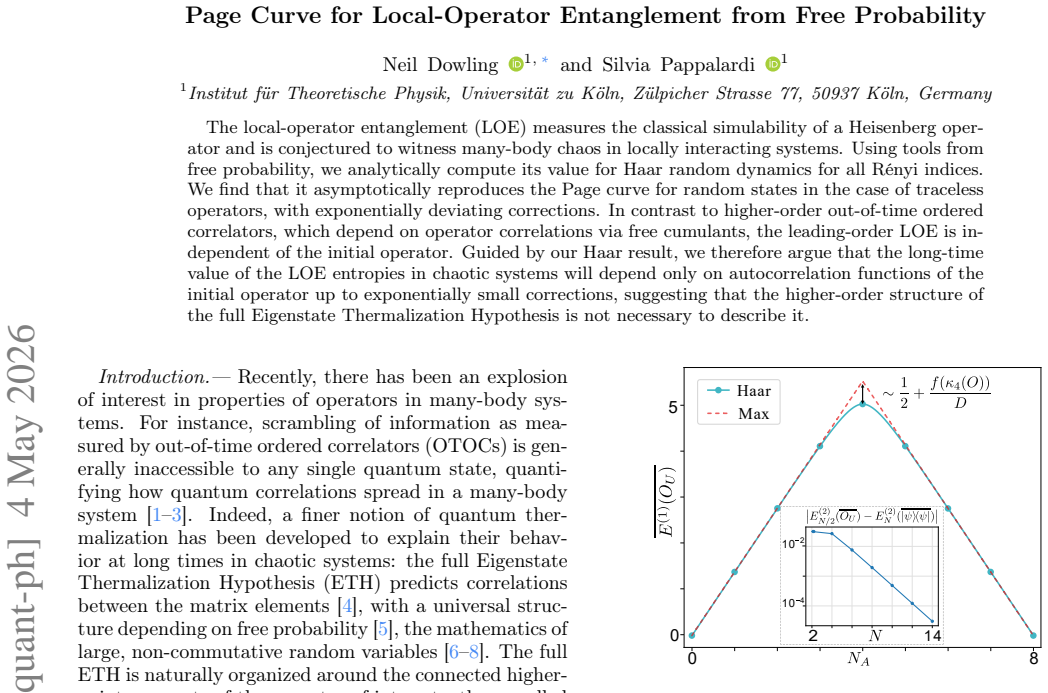
Using free probability, the authors derive closed-form expressions for the Rényi local-operator entropies under Haar-random evolution. They show that for operators with zero trace, the LOE asymptotically matches the Page curve of a random pure state in the thermodynamic limit, with corrections that decay exponentially in time or system size. Unlike out-of-time-order correlators, this leading-order result does not depend on higher moments or free cumulants of the operator.
What carries the argument
Free probability applied to the moment-generating function of the reduced density matrix of the Heisenberg-evolved operator under the Haar measure, producing exact Rényi entropies for all indices.
If this is right
- Long-time LOE entropies in chaotic systems saturate to a value fixed solely by the initial operator's autocorrelation function.
- Higher-order operator correlations and free cumulants do not enter the leading LOE behavior, unlike in out-of-time-order correlators.
- The Page curve for LOE can be used as a diagnostic of many-body chaos without invoking the complete eigenstate thermalization hypothesis.
Where Pith is reading between the lines
- Analytical or numerical studies of operator growth in chaotic systems could be simplified by tracking only two-point autocorrelation functions.
- The same independence may appear in other operator entanglement measures or in holographic models of chaos.
- The exponential corrections could be measured in small-system numerics to test how quickly the Haar limit is approached.
Load-bearing premise
The exact Haar-random result can be used to infer the long-time behavior of local-operator entanglement in generic chaotic locally-interacting systems, with only autocorrelation functions mattering up to exponentially small corrections.
What would settle it
Numerical computation of long-time local-operator entanglement for a traceless operator in a chaotic spin chain or random circuit, checking whether the saturation value matches the autocorrelation-function prediction within exponentially small deviations.
Figures

read the original abstract
The local-operator entanglement (LOE) measures the classical simulability of a Heisenberg operator and is conjectured to witness many-body chaos in locally interacting systems. Using tools from free probability, we analytically compute its value for Haar random dynamics for all R\'enyi indices. We find that it asymptotically reproduces the Page curve for random states in the case of traceless operators, with exponentially deviating corrections. In contrast to higher-order out-of-time ordered correlators, which depend on operator correlations via free cumulants, the leading-order LOE is independent of the initial operator. Guided by our Haar result, we therefore argue that the long-time value of the LOE entropies in chaotic systems will depend only on autocorrelation functions of the initial operator up to exponentially small corrections, suggesting that the higher-order structure of the full Eigenstate Thermalization Hypothesis is not necessary to describe it.
Editorial analysis
A structured set of objections, weighed in public.
Referee Report
Summary. The manuscript analytically computes the Rényi entropies of local-operator entanglement (LOE) for Haar-random unitaries using free probability for all Rényi indices. For traceless operators it shows that the LOE asymptotically reproduces the Page curve with exponentially small corrections and that the leading-order term is independent of the initial operator. Guided by this exact result, the authors argue that the long-time LOE in generic chaotic locally interacting systems depends only on the autocorrelation functions of the initial operator up to exponentially small corrections.
Significance. The exact, parameter-free computation of LOE Rényi entropies under Haar averaging via free probability is a clear technical strength and supplies a useful analytical benchmark. The reported independence from higher free cumulants at leading order distinguishes LOE from OTOCs and, if the extrapolation holds, would imply that LOE can be described without invoking the full eigenstate thermalization hypothesis, thereby simplifying the analysis of operator growth and classical simulability in many-body systems.
major comments (1)
- [§4] §4 (implications for chaotic dynamics): the claim that 'the long-time value of the LOE entropies in chaotic systems will depend only on autocorrelation functions of the initial operator up to exponentially small corrections' is not supported by an explicit bound, perturbative control, or ETH-style argument showing that higher free cumulants remain exponentially suppressed rather than polynomially small or system-size dependent under local evolution; the step is presented as an extrapolation from the Haar result rather than a derivation.
minor comments (1)
- [Abstract] The abstract states that the leading-order LOE is 'independent of the initial operator' for traceless cases, but the precise statement of this independence (including any residual dependence through the autocorrelation function) should be repeated explicitly in the main text for clarity.
Simulated Author's Rebuttal
We thank the referee for their careful reading of the manuscript and for recognizing the technical value of the free-probability calculation. We address the major comment below and will revise the manuscript accordingly.
read point-by-point responses
-
Referee: §4 (implications for chaotic dynamics): the claim that 'the long-time value of the LOE entropies in chaotic systems will depend only on autocorrelation functions of the initial operator up to exponentially small corrections' is not supported by an explicit bound, perturbative control, or ETH-style argument showing that higher free cumulants remain exponentially suppressed rather than polynomially small or system-size dependent under local evolution; the step is presented as an extrapolation from the Haar result rather than a derivation.
Authors: We agree that the statement in §4 is an extrapolation guided by the exact Haar-random result rather than a derivation. The manuscript does not supply an explicit bound, perturbative control, or ETH-style argument establishing that higher free cumulants remain exponentially suppressed (as opposed to polynomially small or system-size dependent) under local evolution. We will revise the text to present the claim explicitly as a conjecture motivated by the leading-order independence observed for Haar unitaries and by the expected universality of chaotic dynamics, without asserting a derivation. A rigorous justification of the suppression would require additional techniques beyond those employed here and is left for future work. revision: yes
Circularity Check
Haar-random LOE computation via free probability is self-contained; long-time chaotic-system claim is extrapolation, not reduction by construction
full rationale
The paper's primary derivation analytically computes the Rényi LOE entropies under Haar-random unitaries for all indices using free-probability techniques, establishing asymptotic reproduction of the Page curve for traceless operators together with leading-order independence from the initial operator. This calculation is presented as exact and independent of any fitted parameters or self-referential definitions. The subsequent statement that generic locally interacting chaotic dynamics will exhibit the same long-time LOE (depending only on autocorrelation functions up to exponentially small corrections) is explicitly framed as an argument guided by the Haar result rather than a theorem derived from first principles inside the paper. No equation or step equates a claimed prediction to its own inputs by construction, no self-citations are load-bearing for the central result, and no ansatz is smuggled via prior work. The derivation chain for the exact Haar case therefore remains self-contained against external benchmarks.
Axiom & Free-Parameter Ledger
axioms (1)
- standard math Free probability theory applies to the calculation of operator entanglement entropies under Haar-random dynamics
Forward citations
Cited by 1 Pith paper
-
Lecture Notes on Replica Tensor Networks for Random Quantum Circuits
Lecture notes and accompanying library teach replica tensor network methods to compute circuit-averaged observables in random quantum circuits by mapping them to classical statistical mechanics models.
Reference graph
Works this paper leans on
-
[1]
S. H. Shenker and D. Stanford, Multiple shocks, Journal of High Energy Physics2014, 46 (2014)
2014
-
[2]
Nahum, S
A. Nahum, S. Vijay, and J. Haah, Operator spreading in random unitary circuits, Physical Review X8, 021014 (2018)
2018
- [3]
-
[4]
Foini and J
L. Foini and J. Kurchan, Eigenstate thermalization hy- pothesis and out of time order correlators, Phys. Rev. E 99, 042139 (2019)
2019
-
[5]
Pappalardi, L
S. Pappalardi, L. Foini, and J. Kurchan, Eigenstate ther- malization hypothesis and free probability, Phys. Rev. Lett.129, 170603 (2022)
2022
-
[6]
Voiculescu, Limit laws for random matrices and free products, Inventiones mathematicae104, 201–220 (1991)
D. Voiculescu, Limit laws for random matrices and free products, Inventiones mathematicae104, 201–220 (1991)
1991
-
[7]
Speicher, Free probability theory and non-crossing partitions., Séminaire Lotharingien de Combinatoire39, B39c (1997)
R. Speicher, Free probability theory and non-crossing partitions., Séminaire Lotharingien de Combinatoire39, B39c (1997)
1997
-
[8]
Nica and R
A. Nica and R. Speicher,Lectures on the combinatorics of free probability, London Mathematical Society Lecture NoteSeries, Vol.335(CambridgeUniversityPress,2006)
2006
-
[9]
Zanardi, Entanglement of quantum evolutions, Phys
P. Zanardi, Entanglement of quantum evolutions, Phys. Rev. A63, 040304(R) (2001)
2001
-
[10]
Prosen and M
T. Prosen and M. Znidarič, Is the efficiency of classical simulations of quantum dynamics related to integrabil- ity?, Phys. Rev. E75, 015202(R) (2007)
2007
-
[11]
The Haar values thereof have been studied in Refs
The LOE should not be confused with the operator en- tanglement of the time-evolution propagator [9], which tends to behave similarly to state entanglement, grow- ing fast irrespective of integrability [24, 65, 66]. The Haar values thereof have been studied in Refs. [65, 67], where it was found they are identical to the state Page 6 curve [30, 31]
-
[12]
N. Dowling, Classical simulability from operator entan- glement scaling (2026), arXiv:2603.05656 [quant-ph]
-
[13]
Dowling, P
N. Dowling, P. Kos, and X. Turkeshi, Magic resources of the heisenberg picture, Phys. Rev. Lett.135, 050401 (2025)
2025
-
[14]
Dowling, K
N. Dowling, K. Modi, and G. A. L. White, Bridging en- tanglement and magic resources within operator space, Phys. Rev. Lett.135, 160201 (2025)
2025
-
[15]
Rakovszky, C
T. Rakovszky, C. W. von Keyserlingk, and F. Poll- mann,Dissipation-assistedoperatorevolutionmethodfor capturing hydrodynamic transport, Phys. Rev. B105, 075131 (2022)
2022
-
[16]
T. Begušić and G. K.-L. Chan, Real-time operator evo- lution in two and three dimensions via sparse pauli dy- namics (2024), arXiv:2409.03097 [quant-ph]
-
[17]
Schuster, C
T. Schuster, C. Yin, X. Gao, and N. Y. Yao, A polynomial-time classical algorithm for noisy quantum circuits, Phys. Rev. X15, 041018 (2025)
2025
-
[18]
Angrisani, A
A. Angrisani, A. Schmidhuber, M. S. Rudolph, M. Cerezo, Z. Holmes, and H.-Y. Huang, Classically es- timating observables of noiseless quantum circuits, Phys. Rev. Lett.135, 170602 (2025)
2025
- [19]
-
[20]
Bravyi, D
S. Bravyi, D. Browne, P. Calpin, E. Campbell, D. Gosset, and M. Howard, Simulation of quantum circuits by low- rank stabilizer decompositions, Quantum3, 181 (2019)
2019
-
[21]
For general quench settings, free fermion dynamics leads to a volume law growth of state entanglement en- tropy [36], while OTOC growth has been proven to be distinct to state entanglement [68]
-
[22]
Prosen and I
T. Prosen and I. Pižorn, Operator space entanglement entropy in a transverse ising chain, Phys. Rev. A76, 032316 (2007)
2007
-
[23]
I.PižornandT.Prosen,Operatorspaceentanglementen- tropy inxyspin chains, Phys. Rev. B79, 184416 (2009)
2009
-
[24]
J. Dubail, Entanglement scaling of operators: a confor- mal field theory approach, with a glimpse of simulability of long-time dynamics in 1..+..1d, Journal of Physics A: Mathematical and Theoretical50, 234001 (2017)
2017
-
[25]
V. Alba, J. Dubail, and M. Medenjak, Operator entan- glement in interacting integrable quantum systems: The case of the rule 54 chain, Phys. Rev. Lett.122, 250603 (2019)
2019
-
[26]
Bertini, P
B. Bertini, P. Kos, and T. Prosen, Operator Entangle- ment in Local Quantum Circuits II: Solitons in Chains of Qubits, SciPost Phys.8, 068 (2020)
2020
-
[27]
Alba, Diffusion and operator entanglement spreading, Phys
V. Alba, Diffusion and operator entanglement spreading, Phys. Rev. B104, 094410 (2021)
2021
-
[28]
Dowling, P
N. Dowling, P. Kos, and K. Modi, Scrambling Is Neces- sary but Not Sufficient for Chaos, Physical Review Let- ters131, 180403 (2023)
2023
-
[29]
Dowling,Multi-time Structures from Many-body Dy- namics, Ph.D
N. Dowling,Multi-time Structures from Many-body Dy- namics, Ph.D. thesis, Monash University (2025)
2025
-
[30]
D. N. Page, Average entropy of a subsystem, Phys. Rev. Lett.71, 1291 (1993)
1993
-
[31]
Zyczkowski and H.-J
K. Zyczkowski and H.-J. Sommers, Induced measures in the space of mixed quantum states, Journal of Physics A: Mathematical and General34, 7111 (2001)
2001
-
[32]
Srednicki, The approach to thermal equilibrium in quantized chaotic systems, J
M. Srednicki, The approach to thermal equilibrium in quantized chaotic systems, J. Phys. A-Math. Gen.32, 1163 (1999)
1999
-
[33]
D’Alessio, Y
L. D’Alessio, Y. Kafri, A. Polkovnikov, and M. Rigol, From quantum chaos and eigenstate thermalization to statistical mechanics and thermodynamics, Adv. Phys. 65, 239 (2016)
2016
-
[34]
Vidmar and M
L. Vidmar and M. Rigol, Entanglement entropy of eigen- states of quantum chaotic hamiltonians, Phys. Rev. Lett. 119, 220603 (2017)
2017
-
[35]
Murthy and M
C. Murthy and M. Srednicki, Structure of chaotic eigen- states and their entanglement entropy, Phys. Rev. E100, 022131 (2019)
2019
-
[36]
Calabrese and J
P. Calabrese and J. Cardy, Evolution of entanglement entropy in one-dimensional systems, Journal of Statisti- cal Mechanics: Theory and Experiment2005, P04010 (2005)
2005
-
[37]
Bianchi, L
E. Bianchi, L. Hackl, M. Kieburg, M. Rigol, and L. Vid- mar, Volume-law entanglement entropy of typical pure quantum states, PRX Quantum3, 030201 (2022)
2022
-
[38]
Coarse-grained dynamics of operator and state entanglement
C. Jonay, D. A. Huse, and A. Nahum, Coarse-grained dynamics of operator and state entanglement (2018), arXiv:1803.00089 [cond-mat.stat-mech]
work page Pith review arXiv 2018
-
[39]
Kudler-Flam, M
J. Kudler-Flam, M. Nozaki, S. Ryu, and M. T. Tan, En- tanglement of local operators and the butterfly effect, Phys. Rev. Res.3, 033182 (2021)
2021
-
[40]
Bertini, P
B. Bertini, P. Kos, and T. Prosen, Operator Entangle- ment in Local Quantum Circuits I: Chaotic Dual-Unitary Circuits, SciPost Phys.8, 067 (2020)
2020
- [41]
-
[42]
Thek={0,1,∞}entropies are defined through their re- spective limits
-
[43]
Collins and P
B. Collins and P. Sniady, Integration with Respect to the Haar Measure on Unitary, Orthogonal and Symplectic Group, Communications in Mathematical Physics264, 773 (2006)
2006
-
[44]
A. A. Mele, Introduction to haar measure tools in quan- tuminformation: Abeginner’stutorial,Quantum8,1340 (2024)
2024
-
[45]
The inverse is well defined forD>2k, covering the rele- vant asymptotic regime of this work
-
[46]
The two unique Wein- garten function components can be explicitly evaluated asWg ee =Wg γγ =(D 2 −1)−1andWg γe =Wg eγ = (D(D2−1))−1
For instance, for two replicas, the permutation group is simply{(1)(2),(12)}, corresponding to the identity and SWAP operations onH ⊗2. The two unique Wein- garten function components can be explicitly evaluated asWg ee =Wg γγ =(D 2 −1)−1andWg γe =Wg eγ = (D(D2−1))−1
-
[47]
B. Collins, Moments and cumulants of polynomial ran- dom variables on unitarygroups, the itzykson-zuber in- tegral, and free probability, International Mathematics Research Notices2003, 953 (2003)
2003
-
[48]
the purities of a quantum state where these averages are equivalent
Note that as a2k-replica quantity, Clifford averages will not return the unitary Haar value for the operator2- purity LOE [14]; cf. the purities of a quantum state where these averages are equivalent
-
[49]
It equals the minimum number of transpositions (SWAP operations) to obtainσfromπ
-
[50]
Alba, More on the operator space entanglement (ose): Renyi ose, revivals, and integrability breaking, Journal of Physics A: Mathematical and Theoretical58, 175003 (2025)
V. Alba, More on the operator space entanglement (ose): Renyi ose, revivals, and integrability breaking, Journal of Physics A: Mathematical and Theoretical58, 175003 (2025)
2025
-
[51]
Aharonov, J
D. Aharonov, J. Cotler, and X.-L. Qi, Quantum algo- rithmic measurement, Nature Communications13, 887 7 (2022)
2022
-
[52]
To multiply elements of the Brauer algebra, one ‘stacks’ the diagrams of e.g. Eq. (20) and˜γ. Calculating the num- ber of cycles of this product,#B, corresponds to connect- ing the upper and lower open wires, which are vertically aligned, and then counting the number of closed loops. For this example, we arrive at two closed loops. It can be checked that ...
-
[53]
M. Fava, J. Kurchan, and S. Pappalardi, Designs via free probability, Phys. Rev. X15, 011031 (2025)
2025
-
[54]
F. Fritzsch and P. W. Claeys, Free probability in a minimal quantum circuit model, arXiv preprint arXiv:2506.11197 (2025), arXiv:2506.11197 [quant-ph]
-
[55]
N. Dowling, J. D. Nardis, M. Heinrich, X. Turkeshi, and S. Pappalardi, Free independence and unitary de- sign from random matrix product unitaries (2025), arXiv:2508.00051 [quant-ph]
-
[56]
Dowling, X
N. Dowling, X. Turkeshi, J. D. Nardis, and G. Lami,In preparation(2026)
2026
-
[57]
E. Vallini, L. Foini, and S. Pappalardi, Refinements of the eigenstate thermalization hypothesis under lo- cal rotational invariance via free probability (2025), arXiv:2511.23217 [cond-mat.stat-mech]
-
[58]
J. M. Deutsch, Quantum statistical mechanics in a closed system, Phys. Rev. A43, 2046 (1991)
2046
-
[59]
Srednicki, Chaos and quantum thermalization, Phys
M. Srednicki, Chaos and quantum thermalization, Phys. Rev. E50, 888 (1994)
1994
-
[60]
J. M. Deutsch, Thermodynamic entropy of a many-body energy eigenstate, New Journal of Physics12, 075021 (2010)
2010
-
[61]
Lu and T
T.-C. Lu and T. Grover, Renyi entropy of chaotic eigen- states, Phys. Rev. E99, 032111 (2019)
2019
-
[62]
S. Jindal and P. Hosur, Generalized free cumu- lants for quantum chaotic systems, arXiv preprint arXiv:2401.13829 (2024)
-
[63]
Pappalardi, L
S. Pappalardi, L. Foini, and J. Kurchan, Microcanoni- cal windows on quantum operators, Quantum8, 1227 (2024)
2024
- [64]
-
[65]
Zhou and D
T. Zhou and D. J. Luitz, Operator entanglement entropy of the time evolution operator in chaotic systems, Phys. Rev. B95, 094206 (2017)
2017
-
[66]
L. Nie, M. Nozaki, S. Ryu, and M. T. Tan, Signature of quantum chaos in operator entanglement in 2d cfts, Journal of Statistical Mechanics: Theory and Experi- ment2019, 093107 (2019)
2019
-
[67]
Z.-W. Liu, S. Lloyd, E. Y. Zhu, and H. Zhu, Generalized entanglement entropies of quantum designs, Phys. Rev. Lett.120, 130502 (2018)
2018
-
[68]
A. W. Harrow, L. Kong, Z.-W. Liu, S. Mehraban, and P. W. Shor, Separation of out-of-time-ordered correlation and entanglement, PRX Quantum2, 020339 (2021)
2021
-
[69]
H. A. Camargo, Y. Fu, V. Jahnke, K. Pal, and K.-Y. Kim, Quantum signatures of chaos from free probability, Journal of High Energy Physics10, 138 (2025)
2025
- [70]
-
[71]
Fritzsch, T
F. Fritzsch, T. Prosen, and S. Pappalardi, Microcanoni- cal free cumulants in lattice systems, Phys. Rev. B111, 054303 (2025)
2025
- [72]
-
[73]
T. Pathak, Full eigenstate thermalization in integrable spin systems (2025), arXiv:2510.05887 [cond-mat.stat- mech]
-
[74]
M. Fava, J. Kurchan, and S. Pappalardi, Designs via free probability, Physical Review X15, 011031 (2025)
2025
-
[75]
Cipolloni, L
G. Cipolloni, L. Erdős, and D. Schröder, Thermalisation for wigner matrices, Journal of Functional Analysis282, 109394 (2022)
2022
-
[76]
H. J. Chen and J. Kudler-Flam, Free independence and the noncrossing partition lattice in dual-unitary quantum circuits, Physical Review B111, 014311 (2025)
2025
-
[77]
E. Vallini and S. Pappalardi, Long-time freeness in the kicked top, arXiv preprint arXiv:2411.12050 (2024), arXiv:2411.12050 [quant-ph]
-
[78]
Mccammond, Noncrossing partitions in surprising lo- cations, American Mathematical Monthly113(2006)
J. Mccammond, Noncrossing partitions in surprising lo- cations, American Mathematical Monthly113(2006). 8 End Matter Appendix A: Operatork-Purity Replica Formula.— Here we provide a proof of replica identity for the op- eratork-purity used in Eq. (8). First, it is convenient to introduce a graphical notation for vectorized operators, Eq. (1), ∣OU⟫= ,(26) ...
2006
discussion (0)
Sign in with ORCID, Apple, or X to comment. Anyone can read and Pith papers without signing in.