Recognition: no theorem link
Characterizing electronic scattering rates with transport in multiterminal devices
Pith reviewed 2026-05-14 21:39 UTC · model grok-4.3
The pith
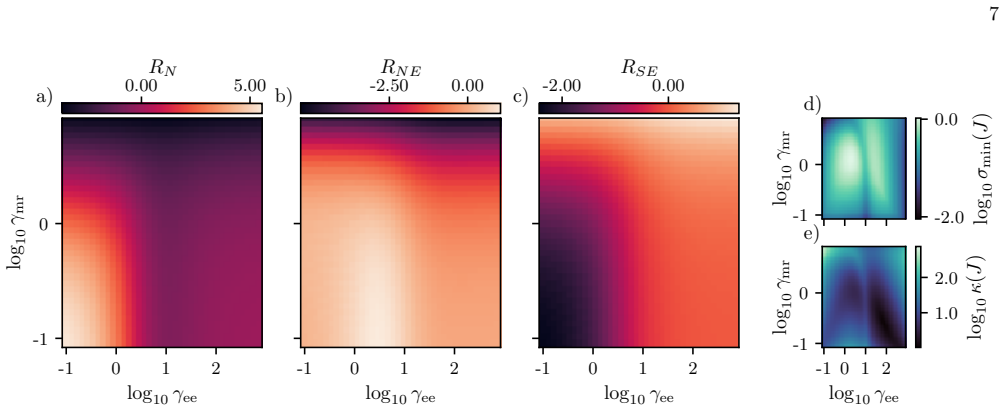
Current partition in a five-terminal device diagnoses the ballistic-hydrodynamic-Ohmic crossover and extracts both momentum-relaxing and momentum-conserving scattering rates.
A machine-rendered reading of the paper's core claim, the machinery that carries it, and where it could break.
Core claim
In a five-terminal geometry the partition of current among the drain contacts diagnoses the ballistic-hydrodynamic-Ohmic crossover in two-dimensional electron liquids. The linearized Boltzmann transport model shows that this partition allows quantitative extraction of both momentum-relaxing and momentum-conserving scattering rates throughout the crossover regime, while also exhibiting clear signatures that discriminate tomographic flow from viscous flow.
What carries the argument
The five-terminal geometry in which current partition among drain contacts acts as the diagnostic observable for transport regime and scattering rates within the linearized Boltzmann equation.
If this is right
- Multiterminal devices can distinguish ballistic, hydrodynamic, and Ohmic regimes from a single current measurement.
- Both momentum-relaxing and momentum-conserving scattering rates become extractable in the crossover regime.
- Clear signatures of the tomographic regime appear, enabling discrimination from viscous flow.
- Multiterminal geometries offer a simpler experimental route than space-resolved imaging for characterizing electron liquids.
Where Pith is reading between the lines
- The same current-partition diagnostic could be applied to other multiterminal layouts to probe additional hydrodynamic observables.
- If the extracted rates match independent measurements from conductivity or noise, the method could be used for in-operando characterization of scattering in working devices.
- The approach assumes linear response, so its predictions must be checked separately against nonlinear transport at higher bias.
Load-bearing premise
The linearized Boltzmann transport equation remains quantitatively accurate across the ballistic-hydrodynamic-Ohmic crossover in this specific five-terminal geometry without higher-order or non-local corrections.
What would settle it
A direct comparison in which measured current-partition ratios at varying densities or temperatures deviate systematically from the ratios predicted by the linearized Boltzmann model once independent estimates of the two scattering rates are inserted.
Figures


read the original abstract
Strongly interacting electrons in clean two-dimensional devices are theorized to exhibit many distinct transport regimes, such as ballistic, hydrodynamic, or diffusive. Realistic samples often lie in crossover regimes between these idealized limits. We show how a single experiment on a multiterminal device can distinguish these regimes and constrain the relevant scattering rates without space-resolved imaging. Using a linearized Boltzmann model in a five-terminal geometry, we find that current partition among the drain contacts diagnoses the ballistic-hydrodynamic-Ohmic crossover and allows extraction of momentum-relaxing and momentum-conserving scattering rates in the crossover regime. The same geometry also exhibits clear signatures of the tomographic regime, potentially allowing for a quantitative discrimination between viscous and tomographic flow in experiments. Our results demonstrate that multiterminal devices are a simpler experimental route to characterize transport regimes in electron liquids, relative to space-resolved imaging experiments.
Editorial analysis
A structured set of objections, weighed in public.
Referee Report
Summary. The paper claims that a five-terminal multiterminal device geometry, analyzed via a linearized Boltzmann transport model, can diagnose the ballistic-hydrodynamic-Ohmic crossover in 2D electron systems through current partition ratios among drain contacts. This partition allows extraction of both momentum-relaxing and momentum-conserving scattering rates in the crossover regime, while also exhibiting signatures of the tomographic regime, offering a simpler alternative to space-resolved imaging for characterizing transport regimes.
Significance. If the numerical results hold under the stated assumptions, the work would provide a practical experimental protocol for constraining scattering rates in realistic crossover regimes without requiring local probes, potentially advancing studies of viscous electron flow in clean 2D devices. The approach leverages standard multiterminal measurements and could be tested in existing GaAs or graphene heterostructures.
major comments (2)
- [Abstract and model description] Abstract and model description: The central claim that current partition quantitatively tracks the ballistic-hydrodynamic-Ohmic crossover and permits unique extraction of the two scattering rates rests on the linearized Boltzmann equation remaining accurate across the crossover. No cross-checks are shown against the full nonlinear Boltzmann equation, higher-order moment expansions, or hydrodynamic simulations including slip-length corrections, which is load-bearing because linearization assumes small deviations from equilibrium and may miss non-local viscous stresses that alter terminal currents.
- [Results on current partition] The extraction procedure for scattering rates from partition ratios is presented as a forward model output. It is unclear whether the mapping is invertible without degeneracy or sensitivity to geometry parameters (e.g., contact spacing or width), as no error bars, sensitivity analysis, or inversion tests are provided in the results.
minor comments (2)
- [Model section] Notation for the two scattering rates (momentum-relaxing vs. conserving) should be defined explicitly with symbols in the model section to avoid ambiguity when discussing the tomographic regime.
- [Figures] Figure captions for the partition plots should include the specific values of the scattering rates used and the range of the crossover parameter scanned.
Simulated Author's Rebuttal
We thank the referee for their careful reading and constructive comments on our manuscript. We address each major comment point by point below and have revised the manuscript to incorporate additional analysis and discussion where appropriate.
read point-by-point responses
-
Referee: [Abstract and model description] Abstract and model description: The central claim that current partition quantitatively tracks the ballistic-hydrodynamic-Ohmic crossover and permits unique extraction of the two scattering rates rests on the linearized Boltzmann equation remaining accurate across the crossover. No cross-checks are shown against the full nonlinear Boltzmann equation, higher-order moment expansions, or hydrodynamic simulations including slip-length corrections, which is load-bearing because linearization assumes small deviations from equilibrium and may miss non-local viscous stresses that alter terminal currents.
Authors: We agree that the validity of the linearized Boltzmann equation is central to our results. This approximation is standard and well-justified for the small-bias linear-response regime relevant to multiterminal transport experiments. Full nonlinear Boltzmann solutions or higher-order expansions are computationally prohibitive for the five-terminal geometry and are not typically required when biases are small enough that quadratic corrections remain negligible, as is the case in standard measurements. To address the referee's concern, we have added a dedicated paragraph in the revised Methods section discussing the range of validity of linearization, referencing prior comparisons between linear and nonlinear treatments in viscous electron flow, and confirming consistency with hydrodynamic limits that include slip-length effects. We view this as sufficient support for the claims without necessitating a full nonlinear re-computation for the present study. revision: partial
-
Referee: [Results on current partition] The extraction procedure for scattering rates from partition ratios is presented as a forward model output. It is unclear whether the mapping is invertible without degeneracy or sensitivity to geometry parameters (e.g., contact spacing or width), as no error bars, sensitivity analysis, or inversion tests are provided in the results.
Authors: We thank the referee for highlighting this point. The original manuscript emphasized the forward mapping to illustrate the diagnostic capability. In the revised manuscript we have added a sensitivity analysis demonstrating that the current partition ratios remain stable under realistic variations in contact spacing and width (within typical lithographic tolerances). We have also included inversion tests: synthetic partition data with added experimental noise levels are inverted to recover the input scattering rates, showing uniqueness in the crossover regime with no observed degeneracy. Error bars on the extracted rates are now reported based on these tests. These additions appear in a new supplementary section with accompanying figures. revision: yes
Circularity Check
Forward modeling of current partitions from linearized Boltzmann equation is independent of extraction claim
full rationale
The derivation solves the linearized Boltzmann equation in the five-terminal geometry for given momentum-relaxing and momentum-conserving rates, then computes terminal current partitions as output. This forward computation is used to show that partitions diagnose the crossover and permit rate extraction; the mapping is not defined by construction to equal its inputs, nor does any step rename a fit as a prediction. No self-citation load-bearing steps, uniqueness theorems, or ansatz smuggling appear in the abstract or model description. The result is therefore self-contained against external benchmarks and receives a low circularity score.
Axiom & Free-Parameter Ledger
free parameters (2)
- momentum-relaxing scattering rate
- momentum-conserving scattering rate
axioms (1)
- domain assumption Linearized Boltzmann transport equation accurately describes electron dynamics in the ballistic-hydrodynamic-Ohmic crossover
Reference graph
Works this paper leans on
-
[1]
INTRODUCTION Hydrodynamics is the effective long-wavelength theory describing how conserved quantities evolve once rapid colli- sions establish local equilibrium [1–5]. In this regime, elec- tron transport is not organized by the full nonequilibrium distribution function, but by a small set of slowly varying fields and transport coefficients, making it po...
work page internal anchor Pith review Pith/arXiv arXiv 2026
-
[2]
METHODS We study fermionic quasiparticles in a single isotropic band with dispersion ε(|p|). With θ≡arctan(p y/px), in the limit T→ 0, dynamics are confined to the Fermi surface, and we may take the deviation from equilbrium to be independent ofp≡ |p|according to δf(x,p) =ϕ(x, θ)δ(µ 0 −ε(p)).(1) Integrating the Boltzmann transport equation for f over the ...
-
[3]
RESULTS For concreteness, in this work, we consider the five- terminal ‘fan’ sketched in Fig. 1. Two design principles motivated our choice of geometry. Firstly, in the ballistic limit, current should preferentially flow into the branch labeled N. Secondly, the three branches labelled SE, E and N E differ in length and width in such a way that they repres...
-
[4]
CONCLUSION We have shown that multiterminal transport in a sin- gle mesoscopic device provides a route for quantitatively diagnosing electronic transport regimes without the need for space-resolved imaging. In the five-terminal fan geom- etry studied here, simple current branching fractions al- ready distinguish the ballistic, hydrodynamic, and Ohmic limi...
-
[5]
L. D. Landau and E. M. Lifshitz,Fluid mechanics, 2nd ed., Course of theoretical physics No. 6 (Elsevier, Butterworth- Heinemann, Amsterdam Heidelberg, 2012)
work page 2012
-
[6]
R. N. Gurzhi, Sov. Phys. Usp.11, 255 (1968)
work page 1968
- [7]
-
[8]
L. Fritz and T. Scaffidi, Annual Review of Condensed Matter Physics15, 17 (2024)
work page 2024
- [9]
-
[10]
S. A. Hartnoll, Nat Phys11, 54 (2015/01//print, 2015- 01)
work page 2015
-
[11]
A. Lucas and S. A. Hartnoll, Proceedings of the National Academy of Sciences114, 11344 (2017)
work page 2017
-
[12]
Planckian bound on the local equilibration time,
M. Qi, A. Milekhin, and L. Delacr´ etaz, “Planckian bound on the local equilibration time,” (2026), arXiv:2602.17638 [cond-mat]
- [13]
-
[14]
C. B. Mendl and A. Lucas, Appl. Phys. Lett.112, 124101 (2018)
work page 2018
-
[15]
J. H. Farrell, N. Grisouard, and T. Scaffidi, Phys. Rev. B106, 195432 (2022)
work page 2022
-
[16]
Supersonic flow and hydraulic jump in an electronic de Laval nozzle,
J. Geurs, T. A. Webb, Y. Guo, I. Keren, J. H. Farrell, J. Xu, K. Watanabe, T. Taniguchi, D. N. Basov, J. Hone, A. Lucas, A. Pasupathy, and C. R. Dean, “Supersonic flow and hydraulic jump in an electronic de Laval nozzle,” (2025), arXiv:2509.16321 [cond-mat]
-
[17]
Spontaneous Running Waves and Self-Oscillatory Transport in Dirac Fluids,
P. Liong, A. Melnichenka, A. Bukhtatyi, A. Bilous, and L. Levitov, “Spontaneous Running Waves and Self-Oscillatory Transport in Dirac Fluids,” (2025), arXiv:2512.16571 [cond-mat]
-
[18]
C. W. J. Beenakker and H. van Houten (1991) pp. 1–228, arXiv:cond-mat/0412664
work page internal anchor Pith review Pith/arXiv arXiv 1991
-
[19]
P. Ledwith, H. Guo, A. Shytov, and L. Levitov, Phys. Rev. Lett.123, 116601 (2019)
work page 2019
- [20]
- [21]
-
[22]
N. W. Ashcroft and N. D. Mermin,Solid state physics (Holt, Rinehart and Winston, New York, 1976)
work page 1976
-
[23]
S. M. Girvin and K. Yang,Modern condensed matter physics(Cambridge university press, Cambridge New York, 2019)
work page 2019
- [24]
-
[25]
D. A. Bandurin, I. Torre, R. K. Kumar, M. Ben Shalom, A. Tomadin, A. Principi, G. H. Auton, E. Khestanova, K. S. Novoselov, I. V. Grigorieva, L. A. Ponomarenko, A. K. Geim, and M. Polini, Science351, 1055 (2016)
work page 2016
-
[26]
D. A. Bandurin, A. V. Shytov, L. S. Levitov, R. K. Kumar, A. I. Berdyugin, M. Ben Shalom, I. V. Grigorieva, A. K. Geim, and G. Falkovich, Nat Commun9, 4533 (2018)
work page 2018
-
[27]
H. Guo, E. Ilseven, G. Falkovich, and L. S. Levitov, Proceedings of the National Academy of Sciences114, 3068 (2017)
work page 2017
- [28]
- [29]
-
[30]
M. J. M. de Jong and L. W. Molenkamp, Phys. Rev. B 51, 13389 (1995)
work page 1995
-
[31]
P. J. W. Moll, P. Kushwaha, N. Nandi, B. Schmidt, and A. P. Mackenzie, Science351, 1061 (2016)
work page 2016
-
[32]
Quantita- tive measurement of viscosity in two-dimensional electron fluids,
Y. Zeng, H. Guo, O. M. Ghosh, K. Watanabe, T. Taniguchi, L. S. Levitov, and C. R. Dean, “Quantita- tive measurement of viscosity in two-dimensional electron fluids,” (2024), arXiv:2407.05026 [cond-mat]
-
[33]
I. Moiseenko, E. M¨ onch, K. Kapralov, D. Bandurin, S. Ganichev, and D. Svintsov, Phys. Rev. Lett.134, 226902 (2025)
work page 2025
-
[34]
J. A. Sulpizio, L. Ella, A. Rozen, J. Birkbeck, D. J. Perello, D. Dutta, M. Ben-Shalom, T. Taniguchi, K. Watanabe, T. Holder, R. Queiroz, A. Principi, A. Stern, T. Scaffidi, A. K. Geim, and S. Ilani, Nature576, 75 (2019)
work page 2019
-
[35]
Imaging flat band electron hydrodynamics in biased bilayer graphene,
C. Zhang, E. Redekop, H. Stoyanov, J. H. Farrell, S. Kim, L. Holleis, D. Gong, A. Keough, Y. Choi, T. Taniguchi, K. Watanabe, M. E. Huber, A. C. B. Jayich, A. Lu- cas, and A. F. Young, “Imaging flat band electron hydrodynamics in biased bilayer graphene,” (2026), arXiv:2603.11175 [cond-mat]
-
[36]
A. Aharon-Steinberg, T. V¨ olkl, A. Kaplan, A. K. Pariari, I. Roy, T. Holder, Y. Wolf, A. Y. Meltzer, Y. Myasoe- dov, M. E. Huber, B. Yan, G. Falkovich, L. S. Levitov, M. H¨ ucker, and E. Zeldov, Nature607, 74 (2022)
work page 2022
- [37]
-
[38]
Cryogenic shock exfoliation for ultrahigh mobility rhombohedral graphite nanoelectronics
L. Holleis, Y. Choi, C. Zhang, J. H. Farrell, G. Bargas, A. Hsu, Z. Chen, I. Sackin, W. Zhou, Y. Guo, T. Char- pentier, Y. Jiang, B. A. Foutty, A. Keough, M. E. Hu- ber, T. Taniguchi, K. Watanabe, A. Lucas, and A. F. Young, “Cryogenic shock exfoliation for ultrahigh mo- bility rhombohedral graphite nanoelectronics,” (2026), arXiv:2604.21912 [cond-mat]
work page internal anchor Pith review Pith/arXiv arXiv 2026
-
[39]
Magnetotransport of tomographic electrons in a channel,
N. Ben-Shachar and J. Hofmann, “Magnetotransport of tomographic electrons in a channel,” (2025), arXiv:2503.14431 [cond-mat]
- [40]
-
[41]
D. Thuillier, S. Ghosh, B. J. Ramshaw, and T. Scaffidi, Phys. Rev. Lett.135, 146302 (2025)
work page 2025
-
[42]
AC Fingerprints of 2D Elec- tron Hydrodynamics: Superdiffusion and Drude Weight Suppression,
D. Thuillier and T. Scaffidi, “AC Fingerprints of 2D Elec- tron Hydrodynamics: Superdiffusion and Drude Weight Suppression,” (2026), arXiv:2603.15737 [cond-mat]
-
[43]
M. Lee, J. R. Wallbank, P. Gallagher, K. Watanabe, T. Taniguchi, V. I. Fal’ko, and D. Goldhaber-Gordon, Science353, 1526 (2016)
work page 2016
-
[44]
M. D. Bachmann, A. L. Sharpe, A. W. Barnard, C. Putzke, M. K¨ onig, S. Khim, D. Goldhaber-Gordon, A. P. Macken- zie, and P. J. W. Moll, Nat Commun10, 5081 (2019)
work page 2019
-
[45]
P. H. McGuinness, E. Zhakina, M. K¨ onig, M. D. Bach- mann, C. Putzke, P. J. W. Moll, S. Khim, and A. P. Mackenzie, Proceedings of the National Academy of Sci- ences118, e2113185118 (2021)
work page 2021
-
[46]
Directional ballistic magnetotransport in the de- lafossite metals PdCoO$ 2$and PtCoO$ 2$,
M. Moravec, G. Baker, M. D. Bachmann, A. Sharpe, N. Nandi, A. W. Barnard, C. Putzke, S. Khim, M. K¨ onig, D. Goldhaber-Gordon, P. J. W. Moll, and A. P. Macken- zie, “Directional ballistic magnetotransport in the de- lafossite metals PdCoO$ 2$and PtCoO$ 2$,” (2026), arXiv:2503.21858 [cond-mat]
-
[47]
L. Saminadayar, D. C. Glattli, Y. Jin, and B. Etienne, Phys. Rev. Lett.79, 2526 (1997)
work page 1997
-
[48]
S. Datta,Electronic transport in mesoscopic systems, 1st ed., Cambridge studies in semiconductor physics and mi- croelectronic engineering No. 3 (Cambridge Univ. Press, Cambridge, 2009)
work page 2009
-
[49]
A. K. Geim and I. V. Grigorieva, Nature499, 419 (2013)
work page 2013
- [50]
-
[51]
Tomographic electron flow in confined geometries: Beyond the dual-relaxation time approximation,
N. Ben-Shachar and J. Hofmann, “Tomographic electron flow in confined geometries: Beyond the dual-relaxation time approximation,” (2025), arXiv:2503.14461 [cond- mat]
-
[52]
T. Oka, S. Tajima, R. Ebisuoka, T. Hirahara, K. Watan- abe, T. Taniguchi, and R. Yagi, Phys. Rev. B99, 035440 (2019)
work page 2019
- [53]
-
[54]
C. Q. Cook and A. Lucas, Phys. Rev. Lett.127, 176603 (2021)
work page 2021
-
[55]
R. J. LeVeque,Finite volume methods for hyperbolic prob- lems, Cambridge texts in applied mathematics (Cam- bridge University Press, Cambridge ; New York, 2002)
work page 2002
-
[56]
Trixi.jl: Adap- tive high-order numerical simulations of hyperbolic PDEs in Julia,
M. Schlottke-Lakemper, G. J. Gassner, H. Ranocha, A. R. Winters, J. Chan, and A. Rueda-Ram´ ırez, “Trixi.jl: Adap- tive high-order numerical simulations of hyperbolic PDEs in Julia,” (2025)
work page 2025
-
[57]
M. Schlottke-Lakemper, A. R. Winters, H. Ranocha, and G. J. Gassner, Journal of Computational Physics442, 110467 (2021)
work page 2021
-
[58]
H. Ranocha, M. Schlottke-Lakemper, A. R. Winters, E. Faulhaber, J. Chan, and G. J. Gassner, JCON1, 77 (2022), arXiv:2108.06476 [cs]
discussion (0)
Sign in with ORCID, Apple, or X to comment. Anyone can read and Pith papers without signing in.