Recognition: 3 theorem links
· Lean TheoremExchange-Only Silicon Based Spin Qubits: Charge Noise, PINN Optimised Pulse Sequences,and Gate-Level Fidelity
Pith reviewed 2026-05-08 18:48 UTC · model grok-4.3
The pith
A two-stage PINN optimizes pulses to reach 99% fidelity and shorten gate times for noisy silicon spin qubits
A machine-rendered reading of the paper's core claim, the machinery that carries it, and where it could break.
Core claim
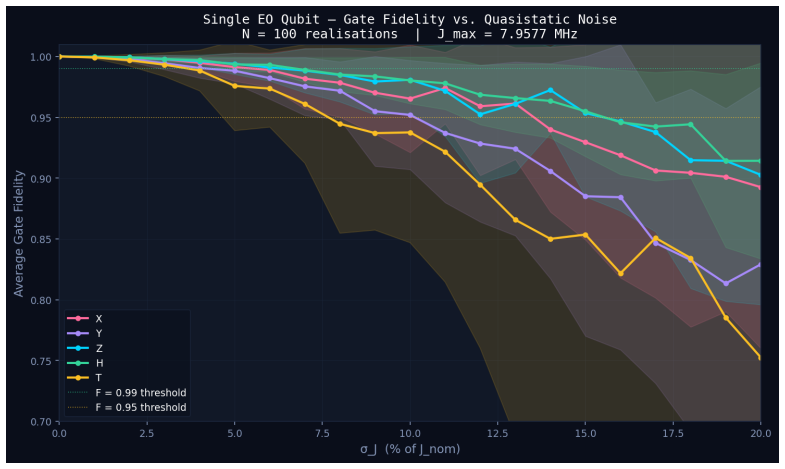
We present a two-stage PINN framework for per-gate pulse optimisation. In Stage I the PINN maximises the noise-averaged gate fidelity toward a threshold of 0.99 with fixed pulse duration. Once the threshold is crossed, Stage II progressively compresses the total pulse time while maintaining F greater than or equal to 0.99. The cost function is a Monte-Carlo ensemble mean-squared error averaged over 2000 quasi-static Gaussian noise realisations. All single-qubit gates cross the threshold within the first 100 iterations across all noise levels, and Stage II reduces pulse durations by 20-40 percent; the CX gate compresses from 31 ns to approximately 22 ns at 1 percent noise.
What carries the argument
The two-stage Physics-Informed Neural Network (PINN) optimizer that first maximizes fidelity at fixed pulse time and then minimizes pulse time at fixed fidelity threshold, with cost based on ensemble-averaged mean-squared error over 2000 noise realizations.
If this is right
- All single-qubit gates reach the 0.99 fidelity threshold within 100 iterations at noise levels of 1% to 10%.
- Stage II reduces single-qubit pulse durations by 20-40% while preserving fidelity.
- The CX two-qubit gate duration decreases from its nominal 31 ns to about 22 ns at 1% noise.
- The two-phase optimization behavior applies equally to single- and two-qubit gates in the tested set.
Where Pith is reading between the lines
- The approach may be extended to optimize sequences for larger multi-qubit operations.
- Hardware experiments could test whether the simulated fidelity improvements translate to real devices.
- Alternative noise models beyond quasi-static Gaussian could be incorporated to broaden applicability.
Load-bearing premise
The charge noise can be represented by quasi-static Gaussian fluctuations in the exchange coupling J, and that the average fidelity over 2000 independent realizations accurately reflects the true noise-averaged performance.
What would settle it
Performing the optimized gates on a physical silicon exchange-only qubit chip at a known charge noise level and verifying that the experimental fidelity meets or exceeds 0.99 at the shortened pulse durations.
Figures




read the original abstract
Exchange-only (EO) spin qubits in silicon realise all-electrical qubit control through pairwise Heisenberg exchange interactions, making them attractive for scalable quantum computation. Their principal vulnerability is charge noise, which couples multiplicatively to the exchange coupling and degrades gate fidelity. We present a \emph{two-stage} Physics-Informed Neural Network (PINN) framework for per-gate pulse optimisation. In \textbf{Stage~I} (iterations~1--100) the PINN maximises the noise-averaged gate fidelity toward a threshold of $\Fth=0.99$; the pulse duration is held fixed at its nominal hardware value. Once the threshold is crossed, \textbf{Stage~II} (iterations~101--250) progressively compresses the total pulse time while maintaining $F\geq\Fth$ via continuous fine-tuning of the pulse-shape parameters. The cost function is a Monte-Carlo ensemble mean-squared error (MSE) averaged over $N_{\rm real}=2000$ quasi-static Gaussian noise realisations drawn fresh at every iteration. We benchmark the framework on the single-qubit gate set $\{X,Y,Z,H\}$ and the two-qubit set $\{X,Y,Z,H,\mathrm{CX}\}$ at noise levels $\sigmaJ/J\in\{1\%,5\%,10\%\}$. All single-qubit gates cross $\Fth$ within the first 100 iterations across all noise levels; Stage~II then reduces pulse durations by 20--40\% from their nominal values. The two-qubit gates follow the same two-phase behaviour, with the CX gate compressing from its nominal \SI{31}{\nano\second} to $\approx\SI{22}{\nano\second}$ at 1\% noise.
Editorial analysis
A structured set of objections, weighed in public.
Referee Report
Summary. The manuscript introduces a two-stage Physics-Informed Neural Network (PINN) framework for per-gate optimization of control pulses in exchange-only silicon spin qubits. Stage I (iterations 1-100) maximizes the noise-averaged gate fidelity to a threshold F_th=0.99 with fixed nominal pulse duration, using a Monte Carlo MSE cost averaged over N_real=2000 fresh quasi-static Gaussian draws of the exchange coupling J at each iteration. Stage II (iterations 101-250) then compresses the total pulse time while enforcing F >= F_th. The method is benchmarked on the single-qubit set {X,Y,Z,H} and two-qubit set {X,Y,Z,H,CX} at charge-noise levels sigma_J/J in {1%,5%,10%}, with reported outcomes that all single-qubit gates cross threshold rapidly and pulse durations are reduced 20-40%, including CX compression from 31 ns to ~22 ns at 1% noise.
Significance. If the numerical claims hold after statistical validation, the work supplies a concrete, automated procedure for trading off gate speed against fidelity under realistic multiplicative charge noise, which is directly relevant to scaling silicon spin-qubit processors. The two-stage strategy (fidelity-first, then duration compression) is a clear methodological contribution that avoids the common pitfall of optimizing duration at the expense of fidelity. Explicit benchmarking across a full gate set and multiple noise strengths, together with the reproducible Monte-Carlo cost construction, adds practical value. The approach could be extended to larger circuits once the per-gate optimizers are shown to be statistically stable.
major comments (2)
- [Abstract / cost-function description] Abstract and cost-function description: the headline claims that all single-qubit gates cross F_th=0.99 within the first 100 iterations and that the CX gate compresses from 31 ns to ~22 ns rest on a Monte-Carlo estimator (MSE over 2000 independent quasi-static Gaussian realizations of J, refreshed each iteration). No error bars, sample variance, or convergence diagnostics for this estimator are reported. At 5-10% noise the per-realization fidelity variance is plausibly several percent; the resulting standard error on the average is then comparable to the 0.01 margin to threshold, so it is unclear whether the reported crossings are statistically stable or could fall below F_th under a larger ensemble or different random seed.
- [PINN framework section] PINN framework section: the manuscript provides no details on network architecture (depth, width, activation functions), how the physics-informed loss is constructed from the Heisenberg Hamiltonian, training hyperparameters, or convergence behavior of the optimizer. In addition, no comparison is given to alternative pulse optimizers (gradient descent on the same cost, Bayesian optimization, or evolutionary algorithms). Without these elements the advantage of the PINN choice and the reproducibility of the reported pulse compressions cannot be assessed.
minor comments (1)
- [Abstract] Abstract: the symbol F_th is introduced without an explicit definition sentence, although its numerical value is stated; likewise the first use of PINN should be expanded.
Simulated Author's Rebuttal
We thank the referee for their thorough review and constructive comments on our manuscript. We address each major comment below and indicate the revisions planned for the next version.
read point-by-point responses
-
Referee: [Abstract / cost-function description] Abstract and cost-function description: the headline claims that all single-qubit gates cross F_th=0.99 within the first 100 iterations and that the CX gate compresses from 31 ns to ~22 ns rest on a Monte-Carlo estimator (MSE over 2000 independent quasi-static Gaussian realizations of J, refreshed each iteration). No error bars, sample variance, or convergence diagnostics for this estimator are reported. At 5-10% noise the per-realization fidelity variance is plausibly several percent; the resulting standard error on the average is then comparable to the 0.01 margin to threshold, so it is unclear whether the reported crossings are statistically stable or could fall below F_th under a larger ensemble or different random seed.
Authors: We agree that the statistical properties of the Monte Carlo estimator require explicit quantification to support the reported threshold crossings and compressions. In the revised manuscript we will add the standard error of the mean (computed from the 2000 realizations) at the iteration where each gate first exceeds F_th, include convergence plots of both the mean fidelity and its sample variance, and report results from at least three independent optimization runs that employ different random seeds for the noise ensemble. These diagnostics will be placed in the main text and supplementary material. revision: yes
-
Referee: [PINN framework section] PINN framework section: the manuscript provides no details on network architecture (depth, width, activation functions), how the physics-informed loss is constructed from the Heisenberg Hamiltonian, training hyperparameters, or convergence behavior of the optimizer. In addition, no comparison is given to alternative pulse optimizers (gradient descent on the same cost, Bayesian optimization, or evolutionary algorithms). Without these elements the advantage of the PINN choice and the reproducibility of the reported pulse compressions cannot be assessed.
Authors: We acknowledge the need for greater implementation detail. The revised PINN framework section will specify network depth and width, activation functions, the explicit construction of the physics-informed loss from the time-dependent Heisenberg Hamiltonian, all training hyperparameters, and convergence curves for the loss and fidelity. These additions will ensure reproducibility. A full quantitative comparison against gradient descent, Bayesian optimization, and evolutionary algorithms was not performed because it would require a separate, resource-intensive study; we will instead add a concise discussion of why the two-stage PINN formulation is particularly suited to the noisy, high-dimensional pulse-optimization task and flag such benchmarks as future work. revision: partial
Circularity Check
No circularity: numerical optimization results are forward outputs from explicit cost function
full rationale
The paper describes a two-stage PINN optimization procedure that directly maximizes a Monte-Carlo-averaged fidelity cost function (MSE over 2000 independent quasi-static Gaussian draws of J) to reach F_th=0.99 and then compresses pulse duration. The noise model and ensemble averaging are external inputs to the optimizer; the reported pulse durations and fidelities are computed outputs, not inputs redefined as predictions. No self-referential equations, fitted parameters renamed as predictions, load-bearing self-citations, or ansatzes smuggled via prior work appear in the derivation. The framework is self-contained numerical search against an externally specified noise model and threshold.
Axiom & Free-Parameter Ledger
free parameters (4)
- F_th =
0.99
- N_real =
2000
- stage_I_iterations =
100
- stage_II_iterations =
150
axioms (2)
- domain assumption Charge noise couples multiplicatively to the exchange coupling and can be represented by quasi-static Gaussian fluctuations
- domain assumption The total pulse time can be compressed while maintaining fidelity by fine-tuning pulse-shape parameters
Lean theorems connected to this paper
-
IndisputableMonolith.Cost.FunctionalEquationwashburn_uniqueness_aczel (J(x)=½(x+x⁻¹)−1) unclear?
unclearRelation between the paper passage and the cited Recognition theorem.
The cost function is a Monte-Carlo ensemble mean-squared error (MSE) averaged over N_real=2000 quasi-static Gaussian noise realisations ... J_ij → J_ij(1+δ_ij), δ_ij ∼ N(0,σ_J^2)
-
IndisputableMonolith.Foundation.LogicAsFunctionalEquationderivedCost / Translation Theorem unclear?
unclearRelation between the paper passage and the cited Recognition theorem.
H_eff(t) = h_z(t)σ_z + h_x(t)σ_x with h_z = J23/4 − J12/2, h_x = √3 J23/4; pulse shapes optimized by a 4-layer tanh PINN
-
IndisputableMonolith.Foundation.AlexanderDualityalexander_duality_circle_linking (D=3 forcing — unrelated) unclear?
unclearRelation between the paper passage and the cited Recognition theorem.
CX synthesised from √SWAP decomposition; Stage II compresses CX from 31 ns to ≈22 ns at 1% noise
What do these tags mean?
- matches
- The paper's claim is directly supported by a theorem in the formal canon.
- supports
- The theorem supports part of the paper's argument, but the paper may add assumptions or extra steps.
- extends
- The paper goes beyond the formal theorem; the theorem is a base layer rather than the whole result.
- uses
- The paper appears to rely on the theorem as machinery.
- contradicts
- The paper's claim conflicts with a theorem or certificate in the canon.
- unclear
- Pith found a possible connection, but the passage is too broad, indirect, or ambiguous to say the theorem truly supports the claim.
Reference graph
Works this paper leans on
-
[1]
Zheng An and D. L. Zhou. Deep reinforcement learning for quantum gate control. Europhysics Letters, 126(6):60002, jul 2019. doi: 10.1209/0295-5075/126/60002. URL https://doi.org/10.1209/0295-5075/126/60002
-
[2]
Bacon, J
D. Bacon, J. Kempe, D. A. Lidar, and K. B. Whaley. Universal fault-tolerant quantum computation on decoherence-free subspaces.Phys. Rev. Lett., 85:1758–1761, Aug
-
[3]
doi: 10.1103/PhysRevLett.85.1758
-
[4]
Guido Burkard, Daniel Loss, and David P. DiVincenzo. Coupled quantum dots as quantum gates.Phys. Rev. B, 59:2070–2078, Jan 1999. doi: 10.1103/PhysRevB.59. 2070
-
[5]
Pascal Cerfontaine, Tim Botzem, Julian Ritzmann, Simon Sebastian Humpohl, Arne Ludwig, Dieter Schuh, Dominique Bougeard, Andreas D. Wieck, and Hen- drik Bluhm. Closed-loop control of a GaAs-based singlet-triplet spin qubit with 99.5% gate fidelity and low leakage.Nature Communications, 11(1):4144, 2020. doi: 10.1038/s41467-020-17865-3
-
[6]
Connors, JJ Nelson, Haifeng Qiao, Lisa F
Elliot J. Connors, JJ Nelson, Haifeng Qiao, Lisa F. Edge, and John M. Nichol. Low- frequency charge noise in si/sige quantum dots.Phys. Rev. B, 100:165305, Oct 2019. doi: 10.1103/PhysRevB.100.165305
-
[7]
O. E. Dial, M. D. Shulman, S. P. Harvey, H. Bluhm, V. Umansky, and A. Yacoby. Charge noise spectroscopy using coherent exchange oscillations in a singlet-triplet qubit.Phys. Rev. Lett., 110:146804, Apr 2013. doi: 10.1103/PhysRevLett.110.146804
-
[8]
D. P. DiVincenzo, D. Bacon, J. Kempe, G. Burkard, and K. B. Whaley. Universal quantum computation with the exchange interaction.Nature, 408(6810):339–342,
-
[9]
doi: 10.1038/35042541
-
[10]
Fong and Stephen M
Bryan H. Fong and Stephen M. Wandzura. Universal quantum computation and leakage reduction in the 3-qubit decoherence free subsystem.Quantum Info. Comput., 11(11–12):1003–1018, November 2011. ISSN 1533-7146
2011
-
[11]
Todd J Green, Jarrah Sastrawan, Hermann Uys, and Michael J Biercuk. Arbitrary quantum control of qubits in the presence of universal noise.New Journal of Physics, 15(9):095004, sep 2013. doi: 10.1088/1367-2630/15/9/095004. URLhttps://doi. org/10.1088/1367-2630/15/9/095004
-
[12]
C. R. Harris, K. J. Millman, S. J. van der Walt, R. Gommers, P. Virtanen, D. Cour- napeau, E. Wieser, J. Taylor, S. Berg, N. J. Smith, R. Kern, M. Picus, S. Hoyer, M. H. van Kerkwijk, M. Brett, A. Haldane, J. F. del Río, M. Wiebe, P. Peterson, P. Gérard-Marchant, K. Sheppard, T. Reddy, W. Weckesser, H. Abbasi, C. Gohlke, and T. E. Oliphant. Array programm...
-
[13]
Curry, Roza Kotlyar, Florian Luthi, Mateusz T
Irina Heinz, Felix Borjans, Matthew J. Curry, Roza Kotlyar, Florian Luthi, Mateusz T. Mądzik, Fahd A. Mohiyaddin, Nathaniel Bishop, and Guido Burkard. Fast Quantum Gates for Exchange-Only Qubits Using Simultaneous Exchange Pulses.PRX Quantum, 6(3):030353, 2025. doi: 10.1103/njq3-fcdd. 19
-
[14]
J. R. Johansson, P. D. Nation, and F. Nori. QuTiP: An open-source Python framework for the dynamics of open quantum systems.Computer Physics Communications, 183 (8):1760–1772, 2012. doi: 10.1016/j.cpc.2012.02.021
-
[15]
B. E. Kane. A silicon-based nuclear spin quantum computer.Nature, 393(6681): 133–147, 1998. doi: 10.1038/30156
-
[16]
Kevrekidis, Lu Lu, Paris Perdikaris, Sifan Wang, and Liu Yang
George Em Karniadakis, Ioannis G. Kevrekidis, Lu Lu, Paris Perdikaris, Sifan Wang, and Liu Yang. Physics-informed machine learning.Nature Reviews Physics, 3(6): 422–440, 2021. doi: 10.1038/s42254-021-00314-5
-
[17]
Navin Khaneja, Timo Reiss, Cindie Kehlet, Thomas Schulte-Herbrüggen, and Steffen J. Glaser. Optimal control of coupled spin dynamics: design of nmr pulse sequences by gradient ascent algorithms.Journal of Magnetic Resonance, 172(2):296–305, 2005. ISSN 1090-7807. doi: https://doi.org/10.1016/j.jmr.2004.11.004
-
[18]
Kingma and Jimmy Ba
Diederik P. Kingma and Jimmy Ba. Adam: A method for stochastic optimization, 2017
2017
-
[19]
Daniel Loss and David P. DiVincenzo. Quantum computation with quantum dots. Phys. Rev. A, 57:120–126, Jan 1998. doi: 10.1103/PhysRevA.57.120
-
[20]
Frederico Martins, Filip K. Malinowski, Peter D. Nissen, Edwin Barnes, Saeed Fallahi, Geoffrey C. Gardner, Michael J. Manfra, Charles M. Marcus, and Ferdinand Kuemmeth. Noise suppression using symmetric exchange gates in spin qubits.Phys. Rev. Lett., 116:116801, Mar 2016. doi: 10.1103/PhysRevLett.116.116801
-
[21]
Motzoi, J
F. Motzoi, J. M. Gambetta, P. Rebentrost, and F. K. Wilhelm. Simple pulses for elimination of leakage in weakly nonlinear qubits.Phys. Rev. Lett., 103:110501, Sep
-
[22]
doi: 10.1103/PhysRevLett.103.110501
-
[23]
Murphy Yuezhen Niu, Sergio Boixo, Vadim N. Smelyanskiy, and Hartmut Neven. Universal quantum control through deep reinforcement learning.npj Quantum Information, 5(1):33, Apr 2019. doi: 10.1038/s41534-019-0141-3
-
[24]
Pytorch: An imperative style, high-performance deep learning library, 2019
Adam Paszke, Sam Gross, Francisco Massa, Adam Lerer, James Bradbury, Gregory Chanan, Trevor Killeen, Zeming Lin, Natalia Gimelshein, Luca Antiga, Alban Des- maison, Andreas Köpf, Edward Yang, Zach DeVito, Martin Raison, Alykhan Tejani, Sasank Chilamkurthy, Benoit Steiner, Lu Fang, Junjie Bai, and Soumith Chintala. Pytorch: An imperative style, high-perfor...
2019
-
[25]
N. Rach, M. M. Müller, T. Calarco, and S. Montangero. Dressing the chopped- random-basis optimization: A bandwidth-limited access to the trap-free landscape. Phys. Rev. A, 92:062343, Dec 2015. doi: 10.1103/PhysRevA.92.062343
-
[26]
M. Raissi, P. Perdikaris, and G.E. Karniadakis. Physics-informed neural networks: A deep learning framework for solving forward and inverse problems involving nonlinear partial differential equations.Journal of Computational Physics, 378:686–707, 2019. ISSN 0021-9991. doi: https://doi.org/10.1016/j.jcp.2018.10.045
-
[27]
M. D. Reed, B. M. Maune, R. W. Andrews, M. G. Borselli, K. Eng, M. P. Jura, A. A. Kiselev, T. D. Ladd, S. T. Merkel, I. Milosavljevic, E. J. Pritchett, M. T. Rakher, R. S. 20 Ross, A. E. Schmitz, A. Smith, J. A. Wright, M. F. Gyure, and A. T. Hunter. Reduced sensitivity to charge noise in semiconductor spin qubits via symmetric operation. Phys. Rev. Lett....
-
[28]
Abrosimov, Łukasz Cywiński, Do- minique Bougeard, and Lars R
Tom Struck, Arne Hollmann, Floyd Schauer, Olexiy Fedorets, Andreas Schmidbauer, Kentarou Sawano, Helge Riemann, Nikolay V. Abrosimov, Łukasz Cywiński, Do- minique Bougeard, and Lars R. Schreiber. Low-frequency spin qubit energy splitting noise in highly purified28Si/SiGe.npj Quantum Information, 6(1):40, 2020. doi: 10.1038/s41534-020-0276-2
-
[29]
Tyryshkin, Shinichi Tojo, John J
Alexei M. Tyryshkin, Shinichi Tojo, John J. L. Morton, Helge Riemann, Nikolai V. Abrosimov, Peter Becker, Hans-Joachim Pohl, Thomas Schenkel, Michael L. W. Thewalt, Kohei M. Itoh, and S. A. Lyon. Electron spin coherence exceeding seconds in high-purity silicon.Nature Materials, 11(2):143–147, 2012. doi: 10.1038/nmat3182
-
[30]
M. Veldhorst, J. C. C. Hwang, C. H. Yang, A. W. Leenstra, B. de Ronde, J. P. Dehollain, J. T. Muhonen, F. E. Hudson, K. M. Itoh, A. Morello, and A. S. Dzu- rak. An addressable quantum dot qubit with fault-tolerant control-fidelity.Nature Nanotechnology, 9(12):981–985, 2014. doi: 10.1038/nnano.2014.216
-
[31]
Virtanen, R
P. Virtanen, R. Gommers, T. E. Oliphant, M. Haberland, T. Reddy, D. Cournapeau, E. Burovski, P. Peterson, W. Weckesser, J. Bright, S. J. van der Walt, M. Brett, J. Wilson, K. J. Millman, N. Mayorov, A. R. J. Nelson, E. Jones, R. Kern, E. Larson, C. J. Carey, İ. Polat, Y. Feng, E. W. Moore, J. VanderPlas, D. Laxalde, J. Perktold, R. Cimrman, I. Henriksen, ...
2020
-
[32]
Xin Wang, Lev S. Bishop, J. P. Kestner, Edwin Barnes, Kai Sun, and S. Das Sarma. Composite pulses for robust universal control of singlet–triplet qubits.Nature Com- munications, 3(1):997, 2012. doi: 10.1038/ncomms2003
-
[33]
C. H. Yang, K. W. Chan, R. Harper, W. Huang, T. Evans, J. C. C. Hwang, B. Hensen, A. Laucht, T. Tanttu, F. E. Hudson, S. T. Flammia, K. M. Itoh, A. Morello, S. D. Bartlett, and A. S. Dzurak. Silicon qubit fidelities approaching incoherent noise limits via pulse engineering.Nature Electronics, 2(4):151–158, 2019. doi: 10.1038/ s41928-019-0234-1
2019
-
[34]
Jun Yoneda, Kenta Takeda, Tomohiro Otsuka, Takashi Nakajima, Matthieu R. Delbecq, Giles Allison, Takumu Honda, Tetsuo Kodera, Shunri Oda, Yusuke Hoshi, Noritaka Usami, Kohei M. Itoh, and Seigo Tarucha. A quantum-dot spin qubit with coherence limited by charge noise and fidelity higher than 99.9%.Nature Nanotechnology, 13(2):102–106, 2018. doi: 10.1038/s41...
-
[35]
Zwanenburg, Andrew S
Floris A. Zwanenburg, Andrew S. Dzurak, Andrea Morello, Michelle Y. Simmons, Lloyd C. L. Hollenberg, Gerhard Klimeck, Sven Rogge, Susan N. Coppersmith, and Mark A. Eriksson. Silicon quantum electronics.Rev. Mod. Phys., 85:961–1019, Jul
-
[36]
doi: 10.1103/RevModPhys.85.961. 21
discussion (0)
Sign in with ORCID, Apple, or X to comment. Anyone can read and Pith papers without signing in.