Recognition: 2 theorem links
· Lean TheoremScattering of scalar, electromagnetic, and Dirac fields in an asymptotically flat regular black hole supported by primordial dark matter
Pith reviewed 2026-05-07 02:17 UTC · model grok-4.3
The pith
Raising the regularity parameter in this phantom DBI black hole lowers potential barriers and raises absorption cross sections for scalar, electromagnetic, and Dirac waves.
A machine-rendered reading of the paper's core claim, the machinery that carries it, and where it could break.
Core claim
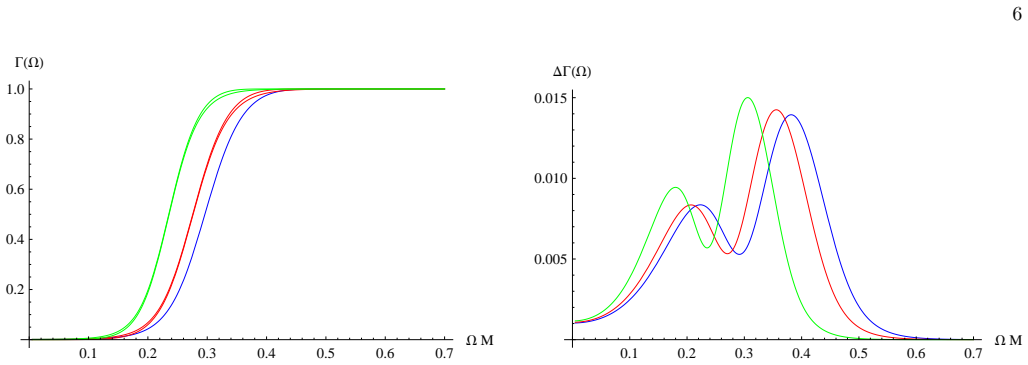
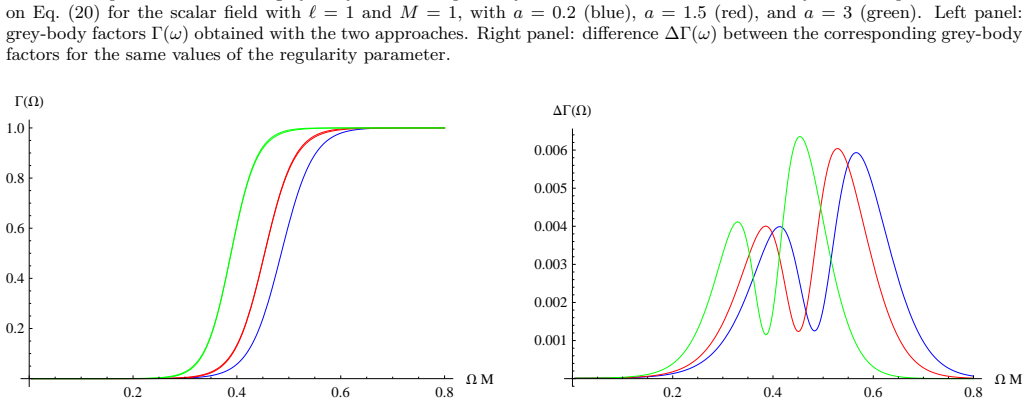
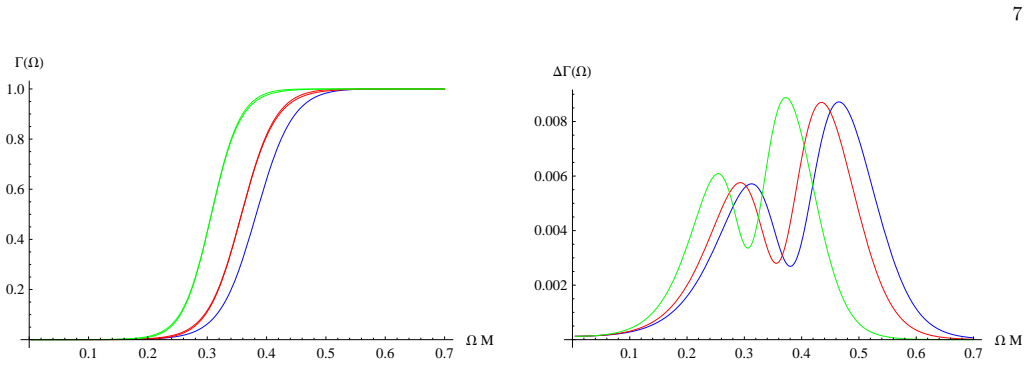
In the black-hole branch of the phantom DBI-supported regular metric, the effective potentials for massless scalar, electromagnetic, and Dirac perturbations remain single-peaked; raising the regularity parameter reduces the height of each barrier, thereby increasing the grey-body factors at fixed frequency and enlarging the absorption cross sections, while direct sixth-order WKB results reproduce the grey-body factors obtained from the lowest quasinormal modes to within 10^{-2} or better.
What carries the argument
Single-barrier effective potentials obtained by separating the wave equations on the phantom DBI regular black-hole metric, evaluated with sixth-order WKB for scattering and compared with the quasinormal-mode/grey-body-factor correspondence.
If this is right
- Absorption cross sections increase monotonically with the regularity parameter in all three field sectors.
- Transmission spectra shift toward lower frequencies as regularity grows.
- The quasinormal-mode reconstruction of grey-body factors remains accurate to the percent level for these single-barrier potentials.
- The same qualitative trend is expected to persist for any massless field whose effective potential is dominated by a single centrifugal or curvature barrier.
Where Pith is reading between the lines
- If the regularity parameter can be related to an observable dark-matter density, scattering signatures could distinguish regular from singular black holes in the same mass range.
- The observed enhancement of low-frequency absorption suggests that Hawking spectra of these objects would be correspondingly brighter at long wavelengths than for Schwarzschild black holes of equal mass.
Load-bearing premise
The spacetime is exactly the phantom DBI regular black-hole solution and the effective potentials stay single-peaked for every value of the regularity parameter that is studied.
What would settle it
A high-precision numerical integration of the radial wave equations that yields grey-body factors differing from the WKB values by more than a few percent at any frequency for some regularity parameter inside the black-hole branch.
Figures




read the original abstract
We study grey-body factors and absorption cross sections for massless scalar, electromagnetic, and Dirac fields in the exact asymptotically flat regular black-hole geometry supported by a phantom Dirac--Born--Infeld scalar. In the black-hole branch all three sectors are governed by single-barrier effective potentials, which allows a direct 6th-order WKB treatment of the scattering problem and a comparison with the recent quasinormal-mode/grey-body-factor correspondence. We show that increasing the regularity parameter lowers the barriers, shifts transmission to lower frequencies, and enhances the absorption cross sections in all three sectors. By comparing the direct WKB grey-body factors with those reconstructed from the lowest quasinormal modes, we explicitly test the QNM/GBF correspondence and find good agreement, typically at the level of $10^{-2}$ or better.
Editorial analysis
A structured set of objections, weighed in public.
Referee Report
Summary. The paper examines grey-body factors and absorption cross sections for massless scalar, electromagnetic, and Dirac fields propagating in an asymptotically flat regular black-hole spacetime sourced by a phantom DBI scalar. It adopts the exact metric from prior literature, derives the effective potentials in each sector, applies sixth-order WKB to compute transmission probabilities, reconstructs grey-body factors from the fundamental quasinormal modes, and reports that increasing the regularity parameter lowers the barriers, shifts transmission to lower frequencies, and increases absorption cross sections, with direct WKB and QNM-reconstructed grey-body factors agreeing at the 10^{-2} level or better.
Significance. If the single-barrier character of the potentials is confirmed across the full parameter range, the work supplies a concrete numerical test of the recent QNM/grey-body-factor correspondence in a regular black-hole background and quantifies how regularity modifies scattering observables in three spin sectors. The explicit side-by-side comparison of two independent computational routes (direct WKB versus QNM reconstruction) is a methodological strength that can be cited by subsequent studies of grey-body factors in non-Schwarzschild geometries.
major comments (1)
- [Sections 3 and 4 (effective potentials and WKB analysis)] The central numerical results rest on the assertion that the effective potentials for scalar, electromagnetic, and Dirac fields remain strictly single-peaked for every value of the regularity parameter in the black-hole branch. No analytic second-derivative test, numerical peak-counting scan, or plot of V'' at the critical point is supplied to verify this assumption over the full interval of the regularity parameter. Without such a check, both the applicability of the sixth-order WKB formula and the validity of the QNM/GBF comparison become uncontrolled.
minor comments (3)
- [Abstract and Section 5] The abstract states agreement 'typically at the level of 10^{-2} or better'; a table or figure quantifying the maximum and mean absolute differences for each field and each regularity parameter would make this claim precise.
- [Section 2] Notation for the DBI coupling and the regularity parameter should be unified between the metric definition and the subsequent potential plots to avoid reader confusion.
- [Figures 2-5] Figure captions for the potential and grey-body plots should explicitly state the range of the regularity parameter shown and whether the curves correspond to the black-hole or the non-black-hole branch.
Simulated Author's Rebuttal
We thank the referee for the detailed report and for highlighting the importance of rigorously confirming the single-barrier character of the effective potentials. We address this point below and will strengthen the manuscript accordingly.
read point-by-point responses
-
Referee: [Sections 3 and 4 (effective potentials and WKB analysis)] The central numerical results rest on the assertion that the effective potentials for scalar, electromagnetic, and Dirac fields remain strictly single-peaked for every value of the regularity parameter in the black-hole branch. No analytic second-derivative test, numerical peak-counting scan, or plot of V'' at the critical point is supplied to verify this assumption over the full interval of the regularity parameter. Without such a check, both the applicability of the sixth-order WKB formula and the validity of the QNM/GBF comparison become uncontrolled.
Authors: We agree that an explicit verification strengthens the paper. While the potentials are single-peaked throughout the black-hole branch (as stated in the abstract and used for all computations), we did not include a dedicated check in the original submission. We have now performed a systematic numerical scan: for each field and for regularity parameter values spanning the entire black-hole branch, we evaluated the second derivative of the effective potential at its maximum and confirmed that exactly one extremum exists with V''<0. We will add a short paragraph in Section 3 together with a supplementary figure (or table) summarizing the sign of V'' and the absence of additional critical points. This directly addresses the applicability of the WKB formula and the QNM/GBF comparison. revision: yes
Circularity Check
No significant circularity; computations are direct on an externally supplied metric
full rationale
The paper imports the exact phantom-DBI regular black-hole line element from prior literature (Bolokhov et al.), writes the standard wave equations for massless scalar, electromagnetic and Dirac fields, derives the effective potentials V(r) by the usual tortoise-coordinate reduction, and then applies the 6th-order WKB formula to those potentials. The single-barrier character is asserted for the black-hole branch but is not itself derived from the scattering results; it is an input assumption whose verification (or lack thereof) does not render the subsequent grey-body or absorption numbers algebraically identical to the metric parameters. No fitted parameter is later relabeled a prediction, no self-citation supplies a uniqueness theorem that forces the outcome, and the QNM–GBF comparison is an independent numerical test rather than a tautology. The derivation chain therefore remains non-circular.
Axiom & Free-Parameter Ledger
axioms (2)
- domain assumption The spacetime is exactly the asymptotically flat regular black-hole solution supported by a phantom DBI scalar (cited prior work).
- domain assumption All three effective potentials remain single-barrier throughout the parameter range.
Forward citations
Cited by 2 Pith papers
-
Quasinormal Spectra of Fields of Various Spin in Asymptotically de Sitter Black Holes within Generalized Proca Theory
Quasinormal frequencies for massless fields in Proca-hairy de Sitter black holes show scalar ℓ=0 modes most sensitive to hair parameter Q, with damping weakening near the three-horizon regime.
-
Hawking Temperature, Sparsity and Energy Emission Rate of Regular Black Holes Supported by Primordial Dark Matter
The primordial dark matter scale suppresses Hawking temperature and spectral energy emission rate relative to Schwarzschild while the heat capacity stays negative and the sparsity parameter receives a small negative c...
Reference graph
Works this paper leans on
-
[1]
S. W. Hawking, Commun. Math. Phys. 43, 199 (1975), [Erratum: Commun.Math.Phys. 46, 206 (1976)]
1975
-
[2]
D. N. Page, Phys. Rev. D 13, 198 (1976)
1976
-
[3]
D. N. Page, Phys. Rev. D 14, 3260 (1976)
1976
-
[4]
P. Kanti and J. March-Russell, Phys. Rev. D 66, 024023 (2002), arXiv:hep-ph/0203223
- [5]
-
[6]
K. D. Kokkotas and B. G. Schmidt, Living Rev. Rel. 2, 2 (1999), arXiv:gr-qc/9909058
work page internal anchor Pith review arXiv 1999
-
[7]
Quasinormal modes of black holes and black branes
E. Berti, V. Cardoso, and A. O. Starinets, Class. Quant. Grav. 26, 163001 (2009), arXiv:0905.2975 [gr-qc]
work page internal anchor Pith review arXiv 2009
-
[8]
R. A. Konoplya and A. Zhidenko, Rev. Mod. Phys. 83, 793 (2011), arXiv:1102.4014 [gr-qc]
work page internal anchor Pith review arXiv 2011
- [9]
- [10]
-
[11]
Quasinormal modes of regular black holes
A. Flachi and J. P. S. Lemos, Phys. Rev. D 87, 024034 (2013), arXiv:1211.6212 [gr-qc]
work page Pith review arXiv 2013
- [12]
- [13]
-
[14]
X.-C. Cai and Y.-G. Miao, Phys. Rev. D 103, 124050 (2021), arXiv:2104.09725 [gr-qc]
-
[15]
J. Li, K. Lin, and N. Yang, Eur. Phys. J. C 75, 131 (2015), arXiv:1409.5988 [gr-qc]
work page Pith review arXiv 2015
- [16]
- [17]
- [18]
-
[19]
B.-H. Huang, H.-W. Hu, and L. Zhao, JCAP 03, 053 (2024), arXiv:2311.12286 [gr-qc]
- [20]
- [21]
-
[22]
Quasinormal Modes of Bardeen Black Hole: Scalar Perturbations
S. Fernando and J. Correa, Phys. Rev. D 86, 064039 (2012), arXiv:1208.5442 [gr-qc]
work page Pith review arXiv 2012
-
[23]
D. Mahdavian Yekta, M. Karimabadi, and S. A. Alavi, Annals Phys. 434, 168603 (2021), arXiv:1912.12017 [hep-th]
- [24]
- [25]
- [26]
-
[27]
Jawad, M
A. Jawad, M. Yasir, and S. Rani, Mod. Phys. Lett. A 35, 2050298 (2020)
2020
-
[28]
O. Pedraza, L. A. López, R. Arceo, and I. Cabrera- Munguia, Mod. Phys. Lett. A 37, 2250057 (2022), arXiv:2111.06488 [gr-qc]
- [29]
-
[30]
K. Lin, J. Li, and S. Yang, Int. J. Theor. Phys. 52, 3771 (2013)
2013
- [31]
-
[32]
A. Held, R. Gold, and A. Eichhorn, JCAP 06, 029 (2019), arXiv:1904.07133 [gr-qc]
work page Pith review arXiv 2019
- [33]
- [34]
- [35]
-
[36]
M. Skvortsova, Grav. Cosmol. 30, 279 (2024), arXiv:2405.15807 [gr-qc]
-
[37]
Skvortsova, EPL 149, 59001 (2025), arXiv:2503.03650 [gr-qc]
M. Skvortsova, EPL 149, 59001 (2025), arXiv:2503.03650 [gr-qc]
- [38]
-
[39]
Z. Malik, Int. J. Grav. Theor. Phys. 2, 3 (2026), arXiv:2603.18887 [gr-qc]
- [40]
-
[41]
Malik, (2025), arXiv:2510.06689 [gr-qc]
Z. Malik, (2025), arXiv:2510.06689 [gr-qc]
-
[42]
Malik, EPL 147, 69001 (2024), arXiv:2410.04306 [gr- qc]
Z. Malik, EPL 147, 69001 (2024), arXiv:2410.04306 [gr- qc]
-
[43]
Malik, Can
Z. Malik, Can. J. Phys. 103, 800 (2025)
2025
-
[44]
From Ringdown to Lensing: Analytic Eikonal Modes of Quasi-Topological Regular Black Holes
A. Dubinsky, (2026), arXiv:2604.13613 [gr-qc]
work page internal anchor Pith review Pith/arXiv arXiv 2026
-
[45]
A. Dubinsky, Int. J. Grav. Theor. Phys. 2, 6 (2026), arXiv:2603.17644 [gr-qc]
-
[46]
A. Dubinsky, Int. J. Theor. Phys. 65, 45 (2026), arXiv:2511.00778 [gr-qc]
- [47]
-
[48]
Exact, non-singular black holes from a phantom DBI Field as primordial dark matter
T. Parvez and S. Shankaranarayanan, arXiv e-prints, accepted for publication in Phys. Rev. D. (2025), arXiv:2511.14047 [gr-qc]
work page internal anchor Pith review Pith/arXiv arXiv 2025
-
[49]
M. Skvortsova, (2026), arXiv:2604.25471 [gr-qc]
work page internal anchor Pith review Pith/arXiv arXiv 2026
-
[50]
B. C. Lütfüoğlu, (2026), arXiv:2604.24349 [gr-qc]
work page internal anchor Pith review Pith/arXiv arXiv 2026
-
[51]
Carter, Communications in Mathematical Physics 10, 280 (1968)
B. Carter, Communications in Mathematical Physics 10, 280 (1968)
1968
-
[52]
Carter, Physical Review 174, 1559 (1968)
B. Carter, Physical Review 174, 1559 (1968)
1968
- [53]
-
[54]
Ruffini, in Black Holes: Les Astres Occlus (Gordon and Breach, 1973)
R. Ruffini, in Black Holes: Les Astres Occlus (Gordon and Breach, 1973)
1973
-
[55]
D. R. Brill and J. A. Wheeler, Rev. Mod. Phys. 29, 465 (1957)
1957
-
[56]
Iyer and C
S. Iyer and C. M. Will, Phys. Rev. D 35, 3621 (1987)
1987
-
[57]
R. A. Konoplya, Phys. Rev. D 68, 024018 (2003), arXiv:gr-qc/0303052
work page Pith review arXiv 2003
-
[58]
Quasinormal modes of black holes. The improved semianalytic approach
J. Matyjasek and M. Opala, Phys. Rev. D 96, 024011 (2017), arXiv:1704.00361 [gr-qc]
work page Pith review arXiv 2017
-
[59]
R. A. Konoplya, A. Zhidenko, and A. F. Zinhailo, Class. Quant. Grav. 36, 155002 (2019), arXiv:1904.10333 [gr- qc]
work page Pith review arXiv 2019
-
[60]
R. A. Konoplya and A. Zhidenko, Phys. Rev. D 82, 084003 (2010), arXiv:1004.3772 [hep-th]
work page Pith review arXiv 2010
-
[61]
Z. Malik, Int. J. Grav. Theor. Phys. 1, 6 (2025), arXiv:2509.15995 [gr-qc]
-
[62]
Y. Guo and Y.-G. Miao, Phys. Rev. D 102, 064049 (2020), arXiv:2005.07524 [hep-th]
-
[63]
K. D. Kokkotas, R. A. Konoplya, and A. Zhidenko, Phys. Rev. D 83, 024031 (2011), arXiv:1011.1843 [gr- qc]
work page Pith review arXiv 2011
-
[64]
R. A. Konoplya and A. Zhidenko, Phys. Lett. B 686, 199 (2010), arXiv:0909.2138 [hep-th]
work page Pith review arXiv 2010
- [65]
-
[66]
M. Skvortsova, Eur. Phys. J. C 85, 854 (2025), arXiv:2411.06007 [gr-qc]
-
[67]
Scalar field evolution in Gauss-Bonnet black holes
E. Abdalla, R. A. Konoplya, and C. Molina, Phys. Rev. D 72, 084006 (2005), arXiv:hep-th/0507100
work page Pith review arXiv 2005
- [68]
-
[69]
R. A. Konoplya and A. Zhidenko, Phys. Lett. B 648, 236 (2007), arXiv:hep-th/0611226
work page Pith review arXiv 2007
-
[70]
A. Pathrikar, Int. J. Grav. Theor. Phys. 1, 1 (2026), arXiv:2510.01376 [gr-qc]
-
[71]
Evolution of perturbations of squashed Kaluza-Klein black holes: escape from instability
H. Ishihara, M. Kimura, R. A. Konoplya, K. Murata, J. Soda, and A. Zhidenko, Phys. Rev. D 77, 084019 (2008), arXiv:0802.0655 [hep-th]
work page Pith review arXiv 2008
- [72]
-
[73]
Quasinormal modes of dilaton-de Sitter black holes: scalar perturbations
S. Fernando, Gen. Rel. Grav. 48, 24 (2016), arXiv:1601.06407 [gr-qc]
work page Pith review arXiv 2016
-
[74]
M. Momennia, S. Hossein Hendi, and F. Soltani Bidgoli, Phys. Lett. B 813, 136028 (2021), arXiv:1807.01792 [hep-th]
- [75]
-
[76]
P. Wongjun, C.-H. Chen, and R. Nakarachinda, Phys. Rev. D 101, 124033 (2020), arXiv:1910.05908 [gr-qc]
-
[77]
Quasinormal modes and absorption cross sections of Born-Infeld-de Sitter black holes
N. Breton, T. Clark, and S. Fernando, Int. J. Mod. Phys. D 26, 1750112 (2017), arXiv:1703.10070 [gr-qc]
work page Pith review arXiv 2017
-
[78]
R. Karmakar and U. D. Goswami, Phys. Scripta 99, 055003 (2024), arXiv:2310.18594 [gr-qc]
- [79]
-
[80]
R. A. Konoplya and E. Abdalla, Phys. Rev. D 71, 084015 (2005), arXiv:hep-th/0503029
work page Pith review arXiv 2005
discussion (0)
Sign in with ORCID, Apple, or X to comment. Anyone can read and Pith papers without signing in.