Recognition: 3 theorem links
· Lean TheoremMapping correlations between quantum discord and Bell non-locality
Pith reviewed 2026-05-08 18:09 UTC · model grok-4.3
The pith
A numerical method finds the lowest quantum discord a state needs to violate a given Bell inequality under noise.
A machine-rendered reading of the paper's core claim, the machinery that carries it, and where it could break.
Core claim
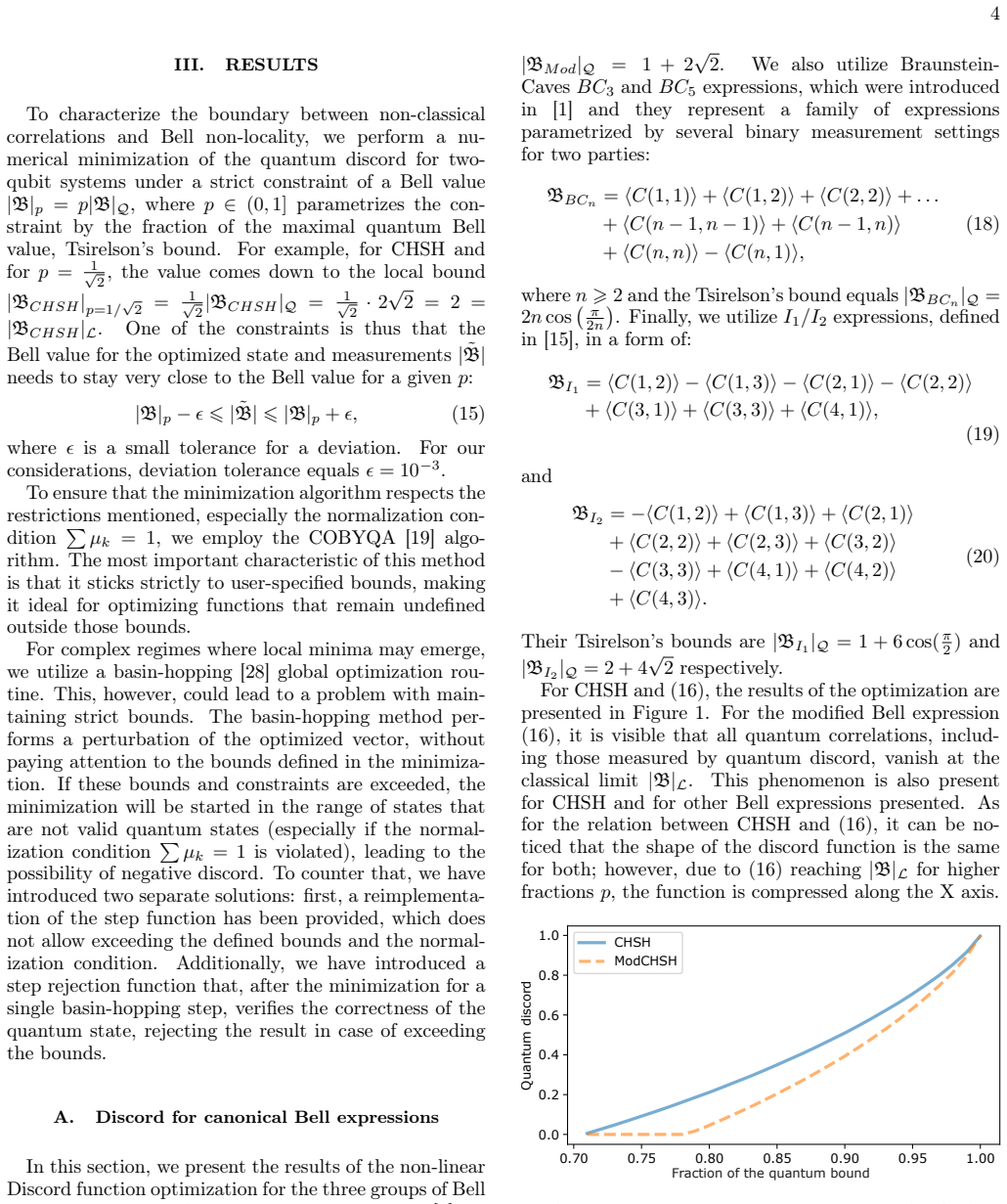
By numerically minimizing quantum discord subject to a fixed Bell violation, lower bounds are established on the discord needed for nonlocality; the landscape of these minima indicates two distinct classes of optimized states grouped by their achieved discord levels.
What carries the argument
The numerical optimization that minimizes quantum discord while enforcing a prescribed value of a chosen Bell expression under white noise.
If this is right
- Each of the six Bell expressions has its own minimal discord threshold that rises with added white noise.
- The two identified classes of states differ systematically in the discord they require for a given violation.
- Any experimentally observed Bell violation immediately implies a lower bound on the discord present in the source state.
- The method supplies a practical way to compare how efficiently different Bell expressions convert discord into nonlocality.
Where Pith is reading between the lines
- The same optimization approach could be reused to map discord against other nonlocality witnesses or to different noise models.
- The two state classes may reflect distinct geometric features in the set of states that can produce nonlocality.
- Experimental groups could use the tabulated minimal discord values to select states that achieve nonlocality with the least correlation overhead.
Load-bearing premise
The numerical search always locates the true global minimum discord rather than stopping at a higher local minimum for any Bell expression and noise level.
What would settle it
Discovery of a bipartite state that produces the same Bell violation with strictly lower quantum discord than the value returned by the optimizer for that expression and noise strength.
Figures


read the original abstract
We present a numerical framework for the certification and systematic analysis of the relationship between Bell nonlocality and quantum discord. By determining the minimum discord required for a bipartite state to manifest a specific Bell violation, we establish lower bounds for these correlations. We evaluate this methodology across six distinct Bell expressions, comparing their performance through the minimal discord values observed under varying intensities of white noise. Analysis of the resulting optimization landscape suggests the existence of two characteristic classes of optimized states, categorized by their minimized quantum discord.
Editorial analysis
A structured set of objections, weighed in public.
Referee Report
Summary. The manuscript presents a numerical optimization framework to compute the minimal quantum discord required for a bipartite state to achieve a prescribed violation of one of six Bell expressions, under varying levels of white noise. The authors minimize discord subject to fixed Bell violation and noise intensity, then analyze the resulting landscape to identify two characteristic classes of optimized states distinguished by their achieved minimal discord values.
Significance. If the reported minima are verifiably global, the work would supply concrete lower bounds relating discord to Bell nonlocality across multiple inequalities and noise levels, together with an empirical classification of states that could guide further analytic study of the discord-nonlocality boundary. The comparative evaluation across six Bell expressions is a positive feature.
major comments (2)
- [Section 3] Section 3 (Numerical Framework): No description is given of the optimization algorithm, state parameterization (e.g., Bloch-vector or density-matrix ansatz), convergence tolerances, number of random restarts, or any validation against known analytic minima for the CHSH or other Bell expressions. Because the central claim of two distinct state classes rests entirely on the numerical minima, the absence of these details makes it impossible to assess whether the observed clustering reflects the true optimization landscape or local-minimum artifacts.
- [Section 4.2] Section 4.2 and Figure 3: The separation into two classes is asserted on the basis of the minimized discord values, yet no quantitative measure (e.g., gap size, silhouette score, or statistical test) is supplied to demonstrate that the clustering is robust rather than an artifact of the particular optimizer or initialization distribution.
minor comments (2)
- [Abstract] The abstract and introduction should explicitly state the six Bell expressions employed (e.g., CHSH, I3322, etc.) rather than referring to them only by number.
- [Figures] Figure captions should include the precise noise parameter range and the number of sampled points per curve to allow reproducibility.
Simulated Author's Rebuttal
We are grateful to the referee for their thorough review and valuable suggestions. We have carefully considered each comment and provide point-by-point responses below. Where appropriate, we have revised the manuscript to address the concerns raised.
read point-by-point responses
-
Referee: [Section 3] Section 3 (Numerical Framework): No description is given of the optimization algorithm, state parameterization (e.g., Bloch-vector or density-matrix ansatz), convergence tolerances, number of random restarts, or any validation against known analytic minima for the CHSH or other Bell expressions. Because the central claim of two distinct state classes rests entirely on the numerical minima, the absence of these details makes it impossible to assess whether the observed clustering reflects the true optimization landscape or local-minimum artifacts.
Authors: We agree that Section 3 would benefit from additional details on the numerical implementation to allow readers to reproduce and validate the results. In the revised version of the manuscript, we have expanded Section 3 to include: (i) a description of the optimization algorithm employed, (ii) the state parameterization used (e.g., the Bloch vector representation for two-qubit states), (iii) the convergence tolerances and stopping criteria, (iv) the number of random restarts performed to mitigate local minima issues, and (v) a validation subsection comparing our numerical minima for the CHSH inequality against known analytic results from the literature. These additions should provide the necessary transparency regarding the reliability of the observed minima and the identified state classes. revision: yes
-
Referee: [Section 4.2] Section 4.2 and Figure 3: The separation into two classes is asserted on the basis of the minimized discord values, yet no quantitative measure (e.g., gap size, silhouette score, or statistical test) is supplied to demonstrate that the clustering is robust rather than an artifact of the particular optimizer or initialization distribution.
Authors: We acknowledge that the classification into two classes in Section 4.2 relies on the observed separation in the minimized discord values without a formal quantitative metric. To address this, we have included in the revised manuscript a quantitative analysis of the clustering. Specifically, we now report the size of the gap between the two groups of minimal discord values across the parameter space and have computed silhouette scores for the clustering to assess its robustness. Additionally, we discuss the sensitivity to different initializations and optimizers to confirm that the two-class structure persists. This strengthens the empirical evidence for the two characteristic classes. revision: yes
Circularity Check
Numerical minimization framework for discord-Bell bounds is self-contained with no circular reductions
full rationale
The paper introduces a numerical optimization procedure to compute the minimum quantum discord needed to achieve a given Bell violation for six expressions under white noise, then examines the resulting states for clustering into two classes based on those minima. This chain relies on standard external numerical methods applied to independently defined quantum information quantities (discord and Bell expressions), without any self-definitional loops, fitted parameters renamed as predictions, load-bearing self-citations, or ansatzes imported from prior author work. The landscape analysis and class identification emerge directly from the computed outputs rather than presupposing the result by construction. No equations or steps reduce the claimed lower bounds or state classes to tautological inputs internal to the paper.
Axiom & Free-Parameter Ledger
Lean theorems connected to this paper
-
Cost.FunctionalEquationwashburn_uniqueness_aczel unclear?
unclearRelation between the paper passage and the cited Recognition theorem.
J(ρ_AB){Π1,y_i} = S(ρ_A) − S(A|{Π1,y_i}) ... D(ρ_AB) = I(ρ_AB) − max J(ρ_AB)
What do these tags mean?
- matches
- The paper's claim is directly supported by a theorem in the formal canon.
- supports
- The theorem supports part of the paper's argument, but the paper may add assumptions or extra steps.
- extends
- The paper goes beyond the formal theorem; the theorem is a base layer rather than the whole result.
- uses
- The paper appears to rely on the theorem as machinery.
- contradicts
- The paper's claim conflicts with a theorem or certificate in the canon.
- unclear
- Pith found a possible connection, but the passage is too broad, indirect, or ambiguous to say the theorem truly supports the claim.
Reference graph
Works this paper leans on
-
[1]
+⟨C(n−1, n−1)⟩+⟨C(n−1, n)⟩ +⟨C(n, n)⟩ − ⟨C(n,1)⟩, (18) wheren⩾2andthe Tsirelson’s boundequals|B BCn |Q = 2ncos π 2n
We also utilize Braunstein- CavesBC 3 andBC 5 expressions, which were introduced in [1] and they represent a family of expressions parametrized by several binary measurement settings for two parties: BBCn =⟨C(1,1)⟩+⟨C(1,2)⟩+⟨C(2,2)⟩+. . . +⟨C(n−1, n−1)⟩+⟨C(n−1, n)⟩ +⟨C(n, n)⟩ − ⟨C(n,1)⟩, (18) wheren⩾2andthe Tsirelson’s boundequals|B BCn |Q = 2ncos π 2n . ...
2018
-
[2]
Samuel L. Braunstein and Carlton M. Caves. Information-theoretic bell inequalities.Physical Review Letters, 61:662–665, August 1988. doi: 10.1103/PhysRevLett.61.662
-
[3]
Convex separation from convex optimization for large-scale problems
Stephen Brierley, Miguel Navascues, and Tamas Vertesi. Convex separation from convex optimization for large- scale problems. 2017. arXiv:1609.05011
work page Pith review arXiv 2017
-
[4]
A. Brodutch and D. R. Terno. Why should we care about quantum discord? InQuantum Science and Technology, pages 183–199. Springer International Publishing, 2017. doi:10.1007/978-3-319-53412-1_8
-
[5]
Cavalcanti, L
D. Cavalcanti, L. Aolita, S. Boixo, K. Modi, M. Piani, and A. Winter. Operational interpretations of quantum discord.Physical Review A, 83(3):032324, 2011
2011
-
[6]
John F. Clauser, Michael A. Horne, Abner Shi- mony, and Richard A. Holt. Proposed experi- ment to test local hidden-variable theories.Physi- cal Review Letters, 23:880–884, October 1969. doi: 10.1103/PhysRevLett.23.880
-
[7]
Dakić et al
B. Dakić et al. Quantum discord as resource for remote state preparation.Nature Physics, 8:666–670, 2012
2012
-
[8]
Quan- tum discord and the power of one qubit.Phys
AnimeshDatta, AnilShaji, andCarltonM.Caves. Quan- tum discord and the power of one qubit.Phys. Rev. Lett., 100:050502, 2008. doi:10.1103/PhysRevLett.100.050502
-
[9]
Sébastien Designolle, Gabriele Iommazzo, Mathieu Be- sançon, Sebastian Knebel, Patrick Gelß, and Sebas- tian Pokutta. Improved local models and new bell inequalities via frank-wolfe algorithms.Physical Re- view Research, 5(4), 2023. ISSN 2643-1564. doi: 10.1103/physrevresearch.5.043059
-
[10]
Qutrit witness from the grothendieck constant of order four.Physical Review A, 96:012113, July 2017
Péter Diviánszky, Erika Bene, and Tamás Vértesi. Qutrit witness from the grothendieck constant of order four.Physical Review A, 96:012113, July 2017. doi: 10.1103/PhysRevA.96.012113
-
[11]
D. P. DiVincenzo, M. Horodecki, D. W. Leung, J. A. Smolin, and B. M. Terhal. Locking classical correlation in quantum states.Physical Review Letters, 92(6):067902,
-
[12]
Ferraro, L
A. Ferraro, L. Aolita, D. Cavalcanti, F. M. Cucchietti, and A. Acin. Almost all quantum states have nonclassical correlations.Physical Review A, 81(5):052318, 2010
2010
-
[13]
Bell inequality, bell states and maximally entangled states for n qubits
N Gisin and H Bechmann-Pasquinucci. Bell inequality, bell states and maximally entangled states for n qubits. Physics Letters A, 246(1–2):1–6, September 1998. ISSN 0375-9601. doi:10.1016/s0375-9601(98)00516-7
- [14]
-
[15]
Hong-Wei Li, Piotr Mironowicz, Marcin Pawłowski, Zhen-Qiang Yin, Yu-Chun Wu, Shuang Wang, Wei Chen, Hong-Gang Hu, Guang-Can Guo, and Zheng-Fu Han. Relationship between semi- and fully-device-independent protocols.Physical Review A, 87:020302, February 2013. doi:10.1103/PhysRevA.87.020302
-
[16]
Piotr Mironowicz and Marcin Pawłowski. Robustness of quantum-randomness expansion protocols in the pres- ence of noise.Physical Review A, 88(3), September 2013. doi:10.1103/physreva.88.032319
-
[17]
K. Modi, A. Brodutch, H. Cable, T. Paterek, and V. Vedral. The classical-quantum boundary for correla- tions: Discord and related measures.Reviews of Modern Physics, 84(4):1655, 2012. [6]
2012
-
[18]
Harold Ollivier and Wojciech H. Zurek. Quantum discord: A measure of the quantumness of corre- lations.Phys. Rev. Lett., 88:017901, 2001. doi: 10.1103/PhysRevLett.88.017901
-
[19]
Ragonneau.Model-Based Derivative-Free Op- timization Methods and Software
Tom M. Ragonneau.Model-Based Derivative-Free Op- timization Methods and Software. PhD thesis, Depart- ment of Applied Mathematics, The Hong Kong Polytech- nic University, Hong Kong, China, 2022. URLhttps: //theses.lib.polyu.edu.hk/handle/200/12294
2022
-
[20]
Ragonneau and Zhang Zaikun
Tom M. Ragonneau and Zhang Zaikun. COBYQA Ver- sion 1.1.2, 2024. URLhttps://www.cobyqa.com
2024
-
[21]
Michael Seevinck and George Svetlichny. Bell-type inequalities for partial separability in n-particle sys- tems and quantum mechanical violations.Physical Review Letters, 89(6), 2002. ISSN 1079-7114. doi: 10.1103/physrevlett.89.060401
-
[22]
Streltsov and W
A. Streltsov and W. H. Zurek. Quantum discord cannot be shared.Physical Review Letters, 111:040401, 2013
2013
-
[23]
Streltsov, H
A. Streltsov, H. Kampermann, and D. Bruß. Quantum cost for sending entanglement.Physical Review Letters, 108:250501, 2012
2012
-
[24]
Quantum discord and its role in quantum information theory, 2014
Alexander Streltsov. Quantum discord and its role in quantum information theory, 2014. arXiv:1411.3208v1
-
[25]
Quantum generalizations of Bell’s inequality,
Boris Semyonovich Tsirelson. Quantum generalizations of Bell’s inequality.Letters in Mathematical Physics, 4 (2):93–100, March 1980. doi:10.1007/BF00417500
-
[26]
Jos Uffink. Quadratic bell inequalities as tests for multi- partite entanglement.Physical Review Letter, 88:230406, May 2002. doi:10.1103/PhysRevLett.88.230406
-
[27]
T. Vértesi. More efficient bell inequalities for werner states.Physical Review A, 78:032112, September 2008. doi:10.1103/PhysRevA.78.032112
-
[28]
Methods17, 261–272, DOI: 10.1038/s41592-019-0686-2 (2020)
Pauli Virtanen, Ralf Gommers, Travis E. Oliphant, Matt Haberland, Tyler Reddy, David Cournapeau, Evgeni Burovski, Pearu Peterson, Warren Weckesser, Jonathan Bright, Stéfan J. van der Walt, Matthew Brett, Joshua Wilson, K. Jarrod Millman, Nikolay Mayorov, Andrew R. J. Nelson, Eric Jones, Robert Kern, Eric Larson, C J Carey, İlhan Polat, Yu Feng, Eric W. Mo...
-
[29]
David J. Wales and Jonathan P. K. Doye. Global optimization by basin-hopping and the lowest energy structures of lennard-jones clusters containing up to 110 atoms.The Journal of Physical Chemistry A, 101(28):5111–5116, 1997. ISSN 1520-5215. doi: 10.1021/jp970984n
-
[30]
H. Wang. Quantum discord and classical correlation in two coupled double quantum dots system.Applied Physics A, 131(8), 2025. doi:10.1007/s00339-025-08787-
-
[31]
Lewis Wooltorton, Peter Brown, and Roger Col- beck. Tight analytic bound on the trade-off between device-independent randomness and nonlocality.Phys- ical Review Letters, 129:150403, October 2022. doi: 10.1103/PhysRevLett.129.150403
-
[32]
Wang Yiding, Huang Xiaofen, and Zhang Tinggui. Note on quantum discord, 2024. arXiv: 2408.05876
-
[33]
W. H. Zurek. Quantum discord and maxwell’s demons. Physical Review A, 67(1):012320, 2003. [4]
2003
discussion (0)
Sign in with ORCID, Apple, or X to comment. Anyone can read and Pith papers without signing in.