Recognition: unknown
Quantum Simulation of the Real-time Dynamics in the multi-flavor Gross-Neveu Model at the utility scale using Superconducting Quantum Computers
Pith reviewed 2026-05-08 16:09 UTC · model grok-4.3
The pith
A controlled approximation for diagonal operators lets superconducting quantum processors simulate real-time dynamics of the multi-flavor Gross-Neveu model beyond 100 qubits.
A machine-rendered reading of the paper's core claim, the machinery that carries it, and where it could break.
Core claim
The Localized Diagonal Operator Approximation formulates the synthesis of each diagonal unitary arising from quartic interactions as a structured least-squares problem in phase space whose solution is obtained via the Moore-Penrose pseudoinverse; the unitary error is thereby directly tied to the phase-reconstruction residual and vanishes asymptotically as the Trotter step size is reduced. When combined with a hardware-efficient Trotterization whose depth scales only with flavor number, this approximation reduces two-qubit gate counts enough to enable simulations on more than 100 qubits while preserving quantitative agreement with classical benchmarks for real-time observables.
What carries the argument
Localized Diagonal Operator Approximation (LDOA), which replaces exact diagonal unitaries for long-range quartic terms by an analytic phase-space least-squares solution that lowers circuit depth on limited-connectivity hardware.
If this is right
- Simulations of the multi-flavor Gross-Neveu model become feasible on current superconducting processors at system sizes exceeding 100 qubits.
- Real-time observables such as density-density correlators can be extracted with quantitative agreement to classical methods.
- The same diagonal-operator technique applies to any model whose interaction terms produce long-range diagonal unitaries on hardware with restricted connectivity.
- Circuit-depth scaling linear in flavor number rather than total size supplies a concrete route toward larger or higher-dimensional fermionic field theories.
Where Pith is reading between the lines
- The same least-squares phase reconstruction could be applied to other lattice models whose Hamiltonians contain similar quartic or long-range diagonal pieces.
- Error bounds derived from the pseudoinverse residual may be used to select optimal Trotter steps without exhaustive numerical testing.
- If the method extends to two spatial dimensions, it would open direct quantum simulation of phase structure in theories that remain difficult for classical tensor networks.
Load-bearing premise
The phase-space least-squares reconstruction of each diagonal unitary remains sufficiently accurate that the accumulated Trotter error stays controlled for the chosen step sizes and lattice sizes.
What would settle it
If successively smaller Trotter steps produce density-density correlators that diverge from exact-diagonalization or tensor-network results rather than converging to them, the controlled accuracy of the LDOA would be falsified.
Figures




read the original abstract
We present a scalable quantum simulation framework for real-time dynamics of the multi-flavor Gross-Neveu model in 1+1 dimensions. Using superconducting quantum processors at utility scale, we develop a hardware-efficient Trotterization whose per-step circuit depth scales with fermion flavor number rather than total system size, enabling simulations beyond 100 qubits. A central contribution of this work is the Localized Diagonal Operator Approximation (LDOA), which systematically reduces the overhead associated with quartic interactions. We formulate diagonal unitary synthesis as a structured least-squares problem in phase space and obtain analytic solutions via the Moore-Penrose pseudoinverse. This formulation provides a principled and quantitatively controlled approximation: in the small Trotter-step regime, the unitary error is directly linked to the phase reconstruction error and vanishes asymptotically as the Trotter step size decreases. This establishes a clear mathematical foundation for the LDOA while significantly reducing two-qubit gate counts and circuit depth, and is broadly applicable to diagonal quantum operators with long-range structure, making it particularly well suited for quantum hardware with limited qubit connectivity. Using these techniques, we run large-scale simulations on IBM superconducting processors and study real-time observables, including density-density correlators. We benchmark against exact diagonalization and tensor network-based methods, finding strong agreement across system sizes. These results show that combining hardware-aware circuit design with rigorous approximations enables practical near-term simulation of interacting fermionic field theories and provides a scalable pathway toward more complex quantum field theory simulations.
Editorial analysis
A structured set of objections, weighed in public.
Referee Report
Summary. The manuscript presents a scalable quantum simulation framework for the real-time dynamics of the multi-flavor Gross-Neveu model in 1+1 dimensions on superconducting quantum processors at utility scale (>100 qubits). It develops a hardware-efficient Trotterization whose depth scales with flavor number, and introduces the Localized Diagonal Operator Approximation (LDOA) that reduces quartic interaction overhead by formulating diagonal unitary synthesis as a structured least-squares problem in phase space solved via the Moore-Penrose pseudoinverse. The authors claim this yields a controlled approximation where unitary error is proportional to phase reconstruction error and vanishes asymptotically for small Trotter steps. They simulate density-density correlators and report strong agreement with exact diagonalization and tensor-network benchmarks.
Significance. If the LDOA error remains quantitatively controlled for the quartic operators and system sizes actually run on hardware, and if the reported benchmark agreement extends reliably beyond small-system validation, the work demonstrates a practical route to near-term simulation of interacting fermionic field theories. The combination of hardware-aware circuit design, analytic least-squares error bounds, and explicit scaling of circuit depth with flavor number rather than total size constitutes a concrete advance over generic Trotterization approaches for long-range diagonal operators.
major comments (2)
- [LDOA formulation and error analysis] The central claim that the LDOA provides a 'principally and quantitatively controlled approximation' whose unitary error 'vanishes asymptotically as the Trotter step size decreases' (abstract) is load-bearing for the scalability argument. However, the manuscript does not appear to supply explicit numerical verification of this scaling for the concrete quartic interaction terms, the specific flavor numbers, and the finite Trotter steps employed in the >100-qubit hardware runs. The conditioning of the phase-space sampling matrix and the residual norm of the Moore-Penrose solution should be reported to confirm that reconstruction error does not introduce systematic bias in the real-time evolution of density-density correlators.
- [Results and benchmarking] The abstract states 'strong agreement' with exact diagonalization and tensor-network benchmarks 'across system sizes,' yet provides no quantitative error metrics (e.g., maximum deviation in correlators, fidelity per Trotter step, or dependence on system size). Without these, it is impossible to assess whether the agreement supports extrapolation to the utility-scale regime where the LDOA is most needed.
minor comments (2)
- The abstract would be strengthened by including at least one concrete quantitative result (e.g., largest system size simulated, number of Trotter steps, or observed correlator error relative to benchmarks).
- Notation for the phase-space least-squares problem and the definition of the Localized Diagonal Operator Approximation should be introduced with an explicit equation number on first use to aid readability.
Simulated Author's Rebuttal
We thank the referee for the constructive and detailed review. The two major comments identify areas where additional numerical evidence and quantitative metrics will strengthen the manuscript. We address each point below and will incorporate the requested material in a revised version.
read point-by-point responses
-
Referee: [LDOA formulation and error analysis] The central claim that the LDOA provides a 'principally and quantitatively controlled approximation' whose unitary error 'vanishes asymptotically as the Trotter step size decreases' (abstract) is load-bearing for the scalability argument. However, the manuscript does not appear to supply explicit numerical verification of this scaling for the concrete quartic interaction terms, the specific flavor numbers, and the finite Trotter steps employed in the >100-qubit hardware runs. The conditioning of the phase-space sampling matrix and the residual norm of the Moore-Penrose solution should be reported to confirm that reconstruction error does not introduce systematic bias in the real-time evolution of density-density correlators.
Authors: We appreciate the referee's emphasis on explicit verification. The manuscript derives the controlled nature of the LDOA analytically by showing that the unitary error is bounded by the phase-reconstruction residual of the Moore-Penrose solution and therefore vanishes as the Trotter step size decreases. To supply the requested numerical confirmation for the quartic operators, specific flavor numbers, and the finite steps used in the hardware runs, we will add a dedicated subsection containing (i) plots of unitary error versus Trotter step size, (ii) the condition numbers of the phase-space sampling matrices, and (iii) the residual norms of the pseudoinverse solutions. These additions will demonstrate that reconstruction error remains small and does not introduce measurable bias in the reported correlators. revision: yes
-
Referee: [Results and benchmarking] The abstract states 'strong agreement' with exact diagonalization and tensor-network benchmarks 'across system sizes,' yet provides no quantitative error metrics (e.g., maximum deviation in correlators, fidelity per Trotter step, or dependence on system size). Without these, it is impossible to assess whether the agreement supports extrapolation to the utility-scale regime where the LDOA is most needed.
Authors: We agree that quantitative metrics are necessary for a rigorous assessment. In the revised manuscript we will augment the benchmarking section with explicit error measures: maximum and mean absolute deviations of the density-density correlators, average fidelity per Trotter step, and their dependence on system size and flavor number. These quantities will be reported separately for the exact-diagonalization comparisons (small systems) and the tensor-network comparisons (larger systems), thereby providing the quantitative basis for the claim of strong agreement and for extrapolation to the utility-scale regime. revision: yes
Circularity Check
No significant circularity in LDOA derivation or simulation framework
full rationale
The paper derives the Localized Diagonal Operator Approximation (LDOA) explicitly as a structured least-squares problem in phase space solved via the Moore-Penrose pseudoinverse, with the unitary error bound stated to be directly proportional to phase reconstruction error and to vanish asymptotically for small Trotter steps. This is a self-contained mathematical construction whose error scaling is tied to the step size by definition of the approximation, not to any fitted parameters, self-citations, or prior results from the same authors. No load-bearing steps reduce to self-definition, renamed known results, or imported uniqueness theorems; external benchmarks against exact diagonalization and tensor networks are invoked for validation rather than as internal justification. The overall framework (hardware-efficient Trotterization plus LDOA) therefore remains independent of its inputs.
Axiom & Free-Parameter Ledger
Reference graph
Works this paper leans on
-
[1]
The quartic terms are composed of single-qubit phase gates, two-qubit phase gates (CP gates), and SWAP gates
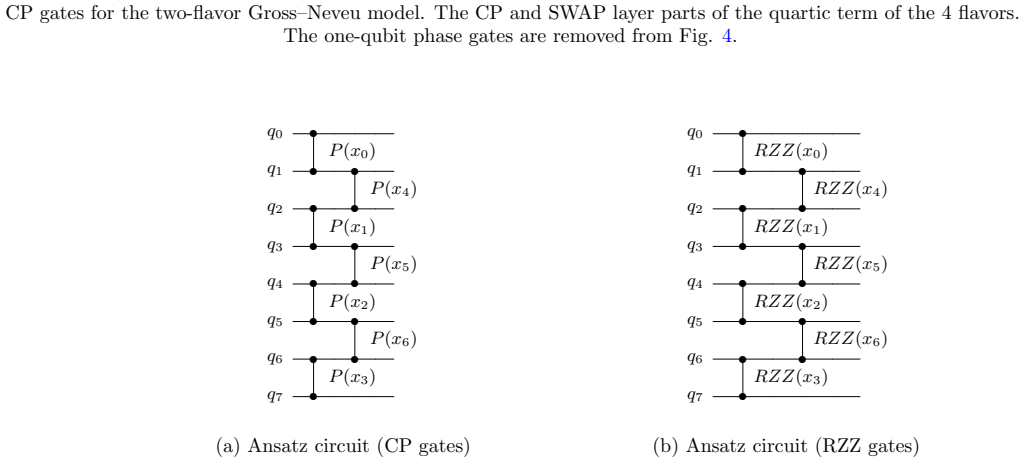
This design requires 4( N− 1) SWAP-gate layers for the N- flavor system. The quartic terms are composed of single-qubit phase gates, two-qubit phase gates (CP gates), and SWAP gates. Since the main challenge in implementing the quartic term is the two-qubit phase gate, we focus on its implementation. Figure 5 shows the two-qubit phase gate and the SWAP ga...
-
[2]
In the form, the target unitary is diagonal in the computational basis as shown Fig
2-flavor Model We apply the diagonal operator approximation to the two-flavor Gross–Neveu evolution operator restricted to a fixed fermion-number sector. In the form, the target unitary is diagonal in the computational basis as shown Fig. 5 and can be written as Utarget(⃗ϕ(θg)) = diag 1,1,1, e iθg ,1, e −iθg , e−iθg , e−iθg ,1, e −iθg , e−iθg , e−iθg , ei...
-
[3]
In the form, the target unitary operator and the Ansatz unitary operators are visualized in Fig
3-flavor Model We apply the diagonal operator approximation to the three-flavor Gross–Neveu evolution operator restricted to a fixed fermion-number sector. In the form, the target unitary operator and the Ansatz unitary operators are visualized in Fig. 10 and 11, respectively. 14 q0 • P(− θg 6 )q1 • • P(− 13θg 12 )q2 • P(− θg 6 ) • q3 • (a) CP-based appro...
-
[4]
In the form, the target unitary operator and the Ansatz unitary operators are visualized in Fig
4-flavor Model In this example, we apply the diagonal operator approximation to the four-flavor Gross–Neveu evolution operator restricted to a fixed fermion-number sector. In the form, the target unitary operator and the Ansatz unitary operators are visualized in Fig. 12 and 13, respectively. q2n,0 : • P(θ g) • P(θ g) × • P(−θ g) × • P(θ g) × × × × q2n,1 ...
1968
- [5]
- [6]
-
[7]
A. J. Daley, I. Bloch, C. Kokail, S. Flannigan, N. Pearson, M. Troyer, and P. Zoller, Practical quantum advantage in quantum simulation, Nature607, 667 (2022)
2022
-
[8]
Simulating lattice gauge theories on a quantum computer
T. Byrnes and Y. Yamamoto, Simulating lattice gauge theories on a quantum computer, Phys. Rev. A73, 022328 (2006), arXiv:quant-ph/0510027 [quant-ph]
work page Pith review arXiv 2006
-
[9]
S. P. Jordan, K. S. M. Lee, and J. Preskill, Quantum Algorithms for Quantum Field Theories, Science336, 1130 (2012), arXiv:1111.3633 [quant-ph]
work page Pith review arXiv 2012
-
[10]
S. P. Jordan, K. S. M. Lee, and J. Preskill, Quantum Computation of Scattering in Scalar Quantum Field Theories, arXiv e-prints , arXiv:1112.4833 (2011), arXiv:1112.4833 [hep-th]
work page Pith review arXiv 2011
-
[11]
S. P. Jordan, K. S. M. Lee, and J. Preskill, Quantum Algorithms for Fermionic Quantum Field Theories, arXiv e-prints , arXiv:1404.7115 (2014), arXiv:1404.7115 [hep-th]
work page Pith review arXiv 2014
- [12]
-
[13]
D. J. Gross and A. Neveu, Dynamical symmetry breaking in asymptotically free field theories, Phys. Rev. D10, 3235 (1974)
1974
-
[14]
R. F. Dashen, B. Hasslacher, and A. Neveu, Semiclassical bound states in an asymptotically free theory, Phys. Rev. D12, 2443 (1975)
1975
-
[15]
elementary
A. B. Zamolodchikov and A. B. Zamolodchikov, Exact S matrix of Gross-Neveu “elementary” fermions, Physics Letters B 72, 481 (1978)
1978
-
[16]
A. B. Zamolodchikov and A. B. Zamolodchikov, Factorized s Matrices in Two-Dimensions as the Exact Solutions of Certain Relativistic Quantum Field Models, Annals Phys.120, 253 (1979)
1979
-
[17]
Witten, Some Properties of the (psi-Bar psi)**2 Model in Two-Dimensions, Nucl
E. Witten, Some Properties of the (psi-Bar psi)**2 Model in Two-Dimensions, Nucl. Phys. B142, 285 (1978)
1978
-
[18]
M. Thies and K. Urlichs, Revised phase diagram of the Gross-Neveu model, Phys. Rev. D67, 125015 (2003), arXiv:hep- th/0302092 [hep-th]
-
[19]
O. Schnetz, M. Thies, and K. Urlichs, Phase diagram of the Gross Neveu model: exact results and condensed matter precursors, Annals of Physics314, 425 (2004), arXiv:hep-th/0402014 [hep-th]
- [20]
- [21]
- [22]
- [23]
-
[24]
M. Asaduzzaman, G. C. Toga, S. Catterall, Y. Meurice, and R. Sakai, Quantum simulation of the N -flavor Gross-Neveu model, Phys. Rev. D106, 114515 (2022), arXiv:2208.05906 [hep-lat]
-
[25]
Kogut and L
J. Kogut and L. Susskind, Hamiltonian formulation of Wilson’s lattice gauge theories, Phys. Rev. D11, 395 (1975)
1975
-
[26]
Banks, L
T. Banks, L. Susskind, and J. Kogut, Strong-coupling calculations of lattice gauge theories: (1 + 1)-dimensional exercises, Phys. Rev. D13, 1043 (1976)
1976
-
[27]
Susskind, Lattice fermions, Phys
L. Susskind, Lattice fermions, Phys. Rev. D16, 3031 (1977)
1977
- [28]
-
[29]
Jordan and E
P. Jordan and E. Wigner, ¨Uber das Paulische ¨Aquivalenzverbot, Zeitschrift f¨ ur Physik47, 631 (1928)
1928
-
[30]
M. Oshikawa and I. Affleck, Field-Induced Gap in S = 1/2 Antiferromagnetic Chains, Phys. Rev. Lett.79, 2883 (1997), arXiv:cond-mat/9706085 [cond-mat.str-el]
-
[31]
Derzhko and T
O. Derzhko and T. Verkholyak, Effects of dzyaloshinskii-moriya interaction in the dynamics of s= 1/2 xx chain, Czechoslovak Journal of Physics54, 531 (2004)
2004
-
[32]
H. F. Trotter, On the product of semi-groups of operators, Proceedings of the American Mathematical Society10, 545 (1959)
1959
-
[33]
M. Suzuki, Generalized trotter’s formula and systematic approximants of exponential operators and inner derivations with applications to many-body problems, Communications in Mathematical Physics51, 183 (1976)
1976
-
[34]
Suzuki, On the convergence of exponential operators-the zassenhaus formula, bch formula and systematic approximants, Communications in Mathematical Physics57, 193 (1977)
M. Suzuki, On the convergence of exponential operators-the zassenhaus formula, bch formula and systematic approximants, Communications in Mathematical Physics57, 193 (1977). 25
1977
- [35]
- [36]
- [37]
-
[38]
Layden, First-Order Trotter Error from a Second-Order Perspective, Phys
D. Layden, First-Order Trotter Error from a Second-Order Perspective, Phys. Rev. Lett.128, 210501 (2022), arXiv:2107.08032 [quant-ph]
-
[39]
M. A. Nielsen and I. L. Chuang, Quantum Computation and Quantum Information , 10th ed. (Cambridge University Press, 2010)
2010
-
[40]
Ben-Israel and T
A. Ben-Israel and T. N. E. Greville, Generalized Inverses: Theory and Applications, 2nd ed. (Springer New York, 2003)
2003
- [41]
-
[42]
Elementary gates for quantum computation
A. Barenco, C. H. Bennett, R. Cleve, D. P. Divincenzo, N. Margolus, P. Shor, T. Sleator, J. A. Smolin, and H. Weinfurter, Elementary gates for quantum computation, Phys. Rev. A52, 3457 (1995), arXiv:quant-ph/9503016 [quant-ph]
-
[43]
A. Muthukrishnan and C. R. Stroud, Jr., Multivalued logic gates for quantum computation, Phys. Rev. A62, 052309 (2000), arXiv:quant-ph/0002033 [quant-ph]
-
[44]
Zhang, K
K. Zhang, K. Yu, K. Hao, and V. Korepin, Optimal realization of yang–baxter gate on quantum computers, Advanced Quantum Technologies7, 2300345 (2024)
2024
-
[45]
Weinberg and M
P. Weinberg and M. Bukov, QuSpin: a Python package for dynamics and exact diagonalisation of quantum many body systems part I: spin chains, SciPost Phys.2, 003 (2017)
2017
-
[46]
M. S. Anis et al., Qiskit: An open-source framework for quantum computing (2021)
2021
-
[47]
J. Haegeman, J. I. Cirac, T. J. Osborne, I. Piˇ zorn, H. Verschelde, and F. Verstraete, Time-Dependent Variational Principle for Quantum Lattices, Phys. Rev. Lett.107, 070601 (2011), arXiv:1103.0936 [cond-mat.str-el]
-
[48]
J. Haegeman, C. Lubich, I. Oseledets, B. Vandereycken, and F. Verstraete, Unifying time evolution and optimization with matrix product states, Physical Review B94, 10.1103/physrevb.94.165116 (2016)
-
[49]
Fishman, S
M. Fishman, S. R. White, and E. M. Stoudenmire, The ITensor Software Library for Tensor Network Calculations, SciPost Phys. Codebases , 4 (2022)
2022
-
[50]
Fishman, S
M. Fishman, S. R. White, and E. M. Stoudenmire, Codebase release 0.3 for ITensor, SciPost Phys. Codebases , 4 (2022)
2022
-
[51]
R. Horodecki, P. Horodecki, M. Horodecki, and K. Horodecki, Quantum entanglement, Reviews of Modern Physics81, 865 (2009), arXiv:quant-ph/0702225 [quant-ph]
-
[52]
Probing entanglement entropy via randomized measurements
T. Brydges, A. Elben, P. Jurcevic, B. Vermersch, C. Maier, B. P. Lanyon, P. Zoller, R. Blatt, and C. F. Roos, Probing R´ enyi entanglement entropy via randomized measurements, Science364, 260 (2019), arXiv:1806.05747 [quant-ph]
work page Pith review arXiv 2019
- [53]
- [54]
-
[55]
B. Vermersch, A. Elben, M. Dalmonte, J. I. Cirac, and P. Zoller, Unitary n -designs via random quenches in atomic Hubbard and spin models: Application to the measurement of R´ enyi entropies, Phys. Rev. A97, 023604 (2018), arXiv:1801.00999 [quant-ph]
- [56]
- [57]
- [58]
- [59]
-
[60]
P. Rao, S. Choi, and K. Yu, Quantum multi-programming for maximum likelihood amplitude estimation, Proc. SPIE Int. Soc. Opt. Eng.12911, 129110E (2024)
2024
- [61]
- [62]
- [63]
- [64]
-
[65]
arXiv preprint arXiv:2112.07091 , year =
Y. Ohkura, T. Satoh, and R. Van Meter, Simultaneous Execution of Quantum Circuits on Current and Near-Future NISQ Systems, IEEE Transactions on Quantum Engineering3, TQE.2022 (2022), arXiv:2112.07091 [quant-ph]
-
[66]
I. D. Kivlichan, C. Gidney, D. W. Berry, N. Wiebe, J. McClean, W. Sun, Z. Jiang, N. Rubin, A. Fowler, A. Aspuru-Guzik, 26 H. Neven, and R. Babbush, Improved Fault-Tolerant Quantum Simulation of Condensed-Phase Correlated Electrons via Trotterization, Quantum4, 296 (2020), arXiv:1902.10673 [quant-ph]
- [67]
- [68]
-
[69]
Y. Kim, A. Eddins, S. Anand, K. X. Wei, E. van den Berg, S. Rosenblatt, H. Nayfeh, Y. Wu, M. Zaletel, K. Temme, and A. Kandala, Evidence for the utility of quantum computing before fault tolerance, Nature618, 500 (2023)
2023
-
[70]
C. Charles, E. J. Gustafson, E. Hardt, F. Herren, N. Hogan, H. Lamm, S. Starecheski, R. S. Van de Water, and M. L. Wagman, SimulatingZ 2 lattice gauge theory on a quantum computer, arXiv:2305.02361 [hep-lat]
-
[71]
van den Berg, Z
E. van den Berg, Z. K. Minev, and K. Temme, Model-free readout-error mitigation for quantum expectation values, Phys. Rev. A105, 032620 (2022)
2022
-
[72]
Dynamical Decoupling of Open Quantum Systems
L. Viola, E. Knill, and S. Lloyd, Dynamical decoupling of open quantum systems, Phys. Rev. Lett.82, 2417 (1999), arXiv:quant-ph/9809071
work page Pith review arXiv 1999
- [73]
- [74]
- [75]
- [76]
-
[77]
Z. Cai and S. C. Benjamin, Constructing smaller pauli twirling sets for arbitrary error channels, Scientific Reports9, 10.1038/s41598-019-46722-7 (2019), arXiv:1807.04973 [quant-ph]
-
[78]
Error mitigation for short-depth quantum circuits
K. Temme, S. Bravyi, and J. M. Gambetta, Error Mitigation for Short-Depth Quantum Circuits, Phys. Rev. Lett.119, 180509 (2017), arXiv:1612.02058 [quant-ph]
work page Pith review arXiv 2017
- [79]
-
[80]
T. Giurgica-Tiron, Y. Hindy, R. LaRose, A. Mari, and W. J. Zeng, Digital zero noise extrapolation for quantum error miti- gation, 2020 IEEE International Conference on Quantum Computing and Engineering (QCE) , 306 (2020), arXiv:2005.10921 [quant-ph]
discussion (0)
Sign in with ORCID, Apple, or X to comment. Anyone can read and Pith papers without signing in.