Recognition: unknown
Detection of an Extended Lyα Halo around a textit{z}=6.64 Broad Absorption Line Quasar with the Keck Cosmic Web Imager
Pith reviewed 2026-05-08 07:49 UTC · model grok-4.3
The pith
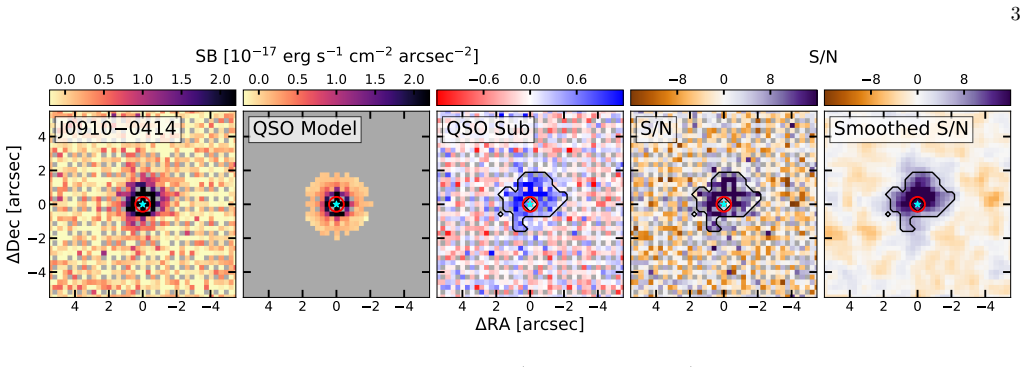
KCWI observations detect an extended Lyα halo around a z=6.64 broad absorption line quasar, extending to 11 pkpc with rotation-like kinematics distinct from the host galaxy.
A machine-rendered reading of the paper's core claim, the machinery that carries it, and where it could break.
Core claim
Our observations reveal a Lyα halo extending to ≃11 pkpc around the z=6.64 broad absorption line quasar J0910−0414. The Lyα velocity field displays a rotation-like gradient, and the gas velocity dispersion is consistent with gravitationally dominated motion (σ_Lyα<300 km s^{-1}). Comparison with the [C II] kinematics of the host galaxy core from ALMA observations shows that the Lyα-emitting gas extends over a much larger region, shows distinct kinematics, and has a smaller velocity dispersion (σ_Lyα ≃ 0.6σ_[C II]). The Lyα spectral region of the quasar is largely obscured by a deep N V absorption trough, and as a result, roughly 55% of the total Lyα flux is from the extended halo. These data
What carries the argument
KCWI red-channel integral-field spectroscopy of the Lyα line, which maps the spatial extent, velocity gradient, and dispersion of the halo emission and enables direct comparison to ALMA [C II] kinematics of the quasar host core.
If this is right
- The halo supplies roughly 55% of the total Lyα flux, indicating that a large fraction of the emission arises outside the obscured quasar core.
- The Lyα gas extends over a much larger region than the [C II] core and exhibits lower velocity dispersion, consistent with a more extended and less turbulent component.
- The rotation-like velocity gradient in the halo suggests coherent, gravitationally influenced gas motions on scales of 11 pkpc.
- KCWI observations demonstrate a practical method for mapping cool gas reservoirs around quasars at z greater than 6.5 during the epoch of reionization.
Where Pith is reading between the lines
- If extended Lyα halos prove common around reionization-era quasars, they may represent the main supply of cool gas for black-hole accretion and host-galaxy growth.
- Repeated KCWI mapping of additional high-redshift quasars could reveal whether the rotation-like gradients trace organized inflows or outflows connecting the halo to the central engine.
- The technique might be applied to non-BAL quasars or star-forming galaxies at similar redshifts to test whether broad absorption features alter the surrounding gas properties.
- Detection of neutral hydrogen or molecular gas co-located with the Lyα halo would strengthen the case that the structure is a stable, long-lived reservoir.
Load-bearing premise
The detected extended emission is genuine Lyα from a gravitationally bound halo rather than scattered light, foreground contamination, or instrumental artifacts, and the kinematic comparison to ALMA data isolates physically distinct gas components without major projection effects.
What would settle it
Deeper integral-field observations at higher spatial resolution or with an independent instrument that either fail to recover the extended emission beyond the quasar point source or show velocity dispersion and gradient matching the ALMA [C II] data exactly would falsify the presence of a distinct extended halo.
Figures


read the original abstract
We present the first results from a program searching for extended Ly$\alpha$ halos around high redshift ($ z \gtrsim 6.5$) quasars using the red channel of the Keck Cosmic Web Imager (KCWI). Our observations reveal a Ly$\alpha$ halo extending to $\simeq11$ pkpc around the $z=6.64$ broad absorption line quasar J0910$-$0414. The Ly$\alpha$ velocity field displays a rotation-like gradient, and the gas velocity dispersion is consistent with gravitationally dominated motion ($\sigma_{\mathrm{Ly\alpha}}<300$ km s$^{-1}$). Comparison with the $[\mathrm{C\;II}]$ kinematics of the host galaxy core from ALMA observations shows that the Ly$\alpha$-emitting gas extends over a much larger region, shows distinct kinematics, and has a smaller velocity dispersion ($\sigma_{\mathrm{Ly\alpha}} \simeq 0.6\sigma_{\mathrm{[C\;II]}}$). The Ly$\alpha$ spectral region of the quasar is largely obscured by a deep $\mathrm{N\;V}$ absorption trough, and as a result, roughly $55\%$ of the total Ly$\alpha$ flux is from the extended halo. These observations demonstrate the potential of KCWI for probing the cool gas reservoir that fuels the growth of quasars and their hosts in the epoch of reionization.
Editorial analysis
A structured set of objections, weighed in public.
Referee Report
Summary. The manuscript reports the first results from a KCWI program targeting extended Lyα halos around z ≳ 6.5 quasars. For the z=6.64 BAL quasar J0910−0414 it claims detection of a Lyα halo extending to ≃11 pkpc, a rotation-like velocity gradient, velocity dispersion σ_Lyα < 300 km s^{-1} consistent with gravitational motion, distinct kinematics and lower dispersion (σ_Lyα ≃ 0.6 σ_[C II]) relative to the ALMA [C II] core, and that ~55% of the total Lyα flux arises from the extended halo because the quasar core is suppressed by a deep N V trough.
Significance. If the detection and kinematic measurements are robust, the result is significant as one of the earliest direct probes of cool gas on ~10 pkpc scales around a quasar in the epoch of reionization. The work is entirely data-driven with no free parameters, no invented entities, and no circular derivations; the quantitative claims (size, gradient, dispersion ratio, flux fraction) are tied directly to the KCWI cube and ALMA comparison. It also demonstrates KCWI’s utility for such observations.
major comments (2)
- [KCWI data reduction and PSF subtraction] The halo size, velocity gradient, and dispersion limit rest on quasar PSF subtraction from the KCWI data cube. No residual maps after subtraction, Monte-Carlo false-positive tests, or comparison to an independent PSF (standard star or model) are described. For a bright BAL quasar whose core Lyα is already suppressed by the N V trough, even small residuals could mimic extended emission and the reported rotation-like field. This is load-bearing for the central claim of an 11 pkpc halo and its kinematics.
- [Kinematic analysis and ALMA comparison] The kinematic comparison to ALMA [C II] (distinct kinematics, σ_Lyα ≃ 0.6 σ_[C II]) inherits the same uncertainty. The velocity field and dispersion are extracted from the same subtracted cube; without explicit tests for projection effects or residual contamination, the claim that the Lyα gas is a distinct, gravitationally dominated component is not yet secure.
minor comments (2)
- [Abstract and §2] The abstract and text should explicitly state the angular-to-physical scale conversion assumptions at z=6.64 and the adopted cosmology.
- [Flux measurements] Clarify whether the 55% extended-flux fraction is measured after PSF subtraction or includes any aperture corrections.
Simulated Author's Rebuttal
We thank the referee for their thorough review and for recognizing the potential significance of our results. We have carefully considered the major comments regarding the KCWI data reduction and kinematic analysis. Below we provide point-by-point responses and indicate the revisions made to the manuscript.
read point-by-point responses
-
Referee: [KCWI data reduction and PSF subtraction] The halo size, velocity gradient, and dispersion limit rest on quasar PSF subtraction from the KCWI data cube. No residual maps after subtraction, Monte-Carlo false-positive tests, or comparison to an independent PSF (standard star or model) are described. For a bright BAL quasar whose core Lyα is already suppressed by the N V trough, even small residuals could mimic extended emission and the reported rotation-like field. This is load-bearing for the central claim of an 11 pkpc halo and its kinematics.
Authors: We agree that explicit documentation of the PSF subtraction process is essential for validating the extended halo detection. In the revised manuscript, we have added a dedicated subsection detailing the PSF subtraction method, including the use of a standard star observed on the same night for the PSF model. We now include residual maps showing the subtracted cube, with the extended emission clearly visible above the noise level. Additionally, we have performed Monte-Carlo simulations by randomly shifting the PSF position and scaling within uncertainties to assess false-positive rates, finding that the detected halo exceeds the 5σ threshold in these tests. These additions confirm the robustness of the 11 pkpc extent and the rotation-like velocity field. revision: yes
-
Referee: [Kinematic analysis and ALMA comparison] The kinematic comparison to ALMA [C II] (distinct kinematics, σ_Lyα ≃ 0.6 σ_[C II]) inherits the same uncertainty. The velocity field and dispersion are extracted from the same subtracted cube; without explicit tests for projection effects or residual contamination, the claim that the Lyα gas is a distinct, gravitationally dominated component is not yet secure.
Authors: We have expanded the kinematic analysis section to include explicit tests for projection effects by extracting velocity fields along multiple position angles and comparing to simple rotating disk models. We also quantify the impact of potential residual contamination by masking regions near the quasar core and re-measuring the dispersion, which remains consistent at σ_Lyα < 300 km s^{-1}. The comparison to the ALMA [C II] data is based on independent observations, and the distinct spatial extent and lower dispersion support our interpretation of a separate cool gas component. We have added a discussion of these tests and their implications for the gravitational dominance of the motion. revision: yes
Circularity Check
No circularity: direct observational detection with independent data products
full rationale
This is an observational report of KCWI imaging and spectroscopy of a z=6.64 quasar, with direct measurements of extended Lyα flux, spatial extent (~11 pkpc), velocity gradient, and dispersion (<300 km s^{-1}), plus a comparison to separate ALMA [C II] kinematics. No equations, models, or predictions appear in the provided text; the central claims are extracted quantities from the data cube after standard reduction steps. The ~55% extended flux fraction and kinematic distinctions are presented as measured results, not as outputs of any self-referential fit or self-citation chain. The paper is self-contained against external benchmarks (KCWI and ALMA datasets) with no load-bearing derivations that collapse to inputs by construction.
Axiom & Free-Parameter Ledger
axioms (2)
- standard math Standard flat ΛCDM cosmology with parameters from Planck or similar is used to convert observed angular sizes to physical kiloparsecs at z=6.64
- domain assumption Lyα emission traces cool, photoionized gas in the circumgalactic medium
Reference graph
Works this paper leans on
-
[1]
Alexander, D. M., Hickox, R. C., Aird, J., et al. 2025, NewAR, 101, 101733, doi: 10.1016/j.newar.2025.101733 Arrigoni Battaia, F., Hennawi, J. F., Prochaska, J. X., et al. 2019, MNRAS, 482, 3162, doi: 10.1093/mnras/sty2827 Arrigoni Battaia, F., Prochaska, J. X., Hennawi, J. F., et al. 2018, MNRAS, 473, 3907, doi: 10.1093/mnras/stx2465 Astropy Collaboratio...
-
[2]
Bacon, R., Accardo, M., Adjali, L., et al. 2010, in Society of Photo-Optical Instrumentation Engineers (SPIE) Conference Series, Vol. 7735, Ground-based and Airborne Instrumentation for Astronomy III, ed. I. S. McLean, S. K. Ramsay, & H. Takami, 773508, doi: 10.1117/12.856027
-
[3]
2025, A&A, 699, A335, doi:10.1051/0004-6361/202554859
Belladitta, S., Ba˜ nados, E., Xie, Z.-L., et al. 2025, A&A, 699, A335, doi: 10.1051/0004-6361/202554859
-
[4]
Borisova, E., Cantalupo, S., Lilly, S. J., et al. 2016, ApJ, 831, 39, doi: 10.3847/0004-637X/831/1/39
-
[5]
Cai, Z., Cantalupo, S., Prochaska, J. X., et al. 2019, ApJS, 245, 23, doi: 10.3847/1538-4365/ab4796
-
[6]
2017, in Astrophysics and Space Science
Cantalupo, S. 2017, in Astrophysics and Space Science
2017
-
[7]
430, Gas Accretion onto Galaxies, ed
Library, Vol. 430, Gas Accretion onto Galaxies, ed. A. Fox & R. Dav´ e, 195, doi: 10.1007/978-3-319-52512-99
-
[8]
doi:10.1038/nature12898 , number =
Hennawi, J. F., & Madau, P. 2014, Nature, 506, 63, doi: 10.1038/nature12898
-
[9]
Cantalupo, S., Porciani, C., Lilly, S. J., & Miniati, F. 2005, ApJ, 628, 61, doi: 10.1086/430758
-
[10]
Costa, T., Arrigoni Battaia, F., Farina, E. P., et al. 2022, MNRAS, 517, 1767, doi: 10.1093/mnras/stac2432
-
[11]
Costa, T., Sijacki, D., Trenti, M., & Haehnelt, M. G. 2014, MNRAS, 439, 2146, doi: 10.1093/mnras/stu101
-
[12]
Decarli, R., Walter, F., Venemans, B. P., et al. 2018, ApJ, 854, 97, doi: 10.3847/1538-4357/aaa5aa den Brok, J. S., Cantalupo, S., Mackenzie, R., et al. 2020, MNRAS, 495, 1874, doi: 10.1093/mnras/staa1269
-
[13]
2017, arXiv e-prints, arXiv:1704.03416, doi: 10.48550/arXiv.1704.03416
Dijkstra, M. 2017, arXiv e-prints, arXiv:1704.03416, doi: 10.48550/arXiv.1704.03416
-
[14]
Drake, A. B., Farina, E. P., Neeleman, M., et al. 2019, ApJ, 881, 131, doi: 10.3847/1538-4357/ab2984
-
[15]
Drake, A. B., Neeleman, M., Venemans, B. P., et al. 2022, The Astrophysical Journal, 929, 86, doi: 10.3847/1538-4357/ac5043
-
[16]
Fan, X., Ba˜ nados, E., & Simcoe, R. A. 2023, Annual Review of Astronomy and Astrophysics, 61, 373, doi: https: //doi.org/10.1146/annurev-astro-052920-102455
-
[17]
Fan, X., Narayanan, V. K., Lupton, R. H., et al. 2001, AJ, 122, 2833, doi: 10.1086/324111
-
[18]
Farina, E. P., Venemans, B. P., Decarli, R., et al. 2017, ApJ, 848, 78, doi: 10.3847/1538-4357/aa8df4
-
[19]
P., Arrigoni-Battaia, F., Costa, T., et al
Farina, E. P., Arrigoni-Battaia, F., Costa, T., et al. 2019, ApJ, 887, 196, doi: 10.3847/1538-4357/ab5847 10
-
[20]
P., Schindler, J.-T., Walter, F., et al
Farina, E. P., Schindler, J.-T., Walter, F., et al. 2022, The Astrophysical Journal, 941, 106, doi: 10.3847/1538-4357/ac9626
-
[21]
Ginolfi, M., Maiolino, R., Carniani, S., et al. 2018, MNRAS, 476, 2421, doi: 10.1093/mnras/sty364 Gonz´ alez Lobos, J., Arrigoni Battaia, F., Obreja, A., et al. 2025, arXiv e-prints, arXiv:2507.16898, doi: 10.48550/arXiv.2507.16898
-
[22]
Gordon, K. D. 2024, Journal of Open Source Software, 9, 7023, doi: 10.21105/joss.07023
-
[23]
Gordon, K. D., Clayton, G. C., Decleir, M., et al. 2023, ApJ, 950, 86, doi: 10.3847/1538-4357/accb59
-
[24]
Haiman, Z., & Rees, M. J. 2001, ApJ, 556, 87, doi: 10.1086/321567
-
[25]
Harris, C. R., Millman, K. J., van der Walt, S. J., et al. 2020, Nature, 585, 357, doi: 10.1038/s41586-020-2649-2
-
[26]
Hennawi, J. F., & Prochaska, J. X. 2013, ApJ, 766, 58, doi: 10.1088/0004-637X/766/1/58
-
[27]
2015, Science, 348, 779, doi: 10.1126/science.aaa5397
Arrigoni-Battaia, F. 2015, Science, 348, 779, doi: 10.1126/science.aaa5397
-
[28]
Herwig, E., Arrigoni Battaia, F., Gonz´ alez Lobos, J., et al. 2024, A&A, 691, A210, doi: 10.1051/0004-6361/202450959
-
[29]
2025, MNRAS, 539, 2039, doi: 10.1093/mnras/staf599
Hoshi, H., Ishimoto, R., Kashikawa, N., et al. 2025, MNRAS, 539, 2039, doi: 10.1093/mnras/staf599
-
[30]
Hunter, J. D. 2007, Computing in Science & Engineering, 9, 90, doi: 10.1109/MCSE.2007.55
-
[31]
2024, in Ground-based and Airborne Instrumentation for Astronomy X, ed
Kassis, M., Alvarez, C., Baker, A., et al. 2024, in Ground-based and Airborne Instrumentation for Astronomy X, ed. J. J. Bryant, K. Motohara, & J. R. D
2024
-
[32]
13096, International Society for Optics and Photonics (SPIE), 1309606, doi: 10.1117/12.3016181
Vernet, Vol. 13096, International Society for Optics and Photonics (SPIE), 1309606, doi: 10.1117/12.3016181
-
[33]
C., Matuszewski, M., Neill, J
McGurk, R. C., Matuszewski, M., Neill, J. D., et al. 2024, in Ground-based and Airborne Instrumentation for Astronomy X, ed. J. J. Bryant, K. Motohara, & J. R. D
2024
-
[34]
13096, International Society for Optics and Photonics (SPIE), 1309647, doi: 10.1117/12.3020646
Vernet, Vol. 13096, International Society for Optics and Photonics (SPIE), 1309647, doi: 10.1117/12.3020646
-
[35]
A., Decarli, R., Walter, F., et al
Meyer, R. A., Decarli, R., Walter, F., et al. 2022, ApJ, 927, 141, doi: 10.3847/1538-4357/ac4f67
-
[36]
2019, MNRAS, 488, 120, doi: 10.1093/mnras/stz1707
Momose, R., Goto, T., Utsumi, Y., et al. 2019, MNRAS, 488, 120, doi: 10.1093/mnras/stz1707
-
[37]
Morrissey, P., Matuszewski, M., Martin, D. C., et al. 2018, ApJ, 864, 93, doi: 10.3847/1538-4357/aad597
-
[38]
2019, ApJ, 880, 77, doi: 10.3847/1538-4357/ab29e9
Onoue, M., Kashikawa, N., Matsuoka, Y., et al. 2019, ApJ, 880, 77, doi: 10.3847/1538-4357/ab29e9
-
[39]
2020, The Journal of Open Source Software, 5, 2308, doi: 10.21105/joss.02308
Prochaska, J., Hennawi, J., Westfall, K., et al. 2020, The Journal of Open Source Software, 5, 2308, doi: 10.21105/joss.02308
-
[40]
Prochaska, J. X., Hennawi, J., Cooke, R., et al. 2020, pypeit/PypeIt: Release 1.0.0, v1.0.0 Zenodo, doi: 10.5281/zenodo.3743493
-
[41]
Remigio, R. P., U, V., Barth, A. J., et al. 2025, The Astrophysical Journal, 992, 42, doi: 10.3847/1538-4357/adfe5d
-
[42]
2014, MNRAS, 443, 3795, doi: 10.1093/mnras/stu1430
Roche, N., Humphrey, A., & Binette, L. 2014, MNRAS, 443, 3795, doi: 10.1093/mnras/stu1430
-
[43]
Schlafly, E. F., & Finkbeiner, D. P. 2011, ApJ, 737, 103, doi: 10.1088/0004-637X/737/2/103
-
[44]
2019, ApJ, 873, 35, doi: 10.3847/1538-4357/ab03d9 ˇDurovˇ c´ ıkov´ a, D., Eilers, A.-C., Meyer, R
Shen, Y., Wu, J., Jiang, L., et al. 2019, ApJ, 873, 35, doi: 10.3847/1538-4357/ab03d9 ˇDurovˇ c´ ıkov´ a, D., Eilers, A.-C., Meyer, R. A., et al. 2025a, ApJ, 990, 174, doi: 10.3847/1538-4357/adf6dd ˇDurovˇ c´ ıkov´ a, D., Eilers, A.-C., Ishikawa, Y., et al. 2025b, arXiv e-prints, arXiv:2510.09753, doi: 10.48550/arXiv.2510.09753
-
[45]
P., Walter, F., Zschaechner, L., et al
Venemans, B. P., Walter, F., Zschaechner, L., et al. 2016, ApJ, 816, 37, doi: 10.3847/0004-637X/816/1/37
-
[46]
Virtanen, P., Gommers, R., Oliphant, T. E., et al. 2020, Nature Methods, 17, 261, doi: 10.1038/s41592-019-0686-2
-
[47]
Volonteri, M., & Rees, M. J. 2006, ApJ, 650, 669, doi: 10.1086/507444
-
[48]
2019, ApJ, 884, 30, doi: 10.3847/1538-4357/ab2be5
Wang, F., Yang, J., Fan, X., et al. 2019, ApJ, 884, 30, doi: 10.3847/1538-4357/ab2be5
-
[49]
Wang, F., Yang, J., Hennawi, J. F., et al. 2023, ApJL, 951, L4, doi: 10.3847/2041-8213/accd6f
-
[50]
Wang, F., Yang, J., Hennawi, J. F., et al. 2024a, The Astrophysical Journal Letters, 962, L11, doi: 10.3847/2041-8213/ad20ef
-
[51]
2024, ApJ, 968, 9, doi: 10.3847/1538-4357/ad3fb4
Wang, F., Yang, J., Fan, X., et al. 2024b, ApJ, 968, 9, doi: 10.3847/1538-4357/ad3fb4
-
[52]
Wright, E. L. 2006, PASP, 118, 1711, doi: 10.1086/510102
-
[53]
2021, ApJ, 923, 262, doi: 10.3847/1538-4357/ac2b32
Yang, J., Wang, F., Fan, X., et al. 2021, ApJ, 923, 262, doi: 10.3847/1538-4357/ac2b32
-
[54]
2025, MNRAS, 531, 3675, doi: 10.1093/mnras/staf1208
Zhang, S., Cai, Z., Obreja, A., et al. 2025, MNRAS, 531, 3675, doi: 10.1093/mnras/staf1208
discussion (0)
Sign in with ORCID, Apple, or X to comment. Anyone can read and Pith papers without signing in.