Recognition: unknown
Asymmetric On-Policy Distillation: Bridging Exploitation and Imitation at the Token Level
Pith reviewed 2026-05-14 21:10 UTC · model grok-4.3
The pith
Asymmetric On-Policy Distillation replaces negative reinforcement with localized divergence minimization for non-positive advantages.
A machine-rendered reading of the paper's core claim, the machinery that carries it, and where it could break.
Core claim
AOPD replaces ineffective negative reinforcement with localized divergence minimization in non-positive advantage regions while preserving positive reinforcement learning, yielding consistent improvements over standard OPD on mathematical reasoning benchmarks.
What carries the argument
Asymmetric handling of advantage regions that applies policy-gradient reinforcement only where advantage is positive and switches to localized teacher divergence minimization elsewhere.
If this is right
- Student policies reach higher final accuracy on mathematical reasoning tasks.
- Policy entropy stays elevated throughout training rather than collapsing.
- Sequential adaptation to tool-use tasks preserves more of the original capability.
- Performance gains appear under both strong and weak starting checkpoints.
Where Pith is reading between the lines
- The same region-specific switch could be tested in other on-policy RL settings that currently rely on full advantage-weighted gradients.
- Token-level teacher signals may allow similar asymmetric treatment in non-math domains once the advantage signal is available.
- Optimal radius or weighting for the localized divergence term remains open for tuning.
Load-bearing premise
That switching to localized divergence minimization in non-positive advantage regions resolves the three listed weaknesses without creating new training instabilities.
What would settle it
Run standard OPD and AOPD side-by-side on the same math-reasoning benchmarks while logging policy entropy, gradient norms, and final accuracy; if the entropy and accuracy gaps disappear or new instabilities appear, the central claim is falsified.
Figures




read the original abstract
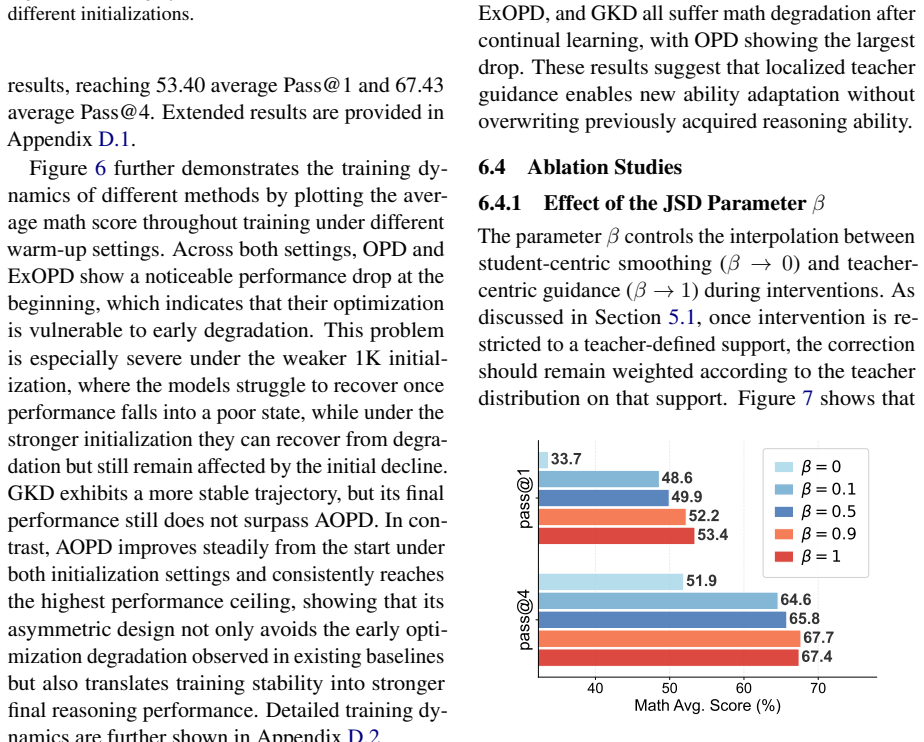
On-policy distillation (OPD) trains a student on its own trajectories with token-level teacher feedback and often outperforms off-policy distillation and standard reinforcement learning. However, we find that its standard advantage weighted policy gradient suffers from three structural weaknesses, including high variance updates, vanishing gradients in zero-advantage regions, and exploration bottlenecks when corrective signals are insufficient. We therefore propose Asymmetric On-Policy Distillation (AOPD), which replaces ineffective negative reinforcement with localized divergence minimization in non-positive advantage regions while preserving positive reinforcement learning. Experiments on mathematical reasoning benchmarks show that AOPD consistently outperforms standard OPD, with average gains of 4.09 / 8.34 under strong / weak initialization, respectively. AOPD also maintains higher policy entropy during training and better capability retention during sequential tool-use adaptation.
Editorial analysis
A structured set of objections, weighed in public.
Referee Report
Summary. The paper identifies three structural weaknesses in standard on-policy distillation (OPD) — high variance updates, vanishing gradients in zero-advantage regions, and exploration bottlenecks — and proposes Asymmetric On-Policy Distillation (AOPD) to address them by replacing negative reinforcement with localized divergence minimization in non-positive advantage regions while preserving positive reinforcement learning. Experiments on mathematical reasoning benchmarks show AOPD consistently outperforms standard OPD, with average gains of 4.09 under strong initialization and 8.34 under weak initialization, while maintaining higher policy entropy during training and better capability retention during sequential tool-use adaptation.
Significance. If the results hold under rigorous validation, AOPD provides a practical algorithmic refinement to on-policy distillation that better balances exploitation and imitation at the token level. The reported gains, entropy preservation, and improved retention in adaptation scenarios represent concrete empirical strengths for reasoning-focused language model training.
major comments (2)
- [Experiments] Experiments section: the central claim of consistent outperformance with gains of 4.09/8.34 rests on benchmark results, yet the manuscript provides no details on statistical significance, variance or standard deviations across runs, number of random seeds, or exact baseline implementations and hyperparameter settings.
- [Method] Method and Experiments: no ablation study isolates the localized divergence minimization component from the positive reinforcement term, leaving open whether the three identified weaknesses are resolved without introducing new instabilities or requiring extensive retuning.
minor comments (2)
- Specify the exact mathematical reasoning benchmarks (e.g., GSM8K, MATH) and the precise metrics used for capability retention in the tool-use adaptation experiments.
- [Introduction] The abstract and introduction would benefit from a brief illustrative example or diagram showing how the asymmetric update differs from standard advantage-weighted gradients in zero- or negative-advantage tokens.
Simulated Author's Rebuttal
We thank the referee for the constructive and insightful comments. We address each major point below and will revise the manuscript to strengthen the experimental reporting and add the requested ablation analysis.
read point-by-point responses
-
Referee: [Experiments] Experiments section: the central claim of consistent outperformance with gains of 4.09/8.34 rests on benchmark results, yet the manuscript provides no details on statistical significance, variance or standard deviations across runs, number of random seeds, or exact baseline implementations and hyperparameter settings.
Authors: We agree that the absence of statistical details, variance measures, seed counts, and precise hyperparameter specifications weakens the empirical claims. In the revised manuscript we will report results over 5 random seeds with means and standard deviations, include paired t-test p-values for the reported gains, and add an appendix with exact baseline implementations, learning rates, and all other hyperparameters used for both strong and weak initialization settings. revision: yes
-
Referee: [Method] Method and Experiments: no ablation study isolates the localized divergence minimization component from the positive reinforcement term, leaving open whether the three identified weaknesses are resolved without introducing new instabilities or requiring extensive retuning.
Authors: We concur that an ablation isolating the localized divergence minimization term is necessary to substantiate that the three structural weaknesses are addressed by the asymmetric design. We will add this ablation study in the revision, comparing (i) full AOPD, (ii) standard OPD (positive reinforcement only), and (iii) a symmetric divergence variant applied to all tokens. The new experiments will also monitor entropy and training stability metrics to check for introduced instabilities or retuning requirements. revision: yes
Circularity Check
No significant circularity in derivation chain
full rationale
The paper identifies three structural weaknesses in standard on-policy distillation's advantage-weighted policy gradient (high variance, vanishing gradients in zero-advantage regions, exploration bottlenecks) and proposes AOPD as an algorithmic replacement of negative reinforcement with localized divergence minimization in non-positive advantage regions. No load-bearing equations, predictions, or first-principles results reduce by construction to fitted parameters, self-definitions, or self-citation chains. The contribution is framed as an empirical algorithmic change, with performance gains (4.09/8.34 on math benchmarks) and secondary metrics (entropy, capability retention) presented as direct experimental evidence rather than derived outputs that loop back to inputs. The derivation chain remains self-contained against external benchmarks.
Axiom & Free-Parameter Ledger
axioms (1)
- standard math Standard RL assumptions hold, including valid advantage estimation and policy gradient applicability to token-level distillation.
Reference graph
Works this paper leans on
-
[1]
OpenAI o3-mini System Card , howpublished =
-
[2]
An Yang and Anfeng Li and Baosong Yang and Beichen Zhang and Binyuan Hui and Bo Zheng and Bowen Yu and Chang Gao and Chengen Huang and others , title =. arXiv preprint arXiv:2505.09388 , year =
work page internal anchor Pith review Pith/arXiv arXiv
-
[3]
DeepSeek-AI and Daya Guo and Dejian Yang and Haowei Zhang and Junxiao Song and Peiyi Wang and Qihao Zhu and Runxin Xu and Ruoyu Zhang and Shirong Ma and Xiao Bi and Xiaokang Zhang and Xingkai Yu and Yu Wu and Z. F. Wu and Zhibin Gou and Zhihong Shao , title =. arXiv preprint arXiv:2501.12948 , year =
work page internal anchor Pith review Pith/arXiv arXiv
-
[4]
The Surprising Effectiveness of Negative Reinforcement in
Xinyu Zhu and Mengzhou Xia and Zhepei Wei and Wei-Lin Chen and Danqi Chen and Yu Meng , booktitle=. The Surprising Effectiveness of Negative Reinforcement in. 2026 , url=
2026
-
[5]
2025 , eprint=
Rethinking Sample Polarity in Reinforcement Learning with Verifiable Rewards , author=. 2025 , eprint=
2025
-
[6]
Caixia Yan, Xiaojun Chang, Minnan Luo, Huan Liu, Xiaoqin Zhang, and Qinghua Zheng
Xu, Xiaohan and Li, Ming and Tao, Chongyang and Shen, Tao and Cheng, Reynold and Li, Jinyang and Xu, Can and Tao, Dacheng and Zhou, Tianyi , title =. arXiv preprint arXiv:2402.13116 , year =
-
[7]
Transactions of the Association for Computational Linguistics , volume =
Zhu, Xunyu and Li, Jian and Liu, Yong and Ma, Can and Wang, Weiping , title =. Transactions of the Association for Computational Linguistics , volume =. 2024 , doi =
2024
-
[8]
and Vinyals, Oriol and Dean, Jeffrey , title =
Hinton, Geoffrey E. and Vinyals, Oriol and Dean, Jeffrey , title =. NIPS Deep Learning and Representation Learning Workshop , year =
-
[9]
Findings of the Association for Computational Linguistics: ACL 2023 , pages =
Hsieh, Cheng-Yu and Li, Chun-Liang and Yeh, Chih-Kuan and Nakhost, Hootan and Fujii, Yasuhisa and Ratner, Alexander and Krishna, Ranjay and Lee, Chen-Yu and Pfister, Tomas , title =. Findings of the Association for Computational Linguistics: ACL 2023 , pages =
2023
-
[10]
, title =
Tian, Yijun and Han, Yikun and Chen, Xiusi and Wang, Wei and Chawla, Nitesh V. , title =. Proceedings of the 18th ACM International Conference on Web Search and Data Mining , pages =. 2025 , url =
2025
-
[11]
Proceedings of the Twelfth International Conference on Learning Representations , year =
Gu, Yuxian and Dong, Li and Wei, Furu and Huang, Minlie , title =. Proceedings of the Twelfth International Conference on Learning Representations , year =
-
[12]
DeepSeekMath: Pushing the Limits of Mathematical Reasoning in Open Language Models
DeepSeekMath: Pushing the Limits of Mathematical Reasoning in Open Language Models , author=. arXiv preprint arXiv:2402.03300 , year=
work page internal anchor Pith review Pith/arXiv arXiv
-
[13]
Proceedings of the Twelfth International Conference on Learning Representations , year =
Agarwal, Rishabh and Vieillard, Nino and Zhou, Yongchao and Stanczyk, Piotr and Ramos, Sabela and Geist, Matthieu and Bachem, Olivier , title =. Proceedings of the Twelfth International Conference on Learning Representations , year =
-
[14]
https://thinkingmachines.ai/blog/ on-policy-distillation/
Lu, Kevin and Thinking Machines Lab , title =. Thinking Machines Lab: Connectionism , year =. doi:10.64434/tml.20251026 , url =
-
[15]
Self-Distillation Enables Continual Learning , journal =
Shenfeld, Idan and Damani, Mehul and H. Self-Distillation Enables Continual Learning , journal =. 2026 , url =
2026
-
[16]
2026 , eprint=
Self-Distilled Reasoner: On-Policy Self-Distillation for Large Language Models , author=. 2026 , eprint=
2026
-
[17]
2026 , eprint=
OPSDL: On-Policy Self-Distillation for Long-Context Language Models , author=. 2026 , eprint=
2026
-
[18]
Advances in Neural Information Processing Systems , volume =
Bengio, Samy and Vinyals, Oriol and Jaitly, Navdeep and Shazeer, Noam , title =. Advances in Neural Information Processing Systems , volume =. 2015 , url =
2015
-
[19]
arXiv preprint arXiv:2504.11456 , year=
He, Zhiwei and Liang, Tian and Xu, Jiahao and Liu, Qiuzhi and Chen, Xingyu and Wang, Yue and Song, Linfeng and Yu, Dian and Liang, Zhenwen and Wang, Wenxuan and Zhang, Zhuosheng and Wang, Rui and Tu, Zhaopeng and Mi, Haitao and Yu, Dong , title =. arXiv preprint arXiv:2504.11456 , year =
-
[20]
Proceedings of the 2016 conference on empirical methods in natural language processing , pages=
Sequence-level knowledge distillation , author=. Proceedings of the 2016 conference on empirical methods in natural language processing , pages=
2016
-
[21]
Proceedings of the 31st ACM SIGKDD International Conference on Knowledge Discovery and Data Mining , year =
Jia, Chen , title =. Proceedings of the 31st ACM SIGKDD International Conference on Knowledge Discovery and Data Mining , year =
-
[22]
Yang, Wenkai and Liu, Weijie and Xie, Ruobing and Yang, Kai and Yang, Saiyong and Lin, Yankai , title =. arXiv preprint arXiv:2602.12125 , year =
-
[23]
Advances in Neural Information Processing Systems , volume =
Yan, Jianhao and Li, Yafu and Hu, Zican and Wang, Zhi and Cui, Ganqu and Qu, Xiaoye and Cheng, Yu and Zhang, Yue , title =. Advances in Neural Information Processing Systems , volume =. 2025 , url =
2025
-
[24]
Proceedings of the Fourteenth International Conference on Learning Representations , year =
Ma, Lu and Liang, Hao and Qiang, Meiyi and Tang, Lexiang and Ma, Xiaochen and Wong, Zhen Hao and Niu, Junbo and Shen, Chengyu and He, Runming and Cui, Bin and Zhang, Wentao , title =. Proceedings of the Fourteenth International Conference on Learning Representations , year =
-
[25]
Proceedings of the Fourteenth International Conference on Learning Representations , year =
Zhang, Wenhao and Xie, Yuexiang and Sun, Yuchang and Chen, Yanxi and Wang, Guoyin and Li, Yaliang and Ding, Bolin and Zhou, Jingren , title =. Proceedings of the Fourteenth International Conference on Learning Representations , year =
-
[26]
arXiv preprint arXiv:2509.06948 , year =
Chen, Liang and Han, Xueting and Shen, Li and Bai, Jing and Wong, Kam-Fai , title =. arXiv preprint arXiv:2509.06948 , year =
-
[27]
Proceedings of the Fourteenth International Conference on Learning Representations , year =
Fu, Yuqian and Chen, Tinghong and Chai, Jiajun and Wang, Xihuai and Tu, Songjun and Yin, Guojun and Lin, Wei and Zhang, Qichao and Zhu, Yuanheng and Zhao, Dongbin , title =. Proceedings of the Fourteenth International Conference on Learning Representations , year =
-
[28]
Huang, Zeyu and Cheng, Tianhao and Qiu, Zihan and Wang, Zili and Xu, Yinghui and Ponti, Edoardo M. and Titov, Ivan , title =. arXiv preprint arXiv:2507.01679 , year =
-
[29]
Chen, Jiaqi and Liu, Fazhong and Liu, Minghao and Luo, Yuhan and Qin, Erqu and Zheng, Haoran and Dong, Tian and Zhu, Haojin and Meng, Yan and Wang, Xiao , title =. arXiv preprint arXiv:2505.13026 , year =
-
[30]
Proceedings of the Fourteenth International Conference on Learning Representations , year =
Guha, Etash and Marten, Ryan and Keh, Sedrick and Raoof, Negin and Smyrnis, Georgios and Bansal, Hritik and Nezhurina, Marianna and Mercat, Jean and Vu, Trung and Sprague, Zayne and others , title =. Proceedings of the Fourteenth International Conference on Learning Representations , year =
-
[31]
Toolalpaca: Generalized tool learning for language models with 3000 simulated cases
Tang, Qiaoyu and Deng, Ziliang and Lin, Hongyu and Han, Xianpei and Liang, Qiao and Cao, Boxi and Sun, Le , title =. arXiv preprint arXiv:2306.05301 , year =
-
[32]
Bowman , booktitle=
David Rein and Betty Li Hou and Asa Cooper Stickland and Jackson Petty and Richard Yuanzhe Pang and Julien Dirani and Julian Michael and Samuel R. Bowman , booktitle=. 2024 , url=
2024
-
[33]
MMLU-Pro: A More Robust and Challenging Multi-Task Language Understanding Benchmark
Mmlu-pro: A more robust and challenging multi-task language understanding benchmark , author=. arXiv preprint arXiv:2406.01574 , year=
work page internal anchor Pith review Pith/arXiv arXiv
discussion (0)
Sign in with ORCID, Apple, or X to comment. Anyone can read and Pith papers without signing in.