Recognition: unknown
GTMDs, orbital angular momentum, and pretzelosity
Pith reviewed 2026-05-08 08:16 UTC · model grok-4.3
The pith
The bag model establishes a direct link between quark orbital angular momentum and pretzelosity via leading GTMDs.
A machine-rendered reading of the paper's core claim, the machinery that carries it, and where it could break.
Core claim
In the bag model the leading GTMDs are shown to be theoretically consistent. Orbital angular momentum is expressed through the GTMD F_{1,4}^q and satisfies Ji's sum rule, with analytical proofs supplied for the associated relations. This framework establishes a deeper connection between orbital angular momentum and the pretzelosity TMD.
What carries the argument
The bag model applied to the leading GTMDs, with the GTMD F_{1,4}^q serving as the carrier of orbital angular momentum information.
If this is right
- The sum rules for orbital angular momentum receive analytical confirmation inside the model.
- Pretzelosity acquires an explicit tie to orbital angular momentum through the GTMD description.
- Ji's sum rule holds exactly when the GTMD F_{1,4}^q is used to compute orbital angular momentum.
- The model remains a viable framework for computing these distributions at leading order.
Where Pith is reading between the lines
- Similar relations might be checked in other quark models to test how model-dependent the link is.
- Experimental access to pretzelosity could offer an indirect route to orbital angular momentum if the model relation generalizes.
- The result suggests that GTMD studies can systematically connect spin decomposition to transverse-momentum observables.
Load-bearing premise
The bag model supplies a theoretically consistent description of the leading GTMDs.
What would settle it
A direct calculation of the pretzelosity TMD or orbital angular momentum in the bag model that violates the proven sum rules or the stated relationship would disprove the central claim.
Figures
read the original abstract
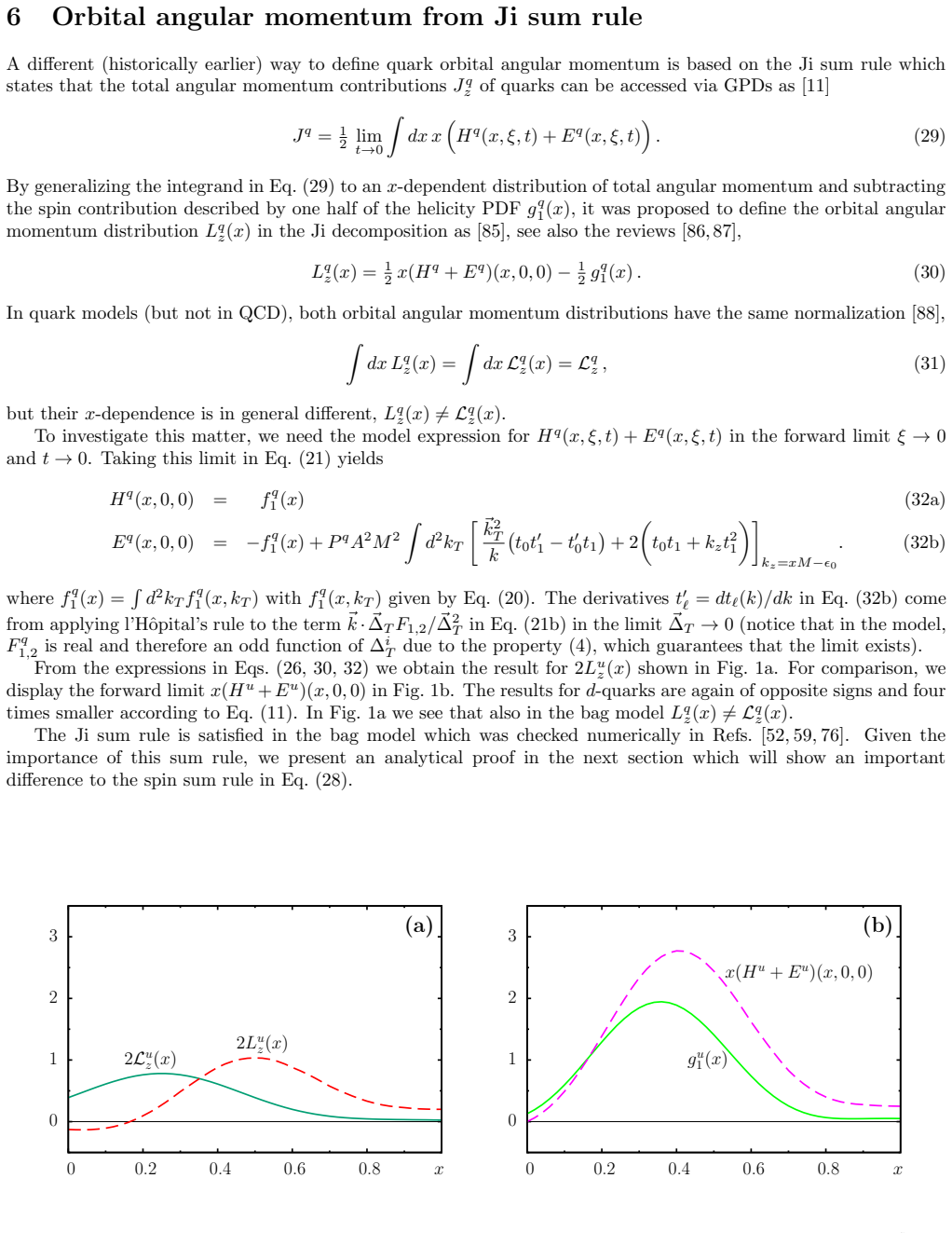
The leading Generalized Transverse Momentum Dependent parton distributions (GTMDs) are studied in the bag model. The model description is shown to be theoretically consistent. The orbital angular momentum is studied in terms of the GTMD $F_{1,4}^q$ and Ji sum rule. Analytical proofs of the associated sum rules are given. A deeper relationship between orbital angular momentum and the pretzelosity TMD is established in this model.
Editorial analysis
A structured set of objections, weighed in public.
Referee Report
Summary. The paper studies the leading Generalized Transverse Momentum Dependent parton distributions (GTMDs) in the bag model. It demonstrates the theoretical consistency of the model description, examines orbital angular momentum in terms of the GTMD F_{1,4}^q and the Ji sum rule, supplies analytical proofs of the associated sum rules, and derives a specific algebraic relation linking orbital angular momentum to the pretzelosity TMD within the same framework.
Significance. If the results hold, the work supplies a concrete, internally consistent example of how GTMDs encode orbital angular momentum and pretzelosity in a simple quark model, with the analytical proofs of sum rules (including Ji's relation) constituting a clear strength. This can serve as a useful benchmark for more advanced calculations, though the significance remains model-specific rather than a general QCD result.
minor comments (3)
- [Abstract] The abstract states that the model description is 'theoretically consistent' but does not indicate which specific consistency conditions (e.g., support properties or positivity bounds) are verified; a brief enumeration in the introduction would improve clarity.
- Notation for the GTMDs (particularly the indices on F_{1,4}^q) should be cross-referenced to a standard convention table or earlier literature to avoid ambiguity for readers unfamiliar with the bag-model implementation.
- [Discussion or Conclusions] A short paragraph comparing the obtained OAM-pretzelosity relation to results from other models (e.g., light-front or spectator) would help readers assess the model dependence without altering the central claim.
Simulated Author's Rebuttal
We thank the referee for the positive assessment of our manuscript and for accurately summarizing its main contributions. The referee correctly identifies our focus on the leading GTMDs in the bag model, the demonstration of theoretical consistency, the analysis of orbital angular momentum via the GTMD F_{1,4}^q and the Ji sum rule (with analytical proofs), and the derived algebraic relation to the pretzelosity TMD. We appreciate the recognition that this provides a concrete, internally consistent example in a simple quark model that can serve as a benchmark, while noting the model-specific nature of the results as already stated in the manuscript.
Circularity Check
No significant circularity in model-based derivation
full rationale
The paper performs explicit calculations of leading GTMDs in the bag model, supplies analytical proofs that sum rules hold (including the Ji relation for OAM via F_{1,4}^q), and derives a model-specific algebraic relation between OAM and pretzelosity. These steps follow from the model's wave functions and operator definitions rather than reducing to fitted parameters by construction or self-citation chains. The bag model is treated as a consistent framework for obtaining relations, not as a source of data-driven predictions relabeled as first-principles results. This is a standard, self-contained model study with no load-bearing steps that collapse to inputs.
Axiom & Free-Parameter Ledger
axioms (1)
- domain assumption The bag model is a valid effective description for nucleon structure and GTMDs.
Reference graph
Works this paper leans on
-
[1]
S. Meissner, A. Metz, M. Schlegel and K. Goeke, JHEP08, 038 (2008) [arXiv:0805.3165]
-
[2]
S. Meissner, A. Metz and M. Schlegel, JHEP08, 056 (2009) [arXiv:0906.5323]
-
[3]
R. Boussarie, M. Burkardt, M. Constantinou, W. Detmold, M. Ebert, M. Engelhardt, S. Fleming, L. Gamberg, X. Ji and Z. B. Kang,et al.“TMD Handbook,” [arXiv:2304.03302]
- [4]
-
[5]
Ji,Viewing the proton through ’color’ filters,Phys
X. Ji, Phys. Rev. Lett.91, 062001 (2003) [arXiv:hep-ph/0304037]
- [6]
-
[7]
C. Lorc´ e and B. Pasquini, Phys. Rev. D84, 014015 (2011) [arXiv:1106.0139]
-
[8]
C. Lorc´ e, A. Metz, B. Pasquini and P. Schweitzer, “Parton Distribution Functions and their Generalizations,” article commissioned for the Encyclopedia of Particle Physics (in press) [arXiv:2507.12664]
- [9]
-
[10]
D. M¨ uller, D. Robaschik, B. Geyer, F. M. Dittes and J. Hoˇ rejˇ si, Fortsch. Phys.42, 101-141 (1994) [arXiv:hep- ph/9812448]
-
[11]
X. D. Ji, Phys. Rev. Lett.78, 610-613 (1997) [arXiv:hep-ph/9603249]
work page Pith review arXiv 1997
-
[12]
A. V. Radyushkin, Phys. Lett. B380, 417-425 (1996) [arXiv:hep-ph/9604317]
work page Pith review arXiv 1996
-
[13]
A. V. Radyushkin, Phys. Lett. B385, 333-342 (1996) [arXiv:hep-ph/9605431]
work page Pith review arXiv 1996
-
[14]
X. D. Ji, Phys. Rev. D55, 7114-7125 (1997) [arXiv:hep-ph/9609381]
work page Pith review arXiv 1997
- [15]
- [16]
-
[17]
Foundations of Perturbative QCD,
J. Collins, “Foundations of Perturbative QCD,” Camb. Monogr. Part. Phys. Nucl. Phys. Cosmol.32, 1 (2011)
2011
- [18]
- [19]
- [20]
- [21]
- [22]
- [23]
-
[24]
M. ˇCui´ c, G. Duplanˇ ci´ c, K. Kumeriˇ cki and K. Passek-K., JHEP12, 192 (2023) [erratum: JHEP02, 225 (2024)] [arXiv:2310.13837]
- [25]
-
[26]
H. Dutrieux, C. Lorc´ e, H. Moutarde, P. Sznajder, A. Trawi´ nski and J. Wagner, Eur. Phys. J. C81, 300 (2021) [arXiv:2101.03855]
- [27]
-
[28]
H. Moutarde, P. Sznajder and J. Wagner, Eur. Phys. J. C79, 614 (2019) [arXiv:1905.02089]. 11
- [29]
- [30]
-
[31]
S. Bhattacharya, A. Metz and J. Zhou, Phys. Lett. B771, 396-400 (2017) [erratum: Phys. Lett. B810, 135866 (2020)] [arXiv:1702.04387]
-
[32]
S. Bhattacharya, A. Metz, V. K. Ojha, J. Y. Tsai and J. Zhou, Phys. Lett. B833, 137383 (2022) [arXiv:1802.10550]
- [33]
-
[34]
S. Bhattacharya, D. DeAngelo, L. Yang, D. Zheng and J. Zhou, [arXiv:2601.17506]
-
[35]
H. Avakian, A. V. Efremov, P. Schweitzer and F. Yuan, Phys. Rev. D78, 114024 (2008) [arXiv:0805.3355]
- [36]
- [37]
-
[38]
The transverse momentum dependent distribution functions in the bag model
H. Avakian, A. V. Efremov, P. Schweitzer and F. Yuan, Phys. Rev. D81, 074035 (2010) [arXiv:1001.5467]
work page Pith review arXiv 2010
-
[39]
H. Avakian, A. V. Efremov, P. Schweitzer, O. V. Teryaev and P. Zavada, [arXiv:1008.1921]
- [40]
-
[41]
Lorc´ e and B
C. Lorc´ e and B. Pasquini, in Sec. III of Ref. [7]
-
[42]
C. Lorc´ e and B. Pasquini, Phys. Lett. B710, 486-488 (2012) [arXiv:1111.6069]
- [43]
-
[44]
D. Chakrabarti, T. Maji, C. Mondal, A. Mukherjee, Eur. Phys. J. C76, 409 (2016) [arXiv:1601.03217]. B. Gurjaret al.Phys. Rev. D104, 076028 (2021) [arXiv:2107.02216]
-
[45]
Chodos, R
A. Chodos, R. L. Jaffe, K. Johnson, C. B. Thorn and V. F. Weisskopf, Phys. Rev. D9, 3471-3495 (1974)
1974
-
[46]
Chodos, R
A. Chodos, R. L. Jaffe, K. Johnson and C. B. Thorn, Phys. Rev. D10, 2599 (1974)
1974
-
[47]
Johnson, Acta Phys
K. Johnson, Acta Phys. Polon. B6, 865 (1975)
1975
-
[48]
P. V. Pobylitsa, [arXiv:hep-ph/0212027]
work page internal anchor Pith review arXiv
-
[49]
L. S. Celenza and C. M. Shakin Phys. Rev. C27, 1561 (1983) Erratum: [Phys. Rev. C39, 2477 (1989)]
1983
-
[50]
R. L. Jaffe, Phys. Rev. D11, 1953 (1975)
1953
-
[51]
R. L. Jaffe and X. D. Ji, Phys. Rev. Lett.67, 552 (1991); Nucl. Phys. B375, 527 (1992)
1991
- [52]
-
[53]
S. Scopetta, Phys. Rev. D72, 117502 (2005) [arXiv:hep-ph/0509287]
- [54]
-
[55]
A. Courtoy, F. Fratini, S. Scopetta and V. Vento, Phys. Rev. D78, 034002 (2008) [arXiv:0801.4347]
- [56]
-
[57]
M. Rinaldi, S. Scopetta and V. Vento, Phys. Rev. D87, 114021 (2013) [arXiv:1302.6462]
- [58]
-
[59]
A. Courtoy and A. S. Miramontes, Phys. Rev. D95, 014027 (2017) [arXiv:1611.03375]
-
[60]
C. Lorc´ e, B. Pasquini and M. Vanderhaeghen, JHEP05, 041 (2011) [arXiv:1102.4704]
-
[61]
C. Lorc´ e, B. Pasquini, X. Xiong and F. Yuan, Phys. Rev. D85, 114006 (2012) [arXiv:1111.4827]. 12
-
[62]
A. Courtoy, G. R. Goldstein, J. O. Gonzalez Hernandez, S. Liuti and A. Rajan, Phys. Lett. B731, 141-147 (2014) [arXiv:1310.5157]
-
[63]
K. Kanazawa, C. Lorc´ e, A. Metz, B. Pasquini, M. Schlegel, Phys. Rev. D90, 014028 (2014) [arXiv:1403.5226]
-
[64]
A. Mukherjee, S. Nair and V. K. Ojha, Phys. Rev. D91, 054018 (2015) [arXiv:1501.03728]
- [65]
- [66]
- [67]
- [68]
-
[69]
D. Chakrabarti, N. Kumar, T. Maji and A. Mukherjee, Eur. Phys. J. Plus135, 496 (2020) [arXiv:1902.07051]
- [70]
- [71]
- [72]
-
[73]
D. Chakrabarti, P. Choudhary, B. Gurjar, T. Maji, C. Mondal and A. Mukherjee, Phys. Rev. D109, 114040 (2024) [arXiv:2402.16503]
- [74]
-
[75]
S. Sharma and H. Dahiya, Eur. Phys. J. A59, 235 (2023) [arXiv:2310.03592]
- [76]
-
[77]
A. Bacchetta, M. Diehl, K. Goeke, A. Metz, P. J. Mulders, M. Schlegel, JHEP02, 093 (2007) [arXiv:hep- ph/0611265]
-
[78]
R. L. Jaffe and A. Manohar, Nucl. Phys. B337, 509-546 (1990)
1990
-
[79]
Maynard, E
M. Maynard, E. Sohail, P. Schweitzeret al.work in preparation (2026)
2026
-
[80]
Karl and J
G. Karl and J. E. Paton, Phys. Rev. D30, 238 (1984)
1984
discussion (0)
Sign in with ORCID, Apple, or X to comment. Anyone can read and Pith papers without signing in.