Recognition: no theorem link
Cryptographic and Information-theoretic Security Capacities for General Arbitrarily Varying Wiretap Channels
Pith reviewed 2026-05-12 03:42 UTC · model grok-4.3
The pith
For Arbitrarily Varying Wiretap Channels, strong secrecy capacity equals semantic secrecy capacity under both average and maximal error criteria.
A machine-rendered reading of the paper's core claim, the machinery that carries it, and where it could break.
Core claim
The average error and strong secrecy capacity of an AVWC is always equal to its maximal error and semantic secrecy capacity. However, this equivalence does not hold for all general communication systems, and we prove this by a counterexample. For the GAVWC, semantic security and the other cryptographic security measures considered achieve the same capacity values. Finally, we bound the gap between the strong secrecy capacity and the semantic secrecy capacity for the GAVWC. The gap vanishes if the choice of the jammer is sub-double-exponential with respect to the block length n.
What carries the argument
Equivalence of capacities defined via average error with strong secrecy versus maximal error with semantic secrecy for AVWCs and GAVWCs.
If this is right
- The capacity is the same whether one uses average or maximal error probability when paired with the corresponding secrecy notion.
- For general systems beyond AVWCs, such equivalences may fail as demonstrated by the counterexample.
- Semantic secrecy is sufficient to achieve the strong secrecy capacity in GAVWCs.
- The difference between strong and semantic secrecy capacities is bounded and can be made to vanish under sub-double-exponential jammer growth.
Where Pith is reading between the lines
- Semantic secrecy may be easier to analyze or achieve in practice while still guaranteeing the full capacity.
- The sub-double-exponential condition suggests that for adversaries with reasonable computational limits, the capacities coincide.
- The counterexample could be used to test similar equivalences in other channel models like broadcast channels or multiple access channels.
Load-bearing premise
The alphabets for channel inputs, outputs, and states are finite, and the channel is memoryless but arbitrarily varying.
What would settle it
Observing a difference in capacities for an AVWC under the two sets of criteria, or a GAVWC where the gap does not vanish for sub-double-exponential jammer choices.
Figures

read the original abstract
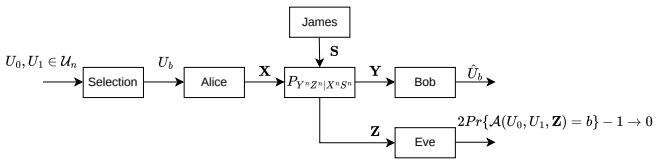
We compare the strong secrecy capacities of Arbitrarily Varying Wiretap Channels (AVWCs) and General Arbitrarily Varying Wiretap Channels (GAVWCs) with their capacities under semantic secrecy constraint and other equivalent cryptographic secrecy constraints. It turns out that the average error and strong secrecy capacity of an AVWC is always equal to its maximal error and semantic secrecy capacity. However, this equivalence does not hold for all general communication systems, and we prove this by a counterexample. We also show that, for the GAVWC, semantic security and the other cryptographic security measures considered achieve the same capacity values. Finally, we bound the gap between the strong secrecy capacity and the semantic secrecy capacity for the GAVWC. The gap vanishes if the choice of the jammer is sub-double-exponential with respect to the block length n, which gives a sufficient condition for the strong and semantic secrecy capacities to be equal for GAVWCs.
Editorial analysis
A structured set of objections, weighed in public.
Referee Report
Summary. The paper compares strong secrecy capacities of Arbitrarily Varying Wiretap Channels (AVWCs) and General Arbitrarily Varying Wiretap Channels (GAVWCs) against semantic secrecy and related cryptographic constraints. It proves that for AVWCs the average-error strong-secrecy capacity equals the maximal-error semantic-secrecy capacity, supplies a counterexample showing the equivalence fails for general communication systems, establishes that semantic security and other cryptographic measures yield identical capacities for GAVWCs, and derives an upper bound on the gap between strong and semantic secrecy capacities for GAVWCs that vanishes when the jammer selection is sub-double-exponential in block length n.
Significance. If the derivations hold, the results clarify when information-theoretic and cryptographic secrecy notions coincide for adversarial wiretap channels, a setting relevant to robust secure communication. The counterexample isolates the special structure of AVWCs, while the gap bound supplies a concrete sufficient condition for capacity equality under standard finite-alphabet memoryless assumptions and random-coding arguments.
minor comments (3)
- §2 (channel definitions): the distinction between the AVWC and GAVWC state alphabets and the auxiliary channels used in the capacity expressions should be stated more explicitly to make the subsequent proofs easier to follow.
- The counterexample construction (presumably §3) would benefit from an explicit verification that the chosen auxiliary channels satisfy the finite-alphabet hypothesis without introducing hidden dependencies on n.
- The gap-bound derivation (presumably §5) relies on sub-double-exponential jammer scaling; a brief remark on whether this scaling is necessary or merely sufficient would strengthen the presentation.
Simulated Author's Rebuttal
We thank the referee for the careful reading of our manuscript and the positive recommendation for minor revision. The referee's summary accurately reflects the main results of the paper.
Circularity Check
No significant circularity; derivation self-contained
full rationale
The paper establishes equivalences between average-error/strong-secrecy and maximal-error/semantic-secrecy capacities for AVWCs, shows the equivalence fails for general systems via counterexample, equates cryptographic measures for GAVWCs, and bounds the strong-vs-semantic gap (vanishing under sub-double-exponential jammer scaling). All steps rely on standard random coding, typicality, and finite-alphabet memoryless AV structure with auxiliary channels; none of the capacity expressions are defined in terms of themselves, no fitted parameters are relabeled as predictions, and no load-bearing self-citations or imported uniqueness theorems appear in the provided derivation chain. The results are externally falsifiable against the stated channel models and do not reduce to their inputs by construction.
Axiom & Free-Parameter Ledger
axioms (2)
- domain assumption Finite input, output, and state alphabets for the channel model
- domain assumption Standard memoryless but arbitrarily varying structure
Reference graph
Works this paper leans on
-
[1]
Information-theoretic key agreement: From weak to strong secrecy for free,
U. Maurer and S. Wolf, “Information-theoretic key agreement: From weak to strong secrecy for free,” inInternational Conference on the Theory and Applications of Cryptographic Techniques, pp. 351–368, Springer, 2000
work page 2000
-
[2]
A. D. Wyner, “The wire-tap channel,”Bell System Technical Journal, vol. 54, no. 8, pp. 1355–1387, 1975
work page 1975
-
[3]
Broadcast channels with confidential messages,
I. Csisz ´ar and J. K ¨orner, “Broadcast channels with confidential messages,”IEEE Transactions on Information Theory, vol. 24, no. 3, pp. 339–348, 1978
work page 1978
-
[4]
Common randomness and secret key generation with a helper,
I. Csisz ´ar and P. Narayan, “Common randomness and secret key generation with a helper,”IEEE Transactions on Information Theory, vol. 46, no. 2, pp. 344–366, 2000
work page 2000
-
[5]
Strong secrecy from channel resolvability,
M. R. Bloch and J. N. Laneman, “Strong secrecy from channel resolvability,”IEEE Transactions on Information Theory, vol. 59, no. 12, pp. 8077–8098, 2013
work page 2013
-
[6]
Multiple access wiretap channels with strong secrecy,
M. H. Yassaee and M. R. Aref, “Multiple access wiretap channels with strong secrecy,” in2010 IEEE Information Theory Workshop, pp. 1–5, IEEE, 2010
work page 2010
-
[7]
Secrecy results for compound wiretap channels,
I. Bjelakovi ´c, H. Boche, and J. Sommerfeld, “Secrecy results for compound wiretap channels,”Problems of Information Transmission, vol. 49, no. 1, pp. 73–98, 2013
work page 2013
-
[8]
Strong secrecy for cooperative broadcast channels,
Z. Goldfeld, G. Kramer, H. H. Permuter, and P. Cuff, “Strong secrecy for cooperative broadcast channels,”IEEE Transactions on Information Theory, vol. 63, no. 1, pp. 469–495, 2016
work page 2016
-
[9]
Strongly secure communications over the two-way wiretap channel,
A. J. Pierrot and M. R. Bloch, “Strongly secure communications over the two-way wiretap channel,”IEEE Transactions on Information Forensics and Security, vol. 6, no. 3, pp. 595–605, 2011
work page 2011
-
[10]
The secrecy capacity of compound gaussian mimo wiretap channels,
R. F. Schaefer and S. Loyka, “The secrecy capacity of compound gaussian mimo wiretap channels,”IEEE Transactions on Information Theory, vol. 61, no. 10, pp. 5535–5552, 2015
work page 2015
-
[11]
Strong secrecy for interference channels based on channel resolvability,
Z. Wang, R. F. Schaefer, M. Skoglund, M. Xiao, and H. V . Poor, “Strong secrecy for interference channels based on channel resolvability,”IEEE Transactions on Information Theory, vol. 64, no. 7, pp. 5110–5130, 2018
work page 2018
-
[12]
Wiretap channels with causal state information: Strong secrecy,
T. S. Han and M. Sasaki, “Wiretap channels with causal state information: Strong secrecy,”IEEE Transactions on Information Theory, vol. 65, no. 10, pp. 6750–6765, 2019
work page 2019
-
[13]
On the fundamental limits of integrated sensing and communications under logarithmic loss,
J. Chen, L. Yu, Y . Li, W. Shi, Y . Ge, and W. Tong, “On the fundamental limits of integrated sensing and communications under logarithmic loss,”arXiv preprint arXiv:2502.08502, 2025
-
[14]
Semantic security for the wiretap channel,
M. Bellare, S. Tessaro, and A. Vardy, “Semantic security for the wiretap channel,” inAnnual cryptology conference, pp. 294–311, Springer, 2012
work page 2012
-
[15]
S. Goldwasser and S. Micali, “Probabilistic encryption,”J. Comput. Syst. Sci., vol. 28, pp. 270–299, 1984
work page 1984
-
[16]
Semantic security via seeded modular coding schemes and ramanujan graphs,
M. Wiese and H. Boche, “Semantic security via seeded modular coding schemes and ramanujan graphs,”IEEE Transactions on Information Theory, vol. 67, no. 1, pp. 52–80, 2020
work page 2020
-
[17]
Experimental validation of information-theoretic physical layer security,
J. V oichtleitner, M. Wiese, A. Frank, and H. Boche, “Experimental validation of information-theoretic physical layer security,”IEEE Transactions on Information Forensics and Security, 2026
work page 2026
-
[18]
Semantic security for quantum wiretap channels,
H. Boche, M. Cai, C. Deppe, R. Ferrara, and M. Wiese, “Semantic security for quantum wiretap channels,”Journal of Mathematical Physics, vol. 63, no. 9, 2022
work page 2022
-
[19]
Semantic security with infinite-dimensional quantum eavesdropping channel,
M. Frey, I. Bjelakovi ´c, J. N ¨otzel, and S. Sta ´nczak, “Semantic security with infinite-dimensional quantum eavesdropping channel,”IEEE Transactions on Information Theory, vol. 71, no. 4, pp. 2662–2697, 2025
work page 2025
-
[20]
Semantic-security capacity for wiretap channels of type ii,
Z. Goldfeld, P. Cuff, and H. H. Permuter, “Semantic-security capacity for wiretap channels of type ii,”IEEE Transactions on Information Theory, vol. 62, no. 7, pp. 3863–3879, 2016
work page 2016
-
[21]
Arbitrarily varying wiretap channels with type constrained states,
Z. Goldfeld, P. Cuff, and H. H. Permuter, “Arbitrarily varying wiretap channels with type constrained states,”IEEE Transactions on Information Theory, vol. 62, no. 12, pp. 7216–7244, 2016
work page 2016
-
[22]
Semantically secure lattice codes for the gaussian wiretap channel,
C. Ling, L. Luzzi, J.-C. Belfiore, and D. Stehl ´e, “Semantically secure lattice codes for the gaussian wiretap channel,”IEEE Transactions on Information Theory, vol. 60, no. 10, pp. 6399–6416, 2014
work page 2014
-
[23]
Semantically secure lattice codes for compound mimo channels,
A. Campello, C. Ling, and J.-C. Belfiore, “Semantically secure lattice codes for compound mimo channels,”IEEE Transactions on Information Theory, vol. 66, no. 3, pp. 1572–1584, 2019
work page 2019
-
[24]
Arbitrary jamming can preclude secure communication,
E. MolavianJazi, M. Bloch, and J. N. Laneman, “Arbitrary jamming can preclude secure communication,” in2009 47th Annual Allerton Conference on Communication, Control, and Computing (Allerton), pp. 1069–1075, IEEE, 2009
work page 2009
-
[25]
Capacity results for arbitrarily varying wiretap channels,
I. Bjelakovi ´c, H. Boche, and J. Sommerfeld, “Capacity results for arbitrarily varying wiretap channels,” inInformation Theory, Combinatorics, and Search Theory, pp. 123–144, Springer, 2013
work page 2013
-
[26]
M. Wiese, J. N ¨otzel, and H. Boche, “A channel under simultaneous jamming and eavesdropping attack—correlated random coding capacities under strong secrecy criteria,”IEEE Transactions on Information Theory, vol. 62, no. 7, pp. 3844–3862, 2016
work page 2016
-
[27]
The arbitrarily varying wiretap channel—secret randomness, stability, and super-activation,
J. N ¨otzel, M. Wiese, and H. Boche, “The arbitrarily varying wiretap channel—secret randomness, stability, and super-activation,”IEEE Transactions on Information Theory, vol. 62, no. 6, pp. 3504–3531, 2016
work page 2016
-
[28]
Strong secrecy of arbitrarily varying multiple access channels,
Y . Chen, D. He, and Y . Luo, “Strong secrecy of arbitrarily varying multiple access channels,”IEEE Transactions on Information Forensics and Security, vol. 16, pp. 3662–3677, 2021
work page 2021
-
[29]
Strong secrecy of arbitrarily varying wiretap channel with constraints,
Y . Chen, D. He, C. Ying, and Y . Luo, “Strong secrecy of arbitrarily varying wiretap channel with constraints,”IEEE Transactions on Information Theory, vol. 68, no. 7, pp. 4700–4722, 2022
work page 2022
-
[30]
Arbitrarily varying wiretap channels with non-causal side information at the jammer,
C. R. Janda, M. Wiese, E. A. Jorswieck, and H. Boche, “Arbitrarily varying wiretap channels with non-causal side information at the jammer,”IEEE Transactions on Information Theory, vol. 69, no. 4, pp. 2635–2663, 2023
work page 2023
-
[31]
On the security of public key protocols,
D. Dolev and A. Yao, “On the security of public key protocols,”IEEE Transactions on information theory, vol. 29, no. 2, pp. 198–208, 1983
work page 1983
-
[32]
Authenticated-encryption with associated-data,
P. Rogaway, “Authenticated-encryption with associated-data,” inProceedings of the 9th ACM Conference on Computer and Communications Security, pp. 98–107, 2002
work page 2002
-
[33]
Stronger security of authenticated key exchange,
B. LaMacchia, K. Lauter, and A. Mityagin, “Stronger security of authenticated key exchange,” inInternational conference on provable security, pp. 1–16, Springer, 2007
work page 2007
-
[34]
Authentication and authenticated key exchanges,
W. Diffie, P. C. Van Oorschot, and M. J. Wiener, “Authentication and authenticated key exchanges,”Designs, Codes and cryptography, vol. 2, no. 2, pp. 107–125, 1992
work page 1992
-
[35]
A cryptographic treatment of the wiretap channel,
M. Bellare, S. Tessaro, and A. Vardy, “A cryptographic treatment of the wiretap channel,”arXiv preprint arXiv:1201.2205, 2012
-
[36]
The capacity of the arbitrarily varying channel revisited: Positivity, constraints,
I. Csisz ´ar and P. Narayan, “The capacity of the arbitrarily varying channel revisited: Positivity, constraints,”IEEE Transactions on Information Theory, vol. 34, no. 2, pp. 181–193, 1988
work page 1988
-
[37]
Exponential error bounds for random codes in the arbitrarily varying channel,
T. Ericson, “Exponential error bounds for random codes in the arbitrarily varying channel,”IEEE Transactions on Information Theory, vol. 31, no. 1, pp. 42–48, 1985
work page 1985
-
[38]
Elimination of correlation in random codes for arbitrarily varying channels,
R. Ahlswede, “Elimination of correlation in random codes for arbitrarily varying channels,”Probability Theory and Related Fields, vol. 44, no. 2, pp. 159–175, 1978
work page 1978
-
[39]
I. Csisz ´ar and J. K ¨orner,Information Theory: Coding Theorems for Discrete Memoryless Systems. Cambridge University Press, 2011
work page 2011
-
[40]
Localized error correction in projective space,
N. Cai, “Localized error correction in projective space,”IEEE transactions on information theory, vol. 59, no. 6, pp. 3282–3294, 2013
work page 2013
-
[41]
H. Boche, M. Cai, and N. Cai, “Message transmission over classical quantum channels with a jammer with side information: Message transmission capacity and resources,”IEEE Transactions on Information Theory, vol. 65, no. 5, pp. 2922–2943, 2018
work page 2018
discussion (0)
Sign in with ORCID, Apple, or X to comment. Anyone can read and Pith papers without signing in.