Recognition: 2 theorem links
· Lean TheoremLHC Mono-W/Z Signatures as a Probe for Dark Matter Explanations of Astrophysical Excesses
Pith reviewed 2026-05-11 01:29 UTC · model grok-4.3
The pith
LHC mono-W/Z searches can test most of the inert doublet dark matter space explaining the galactic excesses
A machine-rendered reading of the paper's core claim, the machinery that carries it, and where it could break.
Core claim
In the inert two-Higgs doublet model the parameter space with dark matter mass 70-75 GeV and dominant SS to WW star annihilation that fits both the galactic center excess and antiproton anomaly can be tested using LHC mono-W/Z plus missing energy searches. A channel separation strategy allows disentangling the contributions from neutral mass splitting Delta zero and charged mass splitting Delta plus minus. At the High-Luminosity LHC this leads to 2 sigma exclusion limits of 80 to 260 GeV on Delta zero from the leptonic channel and 30 to 150 GeV on Delta zero plus 70 to 230 GeV on Delta plus minus from the hadronic channel for a 70 GeV dark matter particle.
What carries the argument
The mono-W/Z plus missing transverse energy signatures at the LHC with a dedicated channel-separation strategy for distinguishing neutral and charged mass splittings in the inert scalars.
Load-bearing premise
The galactic center excess and antiproton anomaly are due to dark matter annihilation in the inert two-Higgs doublet model via the SS to WW star channel in the 70-75 GeV range with no other dominant contributions.
What would settle it
A lack of mono-W/Z events in the relevant signal regions at the High-Luminosity LHC within the mass splitting ranges of 30 to 260 GeV would rule out this dark matter explanation for the astrophysical excesses.
Figures


read the original abstract
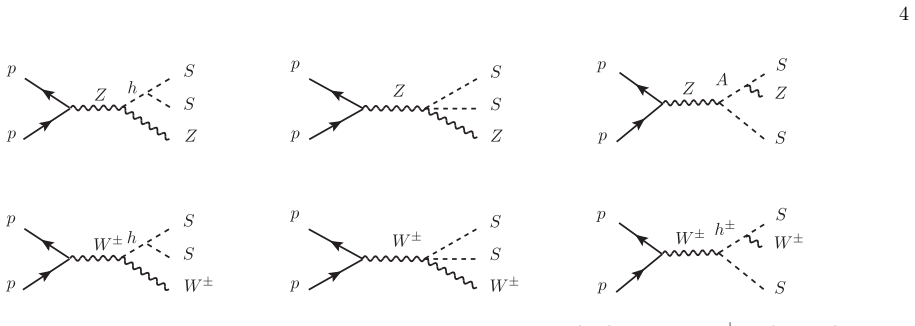
The inert two-Higgs doublet model (IDM) is a compelling framework for weakly interacting massive particles (WIMPs) linked to electroweak symmetry breaking. It can account for both the Galactic Center gamma-ray excess (GCE) and the AMS-02 antiproton anomaly while also satisfying relic density and direct detection constraints for dark matter (DM) masses in the $55-75$ GeV range. Three specific DM annihilation channels can be identified: Higgs resonance, $SA$ co-annihilation, and $SS\to WW^{\ast}$ annihilation. Among these, the DM mass range of $70-75$ GeV with dominant $SS\to WW^{\ast}$ annihilation has received less attention in collider searches. To validate this parameter space, we combine LHC searches for mono-$W/Z$ signatures. In particular, we develop a channel-separation strategy to disentangle the contributions of charged mass splitting ($\Delta^{\pm}$) and neutral mass splitting ($\Delta^0$) in the inert scalar sector at the LHC. Our results indicate that most of the parameter space consistent with these astrophysical anomalies in the $SS\to WW^{\ast}$ annihilation regime will be testable at the High-Luminosity LHC. Specifically, from the leptonic channel we obtain a $2\sigma$ exclusion limit of $80 \lesssim \Delta^0 \lesssim 260$ GeV, while the hadronic channel yields $30 \lesssim \Delta^0 \lesssim 150$ GeV and $70 \lesssim \Delta^{\pm} \lesssim 230$ GeV for $m_S = 70$ GeV.
Editorial analysis
A structured set of objections, weighed in public.
Referee Report
Summary. The paper claims that the inert doublet model (IDM) parameter space with m_S = 70-75 GeV, where SS → WW* annihilation explains the Galactic Center Excess and AMS-02 antiproton anomaly while satisfying relic density and direct detection bounds, can be tested via mono-W/Z signatures at the LHC. A channel-separation strategy using leptonic and hadronic final states is developed to disentangle the neutral mass splitting Δ⁰ and charged mass splitting Δ±, yielding 2σ exclusion limits at the High-Luminosity LHC of 80 ≲ Δ⁰ ≲ 260 GeV (leptonic), and 30 ≲ Δ⁰ ≲ 150 GeV with 70 ≲ Δ± ≲ 230 GeV (hadronic) for m_S = 70 GeV.
Significance. If the projections hold, the work provides a direct collider test of astrophysically motivated DM explanations in the IDM, bridging indirect detection signals with LHC phenomenology. The channel-separation method is a useful technical contribution for isolating effects of the two mass splittings in the inert sector. The analysis follows standard recast procedures for mono-W/Z searches, rendering the limits falsifiable with HL-LHC data.
minor comments (2)
- Abstract: the quoted 2σ limits are presented without any mention of the Monte Carlo tools, background modeling, or systematic uncertainties employed; a one-sentence summary of these elements would strengthen the abstract and allow readers to assess robustness immediately.
- The manuscript would benefit from an explicit statement (perhaps in the introduction or results section) of how the leptonic and hadronic channels are combined to break the degeneracy between Δ⁰ and Δ±, including any assumptions about signal efficiencies or cut optimization.
Simulated Author's Rebuttal
We thank the referee for the positive evaluation of our manuscript, the accurate summary of our results on mono-W/Z signatures in the IDM, and the recommendation for minor revision. We appreciate the recognition that our channel-separation strategy provides a useful technical contribution for testing astrophysically motivated DM explanations at the HL-LHC. As no specific major comments were raised in the report, we have no point-by-point responses to provide below. We will incorporate any minor suggestions into the revised version of the manuscript.
Circularity Check
No significant circularity identified
full rationale
The paper's derivation chain consists of two independent parts: (1) adopting the IDM parameter space (m_S ≈ 70-75 GeV, SS→WW* regime) that is already consistent with GCE and AMS-02 excesses from external astrophysical fits, and (2) performing a standard recast of mono-W/Z searches at the LHC/HL-LHC to project 2σ exclusion limits on the free parameters Δ⁰ and Δ± via a channel-separation strategy that combines leptonic and hadronic final states. The collider projections treat the mass splittings as independent inputs and do not derive them from the astrophysical data; no equation reduces a claimed prediction to a fitted quantity by construction, and no load-bearing step relies on a self-citation chain whose validity is internal to the present work. The overall result is therefore a conditional reach estimate rather than a closed loop.
Axiom & Free-Parameter Ledger
free parameters (2)
- m_S
- Δ⁰ and Δ±
axioms (2)
- domain assumption The IDM scalar potential and Z2 symmetry protect the lightest inert scalar as stable DM.
- domain assumption Standard Model backgrounds and detector effects are correctly modeled in the mono-W/Z channels.
invented entities (1)
-
Inert scalars S, A, H±
no independent evidence
Lean theorems connected to this paper
-
IndisputableMonolith/Foundation/RealityFromDistinction.leanreality_from_one_distinction unclear?
unclearRelation between the paper passage and the cited Recognition theorem.
The general CP-conserving scalar potential is given by: V=μ₁²|H|² + μ₂²|HD|² + λ₁|H|⁴ + ... (Eq. 2); mass splittings Δ⁰ = mA − mS and Δ± = mh± − mS
-
IndisputableMonolith/Cost/FunctionalEquation.leanwashburn_uniqueness_aczel unclear?
unclearRelation between the paper passage and the cited Recognition theorem.
Production cross-sections ... Monte Carlo event generation ... MadGraph5 aMC@NLO ... Pythia8 ... Delphes3
What do these tags mean?
- matches
- The paper's claim is directly supported by a theorem in the formal canon.
- supports
- The theorem supports part of the paper's argument, but the paper may add assumptions or extra steps.
- extends
- The paper goes beyond the formal theorem; the theorem is a base layer rather than the whole result.
- uses
- The paper appears to rely on the theorem as machinery.
- contradicts
- The paper's claim conflicts with a theorem or certificate in the canon.
- unclear
- Pith found a possible connection, but the passage is too broad, indirect, or ambiguous to say the theorem truly supports the claim.
Reference graph
Works this paper leans on
- [1]
- [2]
-
[3]
A. Arbey and F. Mahmoudi, Prog. Part. Nucl. Phys.119, 103865 (2021), arXiv:2104.11488 [hep-ph]
-
[4]
M. Cirelli, A. Strumia, and J. Zupan, “Dark Matter,” (2024), arXiv:2406.01705 [hep-ph]
work page internal anchor Pith review arXiv 2024
- [5]
- [6]
-
[7]
I. Cholis, Y.-M. Zhong, S. D. McDermott, and J. P. Surdutovich, Phys. Rev. D105, 103023 (2022), arXiv:2112.09706 [astro-ph.HE]
-
[8]
M. Di Mauro and M. W. Winkler, Phys. Rev. D103, 123005 (2021), arXiv:2101.11027 [astro-ph.HE]
- [9]
- [10]
- [11]
-
[12]
R. Bartels, S. Krishnamurthy, and C. Weniger, Phys. Rev. Lett.116, 051102 (2016)
work page 2016
- [13]
- [14]
- [15]
- [16]
-
[17]
N. G. Deshpande and E. Ma, Phys. Rev. D18, 2574 (1978)
work page 1978
-
[18]
Improved Naturalness with a Heavy Higgs: An Alternative Road to LHC Physics
R. Barbieri, L. J. Hall, and V. S. Rychkov, Phys. Rev. D74, 015007 (2006), arXiv:hep-ph/0603188
work page Pith review arXiv 2006
-
[19]
The Inert Doublet Model: an Archetype for Dark Matter
L. Lopez Honorez, E. Nezri, J. F. Oliver, and M. H. G. Tytgat, JCAP02, 028 (2007), arXiv:hep-ph/0612275
work page Pith review arXiv 2007
- [20]
- [21]
- [22]
-
[23]
S. Ipek, D. McKeen, and A. E. Nelson, Phys. Rev. D90, 055021 (2014), arXiv:1404.3716 [hep-ph]
work page Pith review arXiv 2014
- [24]
- [25]
-
[26]
P. Agrawal, B. Batell, D. Hooper, and T. Lin, Phys. Rev. D90, 063512 (2014), arXiv:1404.1373 [hep-ph]
-
[27]
E. Izaguirre, G. Krnjaic, and B. Shuve, Phys. Rev. D 90, 055002 (2014), arXiv:1404.2018 [hep-ph]
- [28]
-
[29]
M. Abdullah, A. DiFranzo, A. Rajaraman, T. M. P. Tait, P. Tanedo, and A. M. Wijangco, Phys. Rev. D 90, 035004 (2014), arXiv:1404.6528 [hep-ph]
- [30]
- [31]
- [32]
- [33]
- [34]
- [35]
- [36]
- [37]
-
[38]
M. Abdughani, Y.-Z. Fan, L. Feng, Y.-L. S. Tsai, L. Wu, and Q. Yuan, Sci. Bull.66, 2170 (2021), arXiv:2104.03274 [hep-ph]
-
[39]
M. Di Mauro, C. Arina, N. Fornengo, J. Heisig, and D. Massaro, Phys. Rev. D108, 095008 (2023), arXiv:2305.11937 [hep-ph]
-
[40]
Boet al.(PandaX), Dark Matter Search Results from 1.54 Tonne·Year Exposure of PandaX-4T, Phys
Z. Boet al.(PandaX), Phys. Rev. Lett.134, 011805 (2025), arXiv:2408.00664 [hep-ex]
-
[41]
Dark Matter Search Results from 4.2 Tonne-Years of Exposure of the LUX-ZEPLIN (LZ) Experiment,
J. Aalberset al.(LZ), Phys. Rev. Lett.135, 011802 (2025), arXiv:2410.17036 [hep-ex]
-
[42]
E. Aprileet al.(XENON), Phys. Rev. Lett.135, 221003 (2025), arXiv:2502.18005 [hep-ex]
- [43]
- [44]
- [45]
-
[46]
A. Belyaev, G. Cacciapaglia, I. P. Ivanov, F. Rojas- Abatte, and M. Thomas, Phys. Rev. D97, 035011 (2018), arXiv:1612.00511 [hep-ph]
-
[47]
D. Dercks and T. Robens, Eur. Phys. J. C79, 924 (2019), arXiv:1812.07913 [hep-ph]
-
[48]
J. Kalinowski, T. Robens, D. Sokolowska, and A. F. Zar- necki, Symmetry13, 991 (2021), arXiv:2012.14818 [hep- ph]
-
[49]
Q.-H. Cao, E. Ma, and G. Rajasekaran, Phys. Rev. D 76, 095011 (2007), arXiv:0708.2939 [hep-ph]
work page Pith review arXiv 2007
-
[50]
Dilepton constraints in the Inert Doublet Model from Run 1 of the LHC
G. Belanger, B. Dumont, A. Goudelis, B. Herrmann, S. Kraml, and D. Sengupta, Phys. Rev. D91, 115011 (2015), arXiv:1503.07367 [hep-ph]
work page Pith review arXiv 2015
-
[51]
Inert Doublet Model in light of LHC Run I and astrophysical data
A. Ilnicka, M. Krawczyk, and T. Robens, Phys. Rev. D 93, 055026 (2016), arXiv:1508.01671 [hep-ph]
work page Pith review arXiv 2016
-
[52]
Exploring collider signatures of the inert Higgs doublet model
A. Datta, N. Ganguly, N. Khan, and S. Rakshit, Phys. Rev. D95, 015017 (2017), arXiv:1610.00648 [hep-ph]
work page Pith review arXiv 2017
-
[53]
Advancing LHC Probes of Dark Matter from the Inert 2-Higgs Doublet Model with the Mono-jet Signal
A. Belyaev, T. R. Fernandez Perez Tomei, P. G. Mer- cadante, C. S. Moon, S. Moretti, S. F. Novaes, L. Panizzi, F. Rojas, and M. Thomas, Phys. Rev. D99, 015011 (2019), arXiv:1809.00933 [hep-ph]
work page Pith review arXiv 2019
-
[54]
collaboration (CMS), CMS-PAS-NPS-25-002 (2026)
C. collaboration (CMS), CMS-PAS-NPS-25-002 (2026)
work page 2026
-
[55]
D. Eriksson, J. Rathsman, and O. St˚ al, Computer Physics Communications181, 189 (2010)
work page 2010
-
[56]
de Blas et al., JHEP 01 (2020) 139, arXiv:1905.03764 [hep-ph]
J. de Blaset al., JHEP01, 139 (2020), arXiv:1905.03764 [hep-ph]
-
[57]
A. Tumasyanet al.(CMS), Nature607, 60 (2022), arXiv:2207.00043 [hep-ex]
- [58]
-
[59]
Ajelloet al.(Fermi-LAT), Astrophys
M. Ajelloet al.(Fermi-LAT), The Astrophysical Journal 819, 44 (2016), arXiv:1511.02938 [astro-ph.HE]
- [60]
-
[61]
N. D. Christensen and C. Duhr, Comput. Phys. Com- mun.180, 1614 (2009), arXiv:0806.4194 [hep-ph]
work page Pith review arXiv 2009
- [62]
-
[63]
T. Sj¨ ostrand, S. Ask, J. R. Christiansen, R. Corke, N. De- sai, P. Ilten, S. Mrenna, S. Prestel, C. O. Rasmussen, and P. Z. Skands, Comput. Phys. Commun.191, 159 (2015), arXiv:1410.3012 [hep-ph]
work page internal anchor Pith review arXiv 2015
- [64]
-
[65]
G. Aadet al.(ATLAS), Eur. Phys. J. C79, 970 (2019), arXiv:1907.05120 [hep-ex]
- [66]
-
[67]
Asymptotic formulae for likelihood-based tests of new physics
G. Cowan, K. Cranmer, E. Gross, and O. Vitells, Eur. Phys. J. C71, 1554 (2011), [Erratum: Eur.Phys.J.C 73, 2501 (2013)], arXiv:1007.1727 [physics.data-an]
work page internal anchor Pith review arXiv 2011
-
[68]
M. L. Mangano, M. Moretti, F. Piccinini, and M. Trec- cani, JHEP01, 013 (2007), arXiv:hep-ph/0611129
work page Pith review arXiv 2007
discussion (0)
Sign in with ORCID, Apple, or X to comment. Anyone can read and Pith papers without signing in.